Posts Tagged ‘BUREAUCRACY’
9/11, ABC NEWS, AL QAEDA, ALTERNET, AMERICAN CAESARS: THE LIVES OF THE PRESIDENTS FROM FRANKLIN D. ROOSEVELT TO GEORGE W. BUSH, AMERICAN EMPIRE, AP, BASHAR AL-ASSAD, BILL CLINTON, BUREAUCRACY, BUZZFEED, CBS NEWS, CHRIS MATHEWS, CNN, CONDOLEEZA RICE, CROOKS AND LIARS, DAILY KOZ, DONALD TRUMP, DWIGHT EISENHOWER, FACEBOOK, FBI, FRANKLIN D. ROOSEVELT, GEORGE H.W. BUSH, GEORGE W. BUSH, GERALD R. FORD, HARRY S. TRUMAN, JIMMY CARTER, JOHN F. KENNEDY, LYNDON B. JOHNSON, MOTHER JONES, MOVEON, MSNBC, NBC NEWS, NEWSWEEK, NIGEL HAMILTON, NPR, OSAMA BIN LADEN, POLITICO, RAW STORY, REPUBLICAN PARTY, REUTERS, RICHARD CLARKE, RICHARD NIXON, ROMAN EMPIRE, SALON, SEATTLE TIMES, SEPTEMBER 11, SLATE, SUETONIUS, SYRIA, TERRORISM, THE ATLANTIC, THE CHICAGO SUN-TIMES, THE CHICAGO TRIBUNE, THE DAILY BEAST, THE GUARDIAN, THE HILL, THE HUFFINGTON POST, THE LOS ANGELES TIMES, THE NATION, THE NEW YORK TIMES, THE TWELVE CAESARS, THE WASHINGTON POST, TIME, TWITTER, U.S. NEWS & WORLD REPORT, UP, UPI, USA TODAY
In Bureaucracy, History, Military, Politics, Social commentary on September 18, 2017 at 12:05 am
On September 12, 2001, President George W. Bush attended a meeting of the National Security Council.
“Why shouldn’t we go against Iraq, not just Al-Qaeda?” demanded Donald Rumsfeld, the Secretary of Defense.
Vice President Dick Cheney enthusiastically agreed.
Secretary of State Colin Powell then pointed out there was absolutely no evidence that Iraq had had anything to do with 9/11 or Al-Qaeda. And he added: “The American people want us to do something about Al-Qaeda”–not Iraq.
On November 21, 2001, only 10 weeks after 9/11, Bush told Rumsfeld: It’s time to turn to Iraq.

Liars Club: Condoleeza Rice, Dick Cheney, George Bush, Donald Rumsfeld
Bush and his war-hungry Cabinet officials knew that Americans demanded vengeance on AlQaeda’s mastermind, Osama bin Laden, and not Iraqi dictator Saddam Hussein. So they repeatedly fabricated “links” between the two:
- Saddam had worked hand-in-glove with Bin Laden to plan 9/11.
- Saddam was harboring and supporting Al-Qaeda throughout Iraq.
- Saddam, with help from Al-Qaeda, was scheming to build a nuclear bomb.
Yet as early as September 22, 2001, Bush had received a classified President’s Daily Brief intelligence report, which stated that there was no evidence linking Saddam Hussein to 9/11.
The report added that there was scant credible evidence that Iraq had any significant collaborative ties with Al-Qaeda.
Even more important: Saddam had tried to monitor Al Qaeda through his intelligence service–because he saw Al-Qaeda and other theocratic radical Islamist organizations as a potential threat to his secular regime.
Bush administration officials repeatedly claimed that Iraq possessed huge quantities of chemical and biological weapons, in violation of UN resolutions. And they further claimed that US intelligence agencies had determined:
- the precise locations where these weapons were stored;
- the identities of those involved in their production; and
- the military orders issued by Saddam Hussein for their use in the event of war.
Among other lies stated as fact by members of the Bush administration:
- Iraq had sought uranium from Niger, in west Africa.
- Thousands of aluminum tubes imported by Iraq could be used in centrifuges to create enriched uranium.
- Iraq had up to 20 long-range Scud missiles, prohibited under UN sanctions.
- Iraq had massive stockpiles of chemical and biological agents, including nerve gas, anthrax and botulinum toxin.
- Saddam Hussein had issued chemical weapons to front-line troops who would use them when US forces crossed into Iraq.
Consider the following:
August 26, 2002: Cheney told the Veterans of Foreign Wars, “There is no doubt that Saddam Hussein now has weapons of mass destruction. There is no doubt he is amassing them to use against our friends, against our allies and against us.”
September 8, 2002: National Security Advisor Condoleeza Rice said on CNN: ”There is certainly evidence that Al-Qaeda people have been in Iraq. There is certainly evidence that Saddam Hussein cavorts with terrorists.”
September 18, 2002: Rumsfeld told the House Armed Services Committee, “We do know that the Iraqi regime has chemical and biological weapons. His regime has amassed large, clandestine stockpiles of chemical weapons–including VX, sarin, cyclosarin and mustard gas.”
October 7, 2002: Bush declared in a nationally televised speech in Cincinnati that Iraq “possesses and produces chemical and biological weapons. It is seeking nuclear weapons.”
March 16, 2003: Cheney declared on NBC’s “Meet the Press”: “We believe [Saddam Hussein] has, in fact, reconstituted nuclear weapons.”
March 30, 2003: On ABC’s “This Week” program, 10 days into the war, Rumsfeld said: “We know where they [weapons of mass destruction] are.”
Bush never regretted his decision to invade Iraq, which occurred on March 20, 2003.
Even as American occupying forces repeatedly failed to turn up any evidence of “weapons of mass destruction” (WMDs), Bush and his minions claimed the invasion a good thing.
In fact, Bush–who hid out the Vietnam war in the Texas Air National Guard–even joked publicly about the absence of WMDs.
He did so at a White House Correspondents dinner on March 24, 2004–one year after he had started the war.
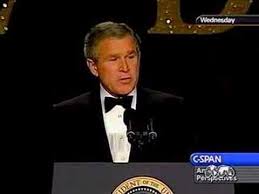
George W. Bush at the 2004 White House Correspondents’ dinner
To Bush, the non-existent WMDs were nothing more than the butt of a joke that night. While an overhead projector displayed photos of a puzzled-looking Bush searching around the Oval Office, Bush recited a comedy routine.
Click here: Bush laughs at no WMD in Iraq – YouTube
“Those weapons of mass destruction have gotta be somewhere,” Bush laughed, while a photo showed him poking around the corners in the Oval Office.
“Nope–no weapons over there! Maybe they’re under here,” he said, as a photo showed him looking under a desk.
Meanwhile, an assembly of wealthy, pampered men and women–the elite of America’s media and political classes–laughed heartily during Bush’s performance. It was a scene worthy of the court of the ancient Caesars, complete with royal flunkies.
Ultimately, the war that Bush had deliberately provoked
- Took the lives of 4,484 Americans.
- Cost the United States Treasury at least $2 trillion.
- Created a Middle East power vacumn.
- Allowed Iran–Iraq’s arch enemy–to eagerly fill it.
- Killed at least 655,000 Iraqis.
- Bush retired from office with a lavish pension and full Secret Service protection.
- He wrote his memoirs and was paid $7 for the first 1.5 million copies.
- Cheney, Rumsfeld, Rice retired to private business, wrote their own memoirs, and lived in comfort as respected elder statesmen.
9/11, ABC NEWS, AL QAEDA, ALTERNET, AMERICAN CAESARS: THE LIVES OF THE PRESIDENTS FROM FRANKLIN D. ROOSEVELT TO GEORGE W. BUSH, AMERICAN EMPIRE, AP, BASHAR AL-ASSAD, BILL CLINTON, BUREAUCRACY, BUZZFEED, CBS NEWS, CHRIS MATHEWS, CNN, CONDOLEEZA RICE, CROOKS AND LIARS, DAILY KOZ, DONALD TRUMP, DWIGHT EISENHOWER, FACEBOOK, FBI, FRANKLIN D. ROOSEVELT, GEORGE H.W. BUSH, GEORGE W. BUSH, GERALD R. FORD, HARRY S. TRUMAN, JIMMY CARTER, JOHN F. KENNEDY, LYNDON B. JOHNSON, MOTHER JONES, MOVEON, MSNBC, NBC NEWS, NEWSWEEK, NIGEL HAMILTON, NPR, OSAMA BIN LADEN, POLITICO, RAW STORY, REPUBLICAN PARTY, REUTERS, RICHARD CLARKE, RICHARD NIXON, ROMAN EMPIRE, SALON, SEATTLE TIMES, SEPTEMBER 11, SLATE, SUETONIUS, SYRIA, TERRORISM, THE ATLANTIC, THE CHICAGO SUN-TIMES, THE CHICAGO TRIBUNE, THE DAILY BEAST, THE GUARDIAN, THE HILL, THE HUFFINGTON POST, THE LOS ANGELES TIMES, THE NATION, THE NEW YORK TIMES, THE TWELVE CAESARS, THE WASHINGTON POST, TIME, TWITTER, U.S. NEWS & WORLD REPORT, UP, UPI, USA TODAY
In Bureaucracy, History, Military, Politics, Social commentary, Uncategorized on September 15, 2017 at 12:05 am
September 11, 2017, marks the 16th anniversary of the worst terrorist attack on United States soil. Inevitably, this is a time to remember all those whose lives were so cruelly snuffed out.
But it should also be a time to remember those who made this atrocity inevitable—by refusing to acknowledge and address the impending threat from Al-Qaeda.
British historian Nigel Hamilton has chronicled their arrogance and indifference in his 2010 biography: American Caesars: Lives of the Presidents from Franklin D. Roosevelt to George W. Bush.
Hamilton noted that Richard Clarke, the national security advisor on terrorism, was certain that Osama bin Laden had arranged the [USS.] Cole bombing in Aden on October 12, 2000.
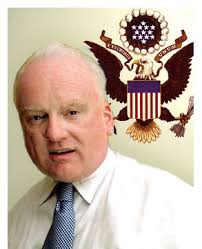
Richard Clarke
For months, Clarke tried to convince others in the Bush Administration that Bin Laden was plotting another attack against the United States—either abroad or at home.
But Clarke could not prevail against the know-it-all arrogance of such higher-ranking Bush officials as Vice President Dick Cheney; Secretary of Defense Donald Rumsfeld; Rumsfeld’s deputy, Paul Wolfowitz; and National Security Advisor Condoleeza Rice.
Rice initially refused to hold a cabinet-level meeting on the subject. Then she “insisted the matter be handled only by a more junior Deputy Principals meeting” in April, 2001, writes Hamilton.
Wolfowitz, the number-two man at the Department of Defense, said: “I don’t understand why we are beginning by talking about this one man, bin Laden.”
Even after Clarke outlined the threat posed by Al-Qaeda, Wolfowitz—whose real target was Saddam Hussein—said: “You give bin Laden too much credit.”
Wolfowitz insisted that bin Laden couldn’t carry out his terrorist acts without the aid of a state sponsor–namely, Iraq.
Wolfowitz, in fact, blamed Iraq for the 1993 bombing of the World Trade Center. Clarke was stunned, since there was absolutely no evidence of Iraqi involvement in this.
“Al-Qaeda plans major acts of terrorism against the United States,” Clarke warned his colleagues. He pointed out that, like Adolf Hitler, bin Laden had actually published his plans for future destruction.
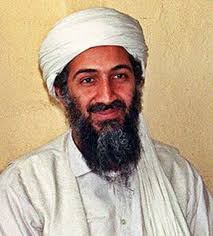
Osama bin Laden
And he added: “Sometimes, as with Hitler in Mein Kampf, you have to believe that these people will actually do what they say they will do.”
Wolfowitz heatedly traded on his Jewish heritage to bring Clarke’s unwelcome arguments to a halt: “I resent any comparison between the Holocaust and this little terrorist in Afghanistan.”
Writing in outraged fury, Hamilton sums up Clarke’s agonizing frustrations:
- Bush’s senior advisors treated their colleagues who had served in the Clinton administration with contempt.
- President Bush, Vice President Dick Cheney, National Security Advisor Condoleeza Rice, Secretary of Defense Donald Rumsfeld and Deputy Defense Secretary Paul Wolfowitz seemed content to ignore the danger signals of an impending al-Qaeda attack.
- This left only Secretary of State Colin Powell, his deputy Richard Armitage, Richard Clarke and a skeptical Treasury Secretary, Paul O’Neill, to wage “a lonely battle to waken a seemingly deranged new administration.”
Clarke alerted Federal Intelligence agencies that “Al-Qaeda is planning a major attack on us.” He asked the FBI and CIA to report to his office all they could learn about suspicious persons or activities at home and abroad.
Finally, at a meeting with Rice on September 4, 2001, Clarke challenged her to “picture yourself at a moment when in the very near future Al-Qaeda has killed hundreds of Americans, and imagine asking yourself what you wish then that you had already done.”
Seven days later, Al-Qaeda struck, and 3,000 Americans died horrifically—and needlessly.
Neither Bush, Cheney, Rice, Rumsfeld nor Wolowitz ever admitted their negligence. Nor would any of them be brought to account.
Disgustingly, these were the same officials who, afterward, posed as the Nation’s saviors—and branded anyone who disagreed with them as a traitor, practices the Right continues to exploit to this day.
Only Richard Clarke—who had vainly argued for stepped-up security precautions and taking the fight to Al-Qaeda—gave that apology.
On March 24, 2004, Clarke testified at the public 9/11 Commission hearings. Addressing relatives of victims in the audience, he said: “Your government failed you, those entrusted with protecting you failed you, and I failed you.”
Yet even worse was to come.
On the evening after the September 11 attacks, Bush took Clarke aside during a meeting in the White House Situation Room:
“I want you, as soon as you can, to go back over everything, everything. See if Saddam [Hussein, the dictator of Iraq] did this. See if he’s linked in any way.”
Clarke was stunned: “But, Mr. President, Al-Qaeda did this.”
“I know, I know,” said Bush. “But see if Saddam was involved. I want to know.”
Hussein had not plotted the attack–and there was no evidence proving that he did. But the attack gave “W” the excuse he wanted to remove the man he blamed for the 1992 defeat of his father, President George H.W. Bush.
Bush believed that his father would have been re-elected if he had “gone all the way” into Baghdad during the 1991 Gulf War.
He would finish the job that his father had started but failed to compete.
On September 12, 2001, Bush attended a meeting of the National Security Council.
“Why shouldn’t we go against Iraq, not just Al-Qaeda?” demanded Donald Rumsfeld, the Secretary of Defense.
Vice President Dick Cheney enthusiastically agreed.
9/11, ABC NEWS, AL QAEDA, ALTERNET, AMERICAN CAESARS: THE LIVES OF THE PRESIDENTS FROM FRANKLIN D. ROOSEVELT TO GEORGE W. BUSH, AMERICAN EMPIRE, AP, BASHAR AL-ASSAD, BILL CLINTON, BUREAUCRACY, BUZZFEED, CBS NEWS, CHRIS MATHEWS, CNN, CONDOLEEZA RICE, CROOKS AND LIARS, DAILY KOZ, DONALD TRUMP, DWIGHT EISENHOWER, FACEBOOK, FBI, FRANKLIN D. ROOSEVELT, GEORGE H.W. BUSH, GEORGE W. BUSH, GERALD R. FORD, HARRY S. TRUMAN, JIMMY CARTER, JOHN F. KENNEDY, LYNDON B. JOHNSON, MOTHER JONES, MOVEON, MSNBC, NBC NEWS, NEWSWEEK, NIGEL HAMILTON, NPR, OSAMA BIN LADEN, POLITICO, RAW STORY, REPUBLICAN PARTY, REUTERS, RICHARD CLARKE, RICHARD NIXON, ROMAN EMPIRE, SALON, SEATTLE TIMES, SEPTEMBER 11, SLATE, SUETONIUS, SYRIA, TERRORISM, THE ATLANTIC, THE CHICAGO SUN-TIMES, THE CHICAGO TRIBUNE, THE DAILY BEAST, THE GUARDIAN, THE HILL, THE HUFFINGTON POST, THE LOS ANGELES TIMES, THE NATION, THE NEW YORK TIMES, THE TWELVE CAESARS, THE WASHINGTON POST, TIME, TWITTER, U.S. NEWS & WORLD REPORT, UP, UPI, USA TODAY
In Bureaucracy, History, Military, Politics, Social commentary on September 14, 2017 at 12:10 am
It’s that time of year again—yet another anniversary celebration of September 11, 2001.
The day when Islamic terrorists slammed two jetliners into the World Trade Center and a third into the Pentagon.
They would have crashed a fourth jetliner into the White House or Capitol Building except for the heroic resistance of passengers aboard United Airlines Flight 93.
In the years immediately following 9/11, politicians of both parties used this anniversary to wave flags and make self-serving patriotic speeches.
This was especially true for officials of the administration of President George W. Bush—which, even as the rubble was being cleared at the Pentagon and World Trade Center, was preparing to use the attack as an excuse to topple Iraqi dictator Saddam Hussein.
Hussein had not plotted 9/11, and there was no evidence that he did. But that didn’t matter to Bush and those planning the invasion and conquest of Iraq.
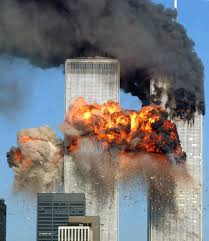
World Trade Center on September 11, 2001
So here it is, 16 years later, and, once again, politicians are using 9/11 as a prop to advance their careers.
President Donald Trump claims that only he can protect America from Al Qaeda, ISIS and any other Islamic terrorist groups. So far, his weapon of choice has been banning Muslims from certain Islamic countries from entering the United States.
Interestingly, Islamic countries where Trump has close business ties—such as Saudi Arabia, the United Arab Emirates, Egypt, and Turkey—are exempt from the ban.
As on past commemorations of 9/11, those who died will be remembered by friends and relatives of those who knew and loved them.
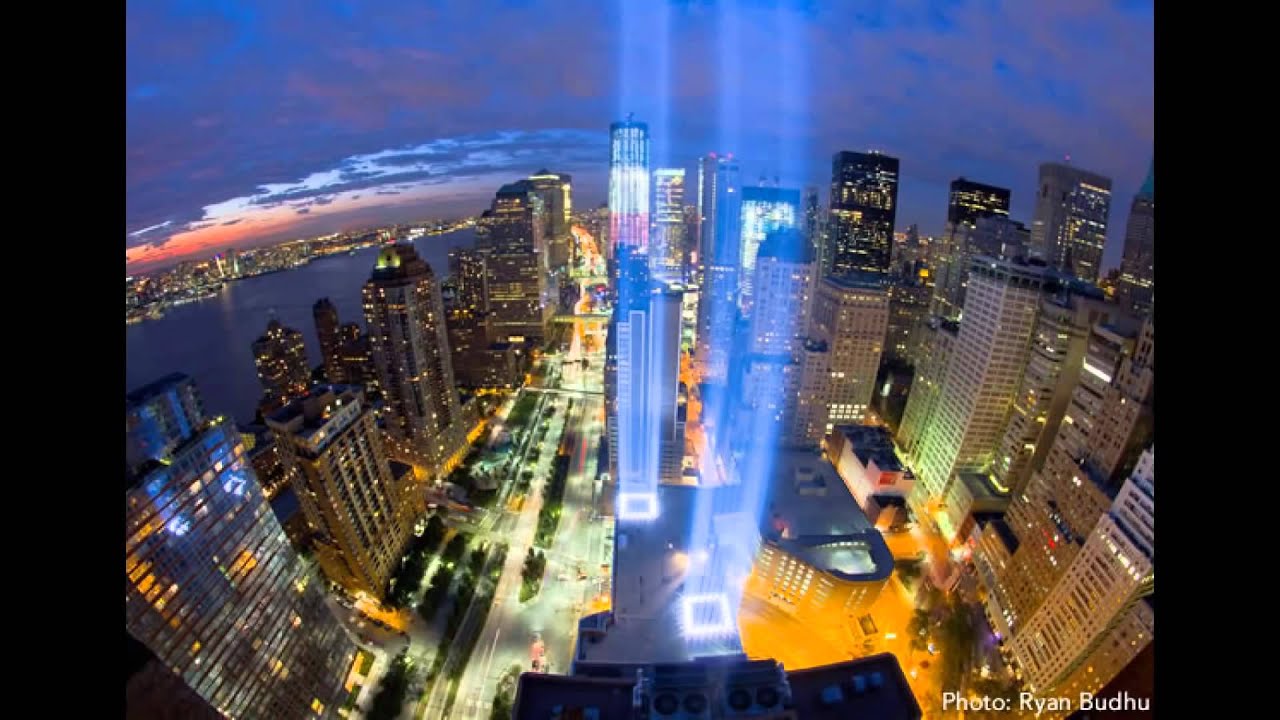
Tribute to 9/11 World Trade Center Victims
It is in fact appropriate to remember the innocents who died on that day—and the heroism of the police and firefighters who died trying to save them.
But it’s equally important to remember those who made 9/11 not simply possible but inevitable.
And that does not mean only the 19 highjackers who turned those planes into fuel-bombs. It means the officials at the highest levels of the administration of President George W. Bush.
Officials who, to this day, have never been held accountable in any way for the resulting death and destruction.
And who have been allowed to blatantly lie that they “kept us safe” from terrorism.
Obviously, such an indictment is not going to be presented by TV commentators today—not even on such liberal networks as CNN and MSNBC. And most definitely not on the right-wing Fox network.
Fortunately, British historian Nigel Hamilton has dared to lay bare the facts of this disgrace. Hamilton is the author of several acclaimed political biographies, including JFK: Reckless Youth and Bill Clinton: Mastering the Presidency.
In 2007, he began research on his latest book: American Caesars: The Lives of the Presidents From Franklin D. Roosevelt to George W. Bush.

The inspiration for this came from a classic work of ancient biography: The Twelve Caesars, by Gaius Suetonius Tranquillus—known as Suetonius.
Suetonius, a Roman citizen and historian, had chronicled the lives of the first twelve Caesars of imperial Rome: Julius Caesar, Augustus, Tiberius, Caligula, Claudius, Nero, Galba, Otho, Vitellius, Vespasian, Titus and Domitian.
Hamilton wanted to examine post-World War II United States history as Suetonius had examined that of ancient Rome: Through the lives of the 12 “emperors” who had held the power of life and death over their fellow citizens—and those of other nations.
For Hamilton, the “greatest of American emperors, the Caesar Augustus of his time,” was Franklin D. Roosevelt, who led his country through the Great Depression and World War II.
His “”great successors” were Harry S. Truman, Dwight D. Eisenhower and John F. Kennedy—who, in turn, contained the Soviet Union abroad and presided over sustained economic prosperity at home.
By contrast, “arguably the worst of all the American Caesars” was “George W. Bush, and his deputy, Dick Cheney, who willfully and recklessly destroyed so much of the moral basis of American leadership in the modern world.”
Among the most lethal of Bush’s offenses: The appointing of officials who refused to take seriously the threat posed by Al-Qaeda.
And this arrogance and indifference continued—right up to September 11, 2001, when the World Trade Center and Pentagon became targets for destruction.
Among the few administration officials who did take Al-Qaeda seriously was Richard Clarke, the chief counter-terrorism adviser on the National Security Council.
Clarke had been thus appointed in 1998 by President Bill Clinton. He continued in the same role under President Bush—but the position was no longer given cabinet-level access.
This put him at a severe disadvantage when dealing with other, higher-ranking Bush officials–such as Vice President Dick Cheney, Secretary of Defense Donald Rumsfeld, Rumsfeld’s deputy, Paul Wolfowitz and National Security Advisor Condoleeza Rice.
These turned out to be the very officials who refused to believe that Al-Qaeda posed a lethal threat to the United States.
“Indeed,” writes Hamilton, “in the entire first eight months of the Bush Presidency, Clarke was not permitted to brief President Bush a single time, despite mounting evidence of plans for a new al-Qaeda outrage.” [Italics added]
Nor did it help that, during his first eight months in office before September 11, Bush was on vacation, according to the Washington Post, 42% of the time.
ABC NEWS, ALTERNET, AP, BUREAUCRACY, BUSINESS REGULATION, BUZZFEED, CBS NEWS, CNN, CONGRESS, CORPORATIONS, CROOKS AND LIARS, DAILY KOZ, DEPARTMENT OF HOMELAND SECURITY, DISASTER RELIEF, FACEBOOK, FEDERAL EMERGENCY MANAGEMENT AGENCY, FERTILIZER PLANT EXPLOSION, HURRICANE SANDY, MOTHER JONES, MOVEON, NBC NEWS, NEWSWEEK, NPR, OCCUPATIONAL SAFETY AND HEALTH ADMINISTRATION (OSHA), POLITICO, RAW STORY, REUTERS, SALON, SEATTLE TIMES, SLATE, TEXAS, THE ATLANTIC, THE CHICAGO SUN-TIMES, THE CHICAGO TRIBUNE, THE DAILY BEAST, THE GUARDIAN, THE HILL, THE HUFFINGTON POST, THE LOS ANGELES TIMES, THE NATION, THE NEW YORK TIMES, THE WASHINGTON POST, TIME, TWITTER, U.S. NEWS & WORLD REPORT, UP, UPI, USA TODAY
In Business, History, Politics, Social commentary on August 30, 2017 at 1:54 am
On August 25, Hurricane Harvey smashed into Texas with torrential rain and winds of 130 mph.
Within three days, thousands of homes were flooded and hundreds had to be rescued from rising flood waters.

Rain-flooded streets in South Texas
And Texas United States Senator Rafael Edward “Ted” Cruz quickly requested full-fledged Federal relief for his state.
But in 2012, Cruz voted three times against federal aid for victims of Hurricane Sandy.
Then he reversed himself in 2013, by seeking “all available resources” for victims of the April 17 explosion at a fertilizer plant in West, McLennan County, Texas.
The blast killed 13 people, wounded about 200 others, and caused extensive damages to surrounding homes.
In October, 2012, Hurricane Sandy had killed about 150 people and caused an estimated $75 billion in damage across the Northeast.
The Republican legislator stood foursquare against the Sandy Aid Relief bill, claiming that it was loaded with “pork”:
“Hurricane Sandy inflicted devastating damage on the East Coast, and Congress appropriately responded with hurricane relief,” said Cruz.
“Unfortunately, cynical politicians in Washington could not resist loading up this relief bill with billions in new spending utterly unrelated to Sandy.
“Emergency relief for the families who are suffering from this natural disaster should not be used as a Christmas tree for billions in unrelated spending, including projects such as Smithsonian repairs, upgrades to National Oceanic and Atmospheric Administration airplanes, and more funding for Head Start.”
Another Republican, Rep. Bill Flores, who represented West, McLennan County, also voted against the Sandy relief package. But this didn’t stop him from requesting federal aid for the disaster in his home district.
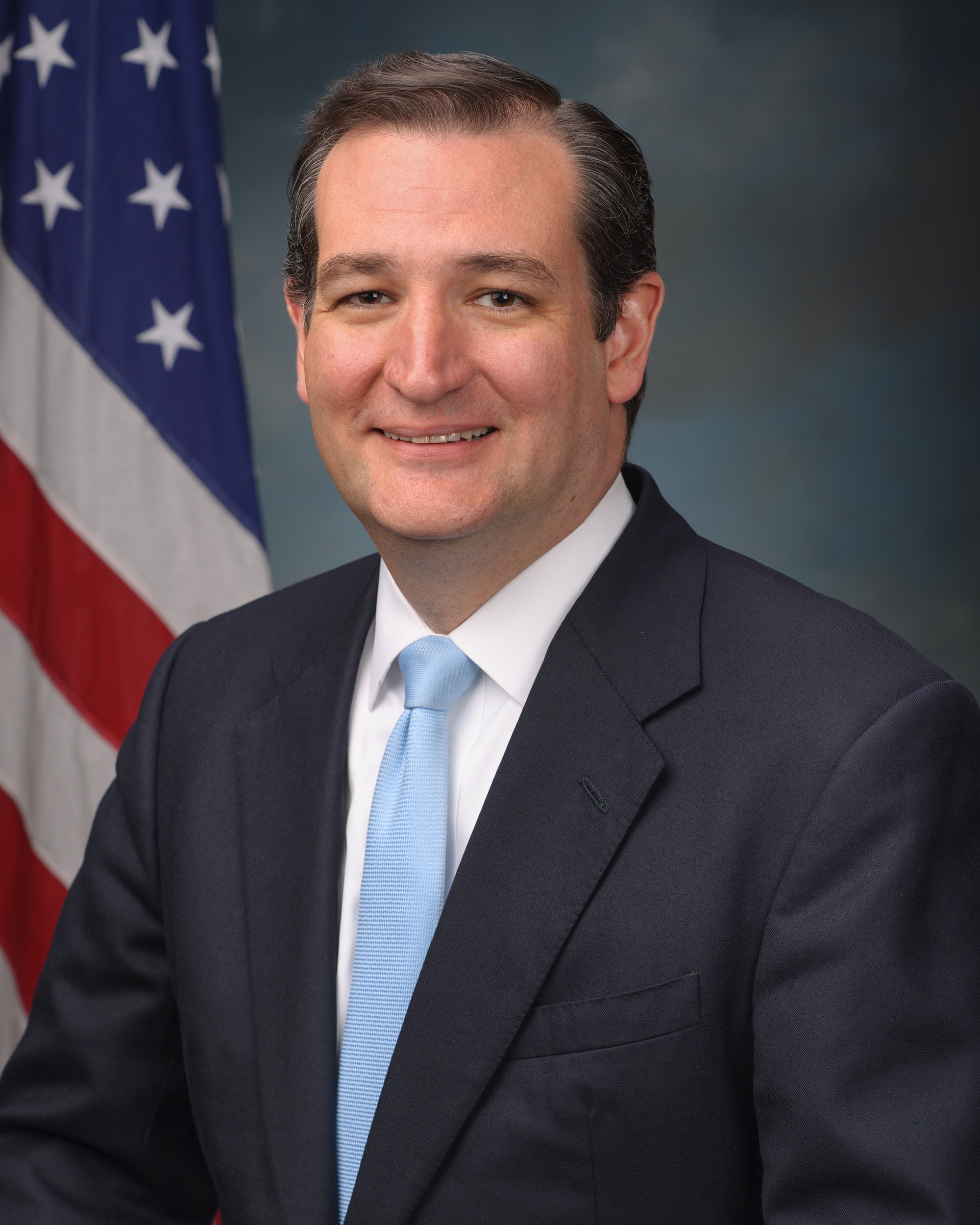
U.S. Senator Ted Cruz (R-Texas)
According to PolitiFact, “A big portion of the $17 billion in ‘immediate’ assistance, more than $5 billion, went to replenish FEMA’s disaster relief fund, which may fund relief from future disasters.”
Furthermore, Rick Ungar, writing at Forbes, pointed out that the “pork” came from having to bribe red state Republicans-–including Texas—to get the package passed over their filibuster:
“However, as it turns out, the pork portions of the Senate bill were not earmarked to benefit Democratic members of the upper chamber of Congress….
“The answer can be found in a quick review of the states that are set to benefit from the Senate’s extra-special benevolence—states including Alabama, Mississippi, Texas and Louisiana.” All of these have solid Republican constituencies.
In fact, Texas had the most FEMA-declared disasters since the start of 2009, according to a September 29, 2011 article in iWatch News
“Eleven Republican U.S. senators who represent the states with the most FEMA-declared disasters since the start of 2009 voted against a bill designed to keep the agency’s disaster relief fund from running out of cash.”
“The top two states, Texas and Oklahoma, combined for more than a quarter of the Federal Emergency Management Agency’s declared disasters since Jan. 1, 2009.”
Yet the hypocrisy didn’t end there.
“The nation’s number one resource is its workers,” said Keith Wrightson, safety expert at Public Citizen, a nonprofit consumer advocacy group. “But the agency that’s charged with protecting them is not given the resources to do it. I think it’s worrisome for the nation.”
The West Fertilizer Company facility hadn’t been inspected by the Labor Department’s Occupational Safety and Health Administration (OSHA) since 1985, when the company was fined $30. Why did the facility go for almost 30 years without further inspections from OSHA?
As a small employer, the fertilizer facility may have been exempt from some forms of OSHA scrutiny. Years ago, Congress attached a rider to agency funding that forbids OSHA to perform inspections of workplaces with 10 or fewer employees and whose industries have low injury rates.
Lawmakers reasoned that small businesses shouldn’t have to shoulder the same costs of compliance as larger ones.
But smaller worksites aren’t necessarily less dangerous. According to safety advocates, small companies often have fewer resources to invest in worker safety and, with less government oversight, even less incentive.
On April 20, 2013, the damning news broke in a Reuters story:
“The fertilizer plant that exploded on Wednesday, obliterating part of a small Texas town and killing at least 14 people, had last year been storing 1,350 times the amount of ammonium nitrate that would normally trigger safety oversight by the U.S. Department of Homeland Security (DHS).”
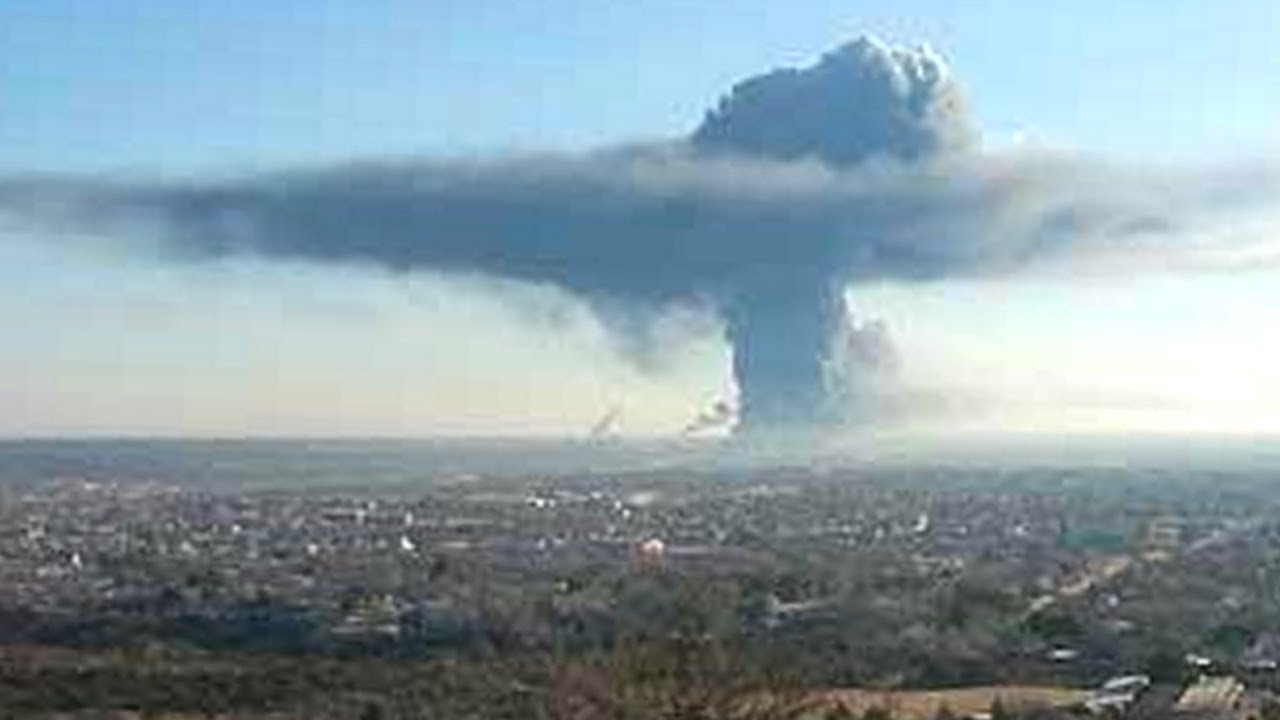
Explosion at a fertilizer plant in West, McLennan County, Texas
According to Reuters, West Fertilizer, the company that owned the plant, did not tell DHS about the potentially explosive fertilizer as it was required to do.
The DHS is a major regulator of ammonium nitrate-–which can also be used in bomb making. Thus, it was left totally unaware of the potential danger posed by the plant..
Fertilizer plants and depots must report to the DHS when they hold 400 lb or more of the substance. Filings this year with the Texas Department of State Health Services, which weren’t shared with DHS, show the plant had 270 tons of it on hand in 2012.
Recently called out for his efforts to deny aid to Hurricane Sandy victims, Cruz replied: “Well, you know, look. There’s time for political sniping later. I think our focus needs to be on this crisis.”
In short, it’s a crisis when it happens in his state, not when it happens elsewhere.
9/11, ABC NEWS, AL QAEDA, ALTERNET, AMERICABLOG, AMERICAN CAESARS: THE LIVES OF THE PRESIDENTS FROM FRANKLIN D. ROOSEVELT TO GEORGE W. BUSH, AMERICAN EMPIRE, AP, BABY BOOMER RESISTANCE, BASHAR AL-ASSAD, BILL CLINTON, BLOOMBERG, BUREAUCRACY, BUZZFEED, CBS NEWS, CHRIS MATHEWS, CNN, CONDOLEEZA RICE, CROOKS AND LIARS, DAILY KOZ, DONALD TRUMP, DRUDGE REPORT, DWIGHT EISENHOWER, FACEBOOK, FBI, FIVETHIRTYEIGHT, FRANKLIN D. ROOSEVELT, GEORGE H.W. BUSH, GEORGE W. BUSH, GERALD R. FORD, HARPER’S MAGAZINE, HARRY S. TRUMAN, HUFFINGTON POST, JIMMY CARTER, JOHN F. KENNEDY, LYNDON B. JOHNSON, MEDIA MATTERS, MOTHER JONES, MOVEON, MSNBC, NBC NEWS, NEWSWEEK, NIGEL HAMILTON, NPR, OSAMA BIN LADEN, PBS NEWSHOUR, POLITICO, POLITICUSUSA, RAW STORY, REPUBLICAN PARTY, REUTERS, RICHARD CLARKE, RICHARD NIXON, ROMAN EMPIRE, SALON, SEATTLE TIMES, SEPTEMBER 11, SLATE, SUETONIUS, SYRIA, TALKING POINTS MEMO, TERRORISM, THE ATLANTIC, THE CHICAGO SUN-TIMES, THE CHICAGO TRIBUNE, THE DAILY BEAST, THE DAILY BLOG, THE GUARDIAN, THE HILL, THE HUFFINGTON POST, THE LOS ANGELES TIMES, THE NATION, THE NEW REPUBLIC, THE NEW YORK TIMES, THE TWELVE CAESARS, THE VILLAGE VOICE, THE WASHINGTON POST, THINKPROGRESS, TIME, TRUTHDIG, TRUTHOUT, TWITTER, TWO POLITICAL JUNKIES, U.S. NEWS & WORLD REPORT, UPI, USA TODAY
In Bureaucracy, History, Military, Politics, Social commentary on September 13, 2016 at 12:30 am
Colonel Brandt: “I wonder what we’ll do after we lose the war.”
Captain Kiesel: “Prepare for the next one.”
–-“The Cross of Iron,” film by Sam Peckinpah
On September 12, 2001, President George W. Bush attended a meeting of the National Security Council.
“Why shouldn’t we go against Iraq, not just Al-Qaeda?” demanded Donald Rumsfeld, the Secretary of Defense.
Vice President Dick Cheney enthusiastically agreed.
Secretary of State Colin Powell then pointed out there was absolutely no evidence that Iraq had had anything to do with 9/11 or Al-Qaeda. And he added: “The American people want us to do something about Al-Qaeda”–not Iraq.
On November 21, 2001, only 10 weeks after 9/11, Bush told Rumsfeld: It’s time to turn to Iraq.
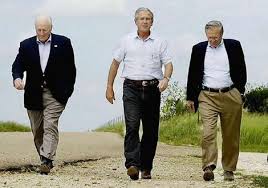
Liars Club: Condoleeza Rice, Dick Cheney, George Bush, Donald Rumsfeld
Bush and his war-hungry Cabinet officials knew that Americans demanded vengeance on AlQaeda’s mastermind, Osama bin Laden, and not Iraqi dictator Saddam Hussein. So they repeatedly fabricated “links” between the two:
- Saddam had worked hand-in-glove with Bin Laden to plan 9/11.
- Saddam was harboring and supporting Al-Qaeda throughout Iraq.
- Saddam, with help from Al-Qaeda, was scheming to build a nuclear bomb.
Yet as early as September 22, 2001, Bush had received a classified President’s Daily Brief intelligence report, which stated that there was no evidence linking Saddam Hussein to 9/11.
The report added that there was scant credible evidence that Iraq had any significant collaborative ties with Al-Qaeda.
Even more important: Saddam had tried to monitor Al Qaeda through his intelligence service–because he saw Al-Qaeda and other theocratic radical Islamist organizations as a potential threat to his secular regime.
Bush administration officials repeatedly claimed that Iraq possessed huge quantities of chemical and biological weapons, in violation of UN resolutions. And they further claimed that US intelligence agencies had determined:
- the precise locations where these weapons were stored;
- the identities of those involved in their production; and
- the military orders issued by Saddam Hussein for their use in the event of war.
Among other lies stated as fact by members of the Bush administration:
- Iraq had sought uranium from Niger, in west Africa.
- Thousands of aluminum tubes imported by Iraq could be used in centrifuges to create enriched uranium.
- Iraq had up to 20 long-range Scud missiles, prohibited under UN sanctions.
- Iraq had massive stockpiles of chemical and biological agents, including nerve gas, anthrax and botulinum toxin.
- Saddam Hussein had issued chemical weapons to front-line troops who would use them when US forces crossed into Iraq.
Consider the following:
August 26, 2002: Cheney told the Veterans of Foreign Wars, “There is no doubt that Saddam Hussein now has weapons of mass destruction. There is no doubt he is amassing them to use against our friends, against our allies and against us.”
September 8, 2002: National Security Advisor Condoleeza Rice said on CNN: ”There is certainly evidence that Al-Qaeda people have been in Iraq. There is certainly evidence that Saddam Hussein cavorts with terrorists.”
September 18, 2002: Rumsfeld told the House Armed Services Committee, “We do know that the Iraqi regime has chemical and biological weapons. His regime has amassed large, clandestine stockpiles of chemical weapons–including VX, sarin, cyclosarin and mustard gas.”
October 7, 2002: Bush declared in a nationally televised speech in Cincinnati that Iraq “possesses and produces chemical and biological weapons. It is seeking nuclear weapons.”
March 16, 2003: Cheney declared on NBC’s “Meet the Press”: “We believe [Saddam Hussein] has, in fact, reconstituted nuclear weapons.”
March 30, 2003: On ABC’s “This Week” program, 10 days into the war, Rumsfeld said: “We know where they [weapons of mass destruction] are.”
Bush never regretted his decision to invade Iraq, which occurred on March 20, 2003.
Even as American occupying forces repeatedly failed to turn up any evidence of “weapons of mass destruction” (WMDs), Bush and his minions claimed the invasion a good thing.
In fact, Bush–who hid out the Vietnam war in the Texas Air National Guard–even joked publicly about the absence of WMDs.
He did so at a White House Correspondents dinner on March 24, 2004–one year after he had started the war.
George W. Bush at the 2004 White House Correspondents’ dinner
To Bush, the non-existent WMDs were nothing more than the butt of a joke that night. While an overhead projector displayed photos of a puzzled-looking Bush searching around the Oval Office, Bush recited a comedy routine.
Click here: Bush laughs at no WMD in Iraq – YouTube
“Those weapons of mass destruction have gotta be somewhere,” Bush laughed, while a photo showed him poking around the corners in the Oval Office.
“Nope–no weapons over there! Maybe they’re under here,” he said, as a photo showed him looking under a desk.
Meanwhile, an assembly of wealthy, pampered men and women–the elite of America’s media and political classes–laughed heartily during Bush’s performance. It was a scene worthy of the court of the ancient Caesars, complete with royal flunkies.
Ultimately, the war that Bush had deliberately provoked
- Took the lives of 4,484 Americans.
- Cost the United States Treasury at least $2 trillion.
- Created a Middle East power vacumn.
- Allowed Iran–Iraq’s arch enemy–to eagerly fill it.
- Killed at least 655,000 Iraqis.
- Bush retired from office with a lavish pension and full Secret Service protection.
- He wrote his memoirs and was paid $7 for the first 1.5 million copies.
- Cheney, Rumsfeld, Rice retired to private business, wrote their own memoirs, and lived in comfort as respected elder statesmen.
9/11, ABC NEWS, AL QAEDA, ALTERNET, AMERICABLOG, AMERICAN CAESARS: THE LIVES OF THE PRESIDENTS FROM FRANKLIN D. ROOSEVELT TO GEORGE W. BUSH, AMERICAN EMPIRE, AP, BABY BOOMER RESISTANCE, BASHAR AL-ASSAD, BILL CLINTON, BLOOMBERG, BUREAUCRACY, BUZZFEED, CBS NEWS, CHRIS MATHEWS, CNN, CONDOLEEZA RICE, CROOKS AND LIARS, DAILY KOZ, DONALD TRUMP, DRUDGE REPORT, DWIGHT EISENHOWER, FACEBOOK, FBI, FIVETHIRTYEIGHT, FRANKLIN D. ROOSEVELT, GEORGE H.W. BUSH, GEORGE W. BUSH, GERALD R. FORD, HARPER’S MAGAZINE, HARRY S. TRUMAN, HUFFINGTON POST, JIMMY CARTER, JOHN F. KENNEDY, LYNDON B. JOHNSON, MEDIA MATTERS, MOTHER JONES, MOVEON, MSNBC, NBC NEWS, NEWSWEEK, NIGEL HAMILTON, NPR, OSAMA BIN LADEN, PBS NEWSHOUR, POLITICO, POLITICUSUSA, RAW STORY, REPUBLICAN PARTY, REUTERS, RICHARD CLARKE, RICHARD NIXON, ROMAN EMPIRE, SALON, SEATTLE TIMES, SEPTEMBER 11, SLATE, SUETONIUS, SYRIA, TALKING POINTS MEMO, TERRORISM, THE ATLANTIC, THE CHICAGO SUN-TIMES, THE CHICAGO TRIBUNE, THE DAILY BEAST, THE DAILY BLOG, THE GUARDIAN, THE HILL, THE HUFFINGTON POST, THE LOS ANGELES TIMES, THE NATION, THE NEW REPUBLIC, THE NEW YORK TIMES, THE TWELVE CAESARS, THE VILLAGE VOICE, THE WASHINGTON POST, THINKPROGRESS, TIME, TRUTHDIG, TRUTHOUT, TWITTER, TWO POLITICAL JUNKIES, U.S. NEWS & WORLD REPORT, UPI, USA TODAY
In Bureaucracy, History, Military, Politics, Social commentary on September 12, 2016 at 12:23 am
September 11, 2016, marks the 15th anniversary of the worst terrorist attack on United States soil. Inevitably, this is a time to remember all those whose lives were so cruelly snuffed out.
But it should also be a time to remember those who made this atrocity inevitable–by refusing to acknowledge and address the impending threat from Al-Qaeda.
British historian Nigel Hamilton has chronicled their arrogance and indifference in his 2010 biography: American Caesars: Lives of the Presidents from Franklin D. Roosevelt to George W. Bush.
Hamilton noted that Richard Clarke, the national security advisor on terrorism, was certain that Osama bin Laden had arranged the [USS.] Cole bombing in Aden on October 12, 2000.
Richard Clarke
For months, Clarke tried to convince others in the Bush Administration that Bin Laden was plotting another attack against the United States–either abroad or at home.
But Clarke could not prevail against the know-it-all arrogance of such higher-ranking Bush officials as Vice President Dick Cheney; Secretary of Defense Donald Rumsfeld; Rumsfeld’s deputy, Paul Wolfowitz; and National Security Advisor Condoleeza Rice.
Rice initially refused to hold a cabinet-level meeting on the subject. Then she “insisted the matter be handled only by a more junior Deputy Principals meeting” in April, 2001, writes Hamilton.
Wolfowitz, the number-two man at the Department of Defense, said: “I don’t understand why we are beginning by talking about this one man, bin Laden.”
Even after Clarke outlined the threat posed by Al-Qaeda, Wolfowitz–whose real target was Saddam Hussein–said: “You give bin Laden too much credit.”
Wolfowitz insisted that bin Laden couldn’t carry out his terrorist acts without the aid of a state sponsor–namely, Iraq.
Wolfowitz, in fact, blamed Iraq for the 1993 bombing of the World Trade Center. Clarke was stunned, since there was absolutely no evidence of Iraqi involvement in this.
“Al-Qaeda plans major acts of terrorism against the United States,” Clarke warned his colleagues. He pointed out that, like Adolf Hitler, bin Laden had actually published his plans for future destruction.
Osama bin Laden
And he added: “Sometimes, as with Hitler in Mein Kampf, you have to believe that these people will actually do what they say they will do.”
Wolfowitz heatedly traded on his Jewish heritage to bring Clarke’s unwelcome arguments to a halt: “I resent any comparison between the Holocaust and this little terrorist in Afghanistan.”
Writing in outraged fury, Hamilton sums up Clarke’s agonizing frustrations:
- Bush’s senior advisors treated their colleagues who had served in the Clinton administration with contempt.
- President Bush, Vice President Dick Cheney, National Security Advisor Condoleeza Rice, Secretary of Defense Donald Rumsfeld and Deputy Defense Secretary Paul Wolfowitz seemed content to ignore the danger signals of an impending al-Qaeda attack.
- This left only Secretary of State Colin Powell, his deputy Richard Armitage, Richard Clarke and a skeptical Treasury Secretary, Paul O’Neill, to wage “a lonely battle to waken a seemingly deranged new administration.”
Clarke alerted Federal Intelligence agencies that “Al-Qaeda is planning a major attack on us.” He asked the FBI and CIA to report to his office all they could learn about suspicious persons or activities at home and abroad.
Finally, at a meeting with Rice on September 4, 2001, Clarke challenged her to “picture yourself at a moment when in the very near future Al-Qaeda has killed hundreds of Americans, and imagine asking yourself what you wish then that you had already done.”
Seven days later, Al-Qaeda struck, and 3,000 Americans died horrifically–and needlessly.
Neither Bush, Cheney, Rice, Rumsfeld nor Wolowitz ever admitted their negligence. Nor would any of them be brought to account.
Disgustingly, these were the same officials who, afterward, posed as the Nation’s saviors–and branded anyone who disagreed with them as a traitor, practices the Right continues to exploit to this day.
Only Richard Clarke–who had vainly argued for stepped-up security precautions and taking the fight to Al-Qaeda–gave that apology.
On March 24, 2004, Clarke testified at the public 9/11 Commission hearings. Addressing relatives of victims in the audience, he said: “Your government failed you, those entrusted with protecting you failed you, and I failed you.”
Yet even worse was to come.
On the evening after the September 11 attacks, Bush took Clarke aside during a meeting in the White House Situation Room:
“I want you, as soon as you can, to go back over everything, everything. See if Saddam [Hussein, the dictator of Iraq] did this. See if he’s linked in any way.”
Clarke was stunned: “But, Mr. President, Al-Qaeda did this.”
“I know, I know,” said Bush. “But see if Saddam was involved. I want to know.”
Hussein had not plotted the attack–and there was no evidence proving that he did. But the attack gave “W” the excuse he wanted to remove the man he blamed for the 1992 defeat of his father, President George H.W. Bush.
Bush believed that his father would have been re-elected if he had “gone all the way” into Baghdad during the 1991 Gulf War.
He would finish the job that his father had started but failed to compete.
On September 12, 2001, Bush attended a meeting of the National Security Council.
“Why shouldn’t we go against Iraq, not just Al-Qaeda?” demanded Donald Rumsfeld, the Secretary of Defense.
Vice President Dick Cheney enthusiastically agreed.
9/11, ABC NEWS, AL QAEDA, ALTERNET, AMERICABLOG, AMERICAN CAESARS: THE LIVES OF THE PRESIDENTS FROM FRANKLIN D. ROOSEVELT TO GEORGE W. BUSH, AMERICAN EMPIRE, AP, BABY BOOMER RESISTANCE, BASHAR AL-ASSAD, BILL CLINTON, BLOOMBERG, BUREAUCRACY, BUZZFEED, CBS NEWS, CHRIS MATHEWS, CNN, CONDOLEEZA RICE, CROOKS AND LIARS, DAILY KOZ, DONALD TRUMP, DRUDGE REPORT, DWIGHT EISENHOWER, FACEBOOK, FBI, FIVETHIRTYEIGHT, FRANKLIN D. ROOSEVELT, GEORGE H.W. BUSH, GEORGE W. BUSH, GERALD R. FORD, HARPER’S MAGAZINE, HARRY S. TRUMAN, HUFFINGTON POST, JIMMY CARTER, JOHN F. KENNEDY, LYNDON B. JOHNSON, MEDIA MATTERS, MOTHER JONES, MOVEON, MSNBC, NBC NEWS, NEWSWEEK, NIGEL HAMILTON, NPR, OSAMA BIN LADEN, PBS NEWSHOUR, POLITICO, POLITICUSUSA, RAW STORY, REPUBLICAN PARTY, REUTERS, RICHARD CLARKE, RICHARD NIXON, ROMAN EMPIRE, SALON, SEATTLE TIMES, SEPTEMBER 11, SLATE, SUETONIUS, SYRIA, TALKING POINTS MEMO, TERRORISM, THE ATLANTIC, THE CHICAGO SUN-TIMES, THE CHICAGO TRIBUNE, THE DAILY BEAST, THE DAILY BLOG, THE GUARDIAN, THE HILL, THE HUFFINGTON POST, THE LOS ANGELES TIMES, THE NATION, THE NEW REPUBLIC, THE NEW YORK TIMES, THE TWELVE CAESARS, THE VILLAGE VOICE, THE WASHINGTON POST, THINKPROGRESS, TIME, TRUTHDIG, TRUTHOUT, TWITTER, TWO POLITICAL JUNKIES, U.S. NEWS & WORLD REPORT, UPI, USA TODAY
In Bureaucracy, History, Military, Politics, Social commentary on September 9, 2016 at 12:01 am
It’s that time of year again–yet another anniversary celebration of September 11, 2001.
The day when Islamic terrorists slammed two jetliners into the World Trade Center and a third into the Pentagon.
They would have crashed a fourth jetliner into the White House or Capitol Building except for the heroic resistance of passengers aboard United Airlines Flight 93.
In the years immediately following 9/11, politicians of both parties used this anniversary to wave flags and make self-serving patriotic speeches.
This was especially true for officials of the administration of President George W. Bush–which, even as the rubble was being cleared at the Pentagon and World Trade Center, was preparing to use the attack as an excuse to topple Iraqi dictator Saddam Hussein.
Hussein had not plotted 9/11, and there was no evidence that he did. But that didn’t matter to Bush and those planning the invasion and conquest of Iraq.
World Trade Center on September 11, 2001
So here it is, 15 years later, and, once again, politicians are using 9/11 as a prop to advance their careers.
Donald Trump, the Republican Presidential nominee, claims that only he can protect America from Al Qaeda, ISIS and any other Islamic terrorist groups. And if that means using nuclear weapons in the Middle East, so be it.
And Hillary Clinton, the Democratic nominee for President, seeks to out-hawk Trump by promising to escalate the fight against ISIS and overthrow Syrian dictator Bashar al-Assad.
As on past commemorations of 9/11, those who died will be remembered by friends and relatives of those who knew and loved them.
Tribute to 9/11 World Trade Center Victims
It is in fact appropriate to remember the innocents who died on that day–and the heroism of the police and firefighters who died trying to save them.
But it’s equally important to remember those who made 9/11 not simply possible but inevitable.
And that does not mean only the 19 highjackers who turned those planes into fuel-bombs. It means the officials at the highest levels of the administration of President George W. Bush.
Officials who, to this day, have never been held accountable in any way for the resulting death and destruction.
And who have been allowed to blatantly lie that they “kept us safe” from terrorism.
Obviously, such an indictment is not going to be presented by TV commentators today–not even on such liberal networks as CNN and MSNBC. And most definitely not on the right-wing Fox network.
Fortunately, British historian Nigel Hamilton has dared to lay bare the facts of this disgrace. Hamilton is the author of several acclaimed political biographies, including JFK: Reckless Youth and Bill Clinton: Mastering the Presidency.
In 2007, he began research on his latest book: American Caesars: The Lives of the Presidents From Franklin D. Roosevelt to George W. Bush.

Nigel Hamilton
By Nigel Hamilton (Nigel Hamilton picture)
The inspiration for this came from a classic work of ancient biography: The Twelve Caesars, by Gaius Suetonius Tranquillus–known as Suetonius.
Suetonius, a Roman citizen and historian, had chronicled the lives of the first twelve Caesars of imperial Rome: Julius Caesar, Augustus, Tiberius, Caligula, Claudius, Nero, Galba, Otho, Vitellius, Vespasian, Titus and Domitian.
Hamilton wanted to examine post-World War II United States history as Suetonius had examined that of ancient Rome: Through the lives of the 12 “emperors” who had held the power of life and death over their fellow citizens–and those of other nations.
For Hamilton, the “greatest of American emperors, the Caesar Augustus of his time,” was Franklin D. Roosevelt, who led his country through the Great Depression and World War II.
His “”great successors” were Harry S. Truman, Dwight D. Eisenhower and John F. Kennedy–who, in turn, contained the Soviet Union abroad and presided over sustained economic prosperity at home.
By contrast, “arguably the worst of all the American Caesars” was “George W. Bush, and his deputy, Dick Cheney, who willfully and recklessly destroyed so much of the moral basis of American leadership in the modern world.”
Among the most lethal of Bush’s offenses: The appointing of officials who refused to take seriously the threat posed by Al-Qaeda.
And this arrogance and indifference continued–right up to September 11, 2001, when the World Trade Center and Pentagon became targets for destruction.
Among the few administration officials who did take Al-Qaeda seriously was Richard Clarke, the chief counter-terrorism adviser on the National Security Council.
Clarke had been thus appointed in 1998 by President Bill Clinton. He continued in the same role under President Bush–but the position was no longer given cabinet-level access.
This put him at a severe disadvantage when dealing with other, higher-ranking Bush officials–such as Vice President Dick Cheney, Secretary of Defense Donald Rumsfeld, Rumsfeld’s deputy, Paul Wolfowitz and National Security Advisor Condoleeza Rice.
These turned out to be the very officials who refused to believe that Al-Qaeda posed a lethal threat to the United States.
“Indeed,” writes Hamilton, “in the entire first eight months of the Bush Presidency, Clarke was not permitted to brief President Bush a single time, despite mounting evidence of plans for a new al-Qaeda outrage.” [Italics added]
Nor did it help that, during his first eight months in office before September 11, Bush was on vacation, according to the Washington Post, 42% of the time.
ABC NEWS, BUREAUCRACY, CATHOLIC CHURCH, CBS NEWS, CHILD ABUSE, CNN, COLLEGE FOOTBALL, FACEBOOK, FBI, J. EDGAR HOOVER, JERRY SANDUSKY, JOE PATERNO, LOUIS J. FREEH, NBC NEWS, NUCLEAR POWER PLANTS, PENN STATE UNIVERSITY, PRIESTS, THE CHICAGO SUN-TIMES, THE CHICAGO TRIBUNE, THE LOS ANGELES TIMES, THE NEW YORK TIMES, THE WASHINGTON POST, THOMAS JEFFERSON, TWITTER
In Bureaucracy, Business, History, Law, Law Enforcement, Medical, Military, Politics, Social commentary on April 7, 2016 at 12:04 am
After spending years of his life sexually abusing boys entrusted into his care, Jerry Sandusky will likely spend the rest of his life as a prison inmate.
On October 9, 2012, a Pennsylvania judge sentenced the 68-year-old former Penn State assistant football coach to at least 30 years in prison. And he may spend as many as 60 years behind bars.
Following his conviction on June 22, 2012, he had faced a maximum of 400 years’ imprisonment for his sexual abuse of 10 boys over a 15-year period.
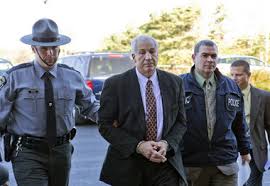
Jerry Sandusky (middle) in police custody
After the sentencing decision was announced, Penn State University President Rodney Erickson released a statement:
“Our thoughts today, as they have been for the last year, go out to the victims of Jerry Sandusky’s abuse.
“While today’s sentence cannot erase what has happened, hopefully it will provide comfort to those affected by these horrible events and help them continue down the road to recovery.”
No doubt Erickson–and the rest of Penn State–waned to move on from this shameful page in the university’s history. And the university desperately tried to sweep the sordid scandal out of sight of the ticket-paying public–-and of history.
Among the steps it took:
- Firing Joe Paterno, the legendary head football coach who had led Penn State to a staggering 112 victories;
- Ousting Graham Spanier, the university’s longtime president; and
- Removing the iconic statue of Paterno–long held in worshipful esteem by almost everyone at the football-obsessed institution.
So what remains to be learned from this sordid affair?
A great deal, it turns out.
To begin at the beginning:
In 2002, assistant coach Mike McQueary, then a Penn State graduate assistant, walked in on Sandusky anally raping a 10-year-old boy. The next day, McQueary reported the incident to head coach Paterno.
“You did what you had to do,” said Paterno. “It is my job now to figure out what we want to do.”
Paterno’s idea of “what we want to do” consisted of reporting the incident to three other top Penn State officials:
Their idea of “what we want to do” was to close ranks around Sandusky and engage in a diabolical “code of silence.”
As former FBI Director Louis J. Freeh summed up in an internal investigative report compiled at the request of Penn State and released on July 12, 2012:
“Four of the most powerful people at the Pennsylvania State University–-President Graham B. Spanier, Senior Vice President-Finance and Business Gary C. Schultz, Athletic Director Timothy M. Curley and Head Football Coach Joseph V. Paterno–-failed to protect against a child sexual predator harming children for over a decade.
“These men concealed Sandusky’s activities from the board of trustees, the university community and authorities.

Louis J. Freeh
“They exhibited a striking lack of empathy for Sandusky’s victims by failing to inquire as to their safety and well-being, especially by not attempting to determine the identity of the child who Sandusky assaulted in the Lasch Building in 2001.
“… In order to avoid the consequences of bad publicity, the most powerful leaders at the University….repeatedly concealed critical facts relating to Sandusky’s child abuse from the authorities, the University’s Board of Trustees, the Penn State community, and the public at large.
“The avoidance of the consequences of bad publicity is the most significant, but not the only, cause for this failure to protect child victims and report to authorities.”
If there is a fundamental truth to be learned from this sordid affair, it is this:
The first rule of any and every bureaucracy is: Above all else, the reputation of the institution must be protected.
And this holds true at:
- The level of local / state / Federal government;
- For-profit organizations;
- Non-profit organizations; or
- Religious institutions
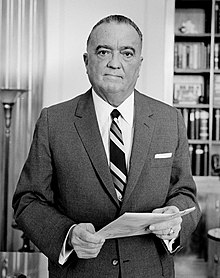
During the 48-year reign of FBI Director J. Edgar Hoover, agents had their own version of this: Do not embarrass the Bureau.
Those who did were fired or shipped to Hoover’s version of Siberia: A posting in remote Butte, Montana.
J. Edgar Hoover
Within the Catholic Church, countless Catholic priests who abused young boys entrusted to their protection were repeatedly protected by their high-ranking superiors.
In private industry, whistleblowers who report rampant safety violations in nuclear power plants are often ignored by the very regulatory agencies the public counts on to prevent catastrophic accidents.
Imperfect institutions staffed by perfect men obsessed with power, money and fame–-and fearful of losing one or all of these–-can never be expected to act otherwise.
And those who do expect ordinary mortals to behave like extraordinary saints will be forever disappointed.
So how can we at least minimize such outrages in the future?
“Eternal vigilance is the price of freedom,” warned Thomas Jefferson. And it remains as true today as it did more than 200 years ago.
Add to this the more recent adage: “Sunlight is the best disinfectant.”
The more we know about how our institutions actually work–as opposed to how they want us to believe they work–the more chances we have to control their behavior.
And to check their abuses when they occur.
Which they will.
9/11, 9/11 ATTACKS, ABC NEWS, ABRAHAM LINCOLN, ASSASSINATION, BARACK OBAMA, BUREAUCRACY, CBS NEWS, CNN, FACEBOOK, GEORGE W. BUSH, HOUSE OVERSIGHT AND GOVERNMENT REFORM COMMITTEE, IRAQ WAR, ISIS, JOHN F. KENNEDY, MSNBC, NBC NEWS, PENTAGON, PRESIDENTIAL PROTECTION, REP. JASON CHAFFETZ, REP. PETER KING, RICHARD NIXON, ROBERT F. KENNEDY, RONALD KESSLER, Secret Service, SECURITY, TERRORISM, THE CHICAGO SUN-TIMES, THE CHICAGO TRIBUNE, THE LOS ANGELES TIMES, THE NEW YORK TIMES, THE WASHINGTON POST, TWITTER, WORLD TRADE CENTER
In Bureaucracy, History, Law Enforcement, Politics on December 29, 2015 at 12:19 am
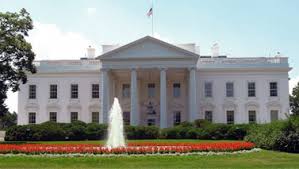
On the night of September 19, 2014, an Iraq war veteran, Omar Gonzales, jumped the White House fence, ran more than 70 yards across the north lawn, and sprinted just past the north portico White House doors.
Only then was he apprehended by Secret Service agents.
Gonzalez’ short-lived trespass onto White House grounds was one of 143 security breaches–or attempted breaches–at facilities protected by the United States Secret Service (USSS) during during the last 10 years.
Then, less than 24 hours after Gonzalez’s arrest, a second man was apprehended after he drove up to a White House gate and refused to leave. This triggered a search of his vehicle by bomb technicians in full gear. Other agents shut down nearby streets. No bombs were found.
Asked for Obama’s reaction, White House spokesman Frank Benenati gave this boilerplate reply: “The president has full confidence in the Secret Service and is grateful to the men and women who day in and day out protect himself, his family and the White House.”
Yet not all is well in Presidential security.
A newly-released report by the House Oversight and Government Reform Committee found the Secret Service to be “in crisis.”
The White House
“Morale is down, attrition is up, misconduct continues and security breaches persist,” Rep. Jason Chaffetz, (R-Utah) publicly stated.
“Strong leadership from the top is required to fix the systematic mismanagement within the agency, and to restore it to its former prestige.”
But the blunt truth is that many of the problems now plaguing the USSS were on full display as early as 2009.
That was when well-known investigative reporter Ronald Kessler published his then-latest book, In the President’s Secret Service.
Kessler had previously pubilshed books outlining the inner workings of the White House, the CIA and the FBI.

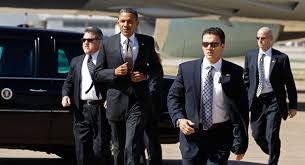
Kessler praised the courage and integrity of Secret Service agents as a whole. But he warned that the agency was risking the safety of many of its protectees, including President Obama.
He was particularly critical of SS management for such practices as:
- Shutting off weapon-scanning magnetometers at rallies for Presidential candidates–and even for Presidents George W. Bush and Obama.
- During a speech Bush gave at Tbilisi, Georgia in 2005, an assailant threw a live hand grenade–which failed to explode–at him.
- Despite 9/11, Secret Service agents are still being trained to expect an attempt by a lone gunman—rather than a professional squad of terrorist assassins.
- The Service’s Counter Assault Teams (CATs) have generally been cut back from five or six agents to two, rendering them useless if a real attack occurred.
- Salaries paid to USSS agents have not kept pace with reality. Veteran USSS men and women are now being offered up to four times their salary for moving to the private sector, and many are leaving the agency for that reason.
Secret Service agents protecting President Barack Obama
- While Congress has greatly expanded the duties of this agency, Secret Service management has not asked for equivalent increases in funding and agents.
- Many agents are leaving out of frustration that it takes “juice” or connections with top management to advance one’s career.
- USSS agents are being trained with weapons that are outdated (such as the MP5, developed in the 1960s) compared to those used by other law enforcement agencies and the potential assassins they face (such as the M4–with greater range and armor-piercing capabilities).
- The Service refuses to ask for help from other agencies to meet its manpower needs. Thus, a visiting head of state at the U.N. General Assembly will usually be assigned only three agents as protection.
- The agency tells agents to grade themselves on their physical training test forms.
- Agents are supposed to be evaluated on their marksmanship skills every three months. But some agents have gone more than a year without being tested.
- Some agents are so overweight they can’t meet the rigorous demands of the job. As a result, they pose a danger to the people they’re supposed to be guarding.
- The Secret Service inflates its own arrest statistics by claiming credit for arrests made by local police.
- Congressional members who visit the agency’s Rowley Training Center in Laurel, Maryland, are treated to rehearsed scenarios of how the agency would deal with attacks. If agents were allowed to perform these exercises without rehearsals, Congressional members would see they make mistakes like anyone else.
Kessler closes his book with the warning: “Without….changes, an assassination of Barack Obama or a future president is likely.
“If that happens, a new Warren Commission will be appointed to study the tragedy. It will find that the Secret Service was shockingly derelict in its duty to the American people and to its own elite corps of brave and dedicated agents.”
And the effects will be not only momentary but long-term. As Kessler writes:
“By definition, an assassination threatens democracy.
“If Abraham Lincoln had not been assassinated, Andrew Johnson, his successor, would not have been able to undermine Lincoln’s efforts to reunite the nation and give more rights to blacks during the Reconstruction period.
“If John F. Kennedy had not been assassinated, Lyndon Johnson likely never would have become President. If Robert F. Kennedy had not been killed and had won the presidency, Richard Nixon might never have been elected.”
9/11, 9/11 ATTACKS, ABC NEWS, ABRAHAM LINCOLN, ASSASSINATION, BARACK OBAMA, BUREAUCRACY, CBS NEWS, CNN, FACEBOOK, GEORGE W. BUSH, HOUSE OVERSIGHT AND GOVERNMENT REFORM COMMITTEE, IRAQ WAR, ISIS, JOHN F. KENNEDY, MSNBC, NBC NEWS, PENTAGON, PRESIDENTIAL PROTECTION, REP. JASON CHAFFETZ, REP. PETER KING, RICHARD NIXON, ROBERT F. KENNEDY, RONALD KESSLER, Secret Service, SECURITY, TERRORISM, THE CHICAGO SUN-TIMES, THE CHICAGO TRIBUNE, THE LOS ANGELES TIMES, THE NEW YORK TIMES, THE WASHINGTON POST, TWITTER, WORLD TRADE CENTER
In Bureaucracy, History, Law Enforcement, Politics on December 28, 2015 at 2:37 am
The United States Secret Service (USSS) is “in crisis”–a crisis that threatens President Barack Obama and his successors as President of the United States.
That’s the verdict of a review of the House Oversight and Government Reform Committee.
Since April, 2012, the agency has faced scandal–and scrutiny by the press and Committee. That was when reports first surfaced of agents buying the favors of prostitutes in Columbia.
Even more embarrassing for the USSS were a series of security breaches that potentially exposed President Barack Obama to danger.
As a result, during the last three years, three directors have headed the Secret Service. Numerous agents–including senior officials–have been disciplined, transferred or fired.
For decades, the Secret Service was seen by the press, public and other law enforcement agencies as an elite agency. And the Presidential Protection Detail (PPD) was seen as the most elite part of the agency.
No longer.

Secret Service agents guarding President Obama
Among the findings of the 438-page report:
- The agency is understaffed and overworked.
- Its staffing crisis started in 2011 owing to government-wide budget cuts demanded by Republicans.
- The Secret Service has fewer employees today than it did in 2014, despite recommendations from an independent panel that staffing be increased.
- There have been a number of undisclosed security breaches–such as in October, 2014, when an unauthorized woman gained access to a Congressional Hispanic Caucus event that Obama attended.
- In February, two people gained access to the outer security perimeter of the White House.
- There have been 143 security breaches–or attempted breaches–during the last 10 years at facilities protected by the agency.
“This report reveals that the Secret Service is in crisis,” Rep. Jason Chaffetz, (R-Utah) publicly stated. “Morale is down, attrition is up, misconduct continues and security breaches persist.
“Strong leadership from the top is required to fix the systematic mismanagement within the agency, and to restore it to its former prestige.”
But the truth is that many of the problems now plaguing the U.S. Secret Service were on display long before the House issued its report.
On September 11, 2001, Secret Service agents literally grabbed Vice President Dick Cheney and hauled him from the White House to a secure facility beneath the Executive Mansion.
As for everyone else who worked in the White House, agents simply threw open the White House doors and ordered: “Run!”
“Women, take off your shoes!” agents shouted–so they could run faster. Frightened Presidential aides were told to remove their White House badges–just in case snipers were lurking nearby.
That was it.
With the World Trade Center and Pentagon in flames, and the White House seemingly next in line as a target, this was the sum total of protection offered White House staffers by the agency considered the elite in Federal law enforcement.

White House staffers fleeing on 9/11
Not knowing what to do, some aides walked home in a daze.
Click here: Amazon.com: Days of Fire: Bush and Cheney in the White House (9780385525190): Peter Baker: Books
(President George W. Bush was not in the White House at the time. He was reading The Pet Goat to a group of children at Emma E. Booker Elementary School in Sarasota, Florida.)
Three days later, on September 14, Andy Card, Bush’s chief of staff, addressed White House staffers in Room 450 of the Eisenhower Executive Office Building, next to the West Wing.
Card said he understood that “this is not what any of you signed up for when you joined the White House staff.” And he offered them the chance to resign without anyone–himself or the President–thinking any less of them.
When no one offered to leave, Card let a Secret Service agent offer security advice:
- Vary your routines to and from work.
- Watch out for any cars that might be following you.
- Go to different restaurants for lunch.
At least one member of the audience, Bradford Berenson, an associate White House counsel, knew he wouldn’t be taking that advice.
Like most of the others at the meeting, his name was listed in the local phone book. A terrorist wanting to kill him need only lurk outside Berenson’s home and open fire when he appeared.
Click here: 500 Days: Secrets and Lies in the Terror Wars: Kurt Eichenwald: 9781451669398: Amazon.com: Books
And that was it, as far as the Secret Service was concerned.
No offers of even temporary escorts by Secret Service agents. No offers to install “panic buttons” in their homes in case of emergency.
In essence: “We’re really glad you’ve decided to serve your country. But don’t expect us to protect you. You’re on your own.”

Fast forward 13 years later.
On the night of September 19, 2014, an Iraq war veteran, Omar Gonzales, jumped the White House fence, ran more than 70 yards across the north lawn, and sprinted just past the north portico White House doors.
Gonzalez appeared unarmed as he ran across the lawn–possibly one reason why Secret Service agents didn’t shoot him or release their service dogs to detain him. But he had a small folding knife with a three-and-one-half-inch serrated blade when he was apprehended.
According to a criminal complaint, when he was arrested he told Secret Service agents he was “concerned that the atmosphere was collapsing” and needed to contact the President “so he could get word out to the people.”



 Bureaucracybuster's Blog
9/11, ABC NEWS, AL QAEDA, ALTERNET, AMERICAN CAESARS: THE LIVES OF THE PRESIDENTS FROM FRANKLIN D. ROOSEVELT TO GEORGE W. BUSH, AMERICAN EMPIRE, AP, BASHAR AL-ASSAD, BILL CLINTON, BUREAUCRACY, BUZZFEED, CBS NEWS, CHRIS MATHEWS, CNN, CONDOLEEZA RICE, CROOKS AND LIARS, DAILY KOZ, DONALD TRUMP, DWIGHT EISENHOWER, FACEBOOK, FBI, FRANKLIN D. ROOSEVELT, GEORGE H.W. BUSH, GEORGE W. BUSH, GERALD R. FORD, HARRY S. TRUMAN, JIMMY CARTER, JOHN F. KENNEDY, LYNDON B. JOHNSON, MOTHER JONES, MOVEON, MSNBC, NBC NEWS, NEWSWEEK, NIGEL HAMILTON, NPR, OSAMA BIN LADEN, POLITICO, RAW STORY, REPUBLICAN PARTY, REUTERS, RICHARD CLARKE, RICHARD NIXON, ROMAN EMPIRE, SALON, SEATTLE TIMES, SEPTEMBER 11, SLATE, SUETONIUS, SYRIA, TERRORISM, THE ATLANTIC, THE CHICAGO SUN-TIMES, THE CHICAGO TRIBUNE, THE DAILY BEAST, THE GUARDIAN, THE HILL, THE HUFFINGTON POST, THE LOS ANGELES TIMES, THE NATION, THE NEW YORK TIMES, THE TWELVE CAESARS, THE WASHINGTON POST, TIME, TWITTER, U.S. NEWS & WORLD REPORT, UP, UPI, USA TODAY
THE AMERICANS WHO GAVE US 9/11: PART THREE (END)
In Bureaucracy, History, Military, Politics, Social commentary on September 18, 2017 at 12:05 amOn September 12, 2001, President George W. Bush attended a meeting of the National Security Council.
“Why shouldn’t we go against Iraq, not just Al-Qaeda?” demanded Donald Rumsfeld, the Secretary of Defense.
Vice President Dick Cheney enthusiastically agreed.
Secretary of State Colin Powell then pointed out there was absolutely no evidence that Iraq had had anything to do with 9/11 or Al-Qaeda. And he added: “The American people want us to do something about Al-Qaeda”–not Iraq.
On November 21, 2001, only 10 weeks after 9/11, Bush told Rumsfeld: It’s time to turn to Iraq.
Liars Club: Condoleeza Rice, Dick Cheney, George Bush, Donald Rumsfeld
Bush and his war-hungry Cabinet officials knew that Americans demanded vengeance on AlQaeda’s mastermind, Osama bin Laden, and not Iraqi dictator Saddam Hussein. So they repeatedly fabricated “links” between the two:
Yet as early as September 22, 2001, Bush had received a classified President’s Daily Brief intelligence report, which stated that there was no evidence linking Saddam Hussein to 9/11.
The report added that there was scant credible evidence that Iraq had any significant collaborative ties with Al-Qaeda.
Even more important: Saddam had tried to monitor Al Qaeda through his intelligence service–because he saw Al-Qaeda and other theocratic radical Islamist organizations as a potential threat to his secular regime.
Bush administration officials repeatedly claimed that Iraq possessed huge quantities of chemical and biological weapons, in violation of UN resolutions. And they further claimed that US intelligence agencies had determined:
Among other lies stated as fact by members of the Bush administration:
Consider the following:
August 26, 2002: Cheney told the Veterans of Foreign Wars, “There is no doubt that Saddam Hussein now has weapons of mass destruction. There is no doubt he is amassing them to use against our friends, against our allies and against us.”
September 8, 2002: National Security Advisor Condoleeza Rice said on CNN: ”There is certainly evidence that Al-Qaeda people have been in Iraq. There is certainly evidence that Saddam Hussein cavorts with terrorists.”
September 18, 2002: Rumsfeld told the House Armed Services Committee, “We do know that the Iraqi regime has chemical and biological weapons. His regime has amassed large, clandestine stockpiles of chemical weapons–including VX, sarin, cyclosarin and mustard gas.”
October 7, 2002: Bush declared in a nationally televised speech in Cincinnati that Iraq “possesses and produces chemical and biological weapons. It is seeking nuclear weapons.”
March 16, 2003: Cheney declared on NBC’s “Meet the Press”: “We believe [Saddam Hussein] has, in fact, reconstituted nuclear weapons.”
March 30, 2003: On ABC’s “This Week” program, 10 days into the war, Rumsfeld said: “We know where they [weapons of mass destruction] are.”
Bush never regretted his decision to invade Iraq, which occurred on March 20, 2003.
Even as American occupying forces repeatedly failed to turn up any evidence of “weapons of mass destruction” (WMDs), Bush and his minions claimed the invasion a good thing.
In fact, Bush–who hid out the Vietnam war in the Texas Air National Guard–even joked publicly about the absence of WMDs.
He did so at a White House Correspondents dinner on March 24, 2004–one year after he had started the war.
George W. Bush at the 2004 White House Correspondents’ dinner
To Bush, the non-existent WMDs were nothing more than the butt of a joke that night. While an overhead projector displayed photos of a puzzled-looking Bush searching around the Oval Office, Bush recited a comedy routine.
Click here: Bush laughs at no WMD in Iraq – YouTube
“Those weapons of mass destruction have gotta be somewhere,” Bush laughed, while a photo showed him poking around the corners in the Oval Office.
“Nope–no weapons over there! Maybe they’re under here,” he said, as a photo showed him looking under a desk.
Meanwhile, an assembly of wealthy, pampered men and women–the elite of America’s media and political classes–laughed heartily during Bush’s performance. It was a scene worthy of the court of the ancient Caesars, complete with royal flunkies.
Ultimately, the war that Bush had deliberately provoked
Share this: