Posts Tagged ‘1776 (PLAY)’
1776 (PLAY), AARON BURR, ABC NEWS, AGING, ALEXANDER HAMILTON, ALTERNET, AMERICABLOG, AP, ASA HUTCHINSON, BABY BOOMER RESISTANCE, BENEDICT ARNOLD, BENJAMIN FRANKLIN, BUZZFEED, CBS NEWS, CHRIS CHRISTIE, CNN, CONGRESS, CROOKS AND LIARS, DAILY KOS, DECLARATION OF INDEPENDENCE, DONALD TRUMP, DOUG BURGUM, ETHAN ALLEN, FIVETHIRTYEIGHT, GEORGE WASHINGTON, GERONTOCRACY, JAMES MADISON, JAMES MONROE, JILL STEIN, JOHN ADAMS, JOHN HANCOCK, JOHN MARSHALL, JOHN PAUL JONES, JOSEPH BIDEN, Kamala Harris, KGB, KONSTANTIN CHERNENKO, LEONID BREZHNEV, MARIANNE WILLIAMSON, MIKHAIL GORBACHEV, MOTHER JONES, MOVEON, MSNBC, NATHAN HALE, NBC NEWS, NEW YORK CITY, NEWSWEEK, NPR, PATRICK HENRY, PAUL REVERE, PBS NEWSHOUR, POLITICO, POLITICUSUSA, RAW STORY, REUTERS, ROBERT F. KENNEDY JR., SALON, SAMUEL ADAMS, SEATTLE TIMES, SLATE, SOVIET UNION, TALKING POINTS MEMO, THE ATLANTIC, THE CHICAGO SUN-TIMES, THE CHICAGO TRIBUNE, THE DAILY BEAST, THE DAILY BLOG, THE GUARDIAN, THE HILL, THE HUFFINGTON POST, THE LOS ANGELES TIMES, THE NATION, THE NEW YORK TIMES, THE WASHINGTON POST, THINKPROGRESS, THOMAS JEFFERSON, THOMAS PAINE, TIME, TRUTHDIG, U.S. NEWS & WORLD REPORT, UPI, USA TODAY, X, YURI ANDROPOV, ZOHRAN MANDANI
In Bureaucracy, History, Medical, Politics, Social commentary on November 24, 2025 at 12:06 am
On November 2, New York City mayoral candidate Zohran Mamdani surprised patrons at a gay night club when he stopped by to campaign at 1 am.
Five hours later, he walked across the Brooklyn Bridge at 6 am.
On the social media platform, Bluesky, a post took notice of this:
“To anyone who’s been awestruck by Zohran’s campaigning stamina in being able to end his night at a gay bar at 1 am and then walk across the Brooklyn Bridge at 6 am….
“This is what happens when you don’t have 76 year old candidates running for office.”
Zohran Mamdani is 34.

Zohran Mamdani
Dmitryshein, CC BY-SA 4.0 <https://creativecommons.org/licenses/by-sa/4.0>, via Wikimedia Commons
On July 4, 1776, representatives of the original Thirteen Colonies met in Philadelphia, Pennsylvania, to affix their signatures to Thomas Jefferson’s Declaration of Independence.
In July, 1776, the ages of key American Revolutionary figures were:
- Marquis de Lafayette, 18
- James Monroe, 18
- Aaron Burr, 20
- John Marshall, 20
- Nathan Hale, 21
- Alexander Hamilton, 21
- James Madison, 25
- John Paul Jones, 28
- Thomas Jefferson, 33
- Benedict Arnold, 35
- Ethan Allen, 38
- John Hancock, 39
- Thomas Paine, 39
- Paul Revere, 41
- George Washington, 44
- Samuel Adams, 53
- Benjamin Franklin, 70

Signing of the Declaration of Independence
Youth was a commonplace among the signers of the Declaration. Their average age was 44.
In the hit play (and later movie) 1776, several members of Congress—including Thomas Jefferson—are surprised to learn that John Adams—who’s 41—still “burns” for his wife Abigail, who’s waiting for him in Boston, Massachusetts.
Today, a nation that once prized youth among its leaders is now moving toward government by gerontocracy.
The average age of members of the House of Representatives is 57.9 years. In the Senate, it’s 64.3.
During 2024, the major Presidential contenders were:
- President Joseph Biden, 81
- Donald Trump, 78
- Robert F. Kennedy Jr, 70
- Jill Stein, 74
- Asa Hutchinson, 72
- Chris Christie, 61
- Doug Burgum, 67
- Marianne Williamson, 71
- Cornel West, 71
- Kamala Harris, 60
A visit to the Soviet Union in the twilight of its 74-year existence reveals where the United States is heading.
In May 1982, 75-year-old General Secretary Leonid Brezhnev, suffered a severe stroke. He had ruled the U.S.S.R. since 1964, but by the early 1980s he was essentially a figurehead. On November 10, 1982, he finally died of a heart attack.
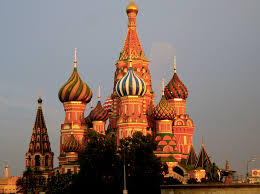
The Kremlin
Succeeding Brezhnev was Yuri Andropov, 69, who until May, 1982, had been chief of the KGB.
Andropov suffered from kidney failure and was often on dialysis. By December, 1983, after barely more than a year in office, he was totally bedridden. On February 9, 1984, he joined Brezhnev at the great Party Congress in the sky.
Andropov had realized that the Soviet Union needed a younger and more energetic ruler. Not long before he died he suggested that Mikhail Gorbachev, his aide, succeed him.
But the Central Committee instead chose Konstantin Chernenko, who, at 72, was older than Andropov. On February 13, 1984, he became the U.S.S.R.’s third leader in a year and a half.
Suffering from emphysema, occasional heart failure and liver disease from alcohol, Chernenko died on March 10, 1985.
Only then did Kremlin rulers decide to choose a General Secretary who was likely to live more than one or two years. One day after Chernenko died, the Politburo chose Gorbachev, a relatively young 54.
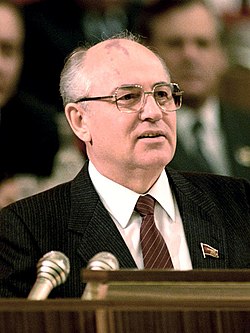
Mikhail Gorbachev
RIA Novosti archive, image #850809 / Vladimir Vyatkin / CC-BY-SA 3.0, CC BY-SA 3.0 <https://creativecommons.org/licenses/by-sa/3.0>, via Wikimedia Commons
Gorbachev survived to retire as President of the Soviet Union on December 25, 1991.
So what does this mean for old men and women seeking the White House?
According to Dr. Michael Roizen, Presidents effectively age twice as fast while in office. Roizen, a chief wellness officer at the Cleveland Clinic and co-founder of RealAge.com, bases his opinion on his research of medical records of previous presidents, back to Theodore Roosevelt.
“The main cause is what we call unrequited stress—they don’t have enough friends to mitigate the stress. The major way most of us handle stress is through a number of techniques, but the most prominent way is to discuss it with friends.
“The problem with presidents is, some of them lose friends, and the closest friend they have is usually the spouse.”
Thus, a person who has been president eight years has the risk of disability or dying of someone who is 16 years older. When you’re already in your late 60s or early 70s, that doesn’t give you much room for risk-taking.
Of course, given America’s Politically Correct social norms, pointing out the disadvantages of combing extreme age with extreme pressure is taboo for many persons.
Julian Castro found this out when, in a debate, he questioned Joseph Biden’s mental acuity.
“In a cultural way, it shocked me,” said Gerson Borrero, a New York City political commentator. “We respect our elders—there may be a point where we smile at their ‘disparates’ (gaffes), but at the same time we stay respectful.”
As the United States approaches the 2028 Presidential election, the perils of gerontocracy loom even larger: Donald Trump has “hinted” he wants to run for a third term in 2028.
Even if he weren’t barred from a third term by the Constitution’s 22nd Amendment, he would be 82 years old when he took office in 2029.
FBI agents have a mandatory retirement age of 57. Airplane pilots must retire at 65. Air traffic controllers must leave at 56.
It’s past time to bring a mandatory retirement age to members of Congress and the Presidency.
1776 (PLAY), ABC NEWS, ALTERNET, AMERICABLOG, AP, “SOUTHERN STRAGEGY”, BABY BOOMER RESISTANCE, BARACK OBAMA, BLOOMBERG, BUZZFEED, CBS NEWS, CEOS, CHRIS MATHEWS, CIVIL RIGHTS ACT OF 1964, CIVIL WAR, CNN, CROOKS AND LIARS, DAILY KOZ, DECLARATION OF INDEPENDENCE, DONALD TRUMP, DRUDGE REPORT, FACEBOOK, FIVETHIRTYEIGHT, FOOD STAMPS, FRED TRUMP, HARPER’S MAGAZINE, HOWARD STERN, HUFFINGTON POST, JOHN DICKINSON, JOHN HANCOCK, MEDIA MATTERS, MEDICARE, MOTHER JONES, MOVEON, MSNBC, NBC NEWS, NEWSWEEK, NPR, PBS NEWSHOUR, PEW FOUNDATION, POLITICO, POLITICUSUSA, PROPAGANDA, RAW STORY, REPUBLICAN PARTY, REPUBLICANS, REUTERS, Ronald Reagan, SALON, SEATTLE TIMES, SLATE, SLAVERY, SOCIAL SECURITY, TALKING POINTS MEMO, THE ATLANTIC, THE CHICAGO SUN-TIMES, THE CHICAGO TRIBUNE, THE DAILY BEAST, THE DAILY BLOG, THE GUARDIAN, THE HILL, THE HUFFINGTON POST, THE LOS ANGELES TIMES, THE NATION, THE NEW REPUBLIC, THE NEW YORK TIMES, THE SOUL OF BATTLE (BOOK), THE VILLAGE VOICE, THE WALL STREET JOURNAL, THE WASHINGTON POST, THINKPROGRESS, TIME, TIME MAGAZINE, TRUTHDIG, TRUTHOUT, TWO POLITICAL JUNKIES, U.S. NEWS & WORLD REPORT, UPI, USA TODAY, VICTOR DAVIS HANSON, VIETNAM WAR, VOTING RIGHTS ACT OF 1965, WILLIAM TECUMSEH SHERMAN, WONKETTE, X
In Bureaucracy, Business, History, Politics, Social commentary on May 23, 2025 at 12:13 am
Republicans have long tried to prevent or eliminate programs that aid the poor and middle-class, including:
- Social Security (since it began in 1935)
- Medicare (started 1965)
- Medicaid (started 1985)
- Food stamps (started 1939)
- WIC (Women, Infants, Children–started 1972).
So why are so many poor Americans flocking to this party’s banner?
Two reasons: Racism and greed. There are historical parallels for both.
First, race:
In 1999, historian Victor Davis Hanson noted the huge gap in wealth between the aristocratic, slave-owning minority of the pre-Civil War South and the vast majority of poor white Southerners.
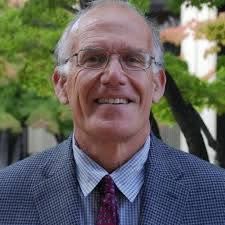
Victor Davis Hanson
“Before the war in the counties [Union General William Tecumseh] Sherman would later ruin, the top 10% of the landowners controlled 40% of the assessed wealth.”
In contrast, “more than half of those who were lucky enough to own any property at all still possessed less than 15% of the area’s valuation.”
So Hanson asked: “Why did the millions of poor whites of the Confederacy fight at all?”
He supplied the answer in his brilliant work on military history, The Soul of Battle: From Ancient Times to the Present Day, How Three Great Liberators Vanquished Tyranny.
One of those liberators was General William Tecumseh Sherman, who led 62,000 Union troops in a victorious “March to the Sea” through the Confederacy in 1864.
So why did so many poor Southern whites literally lay down their lives for the wealthy planter class, which despised them?
According to Hanson: “Behind the entire social fabric of the South lay slavery.
“If slavery eroded the economic position of the poor free citizens, if slavery encouraged a society of haves and have-nots…then it alone offered one promise to the free white man—poor, ignorant and dispirited—that he was at least not black and not a slave.”
And the planter class and its allies in government easily fobbed off their poor white countrymen with cheap flattery. Said Georgia Governor Joseph Brown:
“Among us the poor white laborer is respected as an equal. His family is treated with kindness, consideration, and respect. He does not belong to the menial class. The negro is in no sense his equal. He belongs to the only true aristocracy, the race of white men.”
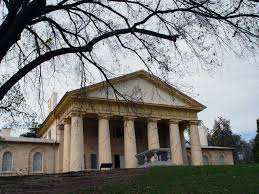
Arlington House and plantation, former home of Robert E. Lee
Similarly, poor whites now flock to the Republican Party—which holds them in equal contempt—in large part to protest the 2008 election of the first black President of the United States.
According to a Pew Research Center study released on July 22, 2011: “Notably, the GOP gains have occurred only among white voters; a 2-point Republican edge among whites in 2008 (46% to 44%) has widened to a 13-point lead today (52% to 39%).”
Since the 1960s, Republicans have pursued a campaign policy of “divide and rule”—divide the nation along racial lines and reap the benefits at election time.
- Republicans opposed the Civil Rights Act of 1964.
- Republicans opposed the Voting Rights Act of 1965.
- Republicans, with Richard Nixon as their Presidential candidate in 1968 and 1972, pursued what they called a “Southern strategy”: Use “code language” to stoke fear and hatred of blacks among whites.
- Republicans have falsely identified welfare programs exclusively with nonwhites. (Of the six million Americans receiving food stamps, about 42% are white, 32% are black, and 22% are Latino—with the growth fastest among whites during the recession.)
Thus, in voting Republican, many of these poor whites believe they are “striking a blow for the white race.”
And they can do so in a more socially acceptable way than joining a certified hate group such as the American Nazi Party or Ku Klux Klan.
Since 2015, openly racist groups such as the Klan and the American Nazi Party have flocked to the banner of Presidential candidate and President Donald Trump. By enthusiastically courting their support, the real estate mogul has made it possible for Republican candidates to openly display their own racism.
Now greed:
In the hit play, 1776, on the creation and signing of the Declaration of Independence, there is a telling exchange between John Dickinson and John Hancock. It comes during the song, “Cool, Cool, Considerate Men.”
Dickinson, the delegate from Pennsylvania, urges Hancock, president of the Second Continental Congress, “to join us in our minuet.” By “us” he means his fellow conservatives who fear losing their property and exalted status by supporting American independence from Great Britain.
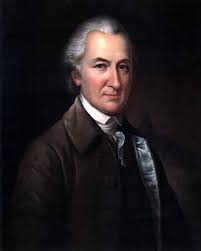
John Dickinson
Hancock declines, saying: “Fortunately, there are not enough men of property in America to dictate policy.”
To which Dickinson replies: “Perhaps not. But don’t forget that most men with nothing would rather protect the possibility of becoming rich than face the reality of being poor. And that is why they will follow us.”
Today, poor whites generally identify with the CEOs of powerful corporations. They believe the Republican gospel that they can attain such wealth—if only the government will “get out of my way.”
They forget—or ignore—the truth that government, for all its imperfections, is sometimes all that stands between them and a wide range of predators.
In return, the CEOs despise them as the privileged have always despised their social and economic “inferiors.”
Unless the Democratic Party can find ways to directly address these bitter, Politically Incorrect truths, it will continue its decline into insignificance.
1776 (PLAY), ABC NEWS, ALTERNET, AMERICABLOG, AP, “SOUTHERN STRAGEGY”, BABY BOOMER RESISTANCE, BARACK OBAMA, BLOOMBERG, BUZZFEED, CBS NEWS, CEOS, CHRIS MATHEWS, CIVIL RIGHTS ACT OF 1964, CIVIL WAR, CNN, CROOKS AND LIARS, DAILY KOZ, DECLARATION OF INDEPENDENCE, DONALD TRUMP, DRUDGE REPORT, FACEBOOK, FIVETHIRTYEIGHT, FOOD STAMPS, FRED TRUMP, HARPER’S MAGAZINE, HOWARD STERN, HUFFINGTON POST, JOHN DICKINSON, JOHN HANCOCK, MEDIA MATTERS, MEDICARE, MOTHER JONES, MOVEON, MSNBC, NBC NEWS, NEWSWEEK, NPR, PBS NEWSHOUR, PEW FOUNDATION, POLITICO, POLITICUSUSA, PROPAGANDA, RAW STORY, REPUBLICAN PARTY, REPUBLICANS, REUTERS, Ronald Reagan, SALON, SEATTLE TIMES, SLATE, SLAVERY, SOCIAL SECURITY, TALKING POINTS MEMO, THE ATLANTIC, THE CHICAGO SUN-TIMES, THE CHICAGO TRIBUNE, THE DAILY BEAST, THE DAILY BLOG, THE GUARDIAN, THE HILL, THE HUFFINGTON POST, THE LOS ANGELES TIMES, THE NATION, THE NEW REPUBLIC, THE NEW YORK TIMES, THE SOUL OF BATTLE (BOOK), THE VILLAGE VOICE, THE WALL STREET JOURNAL, THE WASHINGTON POST, THINKPROGRESS, TIME, TIME MAGAZINE, TRUTHDIG, TRUTHOUT, TWO POLITICAL JUNKIES, U.S. NEWS & WORLD REPORT, UPI, USA TODAY, VICTOR DAVIS HANSON, VIETNAM WAR, VOTING RIGHTS ACT OF 1965, WILLIAM TECUMSEH SHERMAN, WONKETTE, X
In Bureaucracy, Business, History, Politics, Social commentary on May 22, 2025 at 12:20 am
On July 22, 2011, ABC News carried the following story:
The Pew Foundation, analyzing voter identification, found “the electorate’s partisan affiliations have shifted significantly” since Barack Obama won office in 2008.
The GOP had gained strength among white voters, most specifically “the young and poor.”

A seven-point Democratic advantage among whites under age 30 three years earlier had turned into an 11-point GOP advantage. And a 15-point Democratic advantage among whites earning less than $30,000 annually had swung to a slim four-point Republican edge by 2011.
In addition:
- The GOP gains had occurred only among white voters.
- Republicans had made sizable gains among white voters since 2008. Fifty-two percent of white voters called themselves Republicans or leaned to the GOP, compared with 39% who affiliated with the Democratic Party or leaned Democratic.
- Democrats had lost their edge among lower income white voters.
- In 2008, Democrats had a 15 point lead among white voters with family incomes less than $30,000. By 2011, Republicans had a four-point edge among this group.
- The GOP’s lead among middle income white voters had grown since 2008, and Republicans held a substantial advantage with higher income white voters.
- Republicans made gains among whites with a high school education or less. The GOP’s advantage over Democrats had grown from one point in 2008 to 17 points in 2011 among less educated whites.
- Republicans had made smaller gains among white voters who had college degrees.
Five years later, in 2016, these masses of disaffected white men would overwhelmingly vote for Donald Trump, a real estate mogul-turned-celebrity-TV-host of “The Apprentice.”
Trump had been born into a life of luxury. He began his real estate career at his father’s real estate and construction company. He rose to wealth and fame after his father, Fred, gave him control of the business in 1971.
Similarly, soon after acquiring the family business, Trump set out to build his own empire—hotels, golf courses, casinos and skyscrapers across North and South America, Europe and Asia. Of the 515 entities he owns, 268 of them—52%—bear his last name. He often refers to his properties as “the swankiest,” “the most beautiful.”
During the Vietnam war, his father reportedly paid a doctor to claim that Trump suffered from “bone spurs” in his foot—thus enabling him to escape the draft.
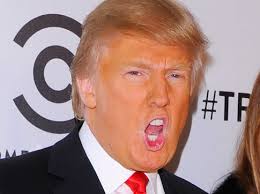
Donald Trump
In short, Trump has literally nothing in common with the masses of poor whites who worship him.
Howard Stern, the notorious radio host, has known Trump many years. Commenting on the appeal Trump has for his followers, Stern says: “The oddity of all this is the people Trump despises most, love him the most.
“The people who are voting for Trump for the most part …he wouldn’t even let them in his fucking hotel. He’d be disgusted by them. Go to Mar-a-Lago. See if there’s any people who look like you. I’m talking to you in the audience.”
Yet, while the poor worship Trump and Republicans generally, there is a disconnect between them: Since 1980, Republicans have pursued a policy of gutting programs aimed at helping the poor—while repeatedly creating tax-breaks for the wealthiest 1% of the population.
For Republicans, the patron saint of this “love-the-rich-screw-the-poor” ideology remains Ronald Reagan—two-time governor of California and twice-elected President of the United States (1981-1989)
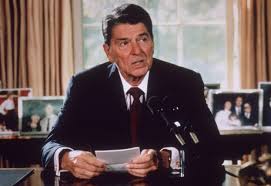
Ronald Reagan, who taught Americans to worship the wealthy
Among those charting Reagan’s legacy as President was former CBS Correspondent David Shoenbrum.
In his bestselling autobiography, America Inside Out: At Home and Abroad from Roosevelt to Reagan, he noted:
- On January 28, 1981, keeping a pledge to his financial backers in the oil industry, Reagan abolished Federal controls on the price of oil.
- Within a week, Exxon, Texaco and Shell raised gasoline prices and prices of home heating oil.
- Reagan saw it as his duty to put a floor under prices, not a ceiling above them.
- Reagan believed that when government helped business it wasn’t interfering. Loaning money to bail out a financially incompetent Chrysler was “supporting the free enterprise system.”
- But putting a high-profits tax on price-gouging corporations or filing anti-trust suits against them was “Communistic” and therefore intolerable.
- Tax-breaks for wealthy businesses meant helping America become stronger.
- But welfare for the poor or the victims of a predatory marketplace economy weakened America by sapping its morale.
“In short, welfare for the rich is good for America. But welfare for the poor is bad for America, even for the poor themselves, for it encourages them to be shiftless and lazy.
“Somehow, loans to the inefficient management of American corporations would not similarly encourage them in their inefficient methods,” wrote Shoenbrun.
Republicans have sought to dismantle Social Security ever since that program began in 1935. And Republicans have furiously opposed other programs aiding the poor and middle-class—such as Medicare, food stamps and WIC (Women, Infants, Children).
In short, this is not a political party with a history of rushing to the defense of those most in need.
So the question remains: Why are so many poor Americans flocking to its banner?
The answer lies in the history of the American South—and slavery.
1776 (PLAY), AARON BURR, ABC NEWS, AGING, ALEXANDER HAMILTON, ALTERNET, AMERICABLOG, AP, BABY BOOMER RESISTANCE, BENEDICT ARNOLD, BENJAMIN FRANKLIN, BUZZFEED, CBS NEWS, CNN, CONGRESS, CROOKS AND LIARS, DAILY KOS, DECLARATION OF INDEPENDENCE, ETHAN ALLEN, FIVETHIRTYEIGHT, GEORGE WASHINGTON, GERONTOCRACY, JAMES MADISON, JAMES MONROE, JOHN ADAMS, JOHN HANCOCK, JOHN MARSHALL, JOHN PAUL JONES, KGB, KONSTANTIN CHERNENKO, LEONID BREZHNEV, MIKHAIL GORBACHEV, MOTHER JONES, MOVEON, MSNBC, NATHAN HALE, NBC NEWS, NEWSWEEK, NPR, PATRICK HENRY, PAUL REVERE, PBS NEWSHOUR, POLITICO, POLITICUSUSA, RAW STORY, REUTERS, SALON, SAMUEL ADAMS, SEATTLE TIMES, SLATE, SOVIET UNION, TALKING POINTS MEMO, THE ATLANTIC, THE CHICAGO SUN-TIMES, THE CHICAGO TRIBUNE, THE DAILY BEAST, THE DAILY BLOG, THE GUARDIAN, THE HILL, THE HUFFINGTON POST, THE LOS ANGELES TIMES, THE NATION, THE NEW YORK TIMES, THE WASHINGTON POST, THINKPROGRESS, THOMAS JEFFERSON, THOMAS PAINE, TIME, TRUTHDIG, TWITTER, U.S. NEWS & WORLD REPORT, UPI, USA TODAY, YURI ANDROPOV
In Bureaucracy, History, Medical, Politics, Social commentary on January 29, 2024 at 12:14 am
“Congress has become the most privileged nursing home in the country,” said Republican Presidential candidate Nikki Haley at a rally in Conway, S.C., on January 28.
American voters, she added, deserved to know that those charged with protecting the nation were “at the top of their game.”
“Don’t you think we need to have mental competency tests for anyone over the age of 75?” asked Haley, 52.
On July 4, 1776, representatives of the original Thirteen Colonies met in Philadelphia, Pennsylvania, to affix their signatures to Thomas Jefferson’s Declaration of Independence.
Signing of the Declaration of Independence
The ages of key American Revolutionary figures in July. 1776, were:
- Marquis de Lafayette, 18
- James Monroe, 18
- Aaron Burr, 20
- John Marshall, 20
- Nathan Hale, 21
- Alexander Hamilton, 21
- George Rodgers Clark, 23
- James Madison, 25
- Edward Rutledge, 26
- John Paul Jones, 28
- Thomas Jefferson, 33
- James Wilson, 34
- Benedict Arnold, 35
- Samuel Chase, 35
- Ethan Allen, 38
- John Hancock, 39
- Thomas Paine, 39
- Patrick Henry, 40
- John Adams, 41
- Paul Revere, 41
- Richard Henry Lee, 44
- George Washington, 44
- Josiah Bartlett, 46
- Lyman Hall, 52
- Samuel Adams, 53
- Roger Sherman, 55
- Benjamin Franklin, 70
Youth was a commonplace among the signers of the Declaration. Their average age was 44.
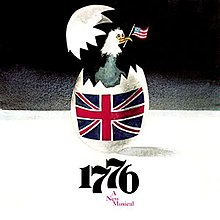
In the hit play (and later movie) 1776, several members of Congress—including Thomas Jefferson—are surprised to learn that John Adams—who’s 41—“burns” for his wife Abigail, who’s waiting for him in Boston, Massachusetts.
Today, a nation that once prized youth among its leaders is now moving toward government by gerontocracy.
The average age of members of the House of Representatives is 58.4 years. In the Senate, it’s 64.3.
During 2020, the major Democratic Presidential contenders were:
- Vermont United States Senator Bernie Sanders: 79
- Former Vice President Joe Biden: 78
- Massachusetts United States Senator Elizabeth Warren: 71
- Minnesota United States Senator Amy Klobuchar: 60

Opposing them was President Donald Trump, 73, as he sought re-election. On Election Day, he would be 74.
A visit to the Soviet Union in the twilight of its 74-year existence reveals where the United States is heading.
In May 1982, 75-year-old General Secretary Leonid Brezhnev, suffered a severe stroke. He had ruled the U.S.S.R. since 1964, but by the early 1980s he was essentially a figurehead. On November 10, 1982, he finally died of a heart attack.
The Kremlin
Succeeding Brezhnev was Yuri Andropov, 69, who until May, 1982, had been chief of the KGB.
Andropov suffered from kidney failure and was often on dialysis. By December, 1983, after barely more than a year in office, he was totally bedridden. On February 9, 1984, he joined Brezhnev at the great Party Congress in the sky.
Andropov had realized that the Soviet Union needed a younger and more energetic ruler. Not long before he died he suggested that Mikhail Gorbachev, his aide, succeed him.
But the Central Committee instead chose Konstantin Chernenko, who, at 72, was older than Andropov. On February 13, 1984, he became the U.S.S.R.’s third leader in a year and a half.
Suffering from emphysema, occasional heart failure and liver disease from alcohol, Chernenko died on March 10, 1985.
Only then did Kremlin rulers decide to choose a General Secretary who was likely to live more than one or two years. One day after Chernenko died, the Politburo chose Gorbachev, a relatively young 54.

Mikhail Gorbachev
Gorbachev survived to retire as President of the Soviet Union on December 25, 1991.
So what does this mean for old men and women seeking the White House?
According to Dr. Michael Roizen, Presidents effectively age twice as fast while in office. Roizen, a chief wellness officer at the Cleveland Clinic and co-founder of RealAge.com, bases his opinion on his research of medical records of previous presidents, back to Theodore Roosevelt.
“The main cause is what we call unrequited stress—they don’t have enough friends to mitigate the stress. The major way most of us handle stress is through a number of techniques, but the most prominent way is to discuss it with friends.
“The problem with presidents is, some of them lose friends, and the closest friend they have is usually the spouse.”
Thus, a person who has been president eight years has the risk of disability or dying of someone who is 16 years older. When you’re already in your late 60s or early 70s, that doesn’t give you much room for risk-taking.
Of course, given America’s Politically Correct social norms, pointing out the disadvantages of combing extreme age with extreme pressure is taboo for many persons.
Julian Castro found this out when, in a debate, he questioned Joseph Biden’s mental acuity.
“In a cultural way, it shocked me,” said Gerson Borrero, a New York City political commentator. “We respect our elders—there may be a point where we smile at their ‘disparates’ (gaffes), but at the same time we stay respectful.”
As the United States approaches the 2024 Presidential election, the perils of gerontocracy loom even larger.
Biden turned 81 on November 20, 202. If re-elected in 2024, he would be 82. If he lived out his full term, he would be 86.
Trump, who still lusts to be President, is 77. If re-elected President in 2024, he would be 78 upon taking office in 2025.
FBI agents have a mandatory retirement age of 57. Airplane pilots must retire at 65.
It’s past time to bring a mandatory retirement age to members of Congress and the Presidency.
1776 (PLAY), AARON BURR, ABC NEWS, ABIGAIL ADAMS, AGING, ALEXANDER HAMILTON, ALTERNET, AMERICABLOG, AP, BABY BOOMER RESISTANCE, BENEDICT ARNOLD, BENJAMIN FRANKLIN, BUZZFEED, CBS NEWS, CNN, CONGRESS, CROOKS AND LIARS, DAILY KOZ, DECLARATION OF INDEPENDENCE, ETHAN ALLEN, FACEBOOK, FIVETHIRTYEIGHT, GEORGE WASHINGTON, GERONTOCRACY, JAMES MADISON, JAMES MONROE, JOHN ADAMS, JOHN HANCOCK, JOHN MARSHALL, JOHN PAUL JONES, KGB, KONSTANTIN CHERNENKO, LEONID BREZHNEV, MARTHA WASHINGTON, MIKHAIL GORBACHEV, MOTHER JONES, MOVEON, MSNBC, NATHAN HALE, NBC NEWS, NEWSWEEK, NPR, PATRICK HENRY, PAUL REVERE, PBS NEWSHOUR, POLITICO, POLITICUSUSA, RAW STORY, REUTERS, SALON, SAMUEL ADAMS, SEATTLE TIMES, SLATE, SOVIET UNION, TALKING POINTS MEMO, THE ATLANTIC, THE CHICAGO SUN-TIMES, THE CHICAGO TRIBUNE, THE DAILY BEAST, THE DAILY BLOG, THE GUARDIAN, THE HILL, THE HUFFINGTON POST, THE LOS ANGELES TIMES, THE NATION, THE NEW YORK TIMES, THE WASHINGTON POST, THINKPROGRESS, THOMAS JEFFERSON, THOMAS PAINE, TIME, TRUTHDIG, TWITTER, U.S. NEWS & WORLD REPORT, UPI, USA TODAY, YURI ANDROPOV
In Bureaucracy, History, Politics, Social commentary on April 17, 2023 at 12:52 am
“Many Founding Fathers Were Shockingly Young When the Declaration of Independence Was Signed in 1776.”
So read the headline of a July 5, 2014 story in Business Insider.
On July 4, 1776, representatives of the original Thirteen Colonies met in Philadelphia, Pennsylvania, to affix their signatures to Thomas Jefferson’s Declaration of Independence.
Signing of the Declaration of Independence
Below is a list of the ages of key American Revolutionary figures on July 4, 1776. (Those who signed the Declaration are listed in red.)
- Marquis de Lafayette, 18
- James Monroe, 18
- Henry Lee III, 20
- Aaron Burr, 20
- John Marshall, 20
- Nathan Hale, 21
- Alexander Hamilton, 21
- George Rodgers Clark, 23
- James Madison, 25
- Edward Rutledge, 26
- John Paul Jones, 28
- Abigail Adams, 31
- Thomas Jefferson, 33
- James Wilson, 34
- Benedict Arnold, 35
- Samuel Chase, 35
- Ethan Allen, 38
- John Hancock, 39
- Thomas Paine, 39
- Patrick Henry, 40
- John Adams, 41
- Paul Revere, 41
- Richard Henry Lee, 44
- George Washington, 44
- Martha Washington, 45
- Josiah Bartlett, 46
- Caesar Rodney, 47
- Lyman Hall, 52
- Samuel Adams, 53
- Roger Sherman, 55
- Philip Livingston, 60
- Stephen Hopkins, 69
- Benjamin Franklin, 70
Youth was a commonplace among the signers of the Declaration. Their average age was 44.
In the hit play (and later movie) 1776, several members of Congress—including Thomas Jefferson—are surprised to learn that John Adams—who’s 41—“burns” for his wife Abigail, who’s waiting for him in Boston, Massachusetts.
Today, a nation that once prized youth among its leaders is now moving toward government by gerontocracy.
The average age of members of the House of Representatives is 58.4 years. In the Senate, it’s 64.3.
On Election Day, 2020, the following Democratic contenders were:
- Vermont United States Senator Bernie Sanders: 79
- Former Vice President Joe Biden: 78
- Massachusetts United States Senator Elizabeth Warren: 71
- Minnesota United States Senator Amy Klobuchar: 60
- California United States Senator Kamala Harris: 56
- Former Texas Congressman Beto O’Rourke: 48
Of these candidates, the oldest ones—Sanders, Warren and Biden—were considered the frontrunners for the Democratic nomination.
Opposing them was President Donald Trump, 73, as he sought re-election. On Election Day, he would be 74.
To get an idea of where the United States is heading, let’s revisit the Soviet Union in the twilight of its 74-year existence.
In May 1982, 75-year-old General Secretary Leonid Brezhnev, suffered a severe stroke. He had ruled the U.S.S.R. since 1964, but by the early 1980s he was essentially a figurehead. On November 10, 1982, he finally died of a heart attack.
The Kremlin
Succeeding Brezhnev was Yuri Andropov, 69, who until May, 1982, had been chief of the KGB.
Andropov suffered from kidney failure and was often on dialysis. By December, 1983, after barely more than a year in office, he was totally bedridden. On February 9, 1984, he joined Brezhnev at the great Party Congress in the sky.
Andropov had realized that the Soviet Union needed a younger and more energetic ruler. Not long before he died he suggested that Mikhail Gorbachev, his aide, succeed him.
But the Central Committee instead chose Konstantin Chernenko, who, at 72, was older than Andropov. On February 13, 1984, he became the U.S.S.R.’s third leader in a year and a half.
Suffering from emphysema, occasional heart failure and liver disease from alcohol, Chernenko died on March 10, 1985.
Only then did Kremlin rulers decide to choose a General Secretary who was likely to live more than one or two years. One day after Chernenko died, the Politburo chose Gorbachev, a relatively young 54.
Mikhail Gorbachev
Gorbachev survived to retire as President of the Soviet Union on December 25, 1991.
So what does this mean for old men and women seeking the White House?
According to Dr. Michael Roizen, Presidents effectively age twice as fast while in office. Roizen, a chief wellness officer at the Cleveland Clinic and co-founder of RealAge.com, bases his opinion on his research of medical records of previous presidents, back to Theodore Roosevelt.
“The main cause is what we call unrequited stress—they don’t have enough friends to mitigate the stress. The major way most of us handle stress is through a number of techniques, but the most prominent way is to discuss it with friends.
“The problem with presidents is, some of them lose friends, and the closest friend they have is usually the spouse.”
Thus, a person who has been president eight years has the risk of disability or dying of someone who is 16 years older. When you’re already in your late 60s or early 70s, that doesn’t give you much room for risk-taking.
Of course, given America’s Politically Correct social norms, pointing out the disadvantages of combing extreme age with extreme pressure is taboo for many persons.
Julian Castro found this out when, in a debate, he questioned Joseph Biden’s mental acuity.
“In a cultural way, it shocked me,” said Gerson Borrero, a New York City political commentator. “We respect our elders—there may be a point where we smile at their ‘disparates’ (gaffes), but at the same time we stay respectful.”
That does not, however, make such truths magically disappear.
As the United States approaches the 2024 Presidential election, the perils of gerontocracy loom even larger.
Biden turned 80 on November 20. If re-elected in 2024, he would be 82. If he lived out his full term, he would be 86.
Trump, who still lusts to be President, is 76. If re-elected President in 2024, he would be 77, taking office at 78.
FBI agents have a mandatory retirement age of 57. Airplane pilots must retire at 65.
It’s past time to bring a mandatory retirement age to members of Congress and the Presidency.
1776 (PLAY), ABC NEWS, ALTERNET, AMERICABLOG, AP, “SOUTHERN STRAGEGY”, BABY BOOMER RESISTANCE, BARACK OBAMA, BLOOMBERG, BUZZFEED, CBS NEWS, CEOS, CHRIS MATHEWS, CIVIL RIGHTS ACT OF 1964, CIVIL WAR, CNN, CROOKS AND LIARS, DAILY KOZ, DECLARATION OF INDEPENDENCE, DONALD TRUMP, DRUDGE REPORT, FACEBOOK, FIVETHIRTYEIGHT, FOOD STAMPS, FRED TRUMP, HARPER’S MAGAZINE, HOWARD STERN, HUFFINGTON POST, JOHN DICKINSON, JOHN HANCOCK, MEDIA MATTERS, MEDICARE, MOTHER JONES, MOVEON, MSNBC, NBC NEWS, NEWSWEEK, NPR, PBS NEWSHOUR, PEW FOUNDATION, POLITICO, POLITICUSUSA, PROPAGANDA, RAW STORY, REPUBLICAN PARTY, REPUBLICANS, REUTERS, Ronald Reagan, SALON, SEATTLE TIMES, SLATE, SLAVERY, SOCIAL SECURITY, TALKING POINTS MEMO, THE ATLANTIC, THE CHICAGO SUN-TIMES, THE CHICAGO TRIBUNE, THE DAILY BEAST, THE DAILY BLOG, THE GUARDIAN, THE HILL, THE HUFFINGTON POST, THE LOS ANGELES TIMES, THE NATION, THE NEW REPUBLIC, THE NEW YORK TIMES, THE SOUL OF BATTLE (BOOK), THE VILLAGE VOICE, THE WALL STREET JOURNAL, THE WASHINGTON POST, THINKPROGRESS, TIME, TIME MAGAZINE, TRUTHDIG, TRUTHOUT, TWITTER, TWO POLITICAL JUNKIES, U.S. NEWS & WORLD REPORT, UPI, USA TODAY, VICTOR DAVIS HANSON, VIETNAM WAR, VOTING RIGHTS ACT OF 1965, WILLIAM TECUMSEH SHERMAN, WONKETTE
In Bureaucracy, History, Politics, Social commentary on July 27, 2022 at 12:12 am
Republicans have long tried to prevent or eliminate programs that aid the poor and middle-class, including:
- Social Security (since it began in 1935)
- Medicare
- National health insurance
- Food stamps
- WIC (Women, Infants, Children).
So why are so many poor Americans now flocking to this party’s banner?
Two reasons: Racism and greed. There are historical parallels for both.
First, race:
In 1999, historian Victor Davis Hanson noted the huge gap in wealth between the aristocratic, slave-owning minority of the pre-Civil War South and the vast majority of poor white Southerners.
Victor Davis Hanson
“Before the war in the counties [Union General William Tecumseh] Sherman would later ruin, the top 10% of the landowners controlled 40% of the assessed wealth.”
In contrast, “more than half of those who were lucky enough to own any property at all still possessed less than 15% of the area’s valuation.”
So Hanson asked: “Why did the millions of poor whites of the Confederacy fight at all?”
He supplied the answer in his brilliant work on military history, The Soul of Battle: From Ancient Times to the Present Day, How Three Great Liberators Vanquished Tyranny.
One of those liberators was General William Tecumseh Sherman, who led 62,000 Union troops in a victorious “March to the Sea” through the Confederacy in 1864.
So why did so many poor Southern whites literally lay down their lives for the wealthy planter class, which despised them?
According to Hanson: “Behind the entire social fabric of the South lay slavery.
“If slavery eroded the economic position of the poor free citizens, if slavery encouraged a society of haves and have-nots…then it alone offered one promise to the free white man–poor, ignorant and dispirited–that he was at least not black and not a slave.”
And the planter class and its allies in government easily fobbed off their poor white countrymen with cheap flattery. Said Georgia Governor Joseph Brown:
“Among us the poor white laborer is respected as an equal. His family is treated with kindness, consideration, and respect. He does not belong to the menial class. The negro is in no sense his equal. He belongs to the only true aristocracy, the race of white men.”
Arlington House and plantation, former home of Robert E. Lee
Similarly, poor whites now flock to the Republican Party–which holds them in equal contempt– in large part to protest the 2008 election of the first black President of the United States.
According to a Pew Research Center study released on July 22, 2011: “Notably, the GOP gains have occurred only among white voters; a 2-point Republican edge among whites in 2008 (46% to 44%) has widened to a 13-point lead today (52% to 39%).”
Since the 1960s, Republicans have pursued a campaign policy of “divide and rule”–divide the nation along racial lines and reap the benefits at election time.
- Republicans opposed the Civil Rights Act of 1964.
- Republicans opposed the Voting Rights Act of 1965.
- Republicans, with Richard Nixon as their Presidential candidate in 1968 and 1972, pursued what they called a “Southern strategy”: Use “code language” to stoke fear and hatred of blacks among whites.
- Republicans have falsely identified welfare programs exclusively with non-whites. (Of the six million Americans receiving food stamps, about 42% are white, 32% are black, and 22% are Latino–with the growth fastest among whites during the recession.)
Thus, in voting Republican, many of these poor whites believe they are “striking a blow for the white race.”
And they can do so in a more socially acceptable way than joining a certified hate group such as the American Nazi Party or Ku Klux Klan.
Since 2015, openly racist groups such as the Klan and the American Nazi Party have flocked to the banner of Presidential candidate Donald Trump. By enthusiastically courting their support, the real estate mogul has made it possible for Republican candidates to openly display their own racism.
Now greed:
In the hit play, 1776, on the creation and signing of the Declaration of Independence, there is a telling exchange between John Dickinson and John Hancock. It comes during the song, “Cool, Cool, Considerate Men.”
Dickinson, the delegate from Pennsylvania, urges Hancock, president of the Second Continental Congress, “to join us in our minuet.” By “us” he means his fellow conservatives who fear losing their property and exalted status by supporting American independence from Great Britain.
John Dickinson
Hancock declines, saying: “Fortunately, there are not enough men of property in America to dictate policy.”
To which Dickinson replies: “Perhaps not. But don’t forget that most men with nothing would rather protect the possibility of becoming rich than face the reality of being poor. And that is why they will follow us.”
Today, poor whites generally identify with the CEOs of powerful corporations. They believe the Republican gospel that they can attain such wealth–if only the government will “get out of my way.”
They forget—or ignore—the truth that government, for all its imperfections, is sometimes all that stands between them and a wide range of predators.
In return, the CEOs despise them as the privileged have always despised their social and economic “inferiors.”
Unless the Democratic Party can find ways to directly address these bitter, Politically Incorrect truths, it will continue its decline into insignificance.
1776 (PLAY), ABC NEWS, ALTERNET, AMERICABLOG, AP, “SOUTHERN STRAGEGY”, BABY BOOMER RESISTANCE, BARACK OBAMA, BLOOMBERG, BUZZFEED, CBS NEWS, CEOS, CHRIS MATHEWS, CIVIL RIGHTS ACT OF 1964, CIVIL WAR, CNN, CROOKS AND LIARS, DAILY KOZ, DECLARATION OF INDEPENDENCE, DONALD TRUMP, DRUDGE REPORT, FACEBOOK, FIVETHIRTYEIGHT, FOOD STAMPS, FRED TRUMP, HARPER’S MAGAZINE, HOWARD STERN, HUFFINGTON POST, JOHN DICKINSON, JOHN HANCOCK, MEDIA MATTERS, MEDICARE, MOTHER JONES, MOVEON, MSNBC, NBC NEWS, NEWSWEEK, NPR, PBS NEWSHOUR, PEW FOUNDATION, POLITICO, POLITICUSUSA, PROPAGANDA, RAW STORY, REPUBLICAN PARTY, REPUBLICANS, REUTERS, Ronald Reagan, SALON, SEATTLE TIMES, SLATE, SLAVERY, SOCIAL SECURITY, TALKING POINTS MEMO, THE ATLANTIC, THE CHICAGO SUN-TIMES, THE CHICAGO TRIBUNE, THE DAILY BEAST, THE DAILY BLOG, THE GUARDIAN, THE HILL, THE HUFFINGTON POST, THE LOS ANGELES TIMES, THE NATION, THE NEW REPUBLIC, THE NEW YORK TIMES, THE SOUL OF BATTLE (BOOK), THE VILLAGE VOICE, THE WALL STREET JOURNAL, THE WASHINGTON POST, THINKPROGRESS, TIME, TIME MAGAZINE, TRUTHDIG, TRUTHOUT, TWITTER, TWO POLITICAL JUNKIES, U.S. NEWS & WORLD REPORT, UPI, USA TODAY, VICTOR DAVIS HANSON, VIETNAM WAR, VOTING RIGHTS ACT OF 1965, WILLIAM TECUMSEH SHERMAN, WONKETTE
In Bureaucracy, Business, History, Politics, Social commentary on July 26, 2022 at 12:16 am
On July 22, 2011, ABC News carried the following story:
The Pew Foundation, analyzing voter identification, found “the electorate’s partisan affiliations have shifted significantly” since Barack Obama won office in 2008.
The GOP had gained strength among white voters, most specifically “the young and poor.”
A seven-point Democratic advantage among whites under age 30 three years ago had turned into an 11-point GOP advantage. And a 15-point Democratic advantage among whites earning less than $30,000 annually had swung to a slim four-point Republican edge by 2011.
In addition:
- The GOP gains had occurred only among white voters.
- Republicans had made sizable gains among white voters since 2008. Fifty-two percent of white voters called themselves Republicans or leaned to the GOP, compared with 39% who affiliated with the Democratic Party or leaned Democratic.
- Democrats had lost their edge among lower income white voters.
- In 2008, Democrats had a 15 point lead among white voters with family incomes less than $30,000. By 2011, Republicans had a four-point edge among this group.
- The GOP’s lead among middle income white voters had grown since 2008, and Republicans held a substantial advantage with higher income white voters.
- Republicans have made gains among whites with a high school education or less. The GOP’s advantage over Democrats had grown from one point in 2008 to 17 points in 2011 among less educated whites.
- Republicans had made smaller gains among white voters who had college degrees.
Five years later, in 2016, these masses of disaffected white men would overwhelmingly vote for Donald Trump, a real estate mogul-turned-celebrity-TV-host of “The Apprentice.”
Trump had been born into a life of luxury. He began his real estate career at his father’s real estate and construction company. He rose to wealth and fame after his father, Fred, gave him control of the business in 1971.
Similarly, soon after acquiring the family business, Trump set out to build his own empire—hotels, golf courses, casinos and skyscrapers across North and South America, Europe and Asia. Of the 515 entities he owns, 268 of them—52%—bear his last name. He often refers to his properties as “the swankiest,” “the most beautiful.”
During the Vietnam war, his father reportedly paid a doctor to claim that Trump suffered from “bone spurs” in his foot—thus enabling him to escape the draft.
Donald Trump
In short, Trump has literally nothing in common with the masses of poor whites who worship him.
Howard Stern, the notorious radio host, has known Trump many years. Commenting on the appeal Trump has for his followers, Stern says: “The oddity of all this is the people Trump despises most, love him the most.
“The people who are voting for Trump for the most part …he wouldn’t even let them in his fucking hotel. He’d be disgusted by them. Go to Mar-a-Lago. See if there’s any people who look like you. I’m talking to you in the audience.”
Yet, while the poor worship Trump and Republicans generally, there is a disconnect between them: Since 1980, Republicans have pursued a policy of gutting programs aimed at helping the poor—while repeatedly creating tax-breaks for the wealthiest 1% of the population.
For Republicans, the patron saint of this “love-the-rich-screw-the-poor” ideology remains Ronald Reagan—two-time governor of California and twice-elected President of the United States (1981-1989)
Ronald Reagan, who taught Americans to worship the wealthy
Among those charting Reagan’s legacy as President was former CBS Correspondent David Shoenbrum.
In his bestselling autobiography, America Inside Out: At Home and Abroad from Roosevelt to Reagan, he noted:
- On January 28, 1981, keeping a pledge to his financial backers in the oil industry, Reagan abolished Federal controls on the price of oil.
- Within a week, Exxon, Texaco and Shell raised gasoline prices and prices of home heating oil.
- Reagan saw it as his duty to put a floor under prices, not a ceiling above them.
- Reagan believed that when government helped business it wasn’t interfering. Loaning money to bail out a financially incompetent Chrysler was “supporting the free enterprise system.”
- But putting a high-profits tax on price-gouging corporations or filing anti-trust suits against them was “Communistic” and therefore intolerable.
- Tax-breaks for wealthy businesses meant helping America become stronger.
- But welfare for the poor or the victims of a predatory marketplace economy weakened America by sapping its morale.
“In short, welfare for the rich is good for America. But welfare for the poor is bad for America, even for the poor themselves, for it encourages them to be shiftless and lazy.
“Somehow, loans to the inefficient management of American corporations would not similarly encourage them in their inefficient methods,” wrote Shoenbrun.
Republicans have sought to dismantle Social Security ever since that program began in 1935. And Republicans have furiously opposed other programs aiding the poor and middle-class—such as Medicare, food stamps and WIC (Women, Infants, Children).
In short, this is not a political party with a history of rushing to the defense of those most in need.
So the question remains: Why are so many poor Americans flocking to its banner?
The answer lies in the history of the American South—and slavery.
1776 (PLAY), ABC NEWS, ALTERNET, AMERICABLOG, AP, “SOUTHERN STRAGEGY”, BABY BOOMER RESISTANCE, BARACK OBAMA, BLOOMBERG, BUZZFEED, CBS NEWS, CEOS, CHRIS MATHEWS, CIVIL RIGHTS ACT OF 1964, CIVIL WAR, CNN, CROOKS AND LIARS, DAILY KOZ, DECLARATION OF INDEPENDENCE, DONALD TRUMP, DRUDGE REPORT, FACEBOOK, FIVETHIRTYEIGHT, FOOD STAMPS, FRED TRUMP, HARPER’S MAGAZINE, HOWARD STERN, HUFFINGTON POST, JOHN DICKINSON, JOHN HANCOCK, MEDIA MATTERS, MEDICARE, MOTHER JONES, MOVEON, MSNBC, NBC NEWS, NEWSWEEK, NPR, PBS NEWSHOUR, PEW FOUNDATION, POLITICO, POLITICUSUSA, PROPAGANDA, RAW STORY, REPUBLICAN PARTY, REPUBLICANS, REUTERS, Ronald Reagan, SALON, SEATTLE TIMES, SLATE, SLAVERY, SOCIAL SECURITY, TALKING POINTS MEMO, THE ATLANTIC, THE CHICAGO SUN-TIMES, THE CHICAGO TRIBUNE, THE DAILY BEAST, THE DAILY BLOG, THE GUARDIAN, THE HILL, THE HUFFINGTON POST, THE LOS ANGELES TIMES, THE NATION, THE NEW REPUBLIC, THE NEW YORK TIMES, THE SOUL OF BATTLE (BOOK), THE VILLAGE VOICE, THE WALL STREET JOURNAL, THE WASHINGTON POST, THINKPROGRESS, TIME, TIME MAGAZINE, TRUTHDIG, TRUTHOUT, TWITTER, TWO POLITICAL JUNKIES, U.S. NEWS & WORLD REPORT, UPI, USA TODAY, VICTOR DAVIS HANSON, VIETNAM WAR, VOTING RIGHTS ACT OF 1965, WILLIAM TECUMSEH SHERMAN, WONKETTE
In Bureaucracy, History, Politics, Social commentary on September 25, 2020 at 7:00 am
Republicans have long tried to prevent or eliminate programs that aid the poor and middle-class, including:
- Social Security (since it began in 1935)
- Medicare
- National health insurance
- Food stamps
- WIC (Women, Infants, Children).
So why are so many poor Americans now flocking to this party’s banner?
Two reasons: Racism and greed. There are historical parallels for both.
First, race:
In 1999, historian Victor Davis Hanson noted the huge gap in wealth between the aristocratic, slave-owning minority of the pre-Civil War South and the vast majority of poor white Southerners.
Victor Davis Hanson
“Before the war in the counties [Union General William Tecumseh] Sherman would later ruin, the top 10% of the landowners controlled 40% of the assessed wealth.”
In contrast, “more than half of those who were lucky enough to own any property at all still possessed less than 15% of the area’s valuation.”
So Hanson asked: “Why did the millions of poor whites of the Confederacy fight at all?”
He supplied the answer in his brilliant work on military history, The Soul of Battle: From Ancient Times to the Present Day, How Three Great Liberators Vanquished Tyranny.
One of those liberators was General William Tecumseh Sherman, who led 62,000 Union troops in a victorious “March to the Sea” through the Confederacy in 1864.
So why did so many poor Southern whites literally lay down their lives for the wealthy planter class, which despised them?
According to Hanson: “Behind the entire social fabric of the South lay slavery.
“If slavery eroded the economic position of the poor free citizens, if slavery encouraged a society of haves and have-nots…then it alone offered one promise to the free white man–poor, ignorant and dispirited–that he was at least not black and not a slave.”
And the planter class and its allies in government easily fobbed off their poor white countrymen with cheap flattery. Said Georgia Governor Joseph Brown:
“Among us the poor white laborer is respected as an equal. His family is treated with kindness, consideration, and respect. He does not belong to the menial class. The negro is in no sense his equal. He belongs to the only true aristocracy, the race of white men.”
Arlington House and plantation, former home of Robert E. Lee
Similarly, poor whites now flock to the Republican Party–which holds them in equal contempt– in large part to protest the 2008 election of the first black President of the United States.
According to a Pew Research Center study released on July 22, 2011: “Notably, the GOP gains have occurred only among white voters; a 2-point Republican edge among whites in 2008 (46% to 44%) has widened to a 13-point lead today (52% to 39%).”
Since the 1960s, Republicans have pursued a campaign policy of “divide and rule”–divide the nation along racial lines and reap the benefits at election time.
- Republicans opposed the Civil Rights Act of 1964.
- Republicans opposed the Voting Rights Act of 1965.
- Republicans, with Richard Nixon as their Presidential candidate in 1968 and 1972, pursued what they called a “Southern strategy”: Use “code language” to stoke fear and hatred of blacks among whites.
- Republicans have falsely identified welfare programs exclusively with non-whites. (Of the six million Americans receiving food stamps, about 42% are white, 32% are black, and 22% are Latino–with the growth fastest among whites during the recession.)
Thus, in voting Republican, many of these poor whites believe they are “striking a blow for the white race.”
And they can do so in a more socially acceptable way than joining a certified hate group such as the American Nazi Party or Ku Klux Klan.
Since 2015, openly racist groups such as the Klan and the American Nazi Party have flocked to the banner of Presidential candidate Donald Trump. By enthusiastically courting their support, the real estate mogul has made it possible for Republican candidates to openly display their own racism.
Now greed:
In the hit play, 1776, on the creation and signing of the Declaration of Independence, there is a telling exchange between John Dickinson and John Hancock. It comes during the song, “Cool, Cool, Considerate Men.”
Dickinson, the delegate from Pennsylvania, urges Hancock, president of the Second Continental Congress, “to join us in our minuet.” By “us” he means his fellow conservatives who fear losing their property and exalted status by supporting American independence from Great Britain.
John Dickinson
Hancock declines, saying: “Fortunately, there are not enough men of property in America to dictate policy.”
To which Dickinson replies: “Perhaps not. But don’t forget that most men with nothing would rather protect the possibility of becoming rich than face the reality of being poor. And that is why they will follow us.”
Today, poor whites generally identify with the CEOs of powerful corporations. They believe the Republican gospel that they can attain such wealth–if only the government will “get out of my way.”
They forget—or ignore—the truth that government, for all its imperfections, is sometimes all that stands between them and a wide range of predators.
In return, the CEOs despise them as the privileged have always despised their social and economic “inferiors.”
Unless the Democratic Party can find ways to directly address these bitter, Politically Incorrect truths, it will continue its decline into insignificance.
1776 (PLAY), ABC NEWS, ALTERNET, AMERICABLOG, AP, “SOUTHERN STRAGEGY”, BABY BOOMER RESISTANCE, BARACK OBAMA, BLOOMBERG, BUZZFEED, CBS NEWS, CEOS, CHRIS MATHEWS, CIVIL RIGHTS ACT OF 1964, CIVIL WAR, CNN, CROOKS AND LIARS, DAILY KOZ, DECLARATION OF INDEPENDENCE, DONALD TRUMP, DRUDGE REPORT, FACEBOOK, FIVETHIRTYEIGHT, FOOD STAMPS, FRED TRUMP, HARPER’S MAGAZINE, HOWARD STERN, HUFFINGTON POST, JOHN DICKINSON, JOHN HANCOCK, MEDIA MATTERS, MEDICARE, MOTHER JONES, MOVEON, MSNBC, NBC NEWS, NEWSWEEK, NPR, PBS NEWSHOUR, PEW FOUNDATION, POLITICO, POLITICUSUSA, PROPAGANDA, RAW STORY, REPUBLICAN PARTY, REPUBLICANS, REUTERS, Ronald Reagan, SALON, SEATTLE TIMES, SLATE, SLAVERY, SOCIAL SECURITY, TALKING POINTS MEMO, THE ATLANTIC, THE CHICAGO SUN-TIMES, THE CHICAGO TRIBUNE, THE DAILY BEAST, THE DAILY BLOG, THE GUARDIAN, THE HILL, THE HUFFINGTON POST, THE LOS ANGELES TIMES, THE NATION, THE NEW REPUBLIC, THE NEW YORK TIMES, THE SOUL OF BATTLE (BOOK), THE VILLAGE VOICE, THE WALL STREET JOURNAL, THE WASHINGTON POST, THINKPROGRESS, TIME, TIME MAGAZINE, TRUTHDIG, TRUTHOUT, TWITTER, TWO POLITICAL JUNKIES, U.S. NEWS & WORLD REPORT, UPI, USA TODAY, VICTOR DAVIS HANSON, VIETNAM WAR, VOTING RIGHTS ACT OF 1965, WILLIAM TECUMSEH SHERMAN, WONKETTE
In Bureaucracy, Business, History, Politics, Social commentary on September 24, 2020 at 12:35 am
On July 22, 2011, ABC News carried the following story:
The Pew Foundation, analyzing voter identification, found “the electorate’s partisan affiliations have shifted significantly” since Barack Obama won office in 2008.
The GOP had gained strength among white voters, most specifically “the young and poor.”
A seven-point Democratic advantage among whites under age 30 three years ago had turned into an 11-point GOP advantage. And a 15-point Democratic advantage among whites earning less than $30,000 annually had swung to a slim four-point Republican edge by 2011.
In addition:
- The GOP gains had occurred only among white voters.
- Republicans had made sizable gains among white voters since 2008. Fifty-two percent of white voters called themselves Republicans or leaned to the GOP, compared with 39% who affiliated with the Democratic Party or leaned Democratic.
- Democrats had lost their edge among lower income white voters.
- In 2008, Democrats had a 15 point lead among white voters with family incomes less than $30,000. By 2011, Republicans had a four-point edge among this group.
- The GOP’s lead among middle income white voters had grown since 2008, and Republicans held a substantial advantage with higher income white voters.
- Republicans have made gains among whites with a high school education or less. The GOP’s advantage over Democrats had grown from one point in 2008 to 17 points in 2011 among less educated whites.
- Republicans had made smaller gains among white voters who had college degrees.
Five years later, in 2016, these masses of disaffected white men would overwhelmingly vote for Donald Trump, a real estate mogul-turned-celebrity-TV-host of “The Apprentice.”
Trump had been born into a life of luxury. He began his real estate career at his father’s real estate and construction company. He rose to wealth and fame after his father, Fred, gave him control of the business in 1971.
Similarly, soon after acquiring the family business, Trump set out to build his own empire—hotels, golf courses, casinos and skyscrapers across North and South America, Europe and Asia. Of the 515 entities he owns, 268 of them—52%—bear his last name. He often refers to his properties as “the swankiest,” “the most beautiful.”
During the Vietnam war, his father reportedly paid a doctor to claim that Trump suffered from “bone spurs” in his foot—thus enabling him to escape the draft.
Donald Trump
In short, Trump has literally nothing in common with the masses of poor whites who worship him.
Howard Stern, the notorious radio host, has known Trump many years. Commenting on the appeal Trump has for his followers, Stern says: “The oddity of all this is the people Trump despises most, love him the most.
“The people who are voting for Trump for the most part …he wouldn’t even let them in his fucking hotel. He’d be disgusted by them. Go to Mar-a-Lago. See if there’s any people who look like you. I’m talking to you in the audience.”
Yet, while the poor worship Trump and Republicans generally, there is a disconnect between them: Since 1980, Republicans have pursued a policy of gutting programs aimed at helping the poor—while repeatedly creating tax-breaks for the wealthiest 1% of the population.
For Republicans, the patron saint of this “love-the-rich-screw-the-poor” ideology remains Ronald Reagan–two-time governor of California and twice-elected President of the United States (1981-1989)
Ronald Reagan, who taught Americans to worship the wealthy
Among those charting Reagan’s legacy as President was former CBS Correspondent David Shoenbrum.
In his bestselling autobiography, America Inside Out: At Home and Abroad from Roosevelt to Reagan, he noted:
- On January 28, 1981, keeping a pledge to his financial backers in the oil industry, Reagan abolished Federal controls on the price of oil.
- Within a week, Exxon, Texaco and Shell raised gasoline prices and prices of home heating oil.
- Reagan saw it as his duty to put a floor under prices, not a ceiling above them.
- Reagan believed that when government helped business it wasn’t interfering. Loaning money to bail out a financially incompetent Chrysler was “supporting the free enterprise system.”
- But putting a high-profits tax on price-gouging corporations or filing anti-trust suits against them was “Communistic” and therefore intolerable.
- Tax-breaks for wealthy businesses meant helping America become stronger.
- But welfare for the poor or the victims of a predatory marketplace economy weakened America by sapping its morale.
“In short, welfare for the rich is good for America. But welfare for the poor is bad for America, even for the poor themselves, for it encourages them to be shiftless and lazy.
“Somehow, loans to the inefficient management of American corporations would not similarly encourage them in their inefficient methods,” wrote Shoenbrun.
Republicans have sought to dismantle Social Security ever since that program began in 1935. And Republicans have furiously opposed other programs aiding the poor and middle-class—such as Medicare, food stamps and WIC (Women, Infants, Children).
In short, this is not a political party with a history of rushing to the defense of those most in need.
So the question remains: Why are so many poor Americans flocking to its banner?
The answer lies in the history of the American South—and slavery.
1776 (PLAY), AARON BURR, ABC NEWS, ABIGAIL ADAMS, AGING, ALEXANDER HAMILTON, ALTERNET, AMERICABLOG, AP, BABY BOOMER RESISTANCE, BENEDICT ARNOLD, BENJAMIN FRANKLIN, BUZZFEED, CBS NEWS, CNN, CONGRESS, CROOKS AND LIARS, DAILY KOZ, DECLARATION OF INDEPENDENCE, ETHAN ALLEN, FACEBOOK, FIVETHIRTYEIGHT, GEORGE WASHINGTON, GERONTOCRACY, JAMES MADISON, JAMES MONROE, JOHN ADAMS, JOHN HANCOCK, JOHN MARSHALL, JOHN PAUL JONES, KGB, KONSTANTIN CHERNENKO, LEONID BREZHNEV, MARTHA WASHINGTON, MIKHAIL GORBACHEV, MOTHER JONES, MOVEON, MSNBC, NATHAN HALE, NBC NEWS, NEWSWEEK, NPR, PATRICK HENRY, PAUL REVERE, PBS NEWSHOUR, POLITICO, POLITICUSUSA, RAW STORY, REUTERS, SALON, SAMUEL ADAMS, SEATTLE TIMES, SLATE, SOVIET UNION, TALKING POINTS MEMO, THE ATLANTIC, THE CHICAGO SUN-TIMES, THE CHICAGO TRIBUNE, THE DAILY BEAST, THE DAILY BLOG, THE GUARDIAN, THE HILL, THE HUFFINGTON POST, THE LOS ANGELES TIMES, THE NATION, THE NEW YORK TIMES, THE WASHINGTON POST, THINKPROGRESS, THOMAS JEFFERSON, THOMAS PAINE, TIME, TRUTHDIG, TWITTER, U.S. NEWS & WORLD REPORT, UPI, USA TODAY, YURI ANDROPOV
In Bureaucracy, History, Politics, Social commentary on September 25, 2019 at 1:03 am
“Many Founding Fathers Were Shockingly Young When the Declaration of Independence Was Signed in 1776.”
So read the headline of a July 5, 2014 story in Business Insider.
On July 4, 1776, representatives of the original Thirteen Colonies met in Philadelphia, Pennsylvania, to affix their signatures to Thomas Jefferson’s Declaration of Independence.
Signing of the Declaration of Independence
Below is a list of the ages of key American Revolutionary figures on July 4, 1776.
- Marquis de Lafayette, 18
- James Monroe, 18
- Henry Lee III, 20
- Aaron Burr, 20
- John Marshall, 20
- Nathan Hale, 21
- Alexander Hamilton, 21
- George Rodgers Clark, 23
- James Madison, 25
- Thomas Lynch, Jr., 26
- Edward Rutledge, 26
- John Paul Jones, 28
- John Jay, 30
- Abigail Adams, 31
- Anthony Wayne, 31
- Thomas Jefferson, 33
- James Wilson, 34
- Benedict Arnold, 35
- Samuel Chase, 35
- William Paca, 35
- Ethan Allen, 38
- John Hancock, 39
- Daniel Morgan, 39
- Thomas Paine, 39
- Patrick Henry, 40
- John Adams, 41
- Paul Revere, 41
- Richard Henry Lee, 44
- George Washington, 44
- Martha Washington, 45
- Josiah Bartlett, 46
- Caesar Rodney, 47
- Lyman Hall, 52
- Samuel Adams, 53
- Roger Sherman, 55
- Philip Livingston, 60
- Stephen Hopkins, 69
- Benjamin Franklin, 70
Youth was a commonplace among the signers of the Declaration.
In the hit play (and later movie) 1776, several members of Congress—including Thomas Jefferson—are surprised to learn that John Adams—who’s 41—“burns” for his wife Abigail, who’s waiting for him in Boston, Massachusetts.
Today, a nation that once prized youth among its leaders is now moving toward government by gerontocracy.
The average age of members of the House of Representatives is 57.8 years. In the Senate, it’s 61.8—among the oldest in U.S. history.
With the 2020 Presidential contest now in full swing, the advanced age of most of the candidates has become a central concern for millions of Americans.
On Election Day, 2020, the following Democratic contenders will be:
- Vermont United States Senator Bernie Sanders: 79
- Former Vice President Joe Biden: 77
- Massachusetts United States Senator Elizabeth Warren: 71
- Minnesota United States Senator Amy Klobuchar: 60
- California United States Senator Kamala Harris: 56
- New York United States Senator Kirsten Gillibrand: 53
- New Jersey United States Senator Cory Booker: 51
- Former Texas Congressman Beto O’Rourke: 48
- Former mayor and HUD Secretary Julian Castro: 46
- Hawaii Congresswoman Tulsi Gabbard: 39
- South Bend Mayor Pete Buttigieg: 38
Of these candidates, the oldest ones—Sanders, Warren and Biden—are most likely to win the Democratic nomination.
Opposing them will be President Donald Trump as he seeks re-election. On Election Day, he will be 74.
To get an idea of where the United States is heading, let’s revisit the Soviet Union in the twilight of its 74-year existence.
In May 1982, 75-year-old General Secretary Leonid Brezhnev, suffered a severe stroke. He had ruled the U.S.S.R. since 1964, but by the early 1980s he was essentially a figurehead. On November 10, 1982, he finally died of a heart attack.
The Kremlin
Succeeding Brezhnev was Yuri Andropov, 69, who until May had been chief of the KGB.
Andropov suffered from kidney failure and was often on dialysis. By December, 1983, after barely more than a year in office, he was totally bedridden. On February 9, 1984, he joined Brezhnev at the great Party Congress in the sky.
Andropov had realized that the Soviet Union needed a younger and more energetic ruler. Not long before he died he suggested that Mikhail Gorbachev, his aide, succeed him.
But the Central Committee instead chose Konstantin Chernenko, who, at 72, was older than Andropov. On February 13, 1984, he became the U.S.S.R.’s third leader in a year and a half.
Suffering from emphysema, occasional heart failure and liver disease from alcohol, Chernenko died on March 10, 1985.
Only then did the Kremlin rulers decide to choose a General Secretary who was likely to live more than one or two years. One day after Chernenko died, the Politburo chose Gorbachev, a relatively young 54.
Gorbachev survived to retire as President of the Soviet Union on December 25, 1991.
So what does this mean for old men and women seeking the White House?
According to Dr. Michael Roizen, presidents effectively age twice as fast while in office. Roizen, a chief wellness officer at the Cleveland Clinic and co-founder of RealAge.com, bases his opinion on his research of medical records of previous presidents, back to Theodore Roosevelt.
“The main cause is what we call unrequited stress– they don’t have enough friends to mitigate the stress. The major way most of us handle stress is through a number of techniques, but the most prominent way is to discuss it with friends.
“The problem with presidents is, some of them lose friends, and the closest friend they have is usually the spouse.”
Thus, a person who has been president eight years has the risk of disability or dying of someone who is 16 years older. When you’re already in your late 60s or early 70s, that doesn’t give you much room for risk-taking.
Of course, given America’s Politically Correct social norms, pointing out the disadvantages of combing extreme age with extreme pressure is taboo for many persons.
Julian Castro found this out when, in a recent debate, he questioned Joe Biden’s mental acuity.
“In a cultural way, it shocked me,” said Gerson Borrero, a New York City political commentator. “We respect our elders—there may be a point where we smile at their ‘disparates’ (gaffes), but at the same time we stay respectful.”
That does not, however, make such truths magically disappear.


 Bureaucracybuster's Blog
1776 (PLAY), AARON BURR, ABC NEWS, AGING, ALEXANDER HAMILTON, ALTERNET, AMERICABLOG, AP, ASA HUTCHINSON, BABY BOOMER RESISTANCE, BENEDICT ARNOLD, BENJAMIN FRANKLIN, BUZZFEED, CBS NEWS, CHRIS CHRISTIE, CNN, CONGRESS, CROOKS AND LIARS, DAILY KOS, DECLARATION OF INDEPENDENCE, DONALD TRUMP, DOUG BURGUM, ETHAN ALLEN, FIVETHIRTYEIGHT, GEORGE WASHINGTON, GERONTOCRACY, JAMES MADISON, JAMES MONROE, JILL STEIN, JOHN ADAMS, JOHN HANCOCK, JOHN MARSHALL, JOHN PAUL JONES, JOSEPH BIDEN, Kamala Harris, KGB, KONSTANTIN CHERNENKO, LEONID BREZHNEV, MARIANNE WILLIAMSON, MIKHAIL GORBACHEV, MOTHER JONES, MOVEON, MSNBC, NATHAN HALE, NBC NEWS, NEW YORK CITY, NEWSWEEK, NPR, PATRICK HENRY, PAUL REVERE, PBS NEWSHOUR, POLITICO, POLITICUSUSA, RAW STORY, REUTERS, ROBERT F. KENNEDY JR., SALON, SAMUEL ADAMS, SEATTLE TIMES, SLATE, SOVIET UNION, TALKING POINTS MEMO, THE ATLANTIC, THE CHICAGO SUN-TIMES, THE CHICAGO TRIBUNE, THE DAILY BEAST, THE DAILY BLOG, THE GUARDIAN, THE HILL, THE HUFFINGTON POST, THE LOS ANGELES TIMES, THE NATION, THE NEW YORK TIMES, THE WASHINGTON POST, THINKPROGRESS, THOMAS JEFFERSON, THOMAS PAINE, TIME, TRUTHDIG, U.S. NEWS & WORLD REPORT, UPI, USA TODAY, X, YURI ANDROPOV, ZOHRAN MANDANI
GEEZERS FOR GOVERNMENT
In Bureaucracy, History, Medical, Politics, Social commentary on November 24, 2025 at 12:06 amOn November 2, New York City mayoral candidate Zohran Mamdani surprised patrons at a gay night club when he stopped by to campaign at 1 am.
Five hours later, he walked across the Brooklyn Bridge at 6 am.
On the social media platform, Bluesky, a post took notice of this:
“To anyone who’s been awestruck by Zohran’s campaigning stamina in being able to end his night at a gay bar at 1 am and then walk across the Brooklyn Bridge at 6 am….
“This is what happens when you don’t have 76 year old candidates running for office.”
Zohran Mamdani is 34.
Zohran Mamdani
Dmitryshein, CC BY-SA 4.0 <https://creativecommons.org/licenses/by-sa/4.0>, via Wikimedia Commons
On July 4, 1776, representatives of the original Thirteen Colonies met in Philadelphia, Pennsylvania, to affix their signatures to Thomas Jefferson’s Declaration of Independence.
In July, 1776, the ages of key American Revolutionary figures were:
Signing of the Declaration of Independence
Youth was a commonplace among the signers of the Declaration. Their average age was 44.
In the hit play (and later movie) 1776, several members of Congress—including Thomas Jefferson—are surprised to learn that John Adams—who’s 41—still “burns” for his wife Abigail, who’s waiting for him in Boston, Massachusetts.
Today, a nation that once prized youth among its leaders is now moving toward government by gerontocracy.
The average age of members of the House of Representatives is 57.9 years. In the Senate, it’s 64.3.
During 2024, the major Presidential contenders were:
A visit to the Soviet Union in the twilight of its 74-year existence reveals where the United States is heading.
In May 1982, 75-year-old General Secretary Leonid Brezhnev, suffered a severe stroke. He had ruled the U.S.S.R. since 1964, but by the early 1980s he was essentially a figurehead. On November 10, 1982, he finally died of a heart attack.
The Kremlin
Succeeding Brezhnev was Yuri Andropov, 69, who until May, 1982, had been chief of the KGB.
Andropov suffered from kidney failure and was often on dialysis. By December, 1983, after barely more than a year in office, he was totally bedridden. On February 9, 1984, he joined Brezhnev at the great Party Congress in the sky.
Andropov had realized that the Soviet Union needed a younger and more energetic ruler. Not long before he died he suggested that Mikhail Gorbachev, his aide, succeed him.
But the Central Committee instead chose Konstantin Chernenko, who, at 72, was older than Andropov. On February 13, 1984, he became the U.S.S.R.’s third leader in a year and a half.
Suffering from emphysema, occasional heart failure and liver disease from alcohol, Chernenko died on March 10, 1985.
Only then did Kremlin rulers decide to choose a General Secretary who was likely to live more than one or two years. One day after Chernenko died, the Politburo chose Gorbachev, a relatively young 54.
Mikhail Gorbachev
RIA Novosti archive, image #850809 / Vladimir Vyatkin / CC-BY-SA 3.0, CC BY-SA 3.0 <https://creativecommons.org/licenses/by-sa/3.0>, via Wikimedia Commons
Gorbachev survived to retire as President of the Soviet Union on December 25, 1991.
So what does this mean for old men and women seeking the White House?
According to Dr. Michael Roizen, Presidents effectively age twice as fast while in office. Roizen, a chief wellness officer at the Cleveland Clinic and co-founder of RealAge.com, bases his opinion on his research of medical records of previous presidents, back to Theodore Roosevelt.
“The main cause is what we call unrequited stress—they don’t have enough friends to mitigate the stress. The major way most of us handle stress is through a number of techniques, but the most prominent way is to discuss it with friends.
“The problem with presidents is, some of them lose friends, and the closest friend they have is usually the spouse.”
Thus, a person who has been president eight years has the risk of disability or dying of someone who is 16 years older. When you’re already in your late 60s or early 70s, that doesn’t give you much room for risk-taking.
Of course, given America’s Politically Correct social norms, pointing out the disadvantages of combing extreme age with extreme pressure is taboo for many persons.
Julian Castro found this out when, in a debate, he questioned Joseph Biden’s mental acuity.
“In a cultural way, it shocked me,” said Gerson Borrero, a New York City political commentator. “We respect our elders—there may be a point where we smile at their ‘disparates’ (gaffes), but at the same time we stay respectful.”
As the United States approaches the 2028 Presidential election, the perils of gerontocracy loom even larger: Donald Trump has “hinted” he wants to run for a third term in 2028.
Even if he weren’t barred from a third term by the Constitution’s 22nd Amendment, he would be 82 years old when he took office in 2029.
FBI agents have a mandatory retirement age of 57. Airplane pilots must retire at 65. Air traffic controllers must leave at 56.
It’s past time to bring a mandatory retirement age to members of Congress and the Presidency.
Share this: