So you want to visit the Pentagon and see how America’s military works to protect you? Fine.
Just be prepared to accept the requirements that go with “security theater.”
According to the Pentagon’s webpage: “Tours are available Monday through Thursday from 10:00 A.M. to 4:00 P.M. and Friday from 12:00 P.M. to 4:00 P.M., and normally last approximately 60 minutes.”
Here’s what you’ll need to take the tour:
- Ages 12 and under – ID not required.
- Ages 13 to 17 – One form of photo ID or a parent/guardian to vouch for them.
- Ages 18 and up – At least one form of proper identification, which must be current and contains a photograph.
The Pentagon
Let’s break all this down:
“Ages 12 and under – ID not required.” Strapping bombs to children was a favorite tactic of the Viet Cong. And Al Qaeda has not hesitated to make use of the same weapon. It’s not comforting to learn that our military is still looking at children as “babes of innocence” rather than as possible “bombs of convenience.”
“Ages 13 to 17 – One form of photo ID or a parent/guardian to vouch for them.” Great! So long as an adult says, “Yeah, he’s mine,” any teenager can gain entry to America’s most important military center. This includes those teens who resent the American military’s presence around the world.
“Ages 18 and up – One form of ID, which must be current and contains a photograph, such as a driver’s license or U.S. passport.
Knowing a person’s identity is useful—so long as you have a reliable database system to match it against. An example of this is the FBI’s National Crime Information Center (NCIC).
Since 1967, the NCIC has been America’s central database for tracking crime-related information. It’s linked with such information repositories as:
- Federal law enforcement agencies
- State law enforcement agencies
- Local law enforcement agencies
- Federal and state motor vehicle registration/licensing agencies.
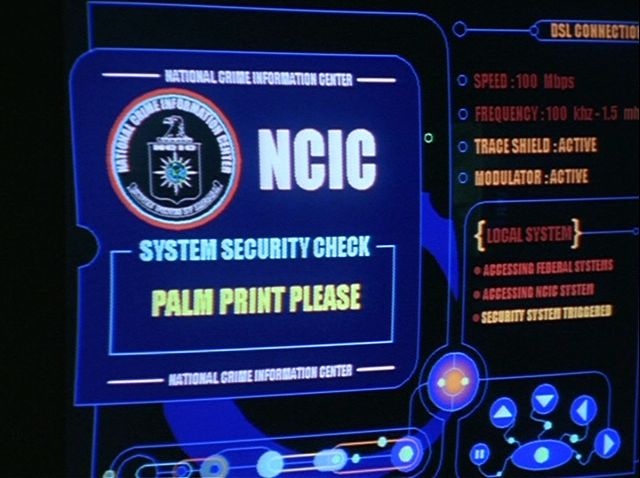
The NCIC makes available a variety of personal and property records for law enforcement and security purposes, covering:
- Convicted sex offenders
- Criminal convictions
- Foreign fugitives
- Immigration violators
- Persons with active protection orders
- Parolees
- Persons with active arrest warrants
- Secret Service protective alerts
- Terrorist organizations and membership
- Violent gang organizations and membership
Behind this lies a simple but highly effective formula, which was best-expressed in the classic 1973 movie, The Day of the Jackal. An anonymous professional killer has been hired to assassinate French President Charles de Gaulle.
At a government meeting called to thwart the plot, a top security expert says: “The first task is to give this man a name. With a name, we get a face, with a face a passport, with a passport an arrest.”
But if you don’t have a reliable database system to match an ID against, forcing people to “show me your ID” is worthless. What does “John Smith” mean to the average ill-paid security guard?
Even if the person is a wanted criminal, just looking at his ID card is worthless. Unless, of course, the person is so notorious as a criminal that his name is known to almost everyone: “My God, it’s Osama bin Laden!”
That’s presuming that the person is not only notorious but stupid enough to flaunt it. There is, after all, such a thing as a falsified ID. Every teenager who’s ever wanted access to a can of beer knows that.
If it seems impossible that any security official could be so stupid, consider this:
In 2010 a friend of mine decided to rent a P.O. box at his local Postal Service office. He was promptly told he would have to provide two pieces of identification, such as:
- A driver’s license or State ID card
- A passport
- A birth certificate
- A bill from a utility company, such as for phone or electric service.
Now, consider:
- He lived only a few blocks from the post office where he was applying for a P.O. box.
- He had lived at the same apartment building for 22 years.
- The Postal Service had been delivering his mail there that entire time—sometimes knocking at his door to do so.
- When he came to its counter to retrieve mail that was otherwise un-deliverable, his showing a State ID card had been entirely enough.
But, to rent a P.O. box at that very same post office, he had to prove he wasn’t a terrorist. And one of the ways he was to do this was to show a utility bill.
What does paying money to an electric or gas company prove about anyone?
Mohammed Atta faithfully paid all his utility bills on an apartment in Hamburg, Germany, where he planned the 9/11 attacks. He continued paying his utility bills during his stay in Venice, Florida—right up to the day he flew American Airlines Flight 11 into the North Tower of the World trade Center.
In short: Creating security theater is not the same as providing real security.

 Bureaucracybuster's Blog
9/11 TERRORIST ATTACKS, ABC NEWS, AFGHANISTAN, ALTERNET, AMERICABLOG, AP, BABY BOOMER RESISTANCE, BBC, BLOOMBERG NEWS, BUZZFEED, CBS NEWS, CNN, CROOKS AND LIARS, DAILY KOZ, DONALD TRUMP, FACEBOOK, FIVETHIRTYEIGHT, HARPER’S MAGAZINE, HUFFINGTON POST, JOSEPH BIDEN, MEDIA MATTERS, MOTHER JONES, MOVEON, MSNBC, NBC NEWS, NEW REPUBLIC, NEWSDAY, NEWSWEEK, NPR, OSAMA BIN LADEN, PBS NEWSHOUR, PENTAGON, PEOPLE’S ARMY OF VIETNAM, POLITICO, POLITICUSUSA, RAW STORY, REUTERS, RICHARD NIXON, RUSSIA, SAIGON, SALON, SEATTLE TIMES, SLATE, TALIBAN, TALKING POINTS MEMO, THE ATLANTIC, THE CHICAGO SUN-TIMES, THE CHICAGO TRIBUNE, THE DAILY BEAST, THE DAILY BLOG, THE GUARDIAN, THE HILL, THE HUFFINGTON POST, THE INTERCEPT, THE LOS ANGELES TIMES, THE NATION, THE NEW REPUBLIC, THE NEW YORK TIMES, THE NEW YORKER, THE VILLAGE VOICE, THE WASHINGTON POST, THINKPROGRESS, TIME, TRUTHDIG, TRUTHOUT, TWITTER, TWO POLITICAL JUNKIES, U.S. NEWS & WORLD REPORT, UKRAINE, UPI, USA TODAY, VIET CONG, VIETNAM WAR, VLADIMIR PUTIN, VOLODYMYR ZELENSKY, WONKETTE, WORLD TRADE CENTER
BAD ALLIES = BAD OUTCOMES
In Bureaucracy, History, Military, Politics, Social commentary on May 18, 2022 at 12:12 amFor those born after 1975, America’s departure from Afghanistan marks the first humiliating retreat from a valuable ally.
But this is wrong.
In April, 1975, the South Vietnamese Army suddenly crumbled under an all-out offensive by North Vietnamese regular army units.
The United States—which had been been supplying military assistance to Vietnam since the Presidency of Dwight D. Eisenhower—suddenly saw its worst nightmare come to life.
It had poured more than $120 billion into the conflict in Vietnam from 1965-73. At least 58,000 United States soldiers had died there. Another 304,000 had been wounded.
Vietnam during the Vietnam war
User:SnowFire, CC BY-SA 4.0 <https://creativecommons.org/licenses/by-sa/4.0>, via Wikimedia Commons
The last American troops had left Vietnam on March 29, 1973. President Richard Nixon claimed that he had achieved “peace with honor.” The South Vietnamese Army was supposedly now trained by Americans to defend the “country” from attack by North Vietnam.
Then came December 13, 1974—the start of the North’s all-out offensive.
The result: South Vietnamese forces melted away.
This was hardly surprising to American veterans of the war. Among them a favorite joke had been: “There’s a new batch of South Vietnamese rifles for sale. Never fired, and only dropped once.”
By April 30, 1975, Saigon, the capitol of South Vietnam, fell to the People’s Army of Vietnam and the Viet Cong.
Fall of Saigon
At home, watching TV, Americans felt shame as Army helicopters hurriedly lifted off the roof of the United States embassy. Numerous South Vietnamese desperately tried to climb aboard—only to have their hands stomped on by Americans equally desperate to get out before North Vietnamese forces reached them.
Now, 46 years later, Americans were seeing Air Force planes taking off from Kabul Airport, with hordes of Afghans desperate to leave the country, racing after them.
Said President Joseph Biden: “Over our country’s 20 years at war in Afghanistan, America has sent its finest young men and women, invested nearly $1 trillion dollars, trained over 300,000 Afghan soldiers and police, equipped them with state-of-the-art military equipment, and maintained their air force as part of the longest war in U.S. history.”
Joseph Biden
Just as the South Vietnamese Army had chosen flight instead of fight, so, too, did the Afghan Army—in just 10 days.
“One more year, or five more years, of U.S. military presence would not have made a difference if the Afghan military cannot or will not hold its own country,” said Biden. “And an endless American presence in the middle of another country’s civil conflict was not acceptable to me.
“When I came to office, I inherited a deal cut by my predecessor—which he invited the Taliban to discuss at Camp David on the eve of 9/11 of 2019—that left the Taliban in the strongest position militarily since 2001 and imposed a May 1, 2021 deadline on U.S. Forces.
Donald Trump
“Shortly before he left office, he also drew U.S. Forces down to a bare minimum of 2,500. Therefore, when I became President, I faced a choice—follow through on the deal, with a brief extension to get our forces and our allies’ forces out safely, or ramp up our presence and send more American troops to fight once again in another country’s civil conflict.
“I was the fourth President to preside over an American troop presence in Afghanistan—two Republicans, two Democrats. I would not, and will not, pass this war onto a fifth.”
Republicans have since tried hard to blame the resulting chaos on Biden. But in doing so they deliberately ignore the role played by his predecessor, Donald Trump, in facilitating that rout.
As Biden noted, Trump had invited the Taliban to Camp David to discuss the withdrawal of American forces from Afghanistan. Making this offer thoroughly disgraceful were two factors:
First: The date for this conference was on the eve of the 18th anniversary of the September 11, 2001 terrorist attacks on the Pentagon and World Trade Center. Osama bin Laden, the mastermind of those attacks, was then living in Afghanistan under the protection of the Taliban.
It was the refusal of the Taliban to turn him over to American justice that led directly to the American invasion of Afghanistan in October, 2001.
Second: Pointedly uninvited to this conference were any members of the Afghan government, which—officially—the United States regarded as a valuable ally.
There is a brutal lesson here that Americans have long refused to learn: Bad allies make for bad outcomes. Those who refuse to defend themselves cannot be bribed or forced to do so by others.
Contrast the “I have to catch a plane” cowardice of Afghan soldiers with the courage of Ukrainian soldiers—and civilians—fiercely defending their country from Vladimir Putin’s unprovoked Russian invasion.
During the assault by Russian troops on the capital of Kiev, the Biden administration urged President Volodymyr Zelensky to evacuate to a safer location and offered to help him do so. Zelensky refused, saying: “The fight is here [in Kiev]; I need ammunition, not a ride.”
Until Presidents and Congressional leaders learn to distinguish worthwhile allies from worthless ones, Americans will continue to waste lives and treasure on the latter.
Share this: