Republicans have a love/hate relationship with Adolf Hitler.
On one hand, they repeatedly accuse President Barack Obama of being another Hitler. They decorate his poster with the toothbrush mustache worn by Germany’s Fuehrer. They dismiss Obama’s eloquence with: “Hitler also gave good speeches.”

Adolf Hitler
On the other hand, they run candidates whose power-lust and ruthlessness match that of Hitler or any of his henchmen.
Among these in the past have been such notorious figures as Senator Joseph “Tail Gunner Joe” McCarthy, House Majority Leader Tom DeLay, President Richard M. Nixon and House Speaker Newt Gingrich.
And now a figure from that past is once again planning a last, desperate grasp for absolute power in 2016: Newt Gingrich.

Newt Gingrich
In a half-hour phone call with reporters on December 17, 2011, Gingrich said that, as President, he would abolish whole courts to be rid of judges whose decisions he feels are out of step with the country.
“Are we forced for a lifetime to keep someone on the bench who is so radically anti-American that they are a threat to the fabric of the country?” Gingrich asked.
“What kind of judge says you’ll go to jail if the word ‘invocation’ is used? If this isn’t a speech dictatorship, I’d like you to show me what one looks like.”
And appearing on CBS’ “Face the Nation,” Gingrich said the President could send federal law enforcement authorities to arrest judges who make controversial rulings in order to compel them to justify their decisions before congressional hearings.
When host Bob Schieffer asked how he would force federal judges to comply with congressional subpoenas, there occurred this telling exchange:
Schieffer: Let me just ask you this. You talk about enforcing it because one of things you say is if you don’t like what a court has done, the congress should subpoena the judge and bring him before congress and hold a congressional hearing.
Some people say that’s unconstitutional but I’ll let that go for a minute. I just want to ask you from a practical standpoint, how would you enforce that? Would you send the Capitol police down to arrest him?
Gingrich: If you had to or you’d instruct the Justice Department to send a U.S. Marshal. Let’s take the case of Judge Biery. I think he should be asked to explain a position that radical.
How could he say he’s going to jail the superintendent over the word benediction and invocation?
Because before…because then I would encourage impeachment. But before you move to impeachment, you’d like to know why he said it. Now clearly since the congress has the power.
Schieffer: What if he didn’t come? What if he said, no thank you, I’m not coming?
Gingrich: Well that is what happens in impeachment cases. In an impeachment case, the House studies whether or not, the House brings them in, the House subpoenas them. And as a general rule they show up.
I mean, but you’re raising the core question, are judges above the rest of the constitution? Or are judges one of the three co-equal branches?
* * * * *
The politicizing of the judiciary was one of the major hallmarks of Hitler’s Germany. Those judges who refused to hand out the types of verdicts Hitler desired were quickly removed.
They were replaced by judges like the infamous Roland Freisler, who chaired the First Senate of the People’s Court, and acted as judge, jury and prosecutor.
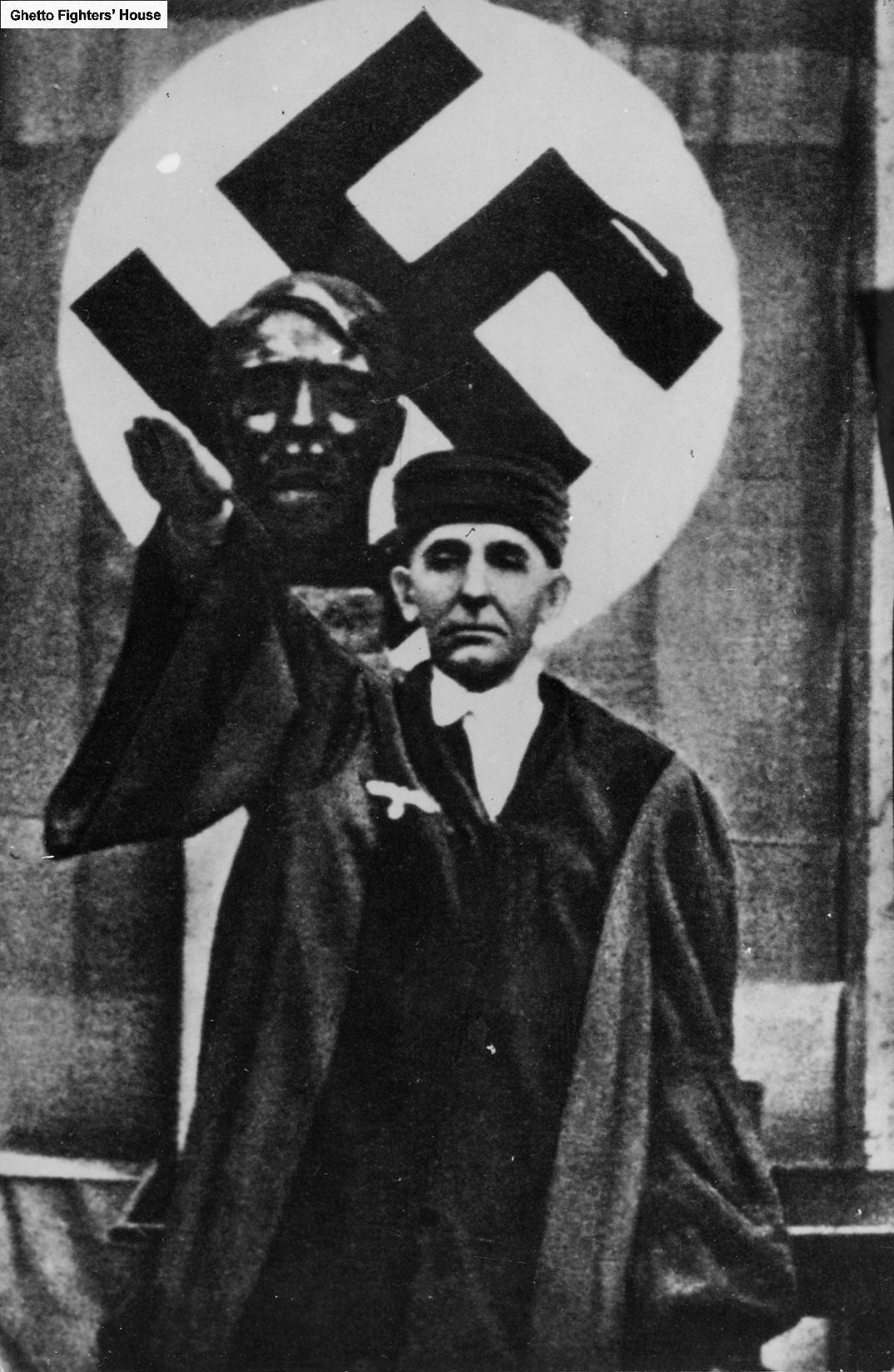
About 90% of all defendants appearing before him were sentenced to death or life imprisonment. The sentences had often been determined before trial.
Between 1942 and 1945, more than 5,000 death sentences were handed out. Of these, 2,600 were issued by the court’s First Senate, which Freisler headed.
Freisler was infamous for humiliating defendants. Several defendants in the July 20, 1944 bomb plot against Hitler appeared before him. One of these was Ulrich-Wilhelm Graf Schwerin von Schwanenfeld.
Schwerin, brought to court without a belt and tie, tried to preserve his dignity by holding up his pants. Freisler mocked him as a pervert for “playing” with his trousers.
When Schwerin said that he had come to oppose Hitler because of “the many murders in Germany and abroad” he was furiously interrupted by Freisler, who finally shouted him down.
On September 8, 1944, Schwerin was hanged in prison in Berlin.
On 3 February 1945, Freisler was conducting a Saturday session of the People’s Court, when American bombers attacked Berlin. A hit on the courthouse unloosed a heavy beam that crushed his skull, instantly killing him.
Adolf Hitler laid out his plans for remaking Germany and the world in his book, Mein Kampf (My Struggle). Newt Gingrich has openly proclaimed his own dictatorial intentions.
Hitler published Mein Kampf in 1925–eight years before he became Germany’s Fuehrer in 1933.
Five years before the 2016 election, Gingrich has given warning of his own dictatorial plans for remaking the United States in his own image.
Most Germans who detested Hitler refused to take him seriously–until it was too late.
History will judge whether Americans act more responsibly than their German counterparts.
END OF PART ONE





ABC NEWS, ADOLF HITLER, BARACK OBAMA, BOB SCHIEFFER, CBS NEWS, CNN, FACE THE NATION, FACEBOOK, JOSEPH MCCARTHY, NAZI GERMANY, NBC NEWS, NEWT GINGRICH, RICHARD NIXON, THE LOS ANGELES TIMES, THE NEW YORK TIMES, THE WASHINGTON POST, TOM DELAY, TWITTER, U.S. MARSHALS SERVICE, U.S. SUPREME COURT
FASCISTS FOREVER, JUDGES NO MORE: PART TWO (END)
In History, Law, Politics, Social commentary on May 2, 2014 at 12:00 amIf Newt Gingrich becomes President, he has big plans for the American federal judiciary: To arrest and remove all those judges who do not follow his right-wing agenda.
Adolf Hitler laid out his plans for remaking Germany and the world in his book, Mein Kampf (My Struggle).
And would-be Fuehrer Gingrich has openly proclaimed his own dictatorial intentions.
In a December 18, 21011 appearance on “Face the Nation,” Gingrich spoke candidly with host Bob Schieffer about his hatred for much of the American federal judiciary.
Schieffer: Mr. Speaker, the old saying in legal circles is that the Supreme Court is not last because it’s right, it’s right because it’s last.
There comes a point where you have to accept things as the law of the land. How do you decide, how does the President decide what’s a good law and I’m going to obey the Supreme Court or what’s a bad law and I’m just going to ignore it?
Gingrich: I think it depends on the severity of the case. I’m not suggesting that the Congress and the President review every decision.
I’m suggesting that when there are decisions….in which they’re literally risking putting civil liberty rules in battlefields, it’s utterly irrational for the Supreme Court to take on its shoulders the defense of the United States. It’s a violation of the Constitution.
* * * * *
Schieffer: …. Next year the Supreme Court is going to take up Obama’s healthcare proposal. What if they throw it out? Can President Obama then say I’m sorry boys, I’m just going to go ahead and implement it. Could he do that?
Gingrich: The key question is, what would the Congress then do? Because there are three branches….
Schieffer: But could he do that?
Gingrich: He could try to do that. And the Congress would then cut him off. Here’s the key — it’s always two out of three.
If the President and the Congress say the court is wrong, in the end the court would lose. If the Congress and the court say the President is wrong, in the end the President would lose.
And if the President and the court agreed, the Congress loses. The founding fathers designed the Constitution very specifically in a Montesquieu spirit of the laws to have a balance of power, not to have a dictatorship by any one of the three branches.
Schieffer: ….And a number of conservatives, including two of George Bush’s attorneys general, Alberto Gonzales and Michael Mulcasey, both said and I’m going to just quote what Mr. Mulcasey said.
….He told Fox News, he said “Mr. Gingrich’s proposal is dangerous, ridiculous, totally irresponsible, outrageous, off the wall, and would reduce the entire judicial system to a spectacle.”
Now that’s a conservative judge or a conservative attorney general. How do you respond to that?
Gingrich: I think many lawyers will find this a very frightening idea. They’ve had this run of 50 years of pretending judges are supreme, that they can’t be challenged. The lawyer class defines America.
We’ve had rulings that outlawed school prayer, we’ve had ruling that outlawed the cross, we’ve had rulings the outlawed the 10 Commandments, we’ve had a steady secular drive to radicalize this country away from all of its core beliefs.
I mean what got me into this was the 9th Circuit saying that one nation under God is unconstitutional.
* * * * *
On June 30, 1934, Hitler ordered his private army, the SS (Schutzstaffel, or Protective Squad) to purge his other private army, the S.A., or Brown Shirts.
At least 200 men and women were murdered throughout Germany.
Some died by firing squad. Others were executed in prison. Still others were shot down in their homes.
Afterward, Hitler appeared before the German parliament, the Reichstag, to justify his actions:
“If someone asks me why we did not use the regular courts, I would reply: At that moment I was responsible for the German nation. It was I, alone, who, during those 24 hours, was the Supreme Court of Justice of the German people.”
It took a six-year war that cost the lives of 50 million men, women and children to finally oust this “Supreme Court of Justice for the German People.”
Apparently Newt Gingrich believes it’s a title well worth resurrecting–here in America.
Share this: