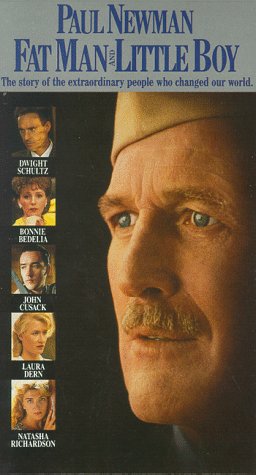
The 1989 movie, Fat Man and Little Boy, provides useful insights into the real-life workings of bureaucracies.
In it, the brilliant and ambitious physicist, J. Robert Oppenheimer (played by Dwight Schultz) comes—too late—to realize he’s made a deal with the devil.
The same proved true for the J. Robert Oppenheimer of history.
In 1942, America’s top military officials become convinced that German scientists are furiously pursuing work on an atomic bomb.
The full horror of the extermination camps has not yet been revealed. But “Oppie” and many other Jewish scientists working on the Manhattan Project can easily imagine the fate of Jews trapped within the borders of the Third Reich. This spurs them on to frenzied efforts to build a bomb that will quickly end the war and end that suffering.
But then something unforeseen happens.
On May 8, 1945, the Third Reich collapses and signs unconditional surrender terms. Almost at the same time, the U.S. military learns that although some German physicists had tried to make an atomic bomb, they never even got close to producing one.
Oppenheimer now finds himself still working to build the most devastating weapon in history—but now lacking the enemy he had originally signed on to destroy.
Meanwhile, the U.S. Government has invested nearly $2 billion in the Manhattan Project—at a time when $2 billion truly meant the equivalent of $1 trillion today. Is all that money to go for nothing?
What to do?
Oppenheimer doesn’t have to make that decision. It’s made for him—by his immediate superior, General Leslie Groves (Paul Newman), by Groves’ superiors in the Army, and ultimately by the new President, Harry S. Truman.

J. Robert Oppenheimer (left) and General Leslie Groves
The bomb will be used, after all. It will just be turned against the Japanese, who are even more hated by most Americans than the Germans.
It doesn’t matter that:
- The Japanese lack the technological skill of the Germans to produce an atomic bomb.
- They are rapidly being pushed across the Pacific to their home islands.
- American bombers are incinerating Japanese cities at will.
- The Japanese are desperately trying to find a way to surrender without losing face.
What matters is that Pearl Harbor is still fresh in the minds of Americans generally and of the American military in particular.
And that now that the Japanese are being pushed back into their home islands, they are fighting ever more fanatically to hold off certain defeat.
General Douglas MacArthur, who is scheduled to command the invasion of Japan, has estimated a million American casualties if this goes forward.
Oppenheimer, who has taught physics at the University of California at Berkeley, now finds himself being taught a lesson about the physics of bureaucracy: That, once set in motion, bureaucracies—like objects—continue to move forward unless something intervenes to stop them.
So, on August 6, 1945, an American B-29 bomber drops “Little Boy” on Hiroshima.
An estimated 80,000 people die instantly. By the end of the year, injury and radiation bring total casualties to 90,000-140,000.
The bombing of Hiroshima
On August 9, it’s the turn of Nagasaki.
Casualty estimates for the dropping of “Fat Man” range from 40,000 to 73,884, with another 74,909 injured, and another several hundred thousand diseased and dying due to fallout and other illness caused by radiation.
For Oppenheimer, the three years he’s devoted to creating an atomic bomb will prove the pivotal event of his life. He will be praised and damned as an “American Prometheus,” who brought atomic fire to man.
Countless Americans—especially those who would have been ordered to invade Japan—revere him for bringing the war to a quick end. And countless Americans condemn him as a man whose arrogance and ambition have enabled mankind to destroy itself.
Upon witnessing the first successful atomic explosion near Alamogordo, New Mexico, on July 16, 1945, Oppenheimer had been stunned by the sheer magnitude of destructiveness he had helped unleash.
Faced with the massive toll of lives taken by the device he had created, Oppenheimer became convinced that the only hope for humanity lay in abolishing nuclear weapons. He vigorously opposed the creation of a “super” hydrogen bomb.
His advice was overruled, however, and construction of this went forward at the same pace that Oppenheimer had once driven others to create the atomic bomb.
The first test of this even more terrifying weapon occurred on November 1, 1952. By 1953, just as Oppenheimer predicted, the Soviet Union launched its own H-bomb test.
In a famous meeting with President Truman, Oppenheimer reportedly said, “Mr. President, I have blood on my hands.”Truman later claimed that he had offered Oppenheimer a handkerchief, saying, “Here, this will wash it off.”
It didn’t.
Accused during the hysteria of the Joseph McCarthy witch-hunts of being a Communist traitor, Oppenheimer found himself stripped of his government security clearance in 1954.
Unable to prevent the military bureaucracy from moving relentlessly to use the atomic bomb, he could not halt the political bureaucracy from its own rush into cowardice and the wrecking of others’ lives.
Although Oppenheimer returned to teaching, at Princeton University, he never recovered from the shame of having lost his security clearance.
A chain smoker, he died of throat cancer in 1967.
.svg)


 Bureaucracybuster's Blog
ABC NEWS, ADOLF HITLER, AFGHANISTAN, AFRIKA KORPS, ALTERNET, AMERICABLOG, AP, BABY BOOMER RESISTANCE, BARACK OBAMA, BUZZFEED, CBS NEWS, CNN, CROOKS AND LIARS, DAILY KOZ, DONALD TRUMP, DRUDGE RETORT, EL ELAMEIN, ERWIN ROMMEL, FACEBOOK, FIVETHIRTYEIGHT, FRIEDRICH VON PAULUS, GEORGE W. BUSH, GREAT BRITAIN, HARPER’S MAGAZINE, IRAQ, JAPAN, JOSEPH GOEBBELS, MEDIA MATTERS, MOSCOW, MOTHER JONES, MOVEON, MSNBC, NAZI GERMANY, NBC NEWS, NEWSWEEK, NPR, PBS NEWSHOUR, PEARL HARBOR, POLITICO, POLITICUSUSA, RAW STORY, REUTERS, SALON, SEATTLE TIMES, SLATE, SOVIET UNION, STALINGRAD, TALKING POINTS MEMO, THANKSGIVING MESSAGE TO U.S. TROOPS, THE ATLANTIC, THE CHICAGO SUN-TIMES, THE CHICAGO TRIBUNE, THE DAILY BEAST, THE DAILY BLOG, THE GUARDIAN, THE HILL, THE HUFFINGTON POST, THE LOS ANGELES TIMES, THE NATION, THE NEW REPUBLIC, THE NEW YORK TIMES, THE VILLAGE VOICE, THE WASHINGTON POST, THINKPROGRESS, TIME, TOTAL WAR SPEECH, TRUTHDIG, TRUTHOUT, TWITTER, TWO POLITICAL JUNKIES, U.S. NEWS & WORLD REPORT, UNITED STATES, UPI, USA TODAY, WEHRMACHT, WINSTON CHURCHILL, WONKETTE, WORLD WAR ii
LIKE HITLER, LIKE TRUMP: BE GRATEFUL YOU HAVE ME
In Bureaucracy, History, Military, Politics, Social commentary on March 20, 2020 at 12:08 amBy February, 1943, the tide of war had turned irrevocably for Nazi Germany.
The string of quick and easy victories that had started on September 1, 1939 was over:
All had fallen under the heel of the Nazi jackboot. The swastika flag still flew triumphantly over the capitols of these once-free nations.
Adolf Hitler
And the word—and whim—of Germany’s Fuhrer, Adolf Hitler remained law for their populations.
But by March, 1943, all except the most fanatical Nazis could see that Germany was on a collision course with disaster.
So, by March, 1943, Germany desperately needed to hear some good news. And Propaganda Minister Joseph Goebbels was eager to supply it.
Joseph Goebbels
He did so in one of his last public addresses, delivered to a large but carefully selected audience in Gorlitz.
For Goebbels, the greatest challenge to the Reich lay in “the Bolshevist danger in the East.” And, for him, the solution was clear: “Total war is the demand of the hour.”
“Our soldiers, as soon as the great push on the Eastern Front gets under way, will ask no mercy and give no mercy.
“Already, our forces have begun softening up operations, and in the next weeks and months the big offensive will begin. They will go into battle with devotion like congregations going to a religious service.
“So, as the Fuhrer has overcome crises in the past, so will he triumph now.
“The other day he told me ‘I firmly believe that we shall overcome this crisis. I firmly believe that our army of millions will beat back our enemy and annihilate him. And some day our banners will be victorious. This is my life’s unshakable belief.'”
Thunderous applause repeatedly interrupted Goebbels’ address. Yet this could not replace the enormous losses Germany had suffered since 1939. Nor could it reverse the march of the Allied armies as they closed in on the Reich from East and West.
Now, fast-forward 74 years to November 23, 2017—Thanksgiving Day.
Donald Trump, President of the United States, speaks by video teleconference to American forces stationed in Iraq and Afghanistan.
Donald Trump
President George W. Bush had risked his life to fly into Baghdad in 2003 to spend Thanksgiving with American forces. He flew into Iraq once again to visit troops in June, 2006.
And President Barack Obama took a similar risk when he visited American soldiers in Iraq in 2009, in Afghanistan in 2010, 2012 and 2014.
For Trump—who had five times dodged the draft during the Vietnam war—visiting an actual combat zone was apparently out of the question.
So he addressed American troops from the safety and comfort of his Mar-a-Lago Club and Resort in Palm Beach, Florida.
The address started off predictably enough: “It’s an honor to speak with you all and to give God thanks for the blessings of freedom and for the heroes who really have this tremendous courage that you do to defend us and to defend freedom.”
But, being Trump, he could not resist paying homage to himself: “We’re being talked about again as an armed forces. We’re really winning. We know how to win, but we have to let you win. They weren’t letting you win before; they we’re letting you play even. We’re letting you win….”
In short: You’re doing the grunt work, but the glory belongs to me.
“They say we’ve made more progress against ISIS than they did in years of the previous administration, and that’s because I’m letting you do your job….”
Translation: All those sacrifices you made under Presidents Bush and Obama went for nothing.
“A lot of things have happened with our country over the last very short period of time, and they’re really good — they’re really good. I especially like saying that companies are starting to come back.
“Now we’re working on tax cuts—big, fat, beautiful tax cuts. And hopefully we’ll get that and then you’re going to really see things happen.”
Or, put another way: Be grateful they elected me—because you’re about to see the 1% richest get even richer. Too bad you won’t be so lucky.
Share this: