bureaucracybusters

Posts Tagged ‘ORGANIZED CRIME CONTROL ACT’

WITNESS-SECURITY: A BLOODSTAINED HISTORY: PART SIX (OF TEN)

In Bureaucracy, History, Law, Law Enforcement on June 17, 2013 at 12:16 am

Mafia Hitman Joseph Barboza had become known throughout the New England underworld as “The Animal.”

He relished his new alias and his reputation as a temperamental killer.

Everyone who dealt with Barboza—including Mafia Boss Raymond Patriarca—feared his explosive temper.

Granted an audience with Patriarca, Barboza was transfixed by the capo’s diamond ring.  Later, he bragged that he had thought of biting off Patriarca’s finger to get the ring.

“He’s crazy,” Patriarca often told his closest associates.  “Someday we’ll have to whack him out.”

Only one other mob gunman could match Barboza’s reputation for deadliness: Steve Hughes, the top triggerman for the McLaughlins.

Barboza spent more than a year trying to eliminate Hughes, until his chance finally came on September 23, 1966.

On that day, Hughes and a loanshark friend, Sammy Lindenbaum, went for a drive along Route 114 in Middleton, Massachusetts.

They paid no attention as another car—carrying Barboza and a crony, Joseph Amico—rapidly closed on them.

With Amico behind the wheel, Barboza aimed a high-powered rifle out the window and dropped Hughes and Lindenbaum in their seats.

Barboza’s moment of supreme triumph was short-lived.  His rising notoriety disturbed Patriarca, who believed in taking a low profile and avoiding the antagonism of the press and police.

Patriarca began searching for an excuse to part with his top muscleman.   He found it on October 6, 1966, when Boston police arrested Barboza and three companions.

Inside Barboza’s car, police found a loaded .45 automatic and an M-1 carbine.  Barboza, then out on bail on a stabbing charge, was shipped off to Walpole State Prison for parole violation.

There he waited vainly for the Patriarca Family to post the $50,000 bond demanded for his release.

Tired of waiting, two of his fellow enforcers decided to lend a hand: Thomas DePrisco and Arthur Bratsos began raiding Patriarca gambling dens to collect the money.

Their fund-raising efforts ended violently one night when their intended victims drew pistols and shot Bratsos and DePrisco to death.

When he learned of the deaths of his friends, Barboza exploded.  He damned Patriarca as a “fag” and swore to kill several of the capo’s top associates, whom he blamed for the slayings.

Word of this outburst reached Patriarca, who sent back a threat of his own: Barboza was a dead man, in or out of prison.

Fearing for his own life, Barboza yielded to the proddings of two FBI agents seeking evidence against Patriarca.  He agreed to act as a federal witness against his former mob cronies.

In exchange, he demanded protection for himself, his wife and young daughter, and the dropping of his parole and all charges now facing him.

Although Barboza’s terms were stiff, Boston District Attorney Gary Byrne and the prosecutors of the Justice Department felt they were getting the best of the bargain.

They saw in Barboza a dramatic, unprecedented opportunity to strike down a powerful crime cartel.

This, in turn, would enable federal lawmen to recruit new informants and witnesses for additional—and successful—prosecutions..

To achieve these goals, however, the Justice Department had to prove it could protect Barboza against mob reprisals.

As a first step in this process, Byrne released the ex-hitman to the protective custody of the FBI.  But the FBI found its budget and manpower strained by the assignment.

Realizing that a combined effort was necessary, the Bureau called in a handpicked security detail of sixteen deputy U.S. marshals.

Heading the detail was Deputy Marshal John Partington, a former agent with the IRS Intelligence Division and a specialist in organized crime.

John Partington (on right)

Equally important, Partington understood the criminal mentality: Not only did Barboza need to be protected, he needed to be kept in a proper state of mind to testify in court.

The marshals transferred Barboza to Thatcher’s Island, an isolated lighthouse station off the coast of Gloucester.  Occupied by two houses and approachable only by sea, the island seemed a perfect security spot.

Every two weeks, a new detail of marshals arrived to relieve the sixteen men on duty.  Food and supplies were regularly shipped in aboard Coast Guard vessels.

Eventually, the press learned of the security detail on ”Baron’s Island”—so  nicknamed because “Baron” had once been a Barboza alias.

The disclosure led to a series of attempts by mob hitmen to eliminate Barboza.

Thatcher’s Island

The first attempt came in September, 1967.  Patriarca ordered a 325-pound stock swindler named Vincent Teresa to take a crew of hitman, infiltrate the island and dispose of Barboza.

But the FBI learned of the plot and tipped off the security detail.

When Teresa’s $112,000, forty-three foot yacht, The Living End, cruised around the island, the hitman couldn’t find an unprotected spot to land.

Everywhere they looked they saw deputy U.S. marshals, armed with pistols and carbines, patrolling the beach.  Barboza never appeared in sight.

Then a Patriarca assassin, Maurice “Pro” Lerner, thought of making a one-man, commando-style assault on the island.  An experienced skindiver, he brought along his own scuba gear for just such an attack.

But he quickly dropped the idea: he estimated the odds of getting a successful shot at Barboza were a million to one.

Copyright@1984 Taking Cover: Inside the Witness Security Program, by Steffen White and Richard St. Germain

WITNESS-SECURITY: A BLOODSTAINED HISTORY: PART FIVE (OF TEN)

In Bureaucracy, History, Law, Law Enforcement on June 14, 2013 at 12:05 am

The Witness Security Program owes its creation to one of the most-feared assassins the Mafia has ever produced: Joseph Barboza, who took pride in his underworld alias, “The Animal.”

It was a nickname he had lived up to.  “I was an enforcer,” he boasted to the House Select Committee on Crime in 1972, “who kept the other enforcers in line.”

Barboza had done so as a top hitman earning $900 a week from the most powerful Mafia family in New England.  Ruling that family was Raymond Patriarca, based in Providence, Rhode Island.

Joseph “The Animal” Barboza

But even before entering the Mafia, Joseph Barboza had spent most of his life as a career criminal.  He was born in 1932, in New Bedford, Massachusetts, to Portuguese immigrant parents.

By the time he was thirty, he had served two prison sentences—one for burglary, the other for assault with a deadly weapon.

Even his jailers couldn’t restrain him.  At Norfolk Prison Colony, he got drunk on illicit “hooch” and led an inmates’ riot, culminating in a short-lived escape-attempt.

When Barboza wasn’t serving time in prison, he made his living as a boxer (winning three professional matches and earning a rating in Ring magazine).  He supplemented his income through a career as a freelance loanshark and extortionist.

By 1963, his growing notoriety had brought him to the attention of Enrico Henry Tameleo, the underboss, or second-in-command, to Raymond Patriarca.

Since 1948, Patriarca had been “the policymaker, judge and overlord of organized crime” throughout New England, according to a 1966 FBI report.

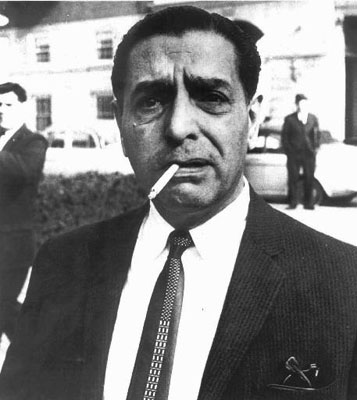
Raymond Patriarca

Tameleo offered a Barboza a job and fulltime income as an enforcer for the Patriarca Family.  Barboza instantly agreed.  He had always dreamed of becoming a “made man” of the Mafia.

(Tameleo didn’t warn him that this was impossible.  Barboza was of Portuguese descent, and only full-blooded Sicilians and Italians could hold Mafia membership.)

Tameleo sent Barboza to shake down 20 nightclubs whose owners had refused to pay “protection insurance” to the mob.

The owners changed their minds after one or two visits from Barboza and his wrecking crew.  Furniture would be smashed and customers terrorized until the owners began paying $1,000 a month to Patriarca’s collectors.

Meanwhile, the always fragile peace of the New England underworld was being shattered by an escalating wave of gangland violence.

In 1961, the two most powerful factions of the region’s “Irish Mafia” had gone to war.  On one side was the Charleston mob of Bernard McLaughlin.  On the other was the Winter Hill gang of James “Buddy” McLean.

The “Irish Gang War” triggered a police crackdown on all the New England organized crime groups—including Patriarca’s.  That was when Patriarca demanded that the fighting stop.

To ensure that it did, he sent his underboss, Tameleo, to arrange a peace conference between the McLeans and McLaughlins.  Both sides agreed to a truce because Tameleo was widely respected for his skills as a negotiator.

But when the conference opened in January, 1965, Tameleo was outraged to find the McLaughlins had come armed–a direct violation of the “rules of order.”  Patriarca also grew furious at this spurning of his efforts as underworld peacemaker.

As a result, the Patriarca Family threw its full weight behind the McLeans.

During 1965, Joseph Barboza moved from being a “mere” legbreaker for the Patriarca Family to becoming its top assassin.  His first important victim was Edward Deegan, a McLaughlin member who had raided several Patriarca gambling dens.

Barboza invited Deegan to join him in a burglary of the Lincoln National Bank in Boston.  Unaware that he had been marked for death, Deegan agreed.

On the night of March 12, 1965, the burglars struck.  As the four men emerged from the bank, Barboza and two cronies emptied their pistols into Deegan.

This killing proved a turning point for Barboza.  He became the top hitman for the Patriarca Family and the McLean mob.  He carried out more  hits than any other assassin during the war.  Later, in a hastily-written autobiography, he would boast of his string of killings.

(But he was always careful to describe his actions in the third-person, as though someone else had actually been responsible.  In this way he protected himself against prosecution for murder, where no immunity existed.)

In June, Jimmy “The Bear” Flemmi, a close friend of Barboza’s, was gravely wounded by a shotgun blast.  Barboza soon learned that the attackers had been Steve Hughes and Edward “Punchy” McLaughlin.

Swearing vengeance, Barboza quickly set out to claim his next victim.  He was especially intent on disposing of Hughes, who had become the top triggerman of the McLaughlins.

On October 20, 1963, Edward McLaughlin was waiting at a bus stop when Barboza casually walked up behind him.  Disguised in a wig and glasses, Barboza drew his pistol and pumped five bullets into McLaughlin.

Less than a month later, on November 11, the hitman visited the Mickey Mouse Club, a tavern in Revere Reach.  This time his intended target was a bartender and McLaughlin member named Ray DiStassio.

Talking with DiStassio at that moment was an innocent bystander, John R. O’Neill.  Barboza simply drew and shot both men dead.

Copyright@1984 Taking Cover: Inside the Witness Security Program, by Steffen White and Richard St. Germain

WITNESS-SECURITY: A BLOODSTAINED HISTORY: PART FOUR (OF TEN)

In Bureaucracy, History, Law, Law Enforcement on June 8, 2013 at 12:05 am

Joseph Valachi was the first member of the Mafia to talk publicly about its secrets.

But before that happened, he had to be persuaded to open up.  The men who first got that assignment were agents of the Federal Bureau of Narcotics and Dangerous Drugs.

But the sessions between him and the agents went badly.  He blamed them for his imprisonment on drug charges in 1960.  And he believed they had deliberately created a rift between him and his cellmate, “Boss of all Bosses” Vito Venovese.

Then the FBI intervened.  Under pressure from Attorney General Robert Kennedy to combat the crime syndicates, the Bureau took an aggressive interest in Valachi.

Seeing him as a potential breakthrough in organized crime intelligence, the FBI cited its greater area of jurisdiction and successfully lobbied the Justice Department to take charge of the new informant.

Valachi’s disclosures proved worthless as prosecution evidence.  They were too dated, and too many of the leading mobsters who figured in them were now dead or retired.

But as strategic intelligence, they were invaluable.

Valachi provided federal lawmen, for the first time, with an insider’s account of the history, membership and operations of organized crime.

Many veteran law enforcement agents were shocked: The shadowy world of the Cosa Nostra was far more extensive and powerful than they had dared imagine.

More important, in Joseph Valachi himself, the Justice Department finally had tangible proof of an organized crime network.  The very existence of the Mafia had long been hotly debated within law enforcement.

Chief among the believers in such a criminal empire had been Harry Anslinger, director of the Federal Bureau of Narcotics.

Anslinger’s certainty that the Mafia existed grew out of his agents’ constant struggles against mobsters importing narcotics into the United States.  His agency had compiled elaborate dossiers on many of these mobsters, and had sent many others to prison.

By far the most important “debunker” of this belief was J. Edgar Hoover, director of the Federal Bureau of Investigation.  Hoover insisted that there was no “national crime confederation,” only loosely-knit groups of criminals whose apprehension was best left to local law enforcers.

J. Edgar Hoover

Hoover’s refusal to admit the existence of the Mafia has long been the subject of heated debate.  Some theorists believe he feared that his “Boy Scout” agents would be corrupted by Mafia bribes.

Others argue that he had been compromised by Mafia bribes or blackmail (the latter through his alleged homosexual relationship with Clyde Tolson, his second-in-command at the FBI).

Still others claim that Hoover simply couldn’t accept that other federal, state and local police agencies had discovered a criminal empire that his own agents had somehow overlooked.

A major reason for the continuing debate over the existence of organized crime lay in the refusal of mob informants to testify as courtroom witnesses.  Abe Reles had been an exception, but he had given his testimony twenty years ago, and only for the State of New York.

More importantly, Reles never appeared before a Senate investigating committee—and on live television.

Joseph Valachi did.  In September, 1963, he became the Senate’s star witness in its hearings on organized crime and narcotics trafficking.

By that time, the mob was offering $100,000 for his life.  To guarantee that no one collected on this contract, federal lawmen turned the Senate Caucus Room into a bodyguards’ convention.

Before Valachi entered the room, FBI agents and deputy U.S. marshals screened the audience for suspicious types or known underworld figures.  While Valachi testified, marshals and capital police filled most of the first eight rows behind him.  Other lawmen were scattered throughout the building.

Joseph Valachi

Whenever Valachi left the witness chair, twenty deputy marshals accompanied him everywhere—even  during trips to the restroom.  And after each day’s proceedings, a fast-moving caravan of police cars returned him to his heavily-guarded cell at the District of Columbia Jail.

During the nearly three years that federal agents interrogated Joseph Valachi, the Justice Department spent more than $167,908 guarding, transporting and maintaining him.

But the money was well-spent: when Valachi died in 1971 at La Tuna Federal Prison, near El Paso, the cause was a heart attack.  And federal lawmen had proven they could guarantee protection for those who betrayed the secrets of the Mafia.

Other organized crime witnesses for the Justice Department didn’t fare so well.

In 1965, two years after Valachi’s appearance before the Senate, Attorney General Nicholas deB. Katzenbach, who had succeeded Robert Kennedy, informed a shocked Congress: “We must dismiss [organized crime cases] because key witnesses or informants suffer ‘accidents’ and turn up, for example, in a river wearing concrete boots.

“Such accidents are not unusual.  We have lost more than twenty-five informants in this and similar ways in the last four years.  We have been unable to bring hundreds of other cases because key witnesses would not testify for fear of the same fate.”

Copyright@1984 Taking Cover: Inside the Witness Security Program, by Steffen White and Richard St. Germain

WITNESS-SECURITY: A BLOODSTAINED HISTORY: PART THREE (OF TEN)

In Bureaucracy, History, Law, Law Enforcement on June 7, 2013 at 12:03 am

Eight years after the death of Arnold Schuster in 1952, the lack of a witness security program cost the life of James V. Delmont, a member of the Stefano Magaddino Mafia Family of Buffalo, New York.  After slipping from underworld grace, Delmont went on the run for his life.

On June 25, 1959, he appeared at the Miami field office of the FBI, offering a rare trade: Mafia secrets for any intelligence the Bureau had on his pursuers.  But the FBI didn’t know what to do with its would-be informant.  One agent advised Delmont to re-enter the Mafia as an FBI plant.  Delmont angrily rejected that idea, and again took flight.

On May 25, 1960, he made a similar offer to agents of the FBI’s Los Angeles office.  They wrote him off as a crank.

Ten days later, Delmont’s body, bearing the marks of a classic Mafia execution (several bullets fired directly into the back of the head), turned up in a field in East Los Angeles.  The Intelligence Division of the Los Angeles Police Department conducted a vigorous probe into the slaying, but couldn’t positively identify Delmont’s killers.

Commenting on the significance of the Delmont case, LAPD Sergeant Peter N. Bagoye, an expert on organized crime, noted: “If any police officer still doubts the existence and power of the Mafia, the Cosa Nostra, or whatever you want to call it, just let him read this case.

“This man Delmont spent a year and traveled thousands of miles to escape the vengeance of the Mafia.  He left a trail of letters and conversations behind-the first known case in which there is any existing blueprint of how the Syndicate works.”

In 1961, after Robert F. Kennedy became Attorney General, the Justice Department mounted the first effective campaign in its history against organized crime.  As part of this effort, the agency began wrestling for the first time with the complex difficulties of creating a protection program for organized crime witnesses.

Robert F. Kennedy

By September, 1963, Kennedy—appearing as a witness during Senate hearings on organized crime and narcotics trafficing—could  cite a number of successes by federal lawmen in safeguarding witnesses.

“How long,” asked Maine Senator Edmund S. Muskie, “can the Justice Department protect people who agree to testify?”

“We have taken steps, Senator, to even move people out of the country,” answered Kennedy.  “We have provided them with positions and work in other cities where nobody will really have any contact with them.  We have arranged to move their families and have their names changed.

“I think we have procedures now where, if an important individual comes forward and is willing to testify, we can give him that kind of protection.”

Such an individual proved to be Joseph Valachi, an aging Cosa Nostra hitman and narcotics trafficker.  In 1962, Valachi was an inmate at Atlanta Federal Prison, serving two concurrent sentences totaling thirty-five years for narcotics trafficking.  His cellmate was Vito Genovese, then the most powerful Mafia boss in the country.

Vito Genovese

Genovese had been convicted of narcotics conspiracy in 1959 and sentenced to fifteen years’ imprisonment.  Now he began suspecting—wrongly—that Valachi was an informer.  The reason: After Valachi’s second trial for narcotics trafficking, he had been repeatedly interviewed—against his will—by federal narcotics agents.

One night, in a scene right out of a B-grade Mafia movie, Genovese summoned Valachi to his cell for a private talk.

“You know,” said Genovese, “we take a barrel of apples.  And in this barrel of apples, there might be a bad apple.  Well, this apple has to be removed.  And if it ain’t removed, it would hurt the rest of the apples.”  Then he gave Valachi the fabled “kiss of death,” signifying that he was now marked for murder.

Valachi survived what he believed were attempts to poison his food and lure him alone into a shower where he could be stabbed to death.   But he knew his luck could not last forever.  He decided to take at least one of his enemies with him.

On June 22, 1963, he beat another inmate to death with an iron pipe.  Only later did he learn that he had killed the wrong man: John Joseph Saupp, a forger without ties to the mob.  It had been Saupp’s bad luck to bear a striking resemblance to another prisoner whom Valachi believed had the contract to kill him.

Valachi grew depressed over having killed the wrong man.  He also knew he couldn’t spend the rest of his life in solitary confinement.  Desperate, he offered himself as an informant to Robert Morgenthau, the New York U.S. Attorney.  Morgenthau, in turn, put him in contact with agents of the Federal Bureau of Narcotics.

The agents quickly transferred Valachi from Atlanta Federal Prison to the first of a series of military bases.  But the sessions between him and the agents went badly.  He still blamed them for his imprisonment in 1960.  And he believed they had deliberately created a rift between him and Geno

Copyright@1984 Taking Cover: Inside the Witness Security Program, by Steffen White and Richard St. Germain

WITNESS-SECURITY: A BLOODSTAINED HISTORY: PART TWO (OF TEN)

In History, Law, Law Enforcement on June 5, 2013 at 12:00 am

The testimony of Abe “Kid Twist” Reles’ propelled seven Mafia assassins or lieutenants into the electric chair—a feat never before or since equaled.  Among these was Louis “Lepke” Buchalter, whose execution, in 1944, makes him to date the only mob boss to suffer the fullest penalty of the law.

Reles’ career as a witness earned him the hatred of mobsters throughout the nation.  The Mafia put out a $100,000 contract on him and hoped that one of its hitmen proved lucky or skillful enough to collect on it.  But no hitman ever tried, for Reles was too carefully guarded, and the mobsters knew it.

When he wasn’t testifying in court, Reles was quartered in a secured room on the sixth floor of the Half Moon Hotel on Coney Island.  There he dined on thick steaks and cold beers and listened to ballgames on the radio.  Eighteen officers of the NYPD, working in three, eight-hour, six-man shifts, protected him at all times.

Despite these precautions, the witnessing career of Abe “Kid Twist” Reles ended abruptly on November 12, 1941.  Sometime around dawn, Reles “fell” to his death from one of the windows of his sixth-floor room.

Abe Reles in death

The sudden death of the prosecution’s star witness scandalized the NYPD.  Local newspapers questioned the integrity of the officers on the Reles security detail.  Both the police and the Brooklyn District Attorney’s office launched investigations to learn whether Reles had died as the result of an accident—or  murder.

But the NYPD quickly moved to protect itself from blame.  Its final report shifted blame for Reles’ death from his bodyguards to the victim himself.  According to this version: Reles, a “notorious” practical joker, had tied two bedsheets together and slipped out of his window to play a trick on his guards.

He intended to enter a vacant room, just below his own, and then walk back upstairs to surprise his protectors.  Unfortunately, his makeshift rope snapped, and he plunged to his death forty-two feet below.

Two bedsheets, knotted together, were in fact discovered near Reles’ corpse.  That seemed to support the police theory of the rope-ladder escape attempt.  But the police could not explain why Reles had landed twenty feet from the wall.

More than twenty years later, Joseph Valachi, an aging Mafia hitman, became the Justice Department’s own version of Abe Reles.  Before dying—of a heart attack—Valachi offered his own view on what had happened to Reles: “I never met anybody yet who thought Reles went out that window on purpose.”

The next important organized crime witnesses to die while under “protective custody” by local police was Peter La Tempa, a cigar store salesman with rackets connections.

His testimony could have supported that of another witness, Ernest “The Hawk”  Rupollo.   Rupollo’s  testimony  linked  Vito Genovese, one of the nation’s most-feared Mafia bosses, with the murder of a Genovese henchman, Ferdinand Boccia, in 1934.

But La Tempa never got the chance to testify.  On January 15, 1945, he swallowed what he thought were pain-killers for his gallstones.  A New York toxicologist later reported there was enough poison in La Tempa’s bloodstream “to kill eight horses.”  At the time of his death, he was being held under police guard in a Brooklyn jail cell.

The circumstances behind La Tempa’s murder were never satisfactorily explained.  The police claimed they couldn’t determine how poison pills had been substituted for the victim’s regular medication.  Nor was anyone ever indicted—exactly the scenario that had followed the equally mysterious death of Abe Reles.

With La Tempa dead, the testimony of Ernest Rupollo could not be corroborated.  The Brooklyn District Attorney’s office dropped the murder charge it had leveled against him to compel his testimony.  Prosecutors declared him a free man, but the Mafia declared him a hunted one.

For eighteen years, Rupollo somehow eluded his pursuers.  Finally, on August 17, 1964, his bullet-riddled body, weighted with chains and concrete blocks, washed ashore in New York.  Four Mafia figures were later fried for the murder, but were acquitted.

Yet another witness to come forward—and die for it—was Arnold Schuster, a shoe salesman. One night in early 1952, he spotted Willie “The Actor” Sutton, a notorious bank robber, on the New York subway.  Schuster tipped off police, who arrested Sutton.

For several days, the mild-mannered Schuster became a minor celebrity.  Then he became a dead one: on March 8, 1952, two gunmen shot him down on the street.

The murder baffled police; Sutton was known as a loner without ties to killers or organized crime.

More than ten years later, the truth finally emerged.  According to Joseph Valachi, the man responsible for Arnold Schuster’s murder was Albert Anastasia, the former boss of Murder, Inc.

Only the untimely death of Abe Reles had prevented Anastasia’s own in the electric chair.  In 1952, he was still one of the most-feared Mafia chieftains in the nation.

Albert Anastasia

Anastasia had seen Schuster being interviewed on television and had flown into a rage.  “I hate squealers!” he had screamed to three of his executioners who were in the room at the time.  “Hit that guy!”

As Valachi saw it, the killing of Arnold Schuster was simply Anastasia’s way of doing a favor for a fellow criminal, even though he had never met Sutton.

Copyright@1984 Taking Cover: Inside the Witness Security Program, by Steffen White and Richard St. Germain

WITNESS-SECURITY: A BLOODSTAINED HISTORY: PART ONE (OF TEN)

In History, Law, Law Enforcement on June 4, 2013 at 12:03 am

Witness-protection has a long and bloodstained history–with the blood belonging to early witnesses against the Mafia.

Fortunately, that has since changed.  Today the Witness Security Program, operated by the U.S. Marshals Service for the Justice Department, is the world’s most sophisticated and effective means of protecting organized crime witnesses.

But before there was the Program (otherwise known as WITSEC), witness-security was provided by local police departments.

Abe “Kid Twist” Reles became the first important mobster to betray the secrets of the Mafia—and the first to die for doing so.

Abe Reles

Since his first arrest at sixteen in 1924, Reles had been in almost constant trouble with the law.  His police record listed forty-two arrests, including six for murder.  He had been sent to prison six times.

What his police record failed to disclose was that, for the last ten years, he had been a highly-paid assassin for Murder, Inc., the execution squad of the New York Mafia.

Then, in early 1940, Reles and two of his fellow killers were arrested and indicted for the 1936 gangland slaying of Alex “Red” Alpert.  Now facing almost certain conviction and death in the electric chair, Reles decided to cut a life-saving deal, even if it came at the Mafia’s expense.

On March 31, 1940, more than forty days after his arrest, Reles sent his wife to the office of Brooklyn District Attorney William O’Dwyer.  Her message: “My husband wants an interview with the law.”

The politically-ambitions O’Dwyer ordered Reles’ immediate release from his cell in the Tombs in Manhattan.  Guards then rushed the killer to the office of the district attorney.

There Reles demanded a private interview with O’Dwyer to propose a nonnegotiable deal: he would tell the prosecutors everything they wanted to know about the Mafia.  More importantly, he agreed to testify in court against his fellow mobsters.

In exchange, he demanded the immediate dropping of all charges against him.  He also insisted on immunity from prosecution on the basis of any testimony that he or anyone else might give.  Finally, once his career as a witnesses ended, he must be granted his complete freedom.

O’Dwyer quickly agreed to these conditions.  Then he ordered that his new prize witness be placed under heavy, constant police guard.

Abe Reles opened his confessions with the details of 50 gangland murders.  His photographic memory cited the names of the victims—and their killers.  He also remembered the names of those who had ordered the killings.  And he supplied names of others who could corroborate his testimony.

Altogether, Reles’ first  gush of testimony lasted 12 days and filled 25 stenographic notebooks.

For the first time, prosecutors learned how the Mafia had turned murder into a lucrative, smoothly-operating business.

In 1930, the chiefs of the five most powerful Mafia “families” in New York had created an execution squad to enforce underworld discipline. Its targets were informers and rival mobsters.

Commanding this squad were the dreaded labor racketeers Albert “The Lord High Executioner” Anastasia and Louis “Lepke” Buchalter.

For ten years, the squad’s killers roamed the nation, carrying out perhaps as many as 9,000 executions.  Police were baffled; there didn’t seem any motive for the killings.  The victims lacked any known ties to their killers, and the assassins usually lived far from the scenes of their carnage.

“Lepke” Buchalter not only turned murder into a business, he adopted business terms to serve as an underworld code.  An assignment to murder was a “contract”; a “hit” was the actual murder; and the “bum” or “mark” was the victim.

Each killer was known as a “hitman,” and earned $1,000 to $5,000 per hit.  The amount depended on the status of the victim and the risks involved in his execution.

The killers drew on their own expense accounts and coverage by generous injury insurance and family-care funds.  In the rare event of their arrest, highly-paid attorneys rushed to their defense.  And they could count on their fellow assassins to remove any troublesome prosecution witnesses.

The Mafia not only had its own execution squad; it also ran a “hideout network” for mobsters on the run from the law.  Such fugitives could quickly obtain jobs—and even new identities—through organized crime groups in other cities or states.

If necessary, they could go permanently underground as “legitimate” employees of mob-owned unions or businesses.  As a result, organized crime boasted a “new identities” program vastly superior to anything existing for organized crime witnesses until 1967.

Copyright@1984 Taking Cover: Inside the Witness Security Program, by Steffen White and Richard St. Germain

“BRANDING” AND BARBARISM: PART THREE (END)

In Business, Law, Politics, Social commentary on May 8, 2013 at 12:00 am

When an American employer can compel his employees to be permanently tattooed with the company’s logo, it’s time for a complete overhaul of the nation’s employment laws.

That’s what happened to about 40 employees of Rapid Reality, a New York-based residentia real estate brokerage firm, in return for a 15% raise in commission.

Behind such an outrage lies the justifiable fear of employees that their employers will throw them into the street and pocket their earnings.

Click here: Rapid Realty discusses company tattoos – YouTube

And the terms of such an overhaul can best be summed up in a nationwide Employers Responsibility Act (ERA)

Eleven of its ts povisions have already been outlined.  Here are the remaining ones:

(12) The U.S. Departments of Justice and Labor would regularly monitor the extent of employer compliance with the provisions of this Act.

Among these measures: Sending undercover agents, posing as highly-qualified job-seekers, to apply at companies—and then vigorously prosecuting those employers who blatantly refused to hire despite their proven economic ability to do so.

This would be comparable to the long-time and legally-validated practice of using undercover agents to determine compliance with fair-housing laws.

(13) The Justice Department and/or the Labor Department would be required to maintain a publicly-accessible database on those companies that had been cited, sued/ and/or convicted for such offenses as discrimination, harassment, health and/or safety violations or employing illegal aliens. Employers would be legally required to regularly provide such information to these agencies, so that it would remain accurate and up-to-date.

Such information would arm job applicants with vital information about the employers they were approaching. They could thus decide in advance if an employer is deserving of their skills and dedication. As matters now stand, employers can legally demand to learn even the most private details of an applicant’s life without having to disclose even the most basic information about themselves and their history of treating employees.

(14) CEOs whose companies employ illegal aliens would be held directly accountable for the actions of their subordinates. Upon conviction, the CEO would be sentenced to a mandatory prison term of at least ten years.

This would prove a more effective remedy for controlling illegal immigration than stationing tens of thousands of soldiers on the U.S./ Mexican border. With CEOs forced to account for their subordinates’ actions, they would take drastic steps to ensure their companies complied with Federal immigration laws. Without employers eager to hire illegal aliens at a fraction of the money paid to American workers, the invasions of illegal job-seekers would quickly come to an end.

(15) A portion of employers’ existing Federal taxes would be set aside to create a national clearinghouse for placing unemployed but qualified job-seekers.

* * * * *

For thousands of years, otherwise highly intelligent men and women believed that kings ruled by divine right. That kings held absolute power, levied extortionate taxes and sent countless millions of men off to war–all because God wanted it that way.

That lunacy was dealt a deadly blow in 1776 when American Revolutionaries threw off the despotic rule of King George III of England.

But today, millions of Americans remain imprisoned by an equally outrageous and dangerous theory: The Theory of the Divine Right of Employers.

Summing up this employer-as-God attitude, Calvin Coolidge still speaks for the overwhelming majority of employers and their paid shills in government: “The man who builds a factory builds a temple, and the man who works there worships there.”

America can no longer afford such a dangerous fallacy as the Theory of the Divine Right of Employers.

The solution lies in remembering that the powerful never voluntarily surrender their privileges.

Americans did not win their freedom from Great Britain–-and its enslaving doctrine of “the divine right of kings”-–by begging for their rights.

And Americans will not win their freedom from their corporate masters–-and the equally enslaving doctrine of “the divine right of employers”–by begging for the right to work and support themselves and their families.

And they will most certainly never win such freedom by supporting right-wing political candidates whose first and only allegiance is to the corporate interests who bankroll their campaigns.

Corporations can–and do–spend millions of dollars on TV ads, selling lies–lies such as the “skills gap,” and how if the wealthy are forced to pay their fair share of taxes, jobs will inevitably disappear.

But Americans can choose to reject those lies–and demand that employers behave like patriots instead of predators.

In 1970, Congress finally recognized the threat organized crime posed to the Nation’s security and passed the Organized Crime Control Act.  This gave law enforcement agents and prosecutors powerful weapons against the Mafia and similar criminal groups.

It’s long past time that Congress be forced–by fed-up voters–to recognize the threat posed to the financial and social security of the Nation by the unchecked power of greed-fueled corporations.

It’s time for Congress to apply to corporate slave-masters the wisdom of Robert F. Kennedy’s warning about the Mafia: “If we do not on a national scale attack organized criminals with weapons and techniques as effective as their own, they will destroy us.”

“BRANDING” AND BARBARISM: PART TWO (OF THREE)

In Business, Law, Politics, Social commentary on May 7, 2013 at 12:05 am

When an American employer can compel his employees to be permanently tattooed with the company’s logo, it’s time for a complete overhaul of the nation’s employment laws.

That’s what happened to about 40 employees of Rapid Reality, a New York-based residentia real estate brokerage firm.  In return, they got a 15% raise in commission.

Although this story has received wide media attention, it has been treated as an oddity out of “Believe It or Not.”  No one has pointed out the sheer barbarity of such a proposal.  Or the sheer barbarity of a culture that bestows such unchecked power on corporate employers.

And the antidote to such employer barbarism: A nationwide Employers Responsibility Act (ERA).

Such legislation would legally require employers to demonstrate as much initiative for hiring as job-seekers are now expected to show in searching for work.

In Part One, I outlined its first two provisions.  Here are an additional nine:

(3) Employers would receive tax credits for creating professional, well-paying, full-time jobs.

This would encourage the creation of better than the menial, dead-end, low-paying and often part-time jobs which exist in the service industry. Employers found using such tax credits for any other purpose would be prosecuted for tax fraud.

(4) A company that acquired another—through a merger or buyout—would be forbidden to fire en masse the career employees of that acquired company.

This would be comparable to the protection existing for career civil service employees. Such a ban would prevent a return to the predatory “corporate raiding” practices of the 1980s, which left so much human and economic wreckage in their wake.

The wholesale firing of employees would trigger the prosecution of the company’s new owners. Employees could still be fired, but only for provable just cause, and only on a case-by-case basis.

(5) Employers would be required to provide full medical and pension benefits for all employees, regardless of their full-time or part-time status.

Increasingly, employers are replacing full-time workers with part-time ones—solely to avoid paying medical and pension benefits. Requiring employers to act humanely and responsibly toward all their employees would encourage them to provide full-time positions—and hasten the death of this greed-based practice.2-28-96

(6) Employers of part-time workers would be required to comply with all federal labor laws.

Under current law, part-time employees are not protected against such abuses as discrimination, sexual harassment and unsafe working conditions. Closing this loophole would immediately create two positive results:

  • Untold numbers of currently-exploited workers would be protected from the abuses of predatory employers; and
  • Even predatorily-inclined employers would be encouraged to offer permanent, fulltime jobs rather than only part-time ones—since a major incentive for offering part-time jobs would now be eliminated.

(7) Employers would be encouraged to hire to their widest possible limits, through a combination of financial incentives and legal sanctions. Among those incentives: Employers demonstrating a willingness to hire would receive substantial Federal tax credits, based on the number of new, permanent employees hired per year.

Employers claiming eligibility for such credits would be required to make their financial records available to Federal investigators. Employers found making false claims would be prosecuted for perjury and tax fraud, and face heavy fines and imprisonment if convicted.

(8) Among those sanctions: Employers refusing to hire could be required to prove, in court:

  • Their economic inability to hire further employees, and/or
  • The unfitness of the specific, rejected applicant.

Companies found guilty of unjustifiably refusing to hire would face the same penalties as now applying in cases of discrimination on the basis of age, race, sex and disability.

Employers would thus fund it easier to hire than to refuse to do so.  Job-seekers would no longer be prevented from even being considered for employment because of arbitrary and interminable “hiring freezes.”

(9) Employers refusing to hire would be required to pay an additional “crime tax.”

Sociologists and criminologists agree that “the best cure for crime is a job.” Thus, employers who refuse to hire contribute to a growing crime rate in this Nation. Such non-hiring employers would be required to pay an additional tax, which would be earmarked for agencies of the criminal justice system at State and Federal levels.

(10) The seeking of “economic incentives” by companies in return for moving to or remaining in cities/states would be strictly forbidden.

Such “economic incentives” usually:

  1. allow employers to ignore existing laws protecting employees from unsafe working conditions;
  2. allow employers to ignore existing laws protecting the environment;
  3. allow employers to pay their employees the lowest acceptable wages, in return for the “privilege” of working at these companies; and/or
  4. allow employers to pay little or no business taxes, at the expense of communities who are required to make up for lost tax revenues.

(11) Employers who continue to make such overtures would be prosecuted for attempted bribery or extortion:

  1. Bribery, if they offered to move to a city/state in return for “economic incentives,” or
  2. Extortion, if they threatened to move their companies from a city/state if they did not receive such “economic incentives.”

This would protect employees against artificially-depressed wages and unsafe working conditions; protect the environment in which these employees live; and protect cities/states from being pitted against one another at the expense of their economic prosperity.

“BRANDING” AND BARBARISM: PART ONE (OF THREE)

In Bureaucracy, Business, Law, Politics, Social commentary on May 6, 2013 at 12:07 am

Would you agree to be permanently mutilated in return for a 15% commission raise by your employer?

Rapid Reality, a New York-based residential real estate brokerage firm, made that offer to its 800 employees, and nearly 40 of them agreed to permanently ink themselves with the company logo.

“I don’t see myself going anywhere, and if I have it on my arm, it’ll force me to keep going and working hard,” Brooklyn-based broker Adam Altman said in a Rapid Realty video  while getting the tattoo. “It’s there for life. Rapid for life, yo.”

Rapid Realty tattoos

And who came up with this new idea in employer barbarism?  Why, no less than Anthony Lolli, the founder of the comopany.

“They wear it like a badge of honor,” said Lolli. “They get a lot of respect from the other agents with the amount of commitment that they have.”

Lolli claimed that the new tatoos help brokers close deals because clients “love the fact there’s someone who’s 100% dedicated to the business.”

Bragging about his brainchild, Lolli tweeted:  “Talk about marketing–they’re walking billboards!”

Click here: Rapid Realty discusses company tattoos – YouTube

For thousands of years, slaves in the ancient world were branded with the mark of their master.  So were slaves in America before the Civil War finally ended 300 years of slaveocracy throughout the South.

During the 20th century, the Nazis tattooed each arriving inmate to their ever-expanding series of extermination camps such as Treblinka and Auschwitz.

Concentration camp inmate tattoo

Behind the practice of branding has always been the equation of “Who/Whom?”  As in: “Who can do What to Whom?”  The one who does the branding is the Conqueror; the one being branded is the Vanquished.

The same holds true for the work-slaves of American corporations as it did for those of the ancient Romans and 20th-century Nazis.

Behind this is the fear American employees justifiably have that, no matter how well or faithfully they work, their employer will cast them into the street.  And, if he does, it will most likely be to pocket their salaries for himself.

The Thirteenth Amendment was supposed to end slavery within the United States.  But the corrupting financial  power of corporate America has turned American workers into so many wage-slaves.

All of which serves as another reason why the United States needs an Enployers Responsibility Act (ERA).

If passed by Congress and vigorously enforced by the U.S. Department of Justice and Labor, an ERA would ensure full-time, permanent and productive employment for millions of capable, job-seeking Americans.

And it would achieve this without raising taxes or creating controversial government “make work” programs.

Such legislation would legally require employers to demonstrate as much initiative for hiring as job-seekers are now expected to show in searching for work.

An Employers Responsibility Act would simultaneously address the following evils for which employers are directly responsible:

  • The loss of jobs within the United States owing to companies’ moving their operations abroad—solely to pay substandard wages to their new employees.
  • The mass firings of employees which usually accompany corporate mergers or acquisitions.
  • The widespread victimization of part-time employees, who are not legally protected against such threats as racial discrimination, sexual harassment and unsafe working conditions.
  • The refusal of many employers to create better than menial, low-wage jobs.
  • The widespread employer practice of extorting “economic incentives” from cities or states in return for moving to or remaining in those areas.  Such “incentives” usually absolve employers from complying with laws protecting the environment and/or workers’ rights.
  • The refusal of many employers to provide medical and pension benefits—nearly always in the case of part-time employees, and, increasingly, for full-time, permanent ones as well.
  • Rising crime rates, due to rising unemployment.

Among its provisions:

(1) American companies that close plants in the United States and open others abroad would be forbidden to sell products made in those foreign plants within the United States.

This would protect both American and foreign workers from employers seeking to profit at their expense. American workers would be ensured of continued employment. And foreign laborers would be protected against substandard wages and working conditions.

Companies found violating this provision would be subject to Federal criminal prosecution. Guilty verdicts would result in heavy fines and lengthy imprisonment for their owners and top managers.

(2) Large companies (those employing more than 100 persons) would be required to create entry-level training programs for new, future employees.

These would be modeled on programs now existing for public employees, such as firefighters, police officers and members of the armed services. Such programs would remove the employer excuse, “I’m sorry, but we can’t hire you because you’ve never had any experience in this line of work.” After all, the Air Force has never rejected an applicant because, “I’m sorry, but you’ve never flown a plane before.”

This Nation has greatly benefited from the humane and professional efforts of the men and women who have graduated from public-sector training programs. There is no reason for the private sector to shun programs that have succeeded so brilliantly for the public sector.