First published in 1532, The Prince lays bare the qualities needed by a successful political leader. At the top of this list must be creating and preserving a sense of his own dignity. Thus, he must appear to be a combination of mercy, faith, integrity, humanity and religion.
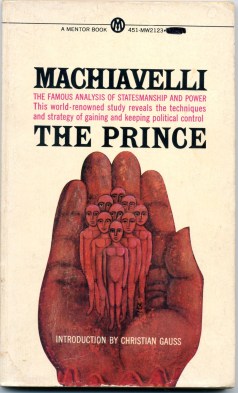
As Machiavelli puts it:
A prince must take great care that nothing goes out of his mouth which is not full of the above-named five qualities, and he should seem to be all mercy, faith, integrity, humanity and religion.
Since taking office on January 20, Trump has violated Machiavelli’s injunction on integrity with a vengeance. He has been caught in repeated falsehoods–so many, in fact, that the New York Times gave over its June 23 front page to a story headlined: “Trump’s Lies.”
According to the Times, Trump “told public falsehoods or lies every day for his first 40 days.”
“There is simply no precedent,” went the Times‘ opinion piece, “for an American president to spend so much time telling untruths. Every president has shaded the truth or told occasional whoppers.
“No other president—of either party—has behaved as Trump is behaving. He is trying to create an atmosphere in which reality is irrelevant.”

Donald Trump
Machiavelli also advises:
[He] must contrive that his actions show grandeur, spirit, gravity and fortitude….
It’s hard to convey those qualities in a series of 140-character rants on Twitter. Yet, from the start of his Presidency, Trump has put his ambitions, excuses and rants on social media.
As CNN Political Analyst Julian Zelizer outlined in a July 3 article:
“Putting aside the specific content of the recent blasts from the Oval smart phone, the President’s ongoing Twitter storms make all leaders uneasy. The heads of government in most nations prefer a certain amount of predictability and decorum from other heads of state.
“To have one of the most powerful people in the room being someone who is willing to send out explosive and controversial statements through social media, including nasty personal attacks or an edited video of him physically assaulting the media, does not make others….feel very confident about how he will handle deliberations with them.”
Trump’s apologists have fiercely defended his tweetstorms, claiming they allow him to bypass the media and “communicate directly with the American people.”
On October 8, Trump attacked retiring Tennessee United States Senator Bob Corker on Twitter:
“Senator Bob Corker ‘begged’ me to endorse him for re-election in Tennessee. I said ‘NO’ and he dropped out (said he could not win without…”
“..my endorsement). He also wanted to be Secretary of State, I said “NO THANKS.” He is also largely responsible for the horrendous Iran Deal!”
“…Hence, I would fully expect Corker to be a negative voice and stand in the way of our great agenda. Didn’t have the guts to run!”
Corker decided to give Trump a taste of his own Twitter medicine: “It’s a shame the White House has become an adult day care center. Someone obviously missed their shift this morning.”
Later that day, Corker told The New York Times: “He concerns me. He would have to concern anyone who cares about our nation.
“I know for a fact that every single day at the White House, it’s a situation of trying to contain him,”
And Todd Womack, Corker’s chief of staff, flatly called Trump a liar: “The president called Senator Corker on Monday afternoon and asked him to reconsider his decision not to seek reelection and reaffirmed that he would have endorsed him, as he has said many times.”
Machiavelli urged rulers to safeguard their reputations:

Niccolo Machiavelli
…A prince must show himself a lover of merit, give preferment to the able, and honor those who excel in every art.
Besides this, he ought, at convenient seasons of the year, to keep the people occupied with festivals and shows….mingle with them from time to time, and give them an example of his humanity and munificence, always upholding, however, the majesty of his dignity, which must never be allowed to fail in anything whatever.
Rulers who disregard this advice do so at their peril:
A prince need trouble little about conspiracies when the people are well disposed. But when they are hostile and hold him in hatred, then he must fear everything and everybody….
…[The Roman Emperor Commodus], being of a cruel and bestial disposition, in order to…exercise his rapacity on the people, he sought to favor the soldiers and render them licentious.
On the other hand, by not maintaining his dignity, by often descending into the theater to fight with gladiators and committing other contemptible actions…he became despicable in the eyes of the soldiers. And being hated on the one hand and despised on the other, he was conspired against and killed.
Donald Trump has repeatedly violated these lessons. It remains to be seen if he will pay a price for doing so.


 Bureaucracybuster's Blog
2016 PRESIDENTIAL CAMPAIGN, ABC NEWS, AL FRANKEN, ALTERNET, AP, BARACK OBAMA, BERNIE SANDERS, BOB CORKER, BUZZFEED, CBS NEWS, CNN, CROOKS AND LIARS, DAILY KOZ, DAVID BROOKS, DEMOCRATIC PARTY, DONALD TRUMP, ELIZABETH WARREN, FACEBOOK, HILLARY CLINTON, JEB BUSH, JEFF FLAKE, JOE SCARBOROUGH, JOSEPH MCCARTHY, KIM JONG-UN, LATE NIGHT WITH STEPHEN COLBERT, LIBERALS, MARCO RUBIO, MARK SHIELDS, MIKA BRZEZINSKI, MOTHER JONES, MOVEON, NBC NEWS, NEWSWEEK, NOCCOLO MACHIAVELLI, NPR, PBS NEWSHOUR, POLITICO, RAW STORY, REPUBLICAN PARTY, REPUBLICANS, REUTERS, SALON, SEATTLE TIMES, SLANDER, SLATE, TED CRUZ, THE ATLANTIC, THE CHICAGO SUN-TIMES, THE CHICAGO TRIBUNE, THE DAILY BEAST, THE GUARDIAN, THE HILL, THE HUFFINGTON POST, THE LOS ANGELES TIMES, THE NATION, THE NEW YORK TIMES, THE PRINCE, THE WASHINGTON POST, TIME, TWITTER, U.S. NEWS & WORLD REPORT, UP, UPI, USA TODAY
BULLIES AND COWARDS: PART ONE (OF TWO)
In History, Politics, Social commentary on November 29, 2017 at 12:36 pmA major reason for Donald Trump’s appeal during the 2016 Presidential campaign was: “He’s not like other politicians.”
And he wasn’t.
The vast majority of politicians adhere to an unwritten rule: Even when you criticize another politician, you do so in a reasonably dignified manner.
Trump threw that rule—along with many others—out the window. In its place, he gave his opponents—Republican and Democrat—a series of disparaging nicknames.
And, as President, he has continued to do so.
His main sources of public defamation have been Twitter and the speeches he makes. Among the insulting nicknames have included:
Syndicated columnist Mark Shields and New York Times columnist David Brooks appear every Friday on the PBS Newshour to review the week’s major political events.
On May 27, 2016, Shields—a liberal, and Brooks, a conservative—reached some disturbingly similar conclusions about the character of Republican Presidential front-runner Donald Trump.
David Brooks and Mark Shields
MARK SHIELDS: “Donald Trump gratuitously slandered Ted Cruz’s wife. He libeled Ted Cruz’s father for being potentially part of Lee Harvey Oswald’s assassination of the president of the United States, suggesting that he was somehow a fellow traveler in that.
“This is a libel. You don’t get over it….
“…I think this man may be addicted to the roar of the grease paint and the sound of the crowd, or however it goes, smell of the crowd.”
Donald Trump
DAVID BROOKS: “Trump, for all his moral flaws, is a marketing genius. And you look at what he does. He just picks a word and he attaches it to a person. Little Marco [Rubio], Lyin’ Ted [Cruz], Crooked Hillary [Clinton].
“And that’s a word. And that’s how marketing works. It’s a simple, blunt message, but it gets under.
“It sticks, and it diminishes. And so it has been super effective for him, because he knows how to do that. And she [Hillary Clinton] just comes with, ‘Oh, he’s divisive.’
“These are words that are not exciting people. And her campaign style has gotten, if anything…a little more stagnant and more flat.”
Only one opponent—who was not a Presidential candidate—managed to stand up to Trump: Massachusetts U.S. Senator Elizabeth Warren. Whenever Trump attacks her, Warren strikes back—sometimes even more harshly.
As Mark Shields noted:
“Elizabeth Warren gets under Donald Trump’s skin. And I think she’s been the most effective adversary. I think she’s done more to unite the Democratic party than either Hillary Clinton or Bernie Sanders.”
From June 15, 2015, when he launched his Presidential campaign, until October 24, 2016, Trump used Twitter to fire almost 4,000 angry, insulting tweets at 281 people and institutions that had somehow offended him.
Warren has dared to do what no other Democrat—or Republican—has: Attack Trump head-on, with the kind of blunt, insulting language he has lavished on his opponents.
Among the jabs she has thrown at him on Twitter:
Nor is Twitter her only weapon.
On March 31, Warren appeared on The Late Show, with Stephen Colbert. Her take on the egotistical billionaire:
“Donald Trump is looking out for exactly one guy, and that guy’s name is Donald Trump. He smells that there’s change in the air and what he wants to do is make sure that that change works really, really well for Donald Trump.
“The truth is, he inherited a fortune from his father, he kept it going by cheating and defrauding people, and then he takes his creditors through Chapter 11.”
When Colbert said that Trump had never broken the law, Warren replied that he had never broken the law “and been caught.”
For David Brooks, Warren’s tactics prove a depressing, lose/lose situation:
“And so the tactics…is either you do what Elizabeth Warren has done, like full-bore negativity, that kind of [get] under the skin, or try to ridicule him and use humor. Humor is not Hillary Clinton’s strongest point.”
As a whole, Democrats have shown themselves indifferent to or ignorant of the power of effective language.
Share this: