Posts Tagged ‘JUSTICE DEPARTMENT’
ABC NEWS, BARACK OBAMA, BREITBART NEWS, CBS NEWS, CHRISTOPHER S. MURPHY, CIA, CNN, DEMOCRATIC NATIONAL COMMITTEE, DEMOCRATIC PARTY, DONALD TRUMP, ERIC SCHNEIDERMAN, EXTORTION, FACE THE NATION, FACEBOOK, FERGUS CULLEN, FOX NEWS SUNDAY, GREG ABBOTT, HACKING, HILLARY CLINTON, IRS, JAMES B. COMEY, JAMES R. CLAPPER, JARED KUSHNER, JEFF SESSIONS, JOHN KASICH, JR., JUSTICE DEPARTMENT, KEN PAXTON, LEON PANETTA, MARK LEVIN, MICHAEL FLYNN, MICHAEL ROGERS, MIKE PENCE, NATIONAL SECURITY AGENCY, NBC NEWS, NEW HAMPSHIRE REPUBLICAN PARTY, NEWSWEEK, NPR, PAM BONDI, PAUL MANAFORT, PAUL RYAN, PHILIP KLEIN, POLITICO, Racketeer Influenced Corrupt Organizations (RICO) Act, REPUBLICAN NATIONAL COMMITTEE, REPUBLICAN NATIONAL CONVENTION, REPUBLICAN PARTY, REX TILLERSON, ROGER STONE, SALON, SOVIET UNION, THE CHICAGO SUN-TIMES, THE CHICAGO TRIBUNE, THE HUFFINGTON POST, THE LOS ANGELES TIMES, THE NEW YORK TIMES, THE WASHINGTON EXAMINER, THE WASHINGTON POST, THREATS, TIME, TREASON, TRUMP TOWER MEETING, TRUMP UNIVERSITY, TRUMP-RUSSIA TIES, TWITTER, U.S. NEWS & WORLD REPORT, U.S. SECRET SERVICE, USA PATRIOT ACT, USA TODAY, VLADIMIR PUTIN, WIRETAPPING
In Bureaucracy, History, Law, Law Enforcement, Politics, Social commentary on July 8, 2019 at 12:03 am
“The only thing necessary for the triumph of evil is for good men to do nothing.”
So wrote Edmund Burke (1729-1797) the Irish statesman, author, orator, political theorist and philosopher. And history has repeatedly proved him right.
One such example was the rise of Adolf Hitler as Germany’s Fuhrer.
Writes historian Volker Ullrich, in his monumental new biography, Hitler: Ascent 1889–1939: “Historians have perennially tried to answer the question of whether Hitler’s rise to power could have been halted….
“There were repeated opportunities to end Hitler’s run of triumphs. The most obvious one was after the failed Putsch of November, 1923. Had the Munich rabble-rouser been forced to serve his full five-year term of imprisonment in Landsberg, it is extremely unlikely that he would have been able to restart his political career.”
But that didn’t happen.

Tried for and convicted of treason, he was sentenced to five years’ imprisonment.
At Landsberg Prison, in Bavaria. he was given a huge cell, allowed to receive unlimited visitors and gifts, and treated with deference by guards and inmates.
Nine months later, he was released on parole—by authorities loyal to the authoritarian Right instead of the newly-created Weimar Republic.
Hitler immediately began rebuilding the shattered Nazi party—and deciding on a new strategy to gain power. Disdaining armed force, he would win office by election—or intrigue.
On January 30, 1933, those intrigues bore fruit: Adolf Hitler was appointed Chancellor of Germany.
Future historians may one day write that what didn’t happen played at least as great a role in electing Donald Trump President as what actually did.
There were at least five instances where the Justice Department of President Barack Obama could have utterly changed the outcome of the 2016 election. Yet, for reasons still unknown, it chose to do nothing.
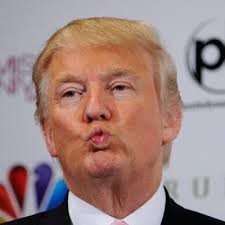
Donald Trump
Case #1: The Obama Justice Department did not indict Trump and/or the Attorney Generals of Texas and/or Florida for their roles in the Trump University scandal.
- Florida Attorney General Pam Bondi personally solicited a political contribution from Donald Trump around the same time her office deliberated joining an investigation of alleged fraud at Trump University and its affiliates.
- After Bondi dropped the Trump University case against Trump, he wrote her a $25,000 check for her re-election campaign. The money came from the Donald J. Trump Foundation.
- Republican Texas Attorney General Ken Paxton moved to muzzle a former state regulator who says he was ordered in 2010 to drop a fraud investigation into Trump University for political reasons.
- Paxton’s office issued a cease and desist letter to former Deputy Chief of Consumer Protection John Owens after he made public copies of a 14-page internal summary of the state’s case against Donald Trump for scamming millions from students of his now-defunct real estate seminar.
- After the Texas case was dropped, Trump cut a $35,000 check to the gubernatorial campaign of then-attorney general and now Texas Governor Greg Abbott.
But New York’s Attorney General, Eric Schneiderman, pressed fraud claims against Trump—and forced the real estate mogul to settle the case out of court for $25 million on November 18, 2016.
There have been no press reports that the Justice Department investigated these cases to determine if Trump violated the Racketeer Influenced Corrupt Organizations (RICO) Act statutes.
If the Justice Department did not investigate these cases, it should have. And if he did violate the RICO statutes, he should have been indicted, even as a Presidential candidate or President-elect.
Even if an indictment had not produced a conviction, the mere bringing of one would have cast an unprecedented cloud over his candidacy—let alone his being sworn in as President.
Case #2: The Justice Department did not indict Trump for the series of threats that he made—directly and indirectly—against Republicans and Democrats throughout the 2016 campaign.
Threatening political opponents with violence is a crime under Federal law. Yet making threats against his Republican and Democratic opponents played a major role in Trump’s Presidential campaign.
- On March 16, he warned Republicans that if he didn’t win the GOP nomination in July, his supporters would literally riot: “I think you’d have riots. I think you would see problems like you’ve never seen before. I think bad things would happen. I really do. I wouldn’t lead it, but I think bad things would happen.”
- An NBC reporter summed it up as: “The message to Republicans was clear on [March 16]: ‘Nice convention you got there, shame if something happened to it.’”
- That Republicans clearly saw this as a threat is undeniable. Paul Ryan, their Speaker of the House, said on March 17: “Nobody should say such things in my opinion because to even address or hint to violence is unacceptable.”
- Philip Klein, the managing editor of the Washington Examiner, wrote on the eve of the Republican National Convention in July: “Political commentators now routinely talk about the riots that would break out in Cleveland if Trump were denied the nomination, about how his supporters have guns and all hell could break loose, that they would burn everything to the ground. It works to Trump’s advantage to not try too hard to dispel these notions.”
A.G. SULZBERGER, ABC NEWS, ALTERNET, AP, BUZZFEED, CBS NEWS, CIA, CNN, CROOKS AND LIARS, DAILY KOZ, DEMOCRATIC PARTY, FACEBOOK, FBI, GEORGE ORWELL, JAMES COMEY, JUSTICE DEPARTMENT, MEDIA, MOTHER JONES, MOVEON, MSNBC, NBC NEWS, NEWSWEEK, NPR, PEGGY NOONAN, POLITICO, RAW STORY, REPUBLICAN PARTY, REUTERS, ROBERT S. MUELLER, Ronald Reagan, SALON, SEATTLE TIMES, SLATE, THE ATLANTIC, THE CHICAGO SUN-TIMES, THE CHICAGO TRIBUNE, THE DAILY BEAST, THE GUARDIAN, THE HILL, THE HUFFINGTON POST, THE LOS ANGELES TIMES, THE NATION, THE NEW YORK TIMES, THE WASHINGTON POST, TIME, TWITTER, U.S. NEWS & WORLD REPORT, UPI, USA TODAY, USA TODAY DONALD TRUMP
In Bureaucracy, History, Law Enforcement, Politics, Social commentary on May 29, 2019 at 12:11 am
Donald Trump has repeatedly claimed that he is a victim of “fake news.”
But future historians will note how often the media ignored the foremost reality of their time: That the United States was led by a psychopathic dictator.
This is true even for CNN, the network that Trump clearly hates the most.
In a May 22, 2018 CNN essay on Trump vs. the press, longtime political consultant David Gergen wrote:
“Instead of raging on about ‘fake news,’ the President would do well to read Peggy Noonan [a Ronald Reagan speechwriter turned author] on Reagan and focus on building his character.”
So what’s wrong with this?
Trump was 72 years old when this was written. George Orwell wrote that, by age 50, every man has the face he deserves. By age 72, every man has the character he has spent his life being. And Trump’s life has been dedicated to inflating his wallet and his ego.
He isn’t going to radically change at this point—especially if he believes himself “a very stable genius.”
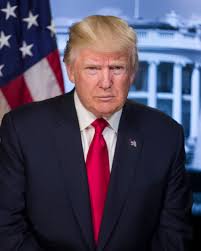
Donald Trump
Then there’s a July 30, 2018 story on CNN: “Trump Opens Window Into His Rage With Mueller Attack.”
This focused on a tweetstorm Trump launched against Special Counsel Robert Mueller just two days before Mueller prosecuted Paul Manafort, Trump’s former campaign chairman.
Among those tweets:
“Is Robert Mueller ever going to release his conflicts of interest with respect to President Trump, including the fact that we had a very nasty & contentious business relationship, I turned him down to head the FBI (one day before appointment as S.C.) & Comey is his close friend.”
And:
“…Also, why is Mueller only appointing Angry Dems, some of whom have worked for Crooked Hillary, others, including himself, have worked for Obama….And why isn’t Mueller looking at all of the criminal activity & real Russian Collusion on the Democrats side-Podesta, Dossier?”
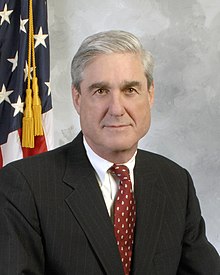
Robert Mueller
CNN characterized this cascade of libels as a “trio of tweets…packed with inaccuracies and misrepresentations.”
An accurate description would have been: “Lies.”
There were no “conflicts of interest” on Mueller’s part. And having been FBI director for 12 years (2001-2013) he had no desire to once again assume such a grueling burden at age 72.
Arthur Gregg Sulzberger, the publisher of the New York Times, described a meeting between himself and Trump:
“I told him that although the phrase ‘fake news’ is untrue and harmful, I am far more concerned about his labeling journalists ‘the enemy of the people.’ I warned that this inflammatory language is contributing to a rise in threats against journalists and will lead to violence.
“I repeatedly stressed that this is particularly true abroad, where the president’s rhetoric is being used by some regimes to justify sweeping crackdowns on journalists. I warned that it was putting lives at risk, that it was undermining the democratic ideals of our nation, and that it was eroding one of our country’s greatest exports: a commitment to free speech and a free press.”
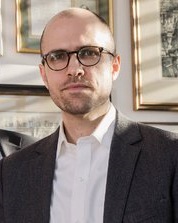
Arthur Gregg Sulzberger
Appealing to Trump’s “better angels” was an exercise in futility—and insanity.
A 2016 analysis by USA Today found that for 30 years, Trump and his businesses had been involved in 3,500 legal cases in U.S. federal and state courts. This is not a man who, at heart, is a peacemaker.
Nor does he respect truth. The Washington Post has reported that, by March 17, 2019, Trump said or tweeted 9,179 lies or misleading statements. This makes for an average of 11.6 lies a day.
To expect that Trump has any regard for such Constitutional niceties as freedom of the press is beyond rationality.
He intends to strip every potential challenger to his authority—or his version of reality—of legitimacy with the public. If he succeeds, there will be:
- No independent press to reveal his failures and crimes.
- No independent law enforcement agencies to investigate his abuses of office.
- No independent judiciary to hold him accountable.
- No independent military to dissent as he recklessly hurtles toward a nuclear disaster.
- No candidate—Democrat or Republican—to challenge him for re-election in 2020.
- No candidate—Democrat or Republican—to challenge his remaining in office as “President-for-Life.”
Yet the media—including CNN—refuses to brand Trump as the liar and dictator he clearly is.
Reporters who cover the White House are among the most knowledgeable their newspapers/networks have to offer. They see the President up close not only there but at campaign stops and state occasions. They quickly gain a sense of him as a man.
So it can’t be ignorance that leads so many of them to refrain from telling the truth. The answer has to be cowardice—by them and/or by their editors.
Newspapers fear Trump’s attacks on their integrity—and the loss of subscriptions. They fear the press will fall into even lower esteem than it’s now held. (An Ipsos poll shows almost a third of Americans agree the news media is “the enemy of the people.”)
For the owners of TV networks, there is an added fear of having their licenses challenged by the Federal Communications Commission, which regulates the airwaves.
Regardless of the reason for this cowardice, it ill serves the journalism profession—and the country.
A.G. SULZBERGER, ABC NEWS, ALTERNET, ANDREW MCCABE, AP, BUZZFEED, CBS NEWS, CIA, CNN, CROOKS AND LIARS, DAILY KOZ, DEMOCRATIC PARTY, DONALD TRUMP, FACEBOOK, FBI, GEORGE ORWELL, JAMES COMEY, JOHN KELLY, JUSTICE DEPARTMENT, LISA PAGE, MEDIA, MOTHER JONES, MOVEON, MSNBC, NANCY PELOSI, NBC NEWS, NEWSWEEK, NONDISCLOSURE AGREEMENTS, NPR, PBS NEWSHOUR, PEGGY NOONAN, PETER STRZOK, POLITICO, RAW STORY, REPUBLICAN PARTY, REUTERS, ROBERT S. MUELLER, Ronald Reagan, RUDOLPH GIULIANI, SALON, SEATTLE TIMES, SLATE, THE ATLANTIC, THE CHICAGO SUN-TIMES, THE CHICAGO TRIBUNE, THE DAILY BEAST, THE GUARDIAN, THE HILL, THE HUFFINGTON POST, THE LOS ANGELES TIMES, THE NATION, THE NEW YORK TIMES, THE WASHINGTON POST, TIME, TREASON, TWITTER, U.S. NEWS & WORLD REPORT, UNITED STATES CONSTITUTION, UPI, USA TODAY, USA TODAY DONALD TRUMP, WHITE HOUSE
In Bureaucracy, History, Law, Politics, Social commentary, Uncategorized on May 28, 2019 at 12:18 am
On May 24, NBC News published a story under the headline: ‘TRUMP DOESN’T SEEM TO UNDERSTAND WHAT ‘TREASON’ MEANS.”
The article noted: “Once again on Thursday, President Donald Trump used the T-word, this time saying that former FBI officials who were involved in investigating his campaign committed treason.
“Asked at a White House event which of his adversaries he had in mind when he accused them of treason, he said, ‘A number of people. They have unsuccessfully tried to take down the wrong person.’ He then specified former FBI director James Comey, former acting FBI director Andrew McCabe, former FBI lawyer Lisa Page, and former FBI agent Peter Strzok.
“‘That’s treason. They couldn’t win the election, and that’s what happened.'”
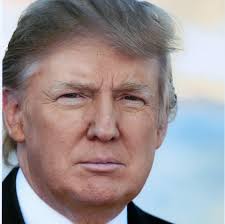
Donald Trump
The story goes on to point out that the Constitution does not define treason as being disloyal to the President—or a private citizen, which is what Trump was when he ran for President in 2016.
In Article III, Section 3, the United States Constitution states: “Treason against the United States, shall consist only in levying War against them, or in adhering to their Enemies, giving them Aid and Comfort.”
“Enemy” means a country or an entity that has declared war or is in a state of open war against the United States.
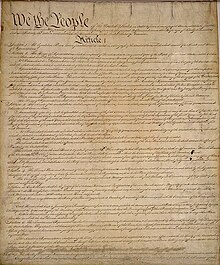
United States Constitution
Although the story got its facts right, the headline gives a thoroughly misleading impression. By saying, “Trump doesn’t seem to understand….” it implies that he’s simply ignorant, and once someone explains the true meaning of treason to him, all will be well.
This is not only patently absurd, it is absolutely dangerous.
First of all, Trump considers himself “a very stable genius”—which in itself proves he’s the opposite of both. This is the sort of megalomania for which brutal dictators like Gaius Caligula were infamous.
Second, he hates being corrected, and those who have tried have been fired or quit after repeated frustration and harassment. John Kelly, his former chief of staff, said of Trump: “He’s an idiot. It’s pointless to try to convince him of anything. He’s gone off the rails. We’re in crazytown.”
Third, he has no respect for anyone but himself, and none for the traditions that go with America’s highest office. He has called the White House “a real dump.”
In addition, Trump has replaced Presidential dignity with infantile tantrums and personal attacks on virtually everyone on Twitter and in press conferences.
Fourth, Trump has always sought absolute control over everyone. As a private businessman, he forced his employees to sign NDAs—Non-Disclosure Agreements—to keep secret his acts of criminality and incompetence. As President, he has tried to continue that practice—even though it’s forbidden by law for Federal employees.
Fifth, he has always been a vindictive man. He and his companies have been involved in more than 3,500 lawsuits. He has openly bragged about how enjoyable it is to “get even” with those who “screw you.” He has “joked” that it would be nice if the United States had a “president-for-life”—like China. And he accused Democrats of “treason” for not applauding his 2018 State of the Union message.
Or take the headline in a May 24 article in Politico: “GIULIANI APPEARS TO DEFEND SHARING A DOCTORED PELOSI VIDEO.”
The story outlines how Rudolph Giuliani, a former United States Attorney and now Trump’s chief legal protector, defended sharing a video of House Speaker Nancy Pelosi—one that had been doctored to make her appear drunk and slurring her words.
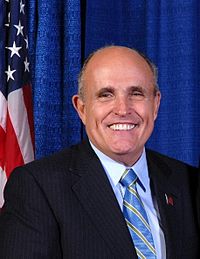
Rudloph Giuliani
“Nancy Pelosi wants an apology for a caricature exaggerating her already halting speech pattern,” Giuliani wrote on Twitter. “First she should withdraw her charge which hurts our entire nation when she says the President needs an ‘intervention’. ‘People who live in a glass house shouldn’t throw stones.’”
Giuliani was referring to a remark Pelosi made on May 23. The day before, Trump had stalked out of infrastructure talks with top congressional Democrats and railed against their investigations.
“I wish that his family or his administration or his staff would have an intervention for the good of the country,” said Pelosi in a press conference.
Pelosi’s words could be interpreted as a slap at Trump’s lack of maturity—or as an invitation for members of his Cabinet to invoke the 25th Amendment. Under this, a President can be removed from office if he is mentally or physically unable to carry out his assigned duties.
Giuliani’s tweet, on the other hand, was pure slander. Including the doctored clip with his tweet, he taunted: “What is wrong with Nancy Pelosi? Her speech pattern is bizarre.”
He later deleted the message.
To assert—as the Politico headline does—that Giuliani “appears” to be defending a lying video is to refuse to tell the full truth. He was defending—and re-posting—it.
His attitude was: “If you’re going to criticize the President, I have the right to slander you.”
But you wouldn’t have gotten that from the headline.
Donald Trump has relentlessly accused the mainstream media of attacking him with “fake news.”
The only “fake news” has been those stories that sugarcoat the despicable behavior of the President and his closest associates.
2016 PRESIDENTIAL ELECTION, ABC NEWS, ADOLF HITLER, BAVARIA, BEER HALL PUTSCH, CBS NEWS, CNN, DEMOCRATIC NATIONAL COMMITTEE, DEMOCRATIC PARTY, DONALD TRUMP, DONALD TRUMP JR., FEDERAL JUDGES, HACKING, HILLARY CLINTON, HITLER: ASCENT, IRS, JARED KUSHNER, JUSTICE DEPARTMENT, KAISER WILHELM II, MEIN KAMPF, MUNICH, NAZI PARTY, NBC NEWS, NEWSWEEK, NPR, PAUL MANAFORT, POLITICO, REPUBLICAN NATIONAL COMMITTEE, REPUBLICAN NATIONAL CONVENTION, REPUBLICAN PARTY, ROBERT S. MUELLER, SALON, T.S. ELLIS, THE CHICAGO SUN-TIMES, THE CHICAGO TRIBUNE, THE HOLOCAUST, THE HUFFINGTON POST, THE LOS ANGELES TIMES, THE NEW YORK TIMES, THE SOVIET UNION, THE WASHINGTON EXAMINER, THE WASHINGTON POST TIME, TREASON, TREATY OF VERSALLIES, TRUMP TOWER MEETING, TWITTER, U.S. NEWS & WORLD REPORT, U.S. SUPREME COURT, UNITED STATES SENATE, USA TODAY, VLADIMIR PUTIN, VOLKER ULLRICH, WALTER RATHENAU, WEIMAR REPUBLIC, WIKILEAKS, WORLD WAR 1
In Bureaucracy, History, Law, Law Enforcement, Military, Politics, Social commentary on March 12, 2019 at 12:13 am
On November 9, 1923, Nazi Party Fuhrer Adolf Hitler tried to overthrow the government in Munich, Bavaria.
About 2,000 Nazis marched to the center of Munich, where they confronted heavily-armed police. A shootout erupted, killing 16 Nazis and four policemen.
Hitler was injured during the clash, but managed to escape. Two days later, he was arrested and charged with treason.
Put on trial, he found himself treated as a celebrity by a judge sympathetic to Right-wing groups. He was allowed to brutally cross-examine witnesses and even make inflammatory speeches.
At the end of the trial, he was convicted of treason and sentenced to five years’ imprisonment.
Serving time in Landsberg Prison, in Bavaria. he was given a huge cell, allowed to receive unlimited visitors and gifts, and treated with deference by guards and inmates.
Hitler used his time in prison to write his infamous book, Mein Kampf-–“My Struggle.” Part autobiography, part political treatise, it laid out his future plans—including the extermination of the Jews and the conquest of the Soviet Union.

Adolf Hitler leaving Landsberg Prison, December, 20, 1924
Nine months later, he was released on parole—by authorities loyal to the authoritarian Right instead of the newly-created Weimar Republic.
Hitler immediately began rebuilding the shattered Nazi party—and deciding on a new strategy to gain power. Never again would he resort to armed force. He would win office by election—or intrigue.
Writes historian Volker Ullrich, in his monumental new biography, Hitler: Ascent 1889 – 1939: “Historians have perennially tried to answer the question of whether Hitler’s rise to power could have been halted….
“There were repeated opportunities to end Hitler’s run of triumphs. The most obvious one was after the failed Putsch of November 1923. Had the Munich rabble-rouser been forced to serve his full five-year term of imprisonment in Landsberg, it is extremely unlikely that he would have been able to restart his political career.”
Thus, it isn’t just what happens that can influence the course of history. Often, it’s what doesn’t happen that has at least as great a result.
Consider the case of Paul Manafort.
Manafort faced 18 counts brought by Special Counsel Robert Mueller’s team investigating Russian subversion of the 2016 election.
These included:
- Filing false income tax statements.
- Failing to file foreign bank account reports to disclose his control over his overseas accounts.
- Bank fraud and bank fraud conspiracy—by lying about Manafort’s income, debt and the nature of his real estate properties.
Mueller believed that Manafort could provide an insider’s account of the infamous June, 2016 Trump Tower meeting. Among the attendees: Manafort, Trump’s son, Donald Trump Jr., and Trump’s son-in-law Jared Kushner—along with Russian nationals offering dirt on Hillary Clinton.
While Manafort managed Trump’s Presidential campaign—from March to September, 2016:
- In July, the GOP gutted an amendment to its platform that advocated sending arms to Ukraine to defend against Russian aggression.
- Later that month, WikiLeaks began dumping emails that Russia had stolen from the Democratic National Committee.
- Manafort also received emails from Trump campaign aide George Papadopoulos, offering to set up a meeting between Trump and Russian President Vladimir Putin.
Manafort refused to cooperate with Mueller, then said he would. Then he lied to the FBI. Then Mueller dumped him as a witness.
Mueller asked Federal Judge T.S. Ellis to sentence Manafort from 20 to 24 years in prison and pay a fine between $50,000 and $24 million.
Instead, the Alexandria, Virginia-based judge sentenced Manafort to only 47 months in prison—one month less than four years.
Throughout the trial, Ellis had made no secret of his sympathy for Manafort:
- Berating prosecutors for moving too slowly through their case.
- Attacking one prosecutor for not looking at Ellis while the judge was talking.
- Limiting the evidence the prosecutors could present.
- Accusing one government lawyer of crying.
During the preliminary hearing, Ellis gave away the game: “You don’t really care about Mr. Manafort You really care about what information Mr. Manafort can give you to lead you to Mr. Trump and an impeachment, or whatever.”
Thus, a former key supporter of a Right-wing President found himself saved by an equally Right-wing supporter of the same President.
The Weimar Republic in Germany faced a similar danger.
Defeat in World War I in 1918 led to the Kaiser’s abdication, a republic and a new constitution.
Many Germans hated the Weimar Republic for signing the armistice in November, 1918. They resented the government for signing the Versallies Treaty, which imposed harsh conditions on Germany, although the Republic had been forced to by the Allies.
Right-wing terrorists assassinated 356 government politicians in the early years of the Republic. Among these were Walter Rathenau, the Jewish foreign minister, and Matthias Erzberger who had been finance minister.
Right-wing judges in their trials, many of whom preferred the Kaiser’s government, consistently gave these terrorists light sentences, or let them go free.
Adolf Hitler drew such a judge at his trial.
By March 7, 2019, the United States Senate had confirmed 89 Right-wing, Trump-nominated judges, including two Associate Justices of the Supreme Court, 34 judges for the United States Courts of Appeals and 53 judges for the United States District Courts.
What boded ill for the Weimar Republic bodes ill for the American Republic.
ABC NEWS, ALTERNET, AP, BARACK OBAMA, BUZZFEED, CBS NEWS, CNN, CROOKS AND LIARS, DAILY KOZ, DONALD TRUMP, FACEBOOK, FBI, HEINRICH HIMMLER, HERMANN GORING, JOSEPH GOEBBELS, JUSTICE DEPARTMENT, MICHAEL COHEN, MOTHER JONES, MOVEON, MSNBC, NBC NEWS, NEWSWEEK, NPR, OMAROSA MANIGAULT, PLAYBOY MAGAZINE, POLITICO, RAW STORY, REUTERS, SALON, SCHUTZSTAFFEL, SEATTLE TIMES, SLATE, THE APPRENTICE, THE ATLANTIC, THE CHICAGO SUN-TIMES, THE CHICAGO TRIBUNE, THE DAILY BEAST, THE GUARDIAN, THE HILL, THE HUFFINGTON POST, THE LOS ANGELES TIMES, THE NATION, THE NEW YORK TIMES, THE WASHINGTON POST, THIRD REICH, TIME, TV GUIDE, TWITTER, U.S. NEWS & WORLD REPORT, UNITED STATES ATTORNEY FOR THE SOUTHERN DISTRICT OF NEW YORK, UPI, USA TODAY, USA TODAY ADOLF HITLER, WIRETAPPING
In Bureaucracy, History, Military, Politics, Social commentary on March 1, 2019 at 12:04 am
In April, 1945, Berlin, capital of the Third Reich, was under siege by the British and Americans from the West—and by the Russians from the East.
On April 20—Adolf Hitler’s 56th birthday—his two most important ministers visited him for the last time.
One minister was Hermann Goring, who still commanded the remnants of the once-powerful German air force, the Luftwaffe.
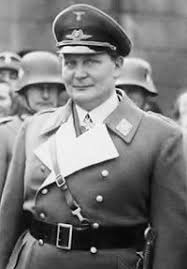
Hermann Goring
Bundesarchiv, Bild 102-15607 / CC-BY-SA 3.0 [CC BY-SA 3.0 de
The other was Heinrich Himmler, absolute ruler of the Schutzstaffel, or “Protection Squadron.” His empire encompassed the black-uniformed secret police and a network of extermination camps throughout Eastern Europe.
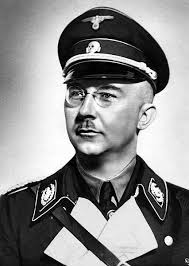
Heinrich Himmler
Bundesarchiv, Bild 183-R99621 / CC-BY-SA 3.0 [CC BY-SA 3.0 de
In the ruins of the Reich Chancellery, Himmler and Goring swore unswerving loyalty to Hitler.
Then, on April 23, Goring sent him a telegram. It proposed that, with Hitler trapped in Berlin, the Reichsmarshall, as his designated successor, should assume leadership of the Reich.
Hitler, furious, refused permission and ordered Goring’s arrest and execution. But Goring eluded the SS units and surrendered to the Americans.
Then, on April 28, the BBC reported that Himmler had tried to open surrender negotiations with the Western Allies.
Now Hitler screamed that Himmler—“the True Heinrich”—had committed the worst treachery he had ever known—and ordered his arrest.
On April 29—one day before he committed suicide—Hitler declared Goring and Himmler traitors and stripped them of all their Nazi party and state offices.
Both would commit suicide by poison—Himmler before he could be tried as a war criminal, and Goring before being hanged as one.
Now, fast forward 73 years later.
Attorney Michael Cohen had long been Donald Trump’s fixer. “If somebody does something Mr. Trump doesn’t like,” he told ABC News in 2011, “I do everything in my power to resolve it to Mr. Trump’s benefit.”

Michael Cohen
IowaPolitics.com [CC BY-SA 2.0 (https://creativecommons.org/licenses/by-sa/2.0)%5D
Then, in April, 2018, the United States Attorney for the Southern District of New York began investigating Cohen.
On April 9, 2018, the FBI, executing a federal search warrant, raided Cohen’s law office, his home and his hotel room. Agents seized emails, tax and business records and recordings of phone conversations that Cohen had made.
(On August 21, Cohen pleaded guilty to eight counts, including tax fraud, bank fraud and campaign finance violations. In December 2018, he was sentenced to three years in federal prison and ordered to pay a $50,000 fine.)
While the media speculated that Cohen was expecting a Presidential pardon, Trump washed his hands of his former fixer: “Michael Cohen only handled a tiny, tiny fraction of my legal work.”
On July 25, Cohen offered a response in kind: A leaked tape of a phone conversation he had had with Trump before the latter became President.
It focused on buying the rights to a Playboy model’s story where she claimed to have had an affair with Trump years earlier.
Trump, furious, blasted Cohen in a tweet: “What kind of a lawyer would tape a client? So sad! Is this a first, never heard of it before? Why was the tape so abruptly terminated (cut) while I was presumably saying positive things? I hear there are other clients and many reporters that are taped – can this be so? Too bad!”
The revelation that he had been secretly taped by his own lawyer proved especially embarrassing for Trump. On March 4, 2017, he had accused President Barack Obama of illegally wiretapping his phones during the 2016 election.
Without citing any evidence to back up his libelous claim, he tweeted: “Terrible! Just found out that [Barack] Obama had my ‘wires tapped’ in Trump Tower just before the victory. Nothing found. This is McCarthyism!”
Subsequent investigations by the Justice Department turned up no evidence to substantiate Trump’s assertion.
But after the release of the Cohen tape, worse was to come.
Omarosa Manigault had become a Trump favorite by generating huge ratings for his “reality series” The Apprentice during its first, seventh and 13th seasons on NBC.

Omarosa Manigault
By Glenn Francis of PacificProDigital.com
Her behavior toward other contestants was marked by insults, egomania and ruthlessness. As a result, she soon became the “woman America loved to hate.”
TV Guide included her in its 2013 list of “The 60 Nastiest TV Villains of All Time.”
During Trump’s Presidential campaign, she was named Director of African-American Outreach. In an interview with Frontline, she boasted: “Every critic, every detractor, will have to bow down to President Trump. It’s everyone who’s ever doubted Donald, who ever disagreed, who ever challenged him.”
In January, 2017, Omarossa moved into the White House—where she became as antagonistic toward her government colleagues as she had those on The Apprentice.
On December 12, 2017, she was forcibly removed from the White House grounds.
Trump tweeted her a goodbye: “Thank you Omarosa for your service! I wish you continued success.”
Apparently he didn’t expect her to attain that success at his expense.
On August 8, 2018, news broke that Omarosa had secretly taped Trump during several phone conversations in the White House. And that she planned to use these tapes to promote an upcoming—and highly critical—book on the President.
The book—Unhinged-–was released on August 14, 2018.
ABC NEWS, ALTERNET, AP, ARTHUR GREGG SULZBERGER, BENJAMIN BRADLEE, BOB WOODWARD, BUZZFEED, CARL BERNSTEIN, CBS NEWS, CIA, CNN, CROOKS AND LIARS, DAILY KOZ, DEMOCRATIC PARTY, DONALD TRUMP, FACEBOOK, FBI, GEORGE ORWELL, JAMES COMEY, JUSTICE DEPARTMENT, MEDIA, MOTHER JONES, MOVEON, MSNBC, NBC NEWS, NEWSWEEK, NPR, PEGGY NOONAN, POLITICO, RAW STORY, REPUBLICAN PARTY, REUTERS, ROBERT S. MUELLER, Ronald Reagan, SALON, SEATTLE TIMES, SLATE, THE ATLANTIC, THE CHICAGO SUN-TIMES, THE CHICAGO TRIBUNE, THE DAILY BEAST, THE GUARDIAN, THE HILL, THE HUFFINGTON POST, THE LOS ANGELES TIMES, THE NATION, THE NEW YORK TIMES, THE WASHINGTON POST, TIME, TWITTER, U.S. NEWS & WORLD REPORT, UPI, USA TODAY
In Bureaucracy, History, Law Enforcement, Politics, Social commentary on February 14, 2019 at 12:13 am
Donald Trump has repeatedly claimed that he is a victim of “fake news.”
But future historians will note how often the media ignored the foremost reality of their time: That the United States was led by a psychopathic dictator.
This is true even for CNN, the network that Trump clearly hates the most.
On May 22, 2018, David Gergen penned a CNN essay on Trump vs. the press.
“Instead of raging on about ‘fake news,'” wrote Gergen, “the President would do well to read Peggy Noonan [a Ronald Reagan speechwriter turned author] on Reagan and focus on building his character.”
So what’s wrong with this?
Trump is 72 years old. George Orwell wrote that, by age 50, every man has the face he deserves. By age 72, every man has the character he has spent his life being. And Trump’s life has been dedicated to inflating his wallet and his ego.
He isn’t going to radically change at this point—especially if he believes himself “a very stable genius.”
Donald Trump
Then there’s this July 30, 2018 CNN story: “Trump Opens Window Into His Rage With Mueller Attack.”
Two days before Special Counsel Robert S. Mueller prosecuted Paul Manafort, Trump’s former campaign chairman, Trump launched a tweetstorm against Mueller.
Among those tweets:
“Is Robert Mueller ever going to release his conflicts of interest with respect to President Trump, including the fact that we had a very nasty & contentious business relationship, I turned him down to head the FBI (one day before appointment as S.C.) & Comey is his close friend.”
And:
“…Also, why is Mueller only appointing Angry Dems, some of whom have worked for Crooked Hillary, others, including himself, have worked for Obama….And why isn’t Mueller looking at all of the criminal activity & real Russian Collusion on the Democrats side—Podesta, Dossier?”
Robert Mueller
CNN characterized this cascade of libel as a “trio of tweets…packed with inaccuracies and misrepresentations.”
An accurate description would have been: “Lies.”
After a meeting with Trump, Arthur Gregg Sulzberger, the publisher of the New York Times, publicly stated:
“I told him that although the phrase ‘fake news’ is untrue and harmful, I am far more concerned about his labeling journalists ‘the enemy of the people.’ I warned that this inflammatory language is contributing to a rise in threats against journalists and will lead to violence.
“I repeatedly stressed that this is particularly true abroad, where the president’s rhetoric is being used by some regimes to justify sweeping crackdowns on journalists. I warned that it was putting lives at risk, that it was undermining the democratic ideals of our nation, and that it was eroding one of our country’s greatest exports: a commitment to free speech and a free press.”
Arthur Gregg Sulzberger
So what is wrong with these comments?
Like the saccharine that floods the airways at Christmastime, they reek of a deliberate suspension of reality.
Appealing to Trump’s “better angels” on behalf of the news media is an exercise in futility—and insanity.
This is a man who has said—proudly: “Get even with people. If they screw you, screw them back 10 times as hard. I really believe it.”
A 2016 analysis by USA Today found that for 30 years, Trump and his businesses had been involved in 3,500 legal cases in U.S. federal courts and state court. This is not a man who, at heart, is a peacemaker.
Nor does he have any respect for truth. The Washington Post has reported that during his first 298 days in the White House, Trump said or tweeted 1,628 lies or misleading statements. This makes for an average of 5.5 lies a day.
To expect—as Sulzberger apparently did—that Trump has any regard for such Constitutional niceties as freedom of the press is beyond rationality.
Trump has furiously attacked the institutions that Americans have long cherished—such as:
- An independent judiciary
- A free press
- Intelligence agencies (such as the FBI and CIA) charged with protecting the country against subversion
- An incorruptible Justice Department.
Donald Trump isn’t crazy. Nor does he abuse power by well-meaning accident.
He knows exactly what he’s doing—and why.
He intends to strip every potential challenger to his authority—or his version of reality—of legitimacy with the public. If he succeeds, there will be:
- No independent press to reveal his failures and crimes.
- No independent law enforcement agencies to investigate his abuses of office.
- No independent judiciary to hold him accountable.
- No independent military to dissent as he recklessly hurtles toward a nuclear disaster.
- No candidate—Democrat or Republican—to challenge him for re-election in 2020.
- No candidate—Democrat or Republican—to challenge his remaining in office as “President-for-Life.”
Yet the media—including CNN and New York Times—has refused to brand Trump as the liar and dictator he clearly is.
There can be only two motives for this:
- Naivety, or
- Cowardice.
Either is totally unworthy of those claiming to defend the First Amendment.
Such reporters, editors and publishers should decide—now–to:
- Live up to the standards set by Bob Woodward, Carl Bernstein and Benjamin Bradlee during the Watergate crisis; or
- Go into a profession better-suited to their character—such as worm-farming.
ABC NEWS, ALTERNET, AP, BLOOD FEUD, BUZZFEED, CARLOS MARCELLO, CBS NEWS, CIA, CNN, COTTER SMITH, CROOKS AND LIARS, CUBA, DAILY KOZ, DONALD TRUMP, ERNEST BORGNINE, FACEBOOK, FBI, FIDEL CASTRO, GUS RUSSO, INTERNATIONAL BROTHERHOOD OF TEAMSTERS, J. EDGAR HOOVER, JAMES R. HOFFA, JUSTICE DEPARTMENT, LIVE BY THE SWORD: THE SECRET WAR AGAINST CASTRO AND THE DEATH OF JFK, MAFIA, MOTHER JONES, MOVEON, MSNBC, NBC NEWS, NEWSWEEK, NPR, PBS NEWSHOUR, POLITICO, RAFAEL EDWARD CRUZ, RAW STORY, REUTERS, ROBERT BLAKE, ROBERT F. KENNEDY, SALON, SAM GROOM, SEATTLE TIMES, Secret Service, SENATE LABOR RACKETS COMMITTEE, SLATE, THE ATLANTIC, THE CHICAGO SUN-TIMES, THE CHICAGO TRIBUNE, THE DAILY BEAST, THE GUARDIAN, THE HILL, THE HUFFINGTON POST, THE LOS ANGELES TIMES, THE NATION, THE NEW YORK TIMES, THE WALL STREET JOURNAL, THE WASHINGTON POST, TIME, TWITTER, U.S. NEWS & WORLD REPORT, UPI, USA TODAY
In Bureaucracy, Entertainment, History, Law, Law Enforcement, Politics, Social commentary on January 16, 2019 at 12:15 am
The 1983 TV mini-series, Blood Feud, chronicles the decade-long struggle between Attorney General Robert F. Kennedy and James R. Hoffa, president of the International Brotherhood of Teamsters union.
By 1963, the Mafia despairs of the increasing pressure of the Justice Department. At a swanky restaurant, several high-ranking members agree that “something” must be done.
[Although this scene is fictional, it’s clearly based on an infamous outburst of Carlos Marcello, the longtime Mafia boss of New Orleans.
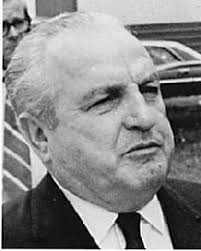
Carlos Marcello
[In 1961, Marcello was deported to his native Guatemala on orders by RFK. After illegally re-entering the country, he swore vengeance against the Attorney General.
[In September, 1962, during a meeting with several mob colleagues, he flew into a rage when someone mentioned Kennedy: “Don’t you worry about that little Bobby sonofabitch. He’s going to be taken care of!”
[Marcello believed that the death of President Kennedy would render the Attorney General powerless. And he added that he planned to use a “nut” to do the job.]
On November 22, 1963, President John F. Kennedy is assassinated in Dallas, Texas.
Blood Feud clearly implies that the Mafia was responsible.
[The House Assassinations Committee investigated this possibility in 1978, and determined that Carlos Marcello, the Mafia boss of New Orleans, had the means, motive and opportunity to kill JFK. But it could not find any conclusive evidence of his involvement.]
Even with the President dead, RFK’s Justice Department continues to pursue Hoffa. In 1964, he is finally convicted of jury tampering and sentenced to 13 years’ imprisonment.
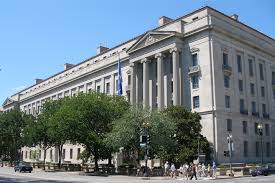
U.S. Department of Justice
Hoping to avoid prison, Hoffa offers future Teamsters support if RFK runs for President. To prove he can deliver, he tells Kennedy that the Teamsters have even penetrated the FBI.
[In March, 1964, Kennedy met with Hoffa on an airfield at Dulles International Airport in Washington, D.C.
[Kennedy spoke quietly with Hoffa. The Attorney General showed him a document, and Hoffa at times nodded or shook his head.
[Kennedy never revealed the reason for the meeting.
[Gus Russo—author of Live By the Sword: The Secret War Against Castro and the Death of JFK—writes that the reason might have been Dallas.
[Perhaps, he speculates, RFK had wanted to look into Hoffa’s eyes while asking him: Did you have anything to do with the assassination? RFK had, in fact, done this with CIA Director John McCone almost immediately after his brother’s death.]
In Blood Feud, Kennedy confronts J. Edgar Hoover (Ernest Borgnine) and accuses him of illegally planting wiretaps in Mob hangouts all over the country.
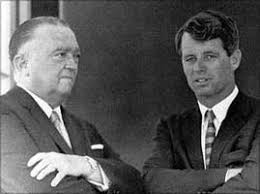
J. Edgar Hoover and Robert F. Kennedy
Hoover retorts that this had been the only way to obtain the prosecution-worthy intelligence Kennedy had demanded: “You loved that flow of information. You didn’t want it to stop.”
Kennedy: Why did you keep the FBI out of the fight against the Mob for decades?
Hoover: “Every agency that came to grips with them got corrupted by their money.”
[So far as is known, Hoover never made any such confession. Historians continue to guess his reason for leaving the Mob alone for decades.]
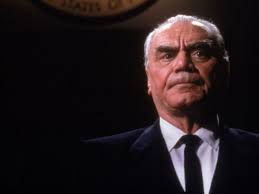

Ernest Borgnine as J. Edgar Hoover
RFK then mentions the CIA’s plots to employ the Mob to assassinate Cuban dictator Fidel Castro
[The agency had wanted to please President Kennedy, and the Mafia had wanted to regain its casinos lost to the Cuban Revolution. The role the Kennedy brothers played in the CIA’s assassination plots remains murky, and has been the subject of endless speculation.]
“The CIA, doing business with the Mob,” says Kennedy. “The FBI, leaking information to its enemies [the Teamsters].” Then, sadly: “I guess it’s true–everyone does business with everyone.”
[So far as is known, the FBI did not pass on secrets to the Teamsters. But during the 1970s, the Mafia penetrated the Cleveland FBI office through bribes to a secretary. Several FBI Mob informants were “clipped” as a result.]
In 1967, Hoffa goes to prison. He stays there until, in 1971, President Richard Nixon commutes his sentence in hopes of gaining Teamsters’ support for his 1972 re-election.
Kennedy leaves the Justice Department in 1964 and is elected U.S. Senator from New York. In 1968 he runs for President. On June 5, after winning the California primary, he’s assassinated.
Hoffa schemes to return to the presidency of the Teamsters–a post now held by his successor, Frank Fitzsimmons. He runs the union in a more relaxed style than Hoffa, thus giving the Mob greater control over its pension fund.
And the Mafia likes it that way.
On July 30, 1975, Hoffa disappears from the parking lot of the Machus Red Fox Restaurant near Detroit. He had gone there to meet with two Mafia leaders.
Forty-three years after the death of James R. Hoffa, and 50 years after that of Robert F. Kennedy:
- Labor unions are a shadow of their former power.
- The threat they once represented to national prosperity has been replaced by that of predatory corporations like Enron and AIG.
- The war RFK began on the Mafia has continued, sending countless mobsters to prison.
- Millions of Americans who once expected the Federal Government to protect them from crime now believe the Government is their biggest threat.
- The idealism that fueled RFK’s life has virtually disappeared from politics.
ABC NEWS, ABCNEWS, ALTERNET, AP, BLOOD FEUD, BUZZFEED, CARLOS MARCELLO, CBS NEWS, CIA, CNN, COTTER SMITH, CROOKS AND LIARS, CUBA, DAILY KOZ, ERNEST BORGNINE, FACEBOOK, FBI, FIDEL CASTRO, GUS RUSSO, INTERNATIONAL BROTHERHOOD OF TEAMSTERS, J. EDGAR HOOVER, JAMES R. HOFFA, JOHN F. KENNEDY, JUSTICE DEPARTMENT, LIVE BY THE SWORD: THE SECRET WAR AGAINST CASTRO AND THE DEATH OF JFK, MAFIA, MOTHER JONES, MOVEON, MSNBC, NBC NEWS, NEWSWEEK, NPR, PBS NEWSHOUR, POLITICO, RAW STORY, REUTERS, ROBERT BLAKE, ROBERT F. KENNEDY, SALON, SAM GROOM, SEATTLE TIMES, SENATE LABOR RACKETS COMMITTEE, SLATE, THE ATLANTIC, THE CHICAGO SUN-TIMES, THE CHICAGO TRIBUNE, THE DAILY BEAST, THE GUARDIAN, THE HILL, THE HUFFINGTON POST, THE LOS ANGELES TIMES, THE NATION, THE NEW YORK TIMES, THE WALL STREET JOURNAL, THE WASHINGTON POST, TIME, TWITTER, U.S. NEWS & WORLD REPORT, UNITED STATES SECRET SERVICE, UPI, USA TODAY
In Bureaucracy, Entertainment, History, Law, Law Enforcement, Politics, Social commentary on January 15, 2019 at 12:08 am
In 1983, Blood Feud, a two-part TV mini-series, depicted the 11-year struggle between Robert F. Kennedy and James Riddle Hoffa. Although it took some dramatic liberties, its portrayal of the major events of that period remains essentially accurate.
Today, labor unions are a rapidly-vanishing species, commanding far less political influence than they did 50 years ago. As a result, young viewers of this series may find it hard to believe that labor ever held such sway, or that the International Brotherhood of Teamsters union posed such a threat.
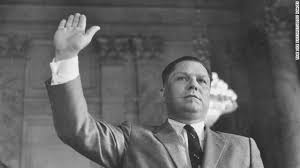
James Riddle Hoffa testifying before the Senate Labor Rackets Committee
And in an age when millions see “Big Government” as the enemy, they may feel strong reservations about the all-out war that Kennedy waged against Hoffa.
Blood Feud opens in 1957, when Hoffa (Robert Blake) is a rising figure within the Teamsters. Kennedy (Cotter Smith) is chief counsel for the Senate Labor Rackets Committee.
At first, Hoffa tries to ingratiate himself with Kennedy, telling him: “I know everybody who can help me and anybody who can hurt me.”
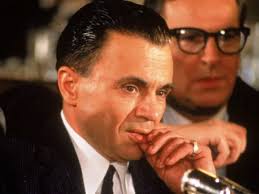
Robert Blake as James R. Hoffa
A wily Hoffa decides to parley Kennedy’s anti-corruption zeal into a path to power for himself. Via his attorney, Eddie Cheyfitz, he feeds Kennedy incriminating evidence against Dave Beck, president of the Teamsters.
Confronted with a Senate subpoena, Beck flees the country—paving the way for Hoffa to assume the top position in the union. Hoffa believes he has solved two problems at once.
“He’s got his scalp,” Hoffa tells an associate. “Now he can move on to other things while I run the union.”
But Hoffa has guessed wrong—with fatal results. Realizing that he’s been “played” by Hoffa, a furious Kennedy strikes back.
He orders increased surveillance of Hoffa and his topmost associates. He subpoenas union records and members of both the Teamsters and the Mafia to appear before his committee in public hearings.
And he tries to enlist the aid of legendary FBI Director J. Edgar Hoover (Ernest Borgnine). But Hoover wants no part of a war against organized crime, whose existence he refuses to admit.

Meanwhile, Kennedy’s confrontations with Hoffa grow increasingly fierce. In open hearings, Kennedy accuses Hoffa of receiving kickbacks in the name of his wife. Hoffa damns him for “dirtying my wife’s name.”
Kennedy secures an indictment against Hoffa for hiring a spy to infiltrate the Senate Labor Rackets Committee. He’s so certain of a conviction that he tells the press he’ll “jump off the Capitol building” if Hoffa beats the rap.
But Hoffa’s lawyer, Edward Bennett Williams (Jose Ferrer) puts Kennedy himself on the witness stand. There he portrays Kennedy as a spoiled rich man who’s waging a vendetta against Hoffa.
Hoffa beats the rap, and offers to send Kennedy a parachute. But he jokingly warns reporters: “Hey, Bobby, you better have it checked. I don’t trust myself!”
By 1959, Robert Kennedy’s work as chief counsel for the Senate Labor Rackets Committee is over. But not his determination to send Teamsters President James Hoffa to prison.
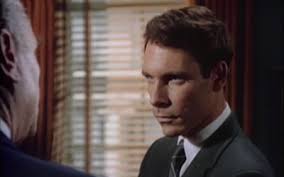
Cotter Smith as Robert Kennedy
Throughout 1960, he manages the Presidential campaign for his brother, John F. Kennedy (Sam Groom). By a margin of only 100,000 votes, JFK wins the election.
Hoffa thinks that his troubles are over, that “Bobby” will move on to other pursuits and forget about the Teamsters.
Hoffa is partly right: Kennedy moves on to another job. But it’s the office of United States Attorney General.
JFK, needing someone in the Cabinet he can trust completely, browbeats Robert into becoming the the nation’s top cop.
For Hoffa, it’s a nightmare come true.
As Attorney General, Kennedy no longer has to beg J. Edgar Hoover to attack organized crime. He can—and does—order him to do so.
Throughout the country, the Mafia feels a new heat as FBI agents plant illegal electronic microphones (“bugs”) in their innermost sanctums. Agents openly tail mobsters—and send them to prison in large numbers.
And Kennedy sets up a special unit, composed of topflight prosecutors and investigators, to go after just one man: James Riddle Hoffa. The press comes to call it the “Get Hoffa” squad.
Hoffa continues to beat federal prosecutors in court. But he believes he’s under constant surveillance by the FBI, and his nerves are starting to crack.
Convinced that the FBI has bugged his office, he literally tears apart the room, hoping to find the bug. But he fails to do so.
What he doesn’t know is he’s facing a more personal danger—from one of his closest associates.
He tells a trusted colleague, Edward Grady Partin (Brian Dennehy) how easy it would be to assassinate Kennedy with a rifle or bomb.
Later, Partin gets into a legal jam—and is abandoned by the Teamsters. Hoping to cut a deal, he relays word to the Justice Department of Hoffa’s threats against the Attorney General.
Now working for the Justice Department, Partin sends in reports on Hoffa’s juror-bribing efforts in yet another trial. Hoffa again beats the rap—but now Kennedy has the insider’s proof he needs to put him away for years.
2016 PRESIDENTIAL RACE, ABC NEWS, ALL THE KING’S MEN, ALTERNET, AP, BLUE BLOODS, BUZZFEED, CBS, CBS NEWS, CNN, CROOKS AND LIARS, DAILY KOZ, ERIC SCHNEIDERMAN, FACEBOOK, FBI, FRANK REAGAN, INDEPENDENT COUNSEL, J. EDGAR HOOVER, JAMES COMEY, JEFF SESSIONS, JUSTICE DEPARTMENT, MOTHER JONES, MOVEON, NBC NEWS, NEW YORK POLICE DEPARTMENT, NEWSWEEK, NPR, POLITICO, RAW STORY, REUTERS, ROBERT MUELLER, ROBERT PENN WARREN, RUSSIA, SALON, SEATTLE TIMES, SERGEI KISLYAK, SEXUAL ASSAULT, SLANDER, SLATE, THE ATLANTIC, THE CHICAGO SUN-TIMES, THE CHICAGO TRIBUNE, THE DAILY BEAST, THE GUARDIAN, THE HILL, THE HUFFINGTON POST, THE LOS ANGELES TIMES, THE NATION, THE NEW YORK TIMES, THE WASHINGTON POST, TIME, TOM SELLECK, TRUMP UNIVERSITY, TWITTER, U.S. NEWS & WORLD REPORT, UPI, USA TODAY, USA TODAY DONALD TRUMP, WILLIAM C. SULLIVAN
In Bureaucracy, History, Law, Law Enforcement, Politics, Social commentary on November 16, 2018 at 12:04 am
Since taking office as President, Donald Trump has openly waged war on his own Justice Department—and especially its chief investigative agency, the FBI.
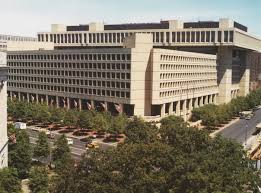
FBI headquarters
For example, he has:
- Fired James Comey, the FBI director pursuing an investigation into Russia’s subversion of the 2016 Presidential race to ensure Trump’s election.
- Threatened to fire Independent Counsel Robert S. Mueller, who continued that investigation after Trump fired Comey.
- Repeatedly attacked—verbally and on Twitter—his Attorney General, Jeff Sessions, for recusing himself from overseeing the Russia investigation. On November 7, Trump fired him.
- (Sessions did so after the press revealed that, during the 2016 race, he twice met secretly with Russian Ambassador Sergei Kislyak.)
- Repeatedly attacked the integrity of the FBI, raising the possibility of his firing more of its senior leadership for pursuing the Russia investigation.
- Forced House Republicans to release a memo falsely accusing the FBI of pursuing a vendetta against him.
But the FBI need not meekly accept such assaults.
A February 2, 2018 episode of the popular CBS police drama, “Blue Bloods,” offers a vivid lesson on bureaucratic self-defense against tyrants.
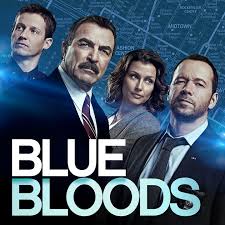
A shootout erupts in a crowded pub between a gunman and NYPD officers. Results: One dead gunman and one wounded bystander.
Problem: The bystander is an aide to New York Governor Martin Mendez.
Mendez visits One Police Plaze, NYPD headquarters, for a private chat with Commissioner Frank Reagan (Tom Selleck). From the outset, he’s aggressive, rude and threatening.
MENDEZ: I know you guys like to whitewash officer-involved shootings. That’s not going to happen here. I want the cop who shot my guy fired and charged.
REAGAN: If the grand jury indicts, my officer could be terminated.
MENDEZ: We all want to protect our people, but mine come first.
Governor Mendez leaves Commissioner Reagan’s office. Later, he returns:
MENDEZ: We’ve got a serious problem.
REAGAN: Why? The grand jury declined to indict my officer.
MENDEZ: Your cop fired into a crowded room.
REAGAN: She returned fire, took out the shooter and likely saved lives.
MENDEZ: What are you going to do?
REAGAN: Our Internal Affairs investigation supports the grand jury’s finding, so the case is closed.
MENDEZ: Either you fire this cop, or I’ll order the Attorney General to investigate every questionable police shooting in the past 10 years and hold public hearings out loud and lights up.
REAGAN: Everybody loves a circus.
MENDEZ: Except the guy who’s got to shovel up afterwards.
At the end of the episode, a third—and final—meeting occurs in a restaurant between Reagan and Mendez.
MENDEZ: Have you dumped the cop who shot my guy?
REAGAN: No.
MENDEZ: Bad news.
REAGAN: Depends on what you compare it to. It turns out that your aide wasn’t drinking alone the night he was shot.
MENDEZ: So what? He’s single.
REAGAN: He was with a married woman.
MENDEZ: That’s on her, not on him.
REAGAN: Except she is married to his boss, your Chief of Staff.
MENDEZ: Sheesh!
REAGAN: Turns out this has been going on for over a year.
MENDEZ: So what are we doing?
REAGAN: If this gets out, the circus comes to Albany [where the Governor has his office].
MENDEZ: Who else knows?
REAGAN: Right now it’s safe in the notebook of my lead detective. Whether or not it finds its way into an arrest report that’s subject to a Freedom of Information Act request—that’s a judgment call.
MENDEZ: Your judgment?
REAGAN: Yes.
MENDEZ: And if my investigation goes away?
REAGAN: Neither of us is shoveling up after the circus.
MENDEZ: I have your word on that?
REAGAN: Yes.
MENDEZ: You have a good evening, Commissioner.
J. Edgar Hoover, the legendary FBI director, used Realpolitik to ensure his reign for 48 years.
As William C. Sullivan, the onetime director of the FBI’s Domestic Intelligence Division, revealed after Hoover’s death in 1972:
“The moment [Hoover] would get something on a Senator, he’d send one of the errand boys up and advise the senator that ‘we’re in the course of an investigation, and we by chance happened to come up with this data on your daughter.
“‘But we wanted you to know this. We realize you’d want to know it.’ Well, Jesus, what does that tell the senator? From that time on, the senator’s right in his pocket.”
Donald Trump has long pursued a strategy of intimidation. But when people have refused to be cowed by his threats, he’s backed off.
During the 2016 Presidential campaign, more than a dozen women accused Trump of sexual misconduct, ranging from inappropriate comments to assault.
Trump responded: “The events never happened. Never. All of these liars will be sued after the election is over.”
Yet he hasn’t filed a single slander suit.
Similarly, when New York’s Attorney General Eric Schneiderman sued Trump for running a fraudulent university, Trump initially said he would fight the charge.
Instead, he settled the case by paying $25 million to compensate the 3,700 students Trump University had defrauded.
“You never have to frame anyone,” says Governor Willie Stark in Robert Penn Warren’s Pulitzer Prize-winning 1946 novel, All the King’s Men. “Because the truth is always sufficient.”
It’s time the FBI re-learned—and applied—that same lesson.
ABC NEWS, ALTERNET, AP, BARACK OBAMA, BUZZFEED, CBS NEWS, CNN, CROOKS AND LIARS, DAILY KOZ, DONALD TRUMP, FACEBOOK, FBI, HEINRICH HIMMLER, HERMANN GORING, JOSEPH GOEBBELS, JUSTICE DEPARTMENT, MICHAEL COHEN, MOTHER JONES, MOVEON, MSNBC, NBC NEWS, NEWSWEEK, NPR, OMAROSA MANIGAULT, PLAYBOY MAGAZINE, POLITICO, RAW STORY, REUTERS, SALON, SCHUTZSTAFFEL, SEATTLE TIMES, SLATE, THE APPRENTICE, THE ATLANTIC, THE CHICAGO SUN-TIMES, THE CHICAGO TRIBUNE, THE DAILY BEAST, THE GUARDIAN, THE HILL, THE HUFFINGTON POST, THE LOS ANGELES TIMES, THE NATION, THE NEW YORK TIMES, THE WASHINGTON POST, THIRD REICH, TIME, TV GUIDE, TWITTER, U.S. NEWS & WORLD REPORT, UNITED STATES ATTORNEY FOR THE SOUTHERN DISTRICT OF NEW YORK, UPI, USA TODAY, USA TODAY ADOLF HITLER, WIRETAPPING
In Bureaucracy, History, Military, Politics, Social commentary on August 13, 2018 at 12:16 am
In April, 1945, Berlin, capital of the Third Reich, was being menaced by the British and Americans from the West. Meanwhile, from the East, an even more dreaded enemy—the Russians—was fast approaching the besieged city.
On April 20—Adolf Hitler’s 56th birthday—his two most important ministers visited him for the last time.
One minister was Hermann Goring, who still commanded the remnants of the once-powerful German air force, the Luftwaffe.
Hermann Goring
Bundesarchiv, Bild 102-15607 / CC-BY-SA 3.0 [CC BY-SA 3.0 de
The other was Heinrich Himmler, absolute ruler of the Schutzstaffel, or “Protection Squadron.” His empire encompassed the black-uniformed secret police and a network of extermination camps throughout Eastern Europe.
Heinrich Himmler
Bundesarchiv, Bild 183-R99621 / CC-BY-SA 3.0 [CC BY-SA 3.0 de
During the final meeting in the ruins of the Reich Chancellery, Himmler and Goring swore unswerving loyalty to Hitler.
So the Fuhrer was understandably startled—and enraged—when, on April 23, Goring sent him a telegram. It proposed that, with Hitler trapped in Berlin, the Reichsmarshall, as his designated successor, should assume leadership of the Reich.
Hitler, furious, refused permission and ordered Goring’s arrest and execution. But Goring eluded the SS units and surrendered to the Americans.
Then, on April 28, the BBC reported that Himmler had tried to open surrender negotiations with the Western Allies.
Hitler had long considered Himmler (“The true Heinrich”) as second only to Propaganda Minister Joseph Goebbels in loyalty.
Now Hitler screamed that Himmler had committed the worst treachery he had ever known—and ordered his arrest.
On April 29—one day before he committed suicide—Hitler declared Goring and Himmler traitors and stripped them of all their Nazi party and state offices.
Both would commit suicide by poison—Himmler before he could be tried as a war criminal, and Goring after being convicted as one.
Now, fast forward 73 years later.
Attorney Michael Cohen had long been Donald Trump’s fixer. “If somebody does something Mr. Trump doesn’t like,” he told ABC News in 2011, “I do everything in my power to resolve it to Mr. Trump’s benefit.”
Michael Cohen
Then, in April, 2018, the United States Attorney for the Southern District of New York began investigating Cohen. Charges reportedly include bank fraud, wire fraud and violations of campaign finance law.
On April 9, 2018, the FBI, executing a federal search warrant, raided Cohen’s law office, his home and his hotel room. Agents seized emails, tax and business records and recordings of phone conversations that Cohen had made.
While the media speculated that Cohen was expecting a Presidential pardon, President Trump responded: “Michael Cohen only handled a tiny, tiny fraction of my legal work.”
On July 25, Cohen apparently offered a response of his own: A leaked tape of a phone conversation he had had with Trump before the latter became President.
It focused on buying the rights to a Playboy model’s story where she claimed to have had an affair with Trump years earlier.
Trump, furious, blasted Cohen in a tweet: “What kind of a lawyer would tape a client? So sad! Is this a first, never heard of it before? Why was the tape so abruptly terminated (cut) while I was presumably saying positive things? I hear there are other clients and many reporters that are taped – can this be so? Too bad!”
The revelation that he had been secretly taped by his own lawyer proved especially embarrassing for Trump. On March 4, 2017, he had accused the Obama administration of illegally wiretapping his phones during the 2016 election.
Without citing any evidence to back up his libelous claim, he tweeted: “Terrible! Just found out that [Barack] Obama had my ‘wires tapped’ in Trump Tower just before the victory. Nothing found. This is McCarthyism!”
Subsequent investigations by the Justice Department turned up no evidence to substantiate Trump’s claim.
But after the release of the Cohen tape, even worse was to come.
Omarosa Manigault had become a Trump favorite by generating huge ratings for his “reality series” The Apprentice during its first, seventh and 13th seasons on NBC.
Omarosa Manigault
By Glenn Francis of PacificProDigital.com
Her behavior toward other contestants was marked by insults, egomania and ruthlessness. As a result, she soon became the “woman America loved to hate.”
TV Guide included her in its 2013 list of “The 60 Nastiest TV Villains of All Time.”
During Trump’s Presidential campaign, she was named Director of African-American Outreach. In an interview with Frontline, she boasted: “Every critic, every detractor, will have to bow down to President Trump. It’s everyone who’s ever doubted Donald, who ever disagreed, who ever challenged him.”
In January, 2017, Omarossa moved into the White House—where she became as antagonistic toward her government colleagues as she had those on The Apprentice.
On December 12, she was forcibly removed from the White House grounds.
Trump tweeted her a goodbye: “Thank you Omarosa for your service! I wish you continued success.”
Apparently he didn’t expect her to attain that success at his expense.
On August 8, 2018, news broke that Omarosa had secretly taped Trump during several phone conversations in the White House. And that she planned to use these to promote an upcoming—and highly critical—book on the President.
The book—Unhinged-–will be released on August 14.


-33510-W&docid=hCd9k6PuglvZAM&tbnid=CAo7BRzGtBWa3M%3A&w=500&h=375&bih=469&biw=819&ved=0ahUKEwiissafvJ_MAhUGKWMKHTZZA_MQxiAIAg&iact=c&ictx=1)

&docid=SiluTuHYHtjaZM&tbnid=uLB-PLYDVdkkVM%3A&w=455&h=341&ei=zeN_VI_hKYHjoATGs4Bo&ved=0CAIQxiAwAA&iact=c)


 Bureaucracybuster's Blog
ABC NEWS, BARACK OBAMA, BREITBART NEWS, CBS NEWS, CHRISTOPHER S. MURPHY, CIA, CNN, DEMOCRATIC NATIONAL COMMITTEE, DEMOCRATIC PARTY, DONALD TRUMP, ERIC SCHNEIDERMAN, EXTORTION, FACE THE NATION, FACEBOOK, FERGUS CULLEN, FOX NEWS SUNDAY, GREG ABBOTT, HACKING, HILLARY CLINTON, IRS, JAMES B. COMEY, JAMES R. CLAPPER, JARED KUSHNER, JEFF SESSIONS, JOHN KASICH, JR., JUSTICE DEPARTMENT, KEN PAXTON, LEON PANETTA, MARK LEVIN, MICHAEL FLYNN, MICHAEL ROGERS, MIKE PENCE, NATIONAL SECURITY AGENCY, NBC NEWS, NEW HAMPSHIRE REPUBLICAN PARTY, NEWSWEEK, NPR, PAM BONDI, PAUL MANAFORT, PAUL RYAN, PHILIP KLEIN, POLITICO, Racketeer Influenced Corrupt Organizations (RICO) Act, REPUBLICAN NATIONAL COMMITTEE, REPUBLICAN NATIONAL CONVENTION, REPUBLICAN PARTY, REX TILLERSON, ROGER STONE, SALON, SOVIET UNION, THE CHICAGO SUN-TIMES, THE CHICAGO TRIBUNE, THE HUFFINGTON POST, THE LOS ANGELES TIMES, THE NEW YORK TIMES, THE WASHINGTON EXAMINER, THE WASHINGTON POST, THREATS, TIME, TREASON, TRUMP TOWER MEETING, TRUMP UNIVERSITY, TRUMP-RUSSIA TIES, TWITTER, U.S. NEWS & WORLD REPORT, U.S. SECRET SERVICE, USA PATRIOT ACT, USA TODAY, VLADIMIR PUTIN, WIRETAPPING
OBMAMA AND THE FBI: CREATING PRESIDENT TRUMP–PART ONE (OF THREE)
In Bureaucracy, History, Law, Law Enforcement, Politics, Social commentary on July 8, 2019 at 12:03 am“The only thing necessary for the triumph of evil is for good men to do nothing.”
So wrote Edmund Burke (1729-1797) the Irish statesman, author, orator, political theorist and philosopher. And history has repeatedly proved him right.
One such example was the rise of Adolf Hitler as Germany’s Fuhrer.
Writes historian Volker Ullrich, in his monumental new biography, Hitler: Ascent 1889–1939: “Historians have perennially tried to answer the question of whether Hitler’s rise to power could have been halted….
“There were repeated opportunities to end Hitler’s run of triumphs. The most obvious one was after the failed Putsch of November, 1923. Had the Munich rabble-rouser been forced to serve his full five-year term of imprisonment in Landsberg, it is extremely unlikely that he would have been able to restart his political career.”
But that didn’t happen.
Tried for and convicted of treason, he was sentenced to five years’ imprisonment.
At Landsberg Prison, in Bavaria. he was given a huge cell, allowed to receive unlimited visitors and gifts, and treated with deference by guards and inmates.
Nine months later, he was released on parole—by authorities loyal to the authoritarian Right instead of the newly-created Weimar Republic.
Hitler immediately began rebuilding the shattered Nazi party—and deciding on a new strategy to gain power. Disdaining armed force, he would win office by election—or intrigue.
On January 30, 1933, those intrigues bore fruit: Adolf Hitler was appointed Chancellor of Germany.
Future historians may one day write that what didn’t happen played at least as great a role in electing Donald Trump President as what actually did.
There were at least five instances where the Justice Department of President Barack Obama could have utterly changed the outcome of the 2016 election. Yet, for reasons still unknown, it chose to do nothing.
Donald Trump
Case #1: The Obama Justice Department did not indict Trump and/or the Attorney Generals of Texas and/or Florida for their roles in the Trump University scandal.
But New York’s Attorney General, Eric Schneiderman, pressed fraud claims against Trump—and forced the real estate mogul to settle the case out of court for $25 million on November 18, 2016.
There have been no press reports that the Justice Department investigated these cases to determine if Trump violated the Racketeer Influenced Corrupt Organizations (RICO) Act statutes.
If the Justice Department did not investigate these cases, it should have. And if he did violate the RICO statutes, he should have been indicted, even as a Presidential candidate or President-elect.
Even if an indictment had not produced a conviction, the mere bringing of one would have cast an unprecedented cloud over his candidacy—let alone his being sworn in as President.
Case #2: The Justice Department did not indict Trump for the series of threats that he made—directly and indirectly—against Republicans and Democrats throughout the 2016 campaign.
Threatening political opponents with violence is a crime under Federal law. Yet making threats against his Republican and Democratic opponents played a major role in Trump’s Presidential campaign.
Share this: