Posts Tagged ‘JUSTICE DEPARTMENT’
ABC NEWS, ADOLF HITLER, BAVARIA, BEER HALL PUTSCH, BREITBART NEWS, CBS NEWS, CHRISTOPHER S. MURPHY, CIA, CNN, DEMOCRATIC NATIONAL COMMITTEE, DEMOCRATIC PARTY, DONALD TRUMP, EXTORTION, FACE THE NATION, FACEBOOK, FERGUS CULLEN, FOX NEWS SUNDAY, GREG ABBOTT, HACKING, HILLARY CLINTON, HITLER: ASCENT, IRS, JAMES B. COMEY, JAMES R. CLAPPER, JEWS, JOHN KASICH, JUSTICE DEPARTMENT, KEN PAXTON, LEON PANETTA, MEIN KAMPF, MICHAEL ROGERS, MIKE PENCE, MUNICH, NATIONAL SECURITY AGENCY, NAZI PARTY, NBC NEWS, NEW HAMPSHIRE REPUBLICAN PARTY, NEWSWEEK, NPR, PAM BONDI, PAUL RYAN, PHILIP KLEIN, POLITICO, Racketeer Influenced Corrupt Organizations (RICO) Act, REPUBLICAN NATIONAL COMMITTEE, REPUBLICAN NATIONAL CONVENTION, REPUBLICAN PARTY, ROGER STONE, SALON, SOVIET UNION, THE CHICAGO SUN-TIMES, THE CHICAGO TRIBUNE, THE HUFFINGTON POST, THE LOS ANGELES TIMES, THE NEW YORK TIMES, THE WASHINGTON EXAMINER, THE WASHINGTON POST, THREATS, TIME, TREASON, TRUMP UNIVERSITY, TWITTER, U.S. NEWS & WORLD REPORT, U.S. SECRET SERVICE, USA PATRIOT ACT, USA TODAY, VLADIMIR PUTIN, VOLKER ULLRICH, WEIMAR REPUBLIC
In Bureaucracy, History, Law, Law Enforcement, Politics, Social commentary on January 3, 2017 at 12:01 am
Threatening his Republican and Democratic opponents with violence played a major role in Donald Trump’s campaign for President.
No other candidate—Republican or Democrat—had ever made such repeated and brutal use of threats of physical assault in pursuing the Presidency.
- Philip Klein, the managing editor of the Washington Examiner, wrote on the eve of the Republican National Convention in July: “Political commentators now routinely talk about the riots that would break out in Cleveland if Trump were denied the nomination, about how his supporters have guns and all hell could break loose, that they would burn everything to the ground. It works to Trump’s advantage to not try too hard to dispel these notions.”
- On August 9, Trump told a rally in Wilmington, North Carolina: “Hillary [Clinton] wants to abolish, essentially abolish, the Second Amendment. If she gets to pick her [Supreme Court] judges, nothing you can do folks. Although the Second Amendment people, maybe there is, I don’t know.”
- “Don’t treat this as a political misstep,” Senator Christopher S. Murphy of Connecticut, who has called for stiffer gun laws, wrote on Twitter. “It’s an assassination threat, seriously upping the possibility of a national tragedy & crisis.”
- “Well, let me say if someone else said that outside of the hall, he’d be in the back of a police wagon now, with the Secret Service questioning him,” said Michael Hayden, former head of the CIA and National Security Agency (NSA).
Making threats against anyone under protection by the U.S. Secret Service is a felony. Yet Donald Trump was never held legally accountable by the Justice Department.
Threats of this type continued to be made by Trump supporters right up to the day of the election.
- On July 29, Roger Stone, a notorious Right-wing political consultant acting as a Trump strategist, told Breitbart News: “The first thing Trump needs to do is begin talking about [voter fraud] constantly. If there’s voter fraud, this election will be illegitimate, the election of the winner will be illegitimate, we will have a constitutional crisis, widespread civil disobedience, and the government will no longer be the government.”
- At a town hall meeting where Trump’s Vice Presidential nominee Mike Pence appeared, a woman named Rhonda said: “For me personally, if Hillary Clinton gets in, I myself am ready for a revolution.”
- In Cincinnati, a Trump supporter threatened to forcibly remove Clinton from the White House if she won the race: “If she’s in office, I hope we can start a coup. She should be in prison or shot. That’s how I feel about it,” Dan Bowman, a 50-year-old contractor, said of Hillary Clinton, the Democratic nominee. “We’re going to have a revolution and take them out of office if that’s what it takes. There’s going to be a lot of bloodshed. But that’s what it’s going to take….I would do whatever I can for my country.”
Even Fergus Cullen, former chairman of the New Hampshire GOP, expressed fear of what might happen if Trump lost the election:
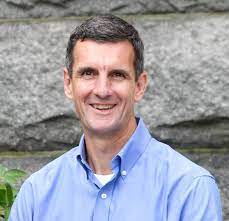

Fergus Cullen
“That’s really scary,” Cullen said, recounting the violence at Trump rallies around the country leading up to the Republican National Convention. “In this country, we’ve always had recriminations after one side loses. But we haven’t had riots. We haven’t had mobs that act out with violence against supporters of the other side.
“There’s no telling what his supporters would be willing to do at the slightest encouragement from their candidate,” he said.
Trump even began encouraging his mostly white supporters to sign up online to be “election observers” to stop “Crooked Hillary from rigging this election.” He urged them to act as poll watchers in “other” [non-white] communities to ensure that things are “on the up and up.”
Many of his supporters promised to do so.
“Trump said to watch your precincts. I’m going to go, for sure,” said Steve Webb, a 61-year-old carpenter from Fairfield, Ohio.
“I’ll look for…well, it’s called racial profiling. Mexicans. Syrians. People who can’t speak American,” he said. “I’m going to go right up behind them. I’ll do everything legally. I want to see if they are accountable. I’m not going to do anything illegal. I’m going to make them a little bit nervous.”
Knowing that large numbers of angry—and possibly armed—Right-wingers planned to descend on polling places could only have had a chilling effect on untold numbers of Democratic voters. And this would have been especially true in heavily conservative states.
Both the USA Patriot Act and the Racketeer Influenced Corrupt Organizations (RICO) Act have statutes dealing with making terrorist threats against government institutions to influence their members.
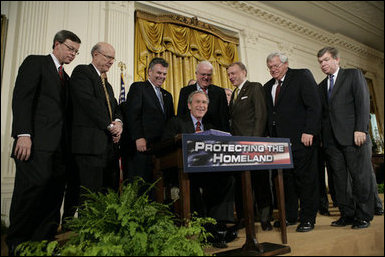
President George W. Bush signing the USA Patriot Reauthorization Act of 2005
If Trump’s remarks did not violate one or both of those laws, certainly remarks made by his surrogates did.
Thus, the Justice Department could have cited the Patriot Act in indicting Trump and/or any number of his followers for “activities that…appear to be intended…to influence the policy of a government by intimidation or coercion [and]…occur primarily within the territorial jurisdiction of the United States.”
The Justice Department could have also demanded that the results of the election be invalidated on the basis that widespread voter and candidate intimidation played a massive role in it.
But of course this did not happen.
ABC NEWS, ADOLF HITLER, BAVARIA, BEER HALL PUTSCH, BREITBART NEWS, CBS NEWS, CHRISTOPHER S. MURPHY, CIA, CNN, DEMOCRATIC NATIONAL COMMITTEE, DEMOCRATIC PARTY, DONALD TRUMP, ERIC SCHNEIDERMAN, EXTORTION, FACE THE NATION, FACEBOOK, FERGUS CULLEN, FOX NEWS SUNDAY, GREG ABBOTT, HACKING, HILLARY CLINTON, HITLER: ASCENT, IRS, JAMES B. COMEY, JAMES R. CLAPPER, JEWS, JOHN KASICH, JUSTICE DEPARTMENT, KEN PAXTON, LEON PANETTA, MEIN KAMPF, MICHAEL ROGERS, MIKE PENCE, MUNICH, NATIONAL SECURITY AGENCY, NAZI PARTY, NBC NEWS, NEW HAMPSHIRE REPUBLICAN PARTY, NEWSWEEK, NPR, PAM BONDI, PAUL RYAN, PHILIP KLEIN, POLITICO, Racketeer Influenced Corrupt Organizations (RICO) Act, REPUBLICAN NATIONAL COMMITTEE, REPUBLICAN NATIONAL CONVENTION, REPUBLICAN PARTY, ROGER STONE, SALON, SOVIET UNION, THE CHICAGO SUN-TIMES, THE CHICAGO TRIBUNE, THE HUFFINGTON POST, THE LOS ANGELES TIMES, THE NEW YORK TIMES, THE WASHINGTON EXAMINER, THE WASHINGTON POST, THREATS, TIME, TREASON, TRUMP UNIVERSITY, TWITTER, U.S. NEWS & WORLD REPORT, U.S. SECRET SERVICE, USA PATRIOT ACT, USA TODAY, VLADIMIR PUTIN, VOLKER ULLRICH, WEIMAR REPUBLIC
In Bureaucracy, History, Law, Law Enforcement, Politics, Social commentary on January 2, 2017 at 12:12 am
On November 9, 1923, Nazi Party Fuhrer Adolf Hitler tried to overthrow the government in Munich, Bavaria.
About 2,000 Nazis marched to the center of Munich, where they confronted heavily-armed police. A shootout erupted, killing 16 Nazis and four policemen.
Hitler was injured during the clash, but managed to escape. Two days later, he was arrested and charged with treason.
Put on trial, he found himself treated as a celebrity by a judge sympathetic to Right-wing groups. He was allowed to brutally cross-examine witnesses and even make inflammatory speeches.
At the end of the trial, he was convicted of treason and sentenced to five years’ imprisonment.
Serving time in Landsberg Prison, in Bavaria. he was given a huge cell, allowed to receive unlimited visitors and gifts, and treated with deference by guards and inmates.
Hitler used his time in prison to write his infamous book, Mein Kampf-–“My Struggle.” Part autobiography, part political treatise, it laid out his future plans—including the extermination of the Jews and the conquest of the Soviet Union.

Adolf Hitler leaving Landsberg Prison, December, 20, 1924
Nine months later, he was released on parole—by authorities loyal to the authoritarian Right instead of the newly-created Weimar Republic.
Hitler immediately began rebuilding the shattered Nazi party—and deciding on a new strategy to gain power. Never again would he resort to armed force. He would win office by election—or intrigue.
Writes historian Volker Ullrich, in his monumental new biography, Hitler: Ascent 1889 – 1939: “Historians have perennially tried to answer the question of whether Hitler’s rise to power could have been halted….
“There were repeated opportunities to end Hitler’s run of triumphs. The most obvious one was after the failed Putsch of November 1923. Had the Munich rabble-rouser been forced to serve his full five-year term of imprisonment in Landsberg, it is extremely unlikely that he would have been able to restart his political career.”


Thus, it isn’t just what happens that can influence the course of history. Often, it’s what doesn’t happen that has at least as great a result.
Future historians—if there are any—may one day write that it’s what didn’t happen that played at least as great a role in electing Donald Trump President as what actually did.
There were at least four instances where intervention by Federal law enforcement authorities could have utterly changed the outcome of the 2016 election.
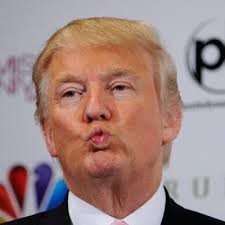
Donald Trump
Case #1: The Justice Department did not indict Trump and/or the Attorney Generals of Texas and/or Florida for their roles in the Trump University scandal.
- Florida Attorney General Pam Bondi personally solicited a political contribution from Donald Trump around the same time her office deliberated joining an investigation of alleged fraud at Trump University and its affiliates.
- After Bondi dropped the Trump University case against Trump, he wrote her a check $25,000 for her re-election campaign. The money came from the Donald J. Trump Foundation.
- Republican Texas Attorney General Ken Paxton moved to muzzle a former state regulator who says he was ordered in 2010 to drop a fraud investigation into Trump University for political reasons.
- Paxton’s office issued a cease and desist letter to former Deputy Chief of Consumer Protection John Owens after he made public copies of a 14-page internal summary of the state’s case against Donald Trump for scamming millions from students of his now-defunct real estate seminar.
- After the Texas case was dropped, Trump cut a $35,000 check to the gubernatorial campaign of then attorney general and now Texas Governor Greg Abbott.
One attorney general who refused to accept money from Trump was New York’s Eric Schneiderman. His decision to press fraud claims against Trump forced the real estate mogul to settle the case out of court for $25 million.
“Today’s $25 million settlement agreement is a stunning reversal by Donald Trump,” said Schneiderman on November 18, “and a major victory for the over 6,000 victims of his fraudulent university.”
There have been no press reports that the Justice Department investigated these cases to determine if Trump violated the Racketeer Influenced Corrupt Organizations (RICO) Act statutes.
If the Justice Department did not investigate these cases, it should have. And if he did violate the RICO statutes, he should have been indicted, even as a Presidential candidate or President-elect.
Even if an indictment had not produced a conviction, the mere bringing of one would have cast an unprecedented cloud over his candidacy–let alone his being sworn in as President.
Case #2: The Justice Department did not indict Trump for his series of threats that he made—directly and indirectly—against Republicans and Democrats throughout the 2016 campaign.
- On March 16, he warned Republicans that if he didn’t win the GOP nomination in July, his supporters would literally riot: “I think you’d have riots. I think you would see problems like you’ve never seen before. I think bad things would happen. I really do. I wouldn’t lead it, but I think bad things would happen.”
- An NBC reporter summed it up as: “The message to Republicans was clear on [March 16]: ‘Nice convention you got there, shame if something happened to it.'”
- That Republicans clearly saw this as a threat is undeniable. Paul Ryan, their Speaker of the House, said on March 17: “Nobody should say such things in my opinion because to even address or hint to violence is unacceptable.”
- And Ohio governor and Republican presidential candidate John Kasich chinned in. “Leaders don’t imply violence,” Kasich told “Face the Nation” on March 20. “When he says that there could be riots, that’s inappropriate. I think you understand that, okay? Secondly, while we have our differences and disagreements, we’re Americans. Americans don’t say, ‘Let’s take to the streets and have violence.'”
2016 PRESIDENTIAL RACE, ABC NEWS, BOEING, CBS NEWS, CNN, DAVID BROOKS, DONALD TRUMP, FACEBOOK, GEORGE C. WALLACE, HILLARY CLINTON, JOHN F. KENNEDY, JOHN MCCAIN, JUSTICE DEPARTMENT, MAFIA, NBC NEWS, PRISONERS OF WAR, ROBERT F. KENNEDY, SAUDI ARABIA, STATE DEPARTMENT, THE CHICAGO SUN-TIMES, THE CHICAGO TRIBUNE, THE KENNEDYS, THE LOS ANGELES TIMES, THE NEW YORK TIMES, THE WALL STREET JOURNAL, THE WASHINGTON POST, TWITTER, WOMEN
In Bureaucracy, History, Politics, Social commentary on October 31, 2016 at 9:15 am
Today, America has two major candidates running for President: Donald Trump and Hillary Clinton.
Trump is a billionaire businessman and television personality. Clinton is a former First Lady (1993-2001), U.S. Senator from New York (2001-2009) and Secretary of State (2009-2013).
Despite the great differences in their backgrounds, they both share one thing in common: They are fiercely hated by millions of their fellow Americans.
Trump’s character has been poignantly summed up by David Brooks, a conservative political columnist for The New York Times:
“The odd thing about [Trump’s] whole career and his whole language, his whole world view is there is no room for love in it. You get a sense of a man who received no love, can give no love, so his relationship with women, it has no love in it. It’s trophy.
“And so you really are seeing someone who just has an odd psychology unleavened by kindness and charity, but where it’s all winners and losers, beating and being beat. And that’s part of the authoritarian personality, but it comes out in his attitude towards women.”
For Republicans, Hillary Clinton arouses hatred that is often as much directed at her sex as her political views: She’s a bitch, a lesbian, physically unattractive. She’s not feminine enough. She “shrieks” and “shouts” when making speeches. She hates men–and, worse, castrates them.
She will abolish religion and force everyone to become atheists. She will authorize U.N. soldiers to confiscate the more than 300 million guns Americans privately hold. She will throw open American borders to millions of illegal aliens from Central and South America. She will sell out America to whoever pays the highest bribe to the Clinton Foundation.
But 48 years ago, Senator Robert Francis Kennedy aroused passions of an altogether different sort.
Kennedy had been a United States Attorney General (1961-1964) and Senator from New York (1964-1968). But it was his connection to his beloved and assassinated brother, President John F. Kennedy, for which he was best known.
In October, 1962, during the Cuban Missile Crisis, his wise counsel helped steer America from the brink of nuclear war with the Soviet Union. As a U.S Senator he championed civil rights and greater Federal efforts to fight poverty.

Robert F. Kennedy campaigning for President
Millions saw RFK as the only candidate who could make life better for America’s impoverished–while standing firmly against those who threatened the Nation’s safety.
As television correspondent Charles Quinn observed: “I talked to a girl in Hawaii who was for [George] Wallace [the segregationist governor of Alabama]. And I said ‘Really?’ [She said] ‘Yeah, but my real candidate is dead.’
“You know what I think it was? All these whites, all these blue collar people who supported Kennedy…all of these people felt that Kennedy would really do what he thought best for the black people, but, at the same time, would not tolerate lawlessness and violence.
“They were willing to gamble…because they knew in their hearts that the country was not right. They were willing to gamble on this man who would try to keep things within reasonable order; and at the same time do some of the things they knew really should be done.”
Campaigning for the Presidency in 1968, RFK had just won the crucial California primary on June 4–when he was shot in the back of the head.
His killer: Sirhan Sirhan, a young Palestinian furious at Kennedy’s support for Israel.
Kennedy died at 1:44 a.m. on June 6.
On June 8, 1,200 men and women boarded a specially-reserved passenger train at New York’s Pennsylvania Station. They were accompanying Kennedy’s body to its final resting place at Arlington National Cemetery.
As the train slowly moved along 225 miles of track, throngs of men, women and children lined the rails to pay their final respects to a man they considered a genuine hero.
Little Leaguers clutched baseball caps across their chests. Uniformed firemen and policemen saluted. Burly men in shirtsleeves held hardhats over their hearts. Black men in overalls waved small American flags. Women from all levels of society stood and cried.

A nation says goodbye to Robert Kennedy
Commenting on RFK’s legacy, historian William L. O’Neil wrote in Coming Apart: An Informal History of America in the 1960′s:
“…He aimed so high that he must be judged for what he meant to do, and, through error and tragic accident, failed at….He will also be remembered as an extraordinary human being who, though hated by some, was perhaps more deeply loved by his countrymen than any man of his time.
“That too must be entered into the final account, and it is no small thing. With his death something precious disappeared from public life.”
America has never again seen a Presidential candidate who combined toughness on crime and compassion for the poor.
Republican candidates have waged war on crime–and the poor. And Democratic candidates have moved to the Right in eliminating anti-poverty programs.
RFK had the courage to fight the Mafia–and the compassion to fight poverty. At a time when Americans long for candidates to give them positive reasons for voting, his kind of politics are sorely missed.
ABC NEWS, AFFORDABLE CARE ACT, BARACK OBAMA, CBS NEWS, CNN, CUBAN MISSILE CRISIS, ERIC HOLDER, EXTORTION, FACEBOOK, GOVERNMENT SHUTDOWN, HILLARY CLINTON, HOUSE OF REPRESENTATIVES, JOHN BOEHNER, JON STEWART, JUSTICE DEPARTMENT, NICCOLO MACHIAVELLI, OBAMACARE, RACKETEER INFLUENCED CORRUPT ORGANIZATIONS ACT, REPUBLICANS, RICHARD WOLFFE, TED CRUZ, THE CHICAGO SUN-TIMES, THE CHICAGO TRIBUNE, THE DAILY SHOW, THE NEW YORK TIMES, THE PRINCE, THE WASHINGTON POST, TWITTER, USA PATRIOT ACT
In Bureaucracy, History, Law, Law Enforcement, Politics, Social commentary on July 22, 2016 at 12:05 am
The ancient Greeks believed: “A man’s character is his fate.” It is Barack Obama’s character–and America’s fate–that he is more inclined to conciliation than confrontation.
Richard Wolffe chronicled Obama’s winning of the White House in his book Renegade: The Making of a President. He noted that Obama was always more comfortable when responding to Republican attacks on his character than he was in making attacks of his own.
Rule #4: Be Open to Compromise–Not Capitulation
Obama came into office determined to find common ground with Republicans. But they quickly made it clear to him that they only wanted his political destruction.
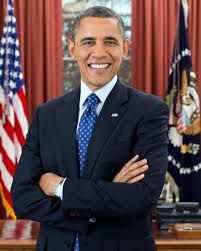
President Barack Obama
At that point, he should have put aside his hopes for a “Kumbaya moment” and applied what Niccolo Machiavelli famously said in The Prince on the matter of love versus fear:
From this arises the question whether it is better to be loved than feared, or feared more than loved. The reply is, that one ought to be both feared and loved, but as it is difficult for the two to go together, it is much safer to be feared than loved.
For it may be said of men in general that they are ungrateful, voluble, dissemblers, anxious to avoid danger and covetous of gain.
As long as you benefit them, they are entirely yours: they offer you their blood, their goods, their life and their children, when the necessity is remote. But when it approaches, they revolt….
And men have less scruple in offending one who makes himself loved than one who makes himself feared; for love is held by a chain of obligations which, men being selfish, is broken whenever it serves their purpose; but fear is maintained by a dread of punishment which never fails.
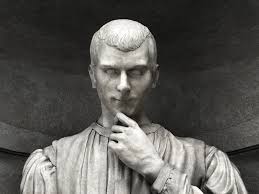
Niccolo Machiavelli
By refusing to vigorously prosecute acts of Republican extortion, President Obama has encouraged Republicans to intensify their aggression against him.
Their most recent act: Refusing to meet with federal appeals court judge Merrick Garland. Obama’s designated nominee to the Supreme Court after the February 13 death of Justice Antonin Scalia.
Kentucky United States Senator Mitch McConnell has flatly stated: There will be no Supreme Court hearing–not during regular business or a post-election lame-duck session.
Had Obama proceeded with indictments against Republican extortion in 2011 or 2013, McConnell–who supported the extortion attempts of those years–would now be desperately meeting with his lawyers.
Rule #5: First Satisfy Your Citizens, Then Help Them
Obama started off well. Americans had high expectations of him.
This was partly due to his being the first black elected President. And it was partly due to the legacies of needless war and financial catastrophe left by his predecessor, George W. Bush.
Obama entered office intending to reform the American healthcare system, to make medical care available to all citizens, and not just the richest.
But that was not what the vast majority of Americans wanted him to concentrate his energies on. With the loss of 2.6 million jobs in 2008, Americans wanted Obama to find new ways to create jobs.
This was especially true for the 11.1 million unemployed, or those employed only part-time.
Jonathan Alter, who writes sympathetically about the President in The Center Holds: Obama and His Enemies, candidly states this.
But Obama chose to spend most of his first two years as President pushing the Affordable Care Act (ACA)–which soon became known as Obamacare–through Congress.
The results were threefold:
First, those desperately seeking employment felt the President didn’t care about them.
Second, the reform effort became a lightning rod for conservative groups like the Tea Party.
And, third, in 2010, a massive Right-wing turnout cost Democrats the House of Representatives and threatened Democratic control of the Senate.
Rule #6: Be Careful What You Promise
Throughout his campaign to win support for the ACA, Obama had repeatedly promised that, under it: “If you like your health insurance plan, you can keep your plan. Period. If you like your doctor, you can keep your doctor. Period.”
But, hidden in the 906 pages of the law, was a fatal catch for the President’s own credibility.
The law stated that those who already had medical insurance could keep their plans--so long as those plans met the requirements of the new healthcare law.
If their plans didn’t meet those requirements, they would have to obtain new coverage that did.
It soon turned out that a great many Americans wanted to keep their current plan–even if it did not provide the fullest possible coverage.
Suddenly, the President found himself facing a PR nightmare: Charged and ridiculed as a liar.
Even Jon Stewart, who on “The Daily Show” had supported the implementation of “Obamacare,” sarcastically ran footage of Obama’s “you can keep your doctor” promise.
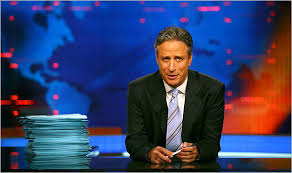
Jon Stewart
The implication: You said we could keep our plan/doctor; since we can’t, you must be a liar.
As a result, the President found his reputation for integrity–long his greatest asset–tarnished.
All of which takes us to yet another warning offered by Machiavelli: Whence it may be seen that hatred is gained as much by good works as by evil….
ABC NEWS, AFFORDABLE CARE ACT, BARACK OBAMA, CBS NEWS, CNN, CUBAN MISSILE CRISIS, ERIC HOLDER, EXTORTION, FACEBOOK, GOVERNMENT SHUTDOWN, HILLARY CLINTON, HOUSE OF REPRESENTATIVES, JOHN BOEHNER, JON STEWART, JUSTICE DEPARTMENT, NICCOLO MACHIAVELLI, OBAMACARE, RACKETEER INFLUENCED CORRUPT ORGANIZATIONS ACT, REPUBLICANS, RICHARD WOLFFE, TED CRUZ, THE CHICAGO SUN-TIMES, THE CHICAGO TRIBUNE, THE DAILY SHOW, THE NEW YORK TIMES, THE PRINCE, THE WASHINGTON POST, TWITTER, USA PATRIOT ACT
In Bureaucracy, History, Law, Law Enforcement, Politics, Social commentary on July 21, 2016 at 12:07 am
If Hillary Clinton succeeds Barack Obama as President, can gain much by learning from his mistakes.
In 2011, Obama could have ended Republican extortion by invoking the law–that of the Racketeer Influenced Corrupt Organizations (RICO) Act and/or the USA Patriot Act.
Or he could have faced down Republican extortionists by urging his fellow Americans to rally to him in a moment of supreme national danger.
Rule #2: Rally Your Citizens Against a Dangerous Enemy
President John F. Kennedy did just that–successfully–during the most dangerous crisis of his administration.
Addressing the Nation on October 22, 1962, Kennedy shocked his fellow citizens by revealing that the Soviet Union had installed offensive nuclear missiles in Cuba.

John F. Kennedy
After outlining a series of steps he had taken to end the crisis, Kennedy sought to reassure and inspire his audience. His words are worth remembering today:
“The path we have chosen for the present is full of hazards, as all paths are, but it is the one most consistent with our character and courage as a nation and our commitments around the world.
“The cost of freedom is always high, but Americans have always paid it. And one path we shall never choose, and that is the path of surrender or submission.”
President Obama could have sent that same message to the extortionists of the Republican Party.
Yet this was another option he failed to exploit. And he and the Nation have continued to pay the price for it.
Rule #3: Timidity Toward Aggressors Only Leads to More Aggression
In September, 2013, Republicans once again threatened to shut down the Federal Government unless the President agreed to defund the Affordable Care Act (ACA), better known as “Obamacare.
They were enraged that millions of uninsured Americans might receive medical care on a par with that given members of the House and Senate.
So on September 20, the House voted on a short-term government funding bill that included a provision to defund Obamacare.
Obama and Senate Democrats rejected that provision. If the House and Senate couldn’t reach a compromise, many functions of the federal government would be shut down indefinitely on October 1.
According to Republicans: They wanted to save the country from bankruptcy–although the Congressional Budget Office stated that the ACA would lower future deficits and Medicare spending.
After passing the House and Senate, the ACA had been signed into law by President Obama on March 23, 2010.
On June 28, 2012, the United States Supreme Court–whose Chief Justice, John Roberts, is a Republican–had upheld the constitutionality of the ACA.
Yet House Republicans still sought a way to stop the law from taking effect. By September, 2013, they had voted 42 times to repeal “Obamacare.”
But their efforts had failed; the Democratic-led Senate made it clear it would never go along with such legislation.
Finally, unable to legally overturn the Act or to legislatively repeal it, House Republicans fell back on something much simpler: Threats and fear.
Threats–of voting to shut down salaries paid to most Federal employees. Most, because they themselves would continue to draw hefty salaries while denying them to FBI agents, air traffic controllers and members of the military, among others.
And fear–that would be generated throughout the Federal government, the United States and America’s international allies.
Republicans claimed it was Obama and Senate Democrats who refused to see reason and negotiate.
But then a Republican accidentally gave away the real reason for the shutdown.
“We’re not going to be disrespected,” Rep. Marlin Stutzman (R-Ind.) told the Washington Examiner. “We have to get something out of this. And I don’t know what that even is.”

Martin Stutzman
In short, Republicans–as admitted by Martlin Stutzman–were out to get “respect.” A member of the Crips or Bloods couldn’t have said it better.
The shutdown began on October 1, 2013–and ended 16 days later with even Republicans admitting it had been a failure.
President Obama, a former attorney, denounced House Republicans as guilty of “extortion” and “blackmail.” If he truly believed them to be so guilty, he could have once again invoked RICO and/or the USA Patriot Act.
Yet he did neither.
Had the President dared to prosecute such criminal conduct, the results would have been:
- Facing lengthy prison terms, those indicted Republicans would have been forced to lawyer-up. That in itself would have been no small thing, since good criminal attorneys cost big bucks.
- Obsessed with their own personal survival, they would have found little time for engaging in the same thuggish behavior that got them indicted. In fact, doing so would have only made their conviction more likely.
- The effect on Right-wing Republicans would have been the same as that of President Ronald Reagan’s firing of striking air traffic controllers: “You cross me and threaten the security of this Nation at your own peril.”
True, some prosecuted Republicans might have beaten the rap. But first they would have been forced to spend huge amounts of time and money on their defense.
And with 75% of Americans voicing disgust with Congress, most of those prosecuted might well have been convicted.
It would have been a long time before Republicans again dared to engage in such behavior.
ABC NEWS, AFFORDABLE CARE ACT, BARACK OBAMA, CBS NEWS, CNN, CUBAN MISSILE CRISIS, ERIC HOLDER, EXTORTION, FACEBOOK, GOVERNMENT SHUTDOWN, HILLARY CLINTON, HOUSE OF REPRESENTATIVES, JOHN BOEHNER, JON STEWART, JUSTICE DEPARTMENT, NICCOLO MACHIAVELLI, OBAMACARE, RACKETEER INFLUENCED CORRUPT ORGANIZATIONS ACT, REPUBLICANS, RICHARD WOLFFE, TED CRUZ, THE CHICAGO SUN-TIMES, THE CHICAGO TRIBUNE, THE DAILY SHOW, THE NEW YORK TIMES, THE PRINCE, THE WASHINGTON POST, TWITTER, USA PATRIOT ACT, WARREN BUFFETT
In Bureaucracy, History, Law, Law Enforcement, Politics, Social commentary on July 20, 2016 at 12:11 am
If Hillary Clinton becomes the nation’s first woman President, that will certainly be as big a historical milestone as Barack Obama’s becoming the first black man to hold that office.
But simply being elected President will not guarantee her success–any more than it guarantees success to any President.
Every President faces challenges that his (up to now) predecessor didn’t. But others can be reasonably anticipated. For Clinton, a totally predictable challenge will be the sheer hatred and ruthless opposition Republicans aimed at Obama.
And unless she determines, early on, to confront and overcome it, she will find her agenda just as blocked and undermined as Obama so often did.
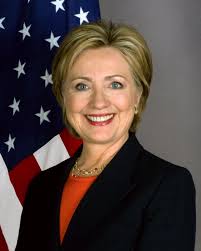
Hillary Clinton
For example:
On July 9, 2011, Republican extortionists threatened the Nation with financial ruin and international disgrace unless their budgetary demands were met.
They refused to raise the debt ceiling unless Democrats agreed to massively cut social programs for the elderly, poor and disabled.
If Congress failed to raise the borrowing limit of the federal government by August 2, the date when the U.S. reached the limit of its borrowing abilities, it would begin defaulting on its loans.
As Warren Buffett, CEO of Berkshire Hathaway, explained the looming economic catastrophe: “If you don’t send out Social Security checks, I would hate to think about the credit meeting at S&P and Moody’s the next morning.
“If you’re not paying millions and millions and millions of people that range in age from 65 on up, money you promised them, you’re not a AAA,” said Buffett.
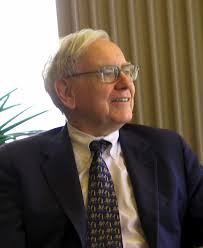
Warren Buffett
A triple-A credit rating is the highest possible rating that can be received.
And while Republicans demanded that the disadvantaged tighten their belts, they rejected raising taxes on their foremost constituency–the wealthiest 1%.
Raising taxes on the wealthy, they insisted, would be a “jobs-killer.” It would “discourage” corporate CEOs from creating tens of thousands of jobs they “want” to create.
As the calendar moved closer to the fateful date of August 2, Republican leaders continued to insist: Any deal that includes taxes “can’t pass the House.”
One senior Republican said talks would go right up to–and maybe beyond–the brink of default.
“I think we’ll be here in August,” said Republican Rep. Pete Sessions, of Texas. “We are not going to leave town until a proper deal gets done.”
President Obama had previously insisted on extending the debt ceiling through 2012. But in mid-July, he simply asked congressional leaders to review three options with their members:
- The “Grand Bargain” choice–favored by Obama–would cut deficits by about $4 trillion, including spending cuts and new tax revenues.
- A medium-range plan would aim to reduce the deficit by about $2 trillion.
- The smallest option would cut between $1 trillion and $1.5 trillion, without increased tax revenue or any Medicare and Medicaid cuts.
And the Republican response?
Said Rep. Darrell Issa, chairman of the Oversight and Government Reform Committee: “Quite frankly, [Republican] members of Congress are getting tired of what the president won’t do and what the president wants.”
With the United States teetering on the brink of national bankruptcy, President Obama faced three choices:
- Counter Republican extortion attempts via RICO–the Racketeer Influenced Corrupt Organizations Act.
- Make a Cuban Missile Crisis-style address to the American people, seeking to rally them against a criminal threat to the financial security of the Nation.
- Cave in to Republican demands.
Unfortunately for Obama and the Nation, he chose Number Three.
Rule #1 Ruthlessly Prosecute the Acts of Ruthless Criminals
But Obama could have countered that danger via the Racketeer Influenced Corrupt Organizations (RICO) Act.
In 1970, Congress passed RICO, Title 18, United States Code, Sections 1961-1968. Its goal: Destroy the Mafia.
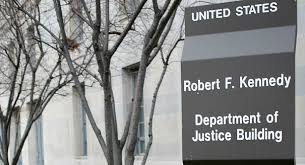
U.S. Department of Justice
RICO opens with a series of definitions of “racketeering activity” which can be prosecuted by Justice Department attorneys. Among those crimes: Extortion.
Extortion is defined as “a criminal offense which occurs when a person unlawfully obtains either money, property or services from a person(s), entity, or institution, through coercion.”
And if President Obama had believed that RICO was insufficient to deal with this crisis, he could have relied on the USA Patriot Act of 2001, passed in the wake of 9/11.

President George W. Bush signs the USA Patriot Act into law – October 26, 2001
In Section 802, the Act defines domestic terrorism. Among the behavior that is defined as criminal:
“Activities that…appear to be intended…to influence the policy of a government by intimidation or coercion [and]…occur primarily within the territorial jurisdiction of the United States.”
The remedies for punishing such criminal behavior were legally in place. President Obama needed only to direct the Justice Department to apply them.
“Activities that…appear to be intended…to influence the policy of a government by intimidation or coercion [and]…occur primarily within the territorial jurisdiction of the United States.”
The remedies for punishing such criminal behavior were legally in place. President Obama needed only to direct the Justice Department to apply them.
Prosecuting members of Congress would not have violated the separation-of-powers principle. Congressmen had been investigated, indicted and convicted for various criminal offenses.
Such prosecutions–and especially convictions–would have served notice on current and future members of Congress that the lives and fortunes of American citizens may not be held hostage as part of a negotiated settlement.
ABC NEWS, ASTROLOGY, BARACK OBAMA, BILL CLINTON, CBS NEWS, CNN, COMMUNIST CHINA, DONALD REGAN, DONALD TRUMP, EMPRESS ALEXANDRA, FACEBOOK, FBI, GEORGE W. BUSH, GERALD R. FORD, GRIGORY RASPUTIN, HILLARY CLINTON, HOUSE OF REPRESENTATIVES, JAMES COMEY, JIMMY CARTER, JOAN QUIGLEY, JODIE FOSTER, JOHN W. HINCKLEY, JUSTICE DEPARTMENT, KEVIN MCCARTHY, MERV GRIFFIN, MIKHAIL GORBACHEV, MITT ROMNEY, NANCY REAGAN, NBC NEWS, NICHOLAS II, PAUL RYAN, REPUBLICANS, Ronald Reagan, SOVIET UNION, SUPERSTITION, THE CHICAGO SUN-TIMES, THE CHICAGO TRIBUNE, THE LOS ANGELES TIMES, THE NEW YORK TIMES, THE WALL STREET JOURNAL, THE WASHINGTON POST, TWITTER, USA TODAY
In Bureaucracy, History, Military, Politics, Social commentary on July 7, 2016 at 12:16 am
On July 6, FBI Director James Comey recommended that the Justice Department not prosecute Hillary Clinton for using a private email server during her tenure as Secretary of State.
Almost immediately afterward, Donald Trump, the presumptive Republican nominee for President, responded on Twitter: “FBI director said Crooked Hillary compromised our national security. No charges. Wow! #RiggedSystem.”
Paul Ryan, the Republican Speaker of the House of Representatives, claimed to be similarly outraged: “Declining to prosecute Secretary Clinton for recklessly mishandling and transmitting national security information will set a terrible precedent.”
“What Director Comey’s statements made clear was that Hillary Clinton’s decision to use a personal unsecured server to send work-related emails while service as Secretary of State—including classified information—was extremely irresponsible,” said House Republican Majority leader Kevin McCarthy.
But 28 years ago, Republicans maintained a tight-lipped silence on another matter involving sensitive national security secrets. That was when news broke that Nancy Reagan, as First Lady, had shared these with a court astrologer.
When President Ronald Reagan wanted advice on whether to nuke the Soviet Union or meet with its leader, Mikhail Gorbachev, his most important adviser wasn’t the CIA or Pentagon.
It was Joan Quigley, a San Francisco-based astrologer.
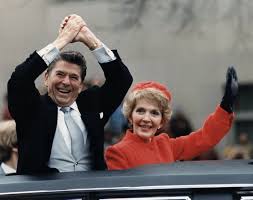
Ronald and Nancy Reagan
Nancy had met Quigley on “The Merve Griffin Show” in 1973. Quigley gave Nancy–and through her, Reagan himself—astrological advice during the latter’s campaign for the Republican Presidential nomination in 1976.
That effort failed to unseat President Gerald Ford–who was defeated by Jimmy Carter. But four years later, in 1980, Reagan defeated Carter to become the 40th President of the United States.
On March 30, 1981, a mentally-disturbed loner named John W. Hinckley shot and critically wounded Reagan. Fixated on actress Jodie Foster, he believed that by shooting the President he could gain her affection.
Shortly after the shooting, Merv Griffin told Nancy that Quigley had told him: If Nancy had called her on that fateful day, she–Quigley–could have warned that the President’s astrological charts had foretold a bad day.
From that moment on, Nancy regularly consulted Quigley on virtually everything that she and the President intended to do.
When Reagan learned of Nancy’s consultations with Quigley, he warned her: Be careful, because it might look odd if it came out.
Nancy may have been speaking on a scrambler-equipped phone. But Quigley–at her San Francisco office–was on an unsecured line. Thus, foreign powers–most notably the Soviet Union and Communist China–could have been privy to President Reagan’s most secret intentions.

Joan Quigley
Nancy passed on Quigley’s suggestions as commands to Donald Regan, chief of the White House staff.
As a result, Regan kept a color-coded calendar on his desk to remember when the astrological signs were good for the President to speak, travel, or negotiate with foreign leaders: Green ink highlighted “good” days; red ink “bad” days; yellow ink “iffy” days.
Donald Regan, no fan of Nancy’s, chafed under such restrictions: “Obviously, this list of dangerous or forbidden dates left very little latitude for scheduling,” he later wrote.
Forced out of the White House in 1987 by Nancy, Regan struck back in a 1988 tell-all memoir: For the Record: From Wall Street to Washington.
Regan’s book revealed, for the first time, how Ronald Reagan had actually made his Presidential decisions.
All–including decisions to risk nuclear war with the Soviet Union–were based on a court astrologer’s horoscopes. Rationality and the best military intelligence available played a lesser, secondary role.
The last major world leader to turn to the supernatural for advice had been Russian Czar Nicholas II. His adviser had been Grigori Rasputin, a Siberian peasant whom Empress Alexandra believed was the only man who could save her hemophiliac son–and heir to the throne.
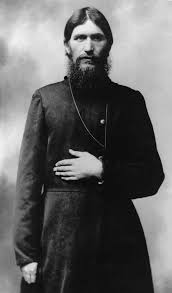
Grigori Rasputin
In 1990, Quigley confirmed the allegations in an autobiography, What Does Joan Say?: My Seven Years As White House Astrologer to Nancy and Ronald Reagan.
The title came from the question that Ronald Reagan asked Nancy before making important decisions–including those that could risk the destruction of the United States.
Bragged Quigley: “Not since the days of the Roman emperors–and never in the history of the United States Presidency—has an astrologer played such a significant role in the nation’s affairs of State.”
Among the successes Quigley took credit for:
- Strategies for winning the Presidential elections of 1980 and 1984;
- Helping Nancy Reagan overhaul her image as a spoiled rich girl;
- Defusing the controversy over Reagan’s visiting a graveyard for SS soldiers in Bitburg, Germany;
- Pursuing “Star Wars” as a major part of his strategy against the Soviet Union;
- The Intermediate-Range Nuclear Forces Treaty;
- Protecting Reagan from would-be assassins through timely warnings to Nancy; and
- Moving Reagan from seeing the Soviet Union as the “Evil Empire” to accepting Mikhail Gorbachev as a peace-seeking leader.
Thirty-five years after he became President, Ronald Reagan remains the most popular figure among Republicans. His deliberately-crafted myth is held up as the example of Presidential greatness by Right-wing candidates.
Curiously, however, none of them mention his approach to government-by-astrologer.
"MISSION: IMPOSSIBLE", "THE FBI" SERIES, ABC NEWS, ALBERT ANASTASIA, ALBERT RUDDY, CARLO GAMBINO, CBS NEWS, CNN, COSA NOSTRA, ELLIOT NESS, FACEBOOK, FBI, FORD MOTOR COMPANY, ISLAMIC STATE OF IRAQ AND SYRIA (ISIS), ISLAMIC TERRORISM, ITALIAN-AMERICAN CIVIL RIGHTS LEAGUE, J. EDGAR HOOVER, JOHN N. MITCHELL, JOSEPH "CRAZY JOE" GALLO, JOSEPH BONANNO, JOSEPH COLUMBO, JUSTICE DEPARTMENT, MAFIA, NBC NEWS, NELSON ROCKEFELLER, NYPD, OMAR MATEEN, POLITICAL CORRECTNESS, ROBERT F. KENNEDY, THE CHICAGO SUN-TIMES, THE CHICAGO TRIBUNE, THE GODFATHER, THE GODTATHER PART II, THE LOS ANGELES TIMES, THE NEW YORK TIMES, THE UNTOUCHABLES, THE WASHINGTON POST, TWITTER, VITO GENOVESE
In Bureaucracy, History, Law Enforcement, Politics, Social commentary, Uncategorized on July 5, 2016 at 12:07 am
In 1970, New York Mafia boss Joseph Columbo declared war on the FBI.
The Bureau had arrested his son, Joseph Columbo, Jr., for melting silver coins down into silver ingots. So Columbo, Sr., created the Italian-American Civil Rights League to “combat prejudice against Italian-Americans.”
Columbo appeared at fundraisers and speaking engagements for the League, and gave interviews on talk-shows–such as the one hosted by Dick Cavett.
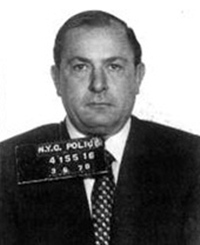
Joseph Columbo
His message: There was no Mafia–only an FBI slander against decent, hard-working Italian-Americans.
And he sent hundreds of members of the League to picket the East Side offices of the FBI.
His actions generated a massive response from many law-abiding Italian-Americans who felt themselves the victims of prejudice.
During the 1950s and early 1960s Congress had held hearings on the Mafia, making Italian and Sicilian criminals like Vito Genovese and Albert Anastasia household words.
Even more enraging had been the depiction of Italians as the villains on the popular ABC TV series, “The Untouchables.” Each week, Eliot Ness and his squad of Treasury agents wiped out a new batch of Prohibition gangsters–who had Italian names like Al Capone and Frank Nitti.
On June 29, 1970, 150,000 people attended an Italian-American Unity Day rally in Columbus Circle in New York City. Several prominent entertainers and five members of the House of Representatives attended.
Under Colombo’s guidance, the League grew quickly and achieved national attention, establishing chapters in 17 states with over 50,000 members.
Shortly after the Columbus Circle rally, then-U.S. Attorney General John N. Mitchell banned the words “Mafia” and “Cosa Nostra” (“Our Thing”) from FBI and Justice Department press releases.
“There is nothing to be gained by using these terms,” said Mitchell, “except to give gratuitous offense to many good Americans of Italian-American descent.”
Seal of the Justice Department
In Albany, New York, then-Governor Nelson Rockefeller instructed the state police to likewise ban such terms.
And the Ford Motor Company, which sponsored the popular ABC-TV series, “The FBI,” also fell into line. While the Bureau’s real-life agents fought the Mafia, its fictionalized agents couldn’t say “Mafia” on TV.
In the spring of 1971, Paramount Pictures began started filming The Godfather, which was to become the most influential movie ever made about the Mafia.
Facing the threat of strikes and violence from the League, the film’s producer, Albert Ruddy, met with Columbo. Ruddy promised that “Mafia” and “Cosa Nostra” would not appear in a film in which almost every major character was a member of the Mafia.

TV’s “Mission: Impossible”–having moved from deposing overseas despots to stateside criminals–similarly referred to organized criminals as “The Syndicate.”
But Columbo was now facing increasing pressure from two sets of enemies.
The first was the FBI–whose agents seethed as they strode through League picket lines near their headquarters at Third Avenue and 69th Street. They were waging war on gangsters, and they resented being called liars and racists.
The second was the Mafia itself. Its older leaders knew there was an all-out Federal drive to destroy the organization. And they feared that Columbo’s in-your-face tactics were goading the FBI and other law enforcement agencies into greater efforts against them.
Of those older leaders, Carlo Gambino, boss of the largest and most powerful Mafia family in New York and the country, was the most important.
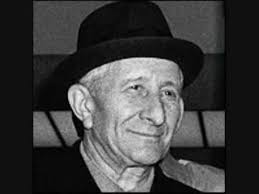
Carlo Gambino
Gambino had set Columbo up in his own family in 1964. This after Columbo had raced to Gambino with the news that his own boss, Joseph Bonanno, planned to “whack” Don Carlo and the other four New York Mafia bosses and become the “boss of all bosses” himself.
Bonnano was thus deposed and sent into exile in Arizona, and Columbo found himself a new boss.
Gambino had always lived in the shadows. As Columbo built up the League, Gambino feared that the publicity and attacks on the FBI would rebound against himself and his brethren.
As the date–June 28, 1971–for the second Italian-American Unity Day rally approached, Gambino quietly put out the word: Stay away.
On that morning Columbo posed for photographers at the rally. Suddenly one of them–a black man–exchanged his camera for an automatic pistol and shot Columbo three times in the head and neck.

Joseph Columbo, after being shot
Seconds later, the shooter was covered by an avalanche of men–one of whom pumped three bullets into him.
The shooter was Jerome Johnson, an ex-con who was linked to mobster Joseph “Crazy Joe” Gallo. The NYPD and FBI believed that Gambino had given Gallo permission to whack Columbo. And that Gallo had used a black man as the ultimate insult to a man he had long hated.
Columbo remained in a vegetative state until May 22, 1978, when he died of cardiac arrest.
There was no third Italian-American Unity Day rally. And the Italian-American Civil Rights League died with Columbo.
Eventually, the Justice Department and FBI went back to using “Mafia” and “La Cosa Nostra.”
And when Francis Ford Coppola made The Godfather, Part II, in 1974, he inserted both words into a scene where Mafia boss Michael Corleone is interrogated by a Senate committee.
For the Mafia, at least, the era of Political Correctness was over.
"MISSION: IMPOSSIBLE", "THE FBI" SERIES, ABC NEWS, AL RUDDY, ALBERT ANASTASIA, ALBERT RUDDY, CARLO GAMBINO, CBS NEWS, CNN, COSA NOSTRA, ELLIOT NESS, FACEBOOK, FBI, FORD MOTOR COMPANY, ISLAMIC STATE OF IRAQ AND SYRIA (ISIS), ISLAMIC TERRORISM, ITALIAN-AMERICAN CIVIL RIGHTS LEAGUE, J. EDGAR HOOVER, JOHN N. MITCHELL, JOSEPH "CRAZY JOE" GALLO, JOSEPH BONANNO, JOSEPH COLUMBO, JUSTICE DEPARTMENT, MAFIA, NBC NEWS, NELSON ROCKEFELLER, NYPD, OMAR MATEEN, POLITICAL CORRECTNESS, ROBERT F. KENNEDY, THE CHICAGO SUN-TIMES, THE CHICAGO TRIBUNE, THE GODFATHER, THE GODTATHER PART II, THE LOS ANGELES TIMES, THE NEW YORK TIMES, THE UNTOUCHABLES, THE WASHINGTON POST, TWITTER, VITO GENOVESE
In Bureaucracy, History, Law Enforcement, Politics, Social commentary on July 4, 2016 at 12:52 am
On June 12, Omar Mateen, a 29-year-old former security guard, slaughtered 49 men and women and injured 53 more inside Pulse, a gay nightclub in Orlando, Florida.
Mateen was then shot to death by Orlando police after a three-hour standoff.
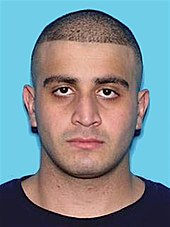
Omar Mateen
It was the deadliest mass shooting by a single gunman in American history–and the deadliest terrorist attack in the United States since the Al Qaeda attacks of September 11, 2001.
The massacre was widely decried as an act of Islamic terrorism. But many others insisted it was simply a hate crime.
Among those opting for the latter: Officials at the Department of Justice (DOJ) and the Federal Bureau of Investigation (FBI).
During his three-hour slaughterfest, Mateen made a call to 9-1-1, pledging his allegiance to the Islamic State of Iraq and Syria (ISIS) and its leader, Abu Bakr al-Baghdadi.
On June 20, the FBI released an edited version of the transcript of that call. All references to ISIS were removed.
The Justice Department claimed that it was withholding some details to avoid putting the victims through any more pain–and to not further the propaganda efforts of ISIS.
A firestorm of protest erupted from Republican Congressional leaders, most notably Speaker of the House Paul Ryan. Since Mateen’s pledge to ISIS had become widely known, they demanded, what was the point of censoring it in the transcript of his phone call?
An additional reason for the fury aimed at the Justice Department: On June 12, ISIS had, through its news agency, Amag, claimed responsibility for the massacre:
“The armed attack that targeted a gay night club in the city of Orlando in the American state of Florida which left over 100 people dead or injured was carried out by an Islamic State fighter.”
Finally, buckling to pressure, on the afternoon of June 20, the FBI released the full, uncensored transcript of Mateen’s call to 9-1-1.
This was definitely not the finest hour of an organization whose motto is: “Fidelity, Bravery, Integrity.”
Seal of the FBI
It was not, however, the first time the Bureau caved in to the demands of Political Correctness.
This occurred almost 50 years earlier–in 1970.
And the man who was responsible for this was not a member of ISIS. Instead, he belonged to another, equally deadly organization: The Mafia.
Joseph Anthony (“Joe”) Columbo was the boss of the Columbo crime family, one of the “Five Families” of the Cosa Nostra in New York.
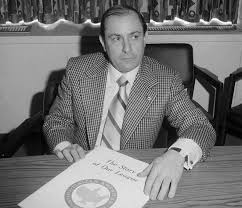
Joseph Columbo
At 45, Columbo was one of the youngest Mafia bosses in the United States. He was also the first American-born boss of a New York crime family.
But, unlike his fellow bosses, he didn’t hesitate to court publicity–or confront law enforcement.
Summoned for questioning about the murder of one of his “soldiers,” Columbo appeared–without a lawyer–at the office of NYPD detective Albert Seedman.
“I am an American citizen, first class,” he blasted Seedman. “I don’t have a badge that makes me an official good guy like you. But I work just as honest for a living.”
Naturally, Columbo denied having anything to do with the death of his subordinate.
In the spring of 1970, Columbo decided to raise his sights. He moved from attacking the NYPD to taking on the FBI.
Throughout most of the tenure of its director, J. Edgar Hoover, the FBI had avoided tackling the Mafia. From the 1920s until the 1950s, mobsters had operated virtually untouched by the most powerful Federal law enforcement agency.
To this day, Hoover’s reasons for avoiding mob enforcement remain unknown. Theories for this include:
- He feared his agents would be corrupted by Mafia bribes.
- He preferred flashy, easily-solved cases like bank-robbery and stolen car rings.
- The Mob blackmailed him with compromising photos of a homosexual relationship with Clyde Tolson, his second-in-command at the FBI.
Then, in 1961, Robert F. Kennedy became Attorney General. As former chief counsel for the Senate Labor Rackets Committee (1957-59) Kennedy had investigated the Mafia’s infiltration of the nation’s labor unions. He had focused especially on its ownership of the International Brotherhood of Teamsters.
Unlike Hoover–who denied the Mafia existed–Kennedy was convinced that it did.
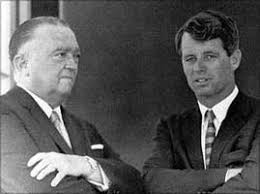
J. Edgar Hoover and Robert F. Kennedy
And as the brother to President John F. Kennedy, RFK had the power to needed to force Hoover to attack the crime syndicates.
Throughout the country, the Mafia felt a new heat as FBI agents planted illegal electronic microphones (“bugs”) in their innermost sanctums. Agents openly tailed mobsters–and sent them to prison in large numbers.
Most old-time Mafia bosses decided to take a low profile to avoid the new Federal pressure. They remembered how Al Capone had flaunted his wealth and power–and had fallen victim to the IRS for it.
In April, 1970, Columbo’s son, Joseph Jr., was arrested by the FBI for melting down coins for resale as silver ingots. The Mafia boss decided to retaliate.
He publicly declared there was no such thing as the Mafia. This was a fiction created by FBI agents taking out their prejudice on law-abiding Italian-Americans.
Then he sent members of his newly-formed organization–the Italian-American Civil Rights League–to picket the East Side offices of the FBI.
2016 PRESIDENTIAL RACE, ABC NEWS, BLACKS, BOEING, CBS NEWS, CNN, DONALD TRUMP, FACEBOOK, GEORGE C. WALLACE, HILLARY CLINTON, JOHN F. KENNEDY, JOHN MCCAIN, JUSTICE DEPARTMENT, MAFIA, MEXICANS, NBC NEWS, PRISONERS OF WAR, ROBERT F. KENNEDY, SAUDI ARABIA, STATE DEPARTMENT, THE CHICAGO SUN-TIMES, THE CHICAGO TRIBUNE, THE KENNEDYS, THE LOS ANGELES TIMES, THE NEW YORK TIMES, THE WALL STREET JOURNAL, THE WASHINGTON POST, TWITTER, WOMEN
In History, Law Enforcement, Politics, Social commentary, Uncategorized on June 6, 2016 at 12:01 am
Today, America has two major candidates running for President: Donald Trump and Hillary Clinton.
Trump is a billionaire businessman. Clinton is a former First Lady, U.S. Senator and Secretary of State.
Despite the great differences in their backgrounds, they both share one thing in common: Extremely high negatives among voters.
Trump’s hate-filled rhetoric has deliberately or unintentionally offended almost every major American voting group, including:
- Mexicans: “They’re bringing drugs.They’re bringing crime. They’re rapists.” He’s also promised to “build a great, great wall on our southern border and I will have Mexico pay for that wall.”
- Prisoners-of-War: Speaking of Arizona U.S. Senator John McCain, a Vietnam POW for seven years: “He’s not a war hero. He’s a war hero because he was captured. I like people that weren’t captured.”
- Women: “If Hillary Clinton can’t satisfy her husband, what makes her think she can satisfy America?”
These insults delight his white, uneducated followers. But they have alienated millions of other Americans who might have voted for him.
As for Clinton: She continues to be dogged by charges that she used her position as Secretary of State (2009-2013) to enrich herself.
Countries that made large contributions to the Clinton Foundation got an increase in State Department-approved arms sales.
For example: In 2011, the State Department green-lighted a $29 billion arms deal to Saudi Arabia, despite its dismal record on human rights.
Years before Clinton became Secretary of State, Saudi Arabia donated $10 million to the Clinton Foundation. And Boeing, the biggest defense contractor involved, donated $900,000 to the Clinton Foundation just two months before the deal was finalized.
But 48 years ago, Senator Robert Francis Kennedy aroused passions of an altogether different sort.
Kennedy had been a United States Attorney General (1961-1964) and Senator (1964-1968). But it was his connection to his beloved and assassinated brother, President John F. Kennedy, for which he was best known.
Robert F. Kennedy campaigning for President
Millions saw RFK as the only candidate who could make life better for America’s impoverished–while standing firmly against those who threatened the Nation’s safety.
As television correspondent Charles Quinn observed: “I talked to a girl in Hawaii who was for [George] Wallace [the segregationist governor of Alabama]. And I said ‘Really?’ [She said] ‘Yeah, but my real candidate is dead.’
“You know what I think it was? All these whites, all these blue collar people who supported Kennedy…all of these people felt that Kennedy would really do what he thought best for the black people, but, at the same time, would not tolerate lawlessness and violence.
“They were willing to gamble…because they knew in their hearts that the country was not right. They were willing to gamble on this man who would try to keep things within reasonable order; and at the same time do some of the things they knew really should be done.”
Campaigning for the Presidency in 1968, RFK had just won the crucial California primary on June 4–when he was shot in the back of the head. His killer: Sirhan Sirhan, a young Palestinian furious at Kennedy’s support for Israel. He died at 1:44 a.m. on June 6.
On June 8, 1,200 men and women boarded a specially-reserved passenger train at New York’s Pennsylvania Station. They were accompanying Kennedy’s body to its final resting place at Arlington National Cemetery.
As the train slowly moved along 225 miles of track, throngs of men, women and children lined the rails to pay their final respects to a man they considered a genuine hero.
Little Leaguers clutched their baseball caps across their chests. Uniformed firemen and policemen saluted. Burly men in shirtsleeves held hardhats over their hearts. Black men in overalls waved small American flags. Women from all levels of society stood and cried.
A nation says goodbye to Robert Kennedy
Commenting on RFK’s legacy, historian William L. O’Neil wrote in Coming Apart: An Informal History of America in the 1960′s:
“…He aimed so high that he must be judged for what he meant to do, and, through error and tragic accident, failed at….He will also be remembered as an extraordinary human being who, though hated by some, was perhaps more deeply loved by his countrymen than any man of his time.
“That too must be entered into the final account, and it is no small thing. With his death something precious disappeared from public life.”
The Kennedy family never again roused the same passions among voters as it did during RFK’s short-lived run for the Presidency.
And America has never again since seen a Presidential candidate who combined toughness on crime and compassion for the poor.
Republican candidates have waged war on crime–and the poor. And Democratic candidates have moved to the Right in eliminating anti-poverty programs.
RFK had the courage to fight the Mafia–and the compassion to fight poverty. At a time of rising rates of income inequality and corporate crime, his kind of politics are sorely missed.


 Bureaucracybuster's Blog
ABC NEWS, ADOLF HITLER, BAVARIA, BEER HALL PUTSCH, BREITBART NEWS, CBS NEWS, CHRISTOPHER S. MURPHY, CIA, CNN, DEMOCRATIC NATIONAL COMMITTEE, DEMOCRATIC PARTY, DONALD TRUMP, EXTORTION, FACE THE NATION, FACEBOOK, FERGUS CULLEN, FOX NEWS SUNDAY, GREG ABBOTT, HACKING, HILLARY CLINTON, HITLER: ASCENT, IRS, JAMES B. COMEY, JAMES R. CLAPPER, JEWS, JOHN KASICH, JUSTICE DEPARTMENT, KEN PAXTON, LEON PANETTA, MEIN KAMPF, MICHAEL ROGERS, MIKE PENCE, MUNICH, NATIONAL SECURITY AGENCY, NAZI PARTY, NBC NEWS, NEW HAMPSHIRE REPUBLICAN PARTY, NEWSWEEK, NPR, PAM BONDI, PAUL RYAN, PHILIP KLEIN, POLITICO, Racketeer Influenced Corrupt Organizations (RICO) Act, REPUBLICAN NATIONAL COMMITTEE, REPUBLICAN NATIONAL CONVENTION, REPUBLICAN PARTY, ROGER STONE, SALON, SOVIET UNION, THE CHICAGO SUN-TIMES, THE CHICAGO TRIBUNE, THE HUFFINGTON POST, THE LOS ANGELES TIMES, THE NEW YORK TIMES, THE WASHINGTON EXAMINER, THE WASHINGTON POST, THREATS, TIME, TREASON, TRUMP UNIVERSITY, TWITTER, U.S. NEWS & WORLD REPORT, U.S. SECRET SERVICE, USA PATRIOT ACT, USA TODAY, VLADIMIR PUTIN, VOLKER ULLRICH, WEIMAR REPUBLIC
WHY TRUMP WON: WHAT DIDN’T HAPPEN: PART TWO (OF THREE)
In Bureaucracy, History, Law, Law Enforcement, Politics, Social commentary on January 3, 2017 at 12:01 amThreatening his Republican and Democratic opponents with violence played a major role in Donald Trump’s campaign for President.
No other candidate—Republican or Democrat—had ever made such repeated and brutal use of threats of physical assault in pursuing the Presidency.
Making threats against anyone under protection by the U.S. Secret Service is a felony. Yet Donald Trump was never held legally accountable by the Justice Department.
Threats of this type continued to be made by Trump supporters right up to the day of the election.
Even Fergus Cullen, former chairman of the New Hampshire GOP, expressed fear of what might happen if Trump lost the election:
Fergus Cullen
“That’s really scary,” Cullen said, recounting the violence at Trump rallies around the country leading up to the Republican National Convention. “In this country, we’ve always had recriminations after one side loses. But we haven’t had riots. We haven’t had mobs that act out with violence against supporters of the other side.
“There’s no telling what his supporters would be willing to do at the slightest encouragement from their candidate,” he said.
Trump even began encouraging his mostly white supporters to sign up online to be “election observers” to stop “Crooked Hillary from rigging this election.” He urged them to act as poll watchers in “other” [non-white] communities to ensure that things are “on the up and up.”
Many of his supporters promised to do so.
“Trump said to watch your precincts. I’m going to go, for sure,” said Steve Webb, a 61-year-old carpenter from Fairfield, Ohio.
“I’ll look for…well, it’s called racial profiling. Mexicans. Syrians. People who can’t speak American,” he said. “I’m going to go right up behind them. I’ll do everything legally. I want to see if they are accountable. I’m not going to do anything illegal. I’m going to make them a little bit nervous.”
Knowing that large numbers of angry—and possibly armed—Right-wingers planned to descend on polling places could only have had a chilling effect on untold numbers of Democratic voters. And this would have been especially true in heavily conservative states.
Both the USA Patriot Act and the Racketeer Influenced Corrupt Organizations (RICO) Act have statutes dealing with making terrorist threats against government institutions to influence their members.
President George W. Bush signing the USA Patriot Reauthorization Act of 2005
If Trump’s remarks did not violate one or both of those laws, certainly remarks made by his surrogates did.
Thus, the Justice Department could have cited the Patriot Act in indicting Trump and/or any number of his followers for “activities that…appear to be intended…to influence the policy of a government by intimidation or coercion [and]…occur primarily within the territorial jurisdiction of the United States.”
The Justice Department could have also demanded that the results of the election be invalidated on the basis that widespread voter and candidate intimidation played a massive role in it.
But of course this did not happen.
Share this: