Posts Tagged ‘HOLOCAUST’
2016 PRESIDENTIAL CAMPAIGN, ABC NEWS, ADOLF HITLER, ALTERNET, ANNE FRANK, ANTONIN SCALIA, AP, AUSCHWITZ, BARACK OBAMA, BERGEN-BELSEN, BUZZFEED, CBS NEWS, CNN, CROOKS AND LIARS, DAILY KOZ, DONALD TRUMP, EVA SCHLOSS, FACEBOOK, HOLOCAUST, illegal immigration, ISIS, MEXICO, MOTHER JONES, MOVEON, MSNBC, NAZI GERMANY, NBC NEWS, NEWSWEEK, NPR, PBS NEWSHOUR, POLITICO, POPE FRANCIS, RAW STORY, REUTERS, SALON, SEATTLE TIMES, SLATE, SRI LANKA EASTER BOMBINGS, SUPREME COURT, SYRIAN REFUGEES, TERRORISM, THE ATLANTIC, THE CHICAGO SUN-TIMES, THE CHICAGO TRIBUNE, THE DAILY BEAST, THE GUARDIAN, THE HILL, THE HUFFINGTON POST, THE LOS ANGELES TIMES, THE NATION, THE NEW YORK TIMES, THE WASHINGTON POST, TIME, TWITTER, U.S. NEWS & WORLD REPORT, UPI, USA TODAY, VATICAN
In History, Law, Military, Politics, Social commentary on May 17, 2019 at 12:06 am
Right-wingers, who support many of the same policies of Adolf Hitler, often attack liberals as Nazis.
This was especially true when President Barack Obama held office.
But in 2016 a genuine authority on Fascism came forward to assess the front-runner for the Republican Presidential nomination.
“If Donald Trump become[s] the next president of the United States it would be a complete disaster. I think he is acting like another Hitler by inciting racism.”
So said Eva Schloss, the stepsister of Holocaust victim Anne Frank. As a survivor of Auschwitz, Schloss knows something about Nazis.

Eva Schloss
Then 86, Schloss met Anne in Amsterdam as a fellow refugee. Both their families had taken refuge there after fleeing Nazi Germany.
Anne Frank spent four years hiding in an attic and keeping a diary. But in 1944 she was discovered by the Nazis and sent to the Bergen-Belsen concentration camp.
She was 15 when she died there of typhus in March, 1945. After the war, Eva Schloss’ mother, Fritzi, married Otto Frank, Anne’s father.

Anne Frank
Eva was detained at the same time as Anne and sent to Auschwitz. She survived when the camp was liberated on January 27,1945.
In a January 27, 2016 essay for Newsweek, Schloss warned of dire consequences if Donald Trump became President:
“During his U.S. presidential campaign he has suggested the ‘total and complete shutdown of Muslims entering the United States,’ as well as pledging to build a wall between the U.S. and Mexico to keep illegal immigrants out.”
She was 11 when her family immigrated to Belgium after Hitler forcibly annexed Austria in 1938.
“We were treated as if we had come from the moon. I felt as if I wasn’t wanted and that I was different to everybody. It is even harder for today’s Syrian refugees who have a very different culture….
“I am very upset that today again so many countries are closing their borders,” said Schloss, who lives in London. “Fewer people would have died in the Holocaust if the world had accepted more Jewish refugees.”
And on February 18, 2016, Pope Francis also waded into the 2016 Presidential race with his own assessment of Trump.
During a six-day trip to Mexico, a reporter asked the Pontiff: What did he think of Trump’s campaign pledge to build a wall along the entire length of the U.S.-Mexican border and expel millions of illegal aliens now living in the United States?
“A person who only thinks about building walls, wherever they are, and not in building bridges, is not Christian,” replied the Pope. “This is not the gospel.”
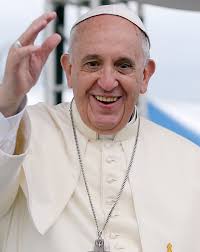
Pope Francis
Francis said he would “give the benefit of the doubt” to Trump because he had not heard Trump’s border plans independently.
But he added: “I say only that this man is not a Christian if he has said things like that.”
Trump, a Presbyterian, responded minutes later: “For a religious leader to question a person’s faith is disgraceful.”
Trump has repeatedly accused President Barack Obama—a self-described Christian—as a secret Muslim.
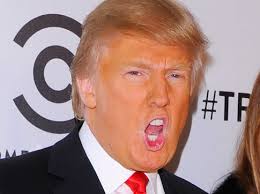
Donald Trump
On February 21, 2016, for example, he tweeted: “I wonder if President Obama would have attended the funeral of [Supreme Court] Justice [Antonin] Scalia if it were held in a mosque.”
Obama had paid tribute to Scalia at the Supreme Court on the day prior to the funeral. He declined to attend the service because his heavy security detail might disrupt the ceremony.
“I am proud to be a Christian,” added Trump, “and as president I will not allow Christianity to be consistently attacked and weakened.”
Nor did he stop there: “If and when the Vatican is attacked by the ISIS [Islamic State of Iraq and Syria], which as everyone knows is ISIS’s ultimate trophy, I can promise you that the pope would have only wished and prayed that Donald Trump would have been president.
“ISIS would have been eradicated, unlike what is happening now with our all talk, no action politicians.”
Trump thus implied that the Pope’s future security depended on the United States generally—and on Trump in particular.
And he ignored the fact that, since September, 2014, the United States Air Force had been bombing ISIS convoys in Iraq and Syria.
On Easter Sunday, 2019—more than two years into Trump’s Presidency—ISIS bombed a series of churches and hotels in Sri Lanka, killing at least 321 people.
Trump has long been critical of the Pope’s stand on immigration.
As the Pope undertook his trip to Mexico, Trump told Fox Business Network that he didn’t think Francis understood “the danger of the open border we have with Mexico.
“I think Mexico got him to do it because they want to keep the border just the way it is,” he said. “They’re making a fortune, and we’re losing.”
A Vatican spokesman replied: “The pope always talks about migration problems all around the world, of the duties we have to solve these problems in a humane manner, of hosting those who come from other countries in search of a life of dignity and peace.”
For millions of Jews and Christians, the election of 2016 has turned into a referendum: Am I serving the Lord—or Satan?
ABC NEWS, ADOLF HITLER, ALTERNET, AP, BILL CLINTON, BUZZFEED, CALIFORNIA ENERGY CRISIS, CBS NEWS, CHEVRON, CNN, COAL INDUSTRY, CROOKS AND LIARS, DAILY KOZ, DE-REGULATION, DEMOCRATS, ENRON, FACEBOOK, FBI, GEORGE W. BUSH, GRAY DAVIS, HEINRICH HIMMLER, HOLOCAUST, MAFIA, MOTHER JONES, MOVEON, MSNBC, NBC NEWS, NEWSWEEK, NICCOLO MACHIAVELLI, NPR, PACIFIC GAS AND ELECTRIC, PBS NEWSHOUR, PETE WILSON, POLITICO, RAW STORY, REPUBLICANS, REUTERS, RICO ACT, SALON, SEATTLE TIMES, SLATE, SS, THE ATLANTIC, THE CHICAGO SUN-TIMES, THE CHICAGO TRIBUNE, THE DAILY BEAST, THE GUARDIAN, THE HILL, THE HUFFINGTON POST, THE LOS ANGELES TIMES, THE NATION, THE NEW YORK TIMES, THE SS, THE WALL STREET JOURNAL, THE WASHINGTON POST, TIME, TWITTER, U.S. DEPARTMENT OF JUSTICE, U.S. NEWS & WORLD REPORT, UPI, USA TODAY
In Bureaucracy, History, Law, Law Enforcement, Politics, Social commentary on November 29, 2018 at 12:05 am
A forgotten anniversary is fast approaching: This December 2 will mark the 17th anniversary of the collapse of Enron Corporation.
Based in Houston, Texas, Enron had employed 22,000 staffers and was one of the world’s leading electricity, natural gas, communications and paper companies.
In 2000, it claimed revenues of nearly $101 billion. Fortune had named Enron “America’s Most Innovative Company” for six consecutive years.
But then the truth emerged in 2001: Enron’s reported profitability was based not on brilliance and innovation but on systematic and creative accounting fraud.
And, on December 2, 2001, Enron filed for bankruptcy under Chapter 11 of the United States Bankruptcy Code.
Enron’s $63.4 billion in assets made it the largest corporate bankruptcy in U.S. history—until WorldCom’s bankruptcy in 2002.

The California electricity crisis (2000-2001) was caused by market manipulations and illegal shutdowns of pipelines by Texas energy companies.
The state suffered from multiple large-scale blackouts. Pacific Gas & Electric, one of the state’s largest energy companies, collapsed, and the economic fall-out greatly harmed Governor Gray Davis’ standing.
The crisis was made possible by Governor Pete Wilson, who had forced the passage of partial de-regulation legislation in 1996.
Enron seized its opportunity to inflate prices and manipulate energy output in California’s spot markets. The crisis cost the state $40 to $45 billion.
The true scandal of Enron was not that it was eventually destroyed by its own greed.
The true scandal was that its leaders were never Federally prosecuted for almost driving California—and the entire Western United States—into bankruptcy.
Under the pro-oil company administration of George W. Bush, no such prosecutions ever occurred. But Americans had a right to expect such redress under “liberal” President Bill Clinton.
Once the news broke that Enron had filed for bankruptcy, commentators almost universally oozed compassion for its thousands of employees who would lose their salaries and pensions.
No one, however, condemned the “profits at any cost” dedication of those same employees for pushing California to the brink of ruin.
To put this in historical perspective:
- Imagine a historian writing about the destruction of Hitler’s Schutzstaffel (Guard Detachment), or SS, as a human interest tragedy.
- Imagine its Reichsfuehrer, Heinrich Himmler, being blamed for failing to prevent its collapse—as CEO Kenneth Lay was blamed for Enron’s demise.
- Imagine that same historian completely ignoring the horrific role the SS had played throughout Nazi-occupied countries—and its primary role in slaughtering six million Jews in the Holocaust.
Nor did anyone in the media or government declare that the solution to such extortionate activity lay within the United States Department of Justice via RICO—the Federal Racketeer Influenced Corrupt Organizations Act.

Passed by Congress in 1970, this was originally aimed at the kingpins of the Mafia. Since the mid-1980s, however, RICO has been successfully applied against both terrorist groups and legitimate businesses engaged in criminal activity.
Under RICO, people financially injured by a pattern of criminal activity can bring a claim in State or Federal court, and obtain damages at three times the amount of their actual claim, plus reimbursement for their attorneys’ fees and costs.
Such prosecutions would have pitted energy-extortionists against the full investigative might of the FBI and the sweeping legal authority of the Justice Department.
Consider this selection from the opening of the Act:
(1) “racketeering activity” means (A) any act or threat involving…extortion; (B) any act which is indictable under any of the following provisions of title 18, United States Code: sections 891-894 (relating to extortionate credit transactions), section 1343 (relating to wire fraud)Section 1344 (relating to financial institution fraud), section 1951 (relating to interference with commerce, robbery, or extortion), section 1952 (relating to racketeering)….
With the 17th anniversary of Enron’s demise coming up, the mantra of “de-regulation” should be ruthlessly turned against those who have most ardently championed it.
Republicans have ingeniously dubbed the estate tax—which affects only a tiny minority of ultra-rich—“the death tax.” This makes it appear to affect everyone.
Democrats should thus recast de-regulation in terms that will prove equally popular. For example:
“Greed Relief”
“Greed Protection”
“Legalized Extortion”
And here are some possible slogans:
“The Energy Industry: Giving You the Best Congress Money Can Buy.”
“De-regulation: Let Criminals Be Criminals.”
Today the coal industry is pumping millions into TV ads touting the non-existent wonders of “clean coal.” And Chevron spends millions assuring us that “all those profits” go strictly toward making the world a better place for others. (Presumably not a penny is left for its altruistic executives.)
When faced with such outright lying by the most vested of financial interests, it’s well to recall the warning given by Niccolo Machiavelli more than 500 years ago:
All those who have written upon civil institutions demonstrate…that whoever desires to found a state and give it laws, must start with assuming that all men are bad and ever ready to display their vicious nature, whenever they may find occasion for it.
If their evil disposition remains concealed for a time, it must be attributed to some unknown reason; and we must assume that it lacked occasion to show itself. But time, which has been said to be the father of all truth, does not fail to bring it to light.
2016 PRESIDENTIAL CAMPAIGN, 2016 PRESIDENTIAL DEBATES, ABC NEWS, ACCESS HOLLYWOOD, ADOLF HITLER, ADRIANNE ZUCKER, ANDERSON COOPER, ANTI-SEMITISM, BARACK OBAMA, BILL CLINTON, BILLY BUSH, CBS NEWS, CNN, DAVID IRVING, DAYS OF OUR LIVES, DEBORAH LIPSTADT, DENIAL, DONALD TRUMP, FACEBOOK, HEINRICH HIMMLER, HILLARY CLINTON, HITLER’S WAR, HOLOCAUST, HOLOCAUST DENIAL, JESSICA LEEDS, LIBEL, MAR-A-LAGO, MELANIA TRUMP, MINDY MCGILLIVRAY, NATASHA STOYNOFF, NBC NEWS, PENGUIN BOOKS, PEOPLE MAGAZINE, RACHEL CROOKS, REINHARD HEYDRICH, RICHARD J. EVANS, SEXUAL HARASSMENT, THE CHICAGO SUN-TIMES, THE CHICAGO TRIBUNE, THE HUFFINGTON POST, THE LOS ANGELES, THE NEW YORK TIMES, THE PALM BEACH POST, THE WALL STREET JOURNAL, THE WASHINGTON POST, THIRD REICH, TWITTER, USA TODAY, WORLD WAR 11
In History, Law, Military, Politics, Social commentary on October 25, 2016 at 12:10 am
On October 7, The Washington Post leaked a video of Donald Trump making sexually predatory comments about women. The remarks came during a 2005 exchange with Billy Bush, then the host of Access Hollywood.
The two were traveling in an Access Hollywood bus to the set of the soap opera Days of Our Lives, where Trump was to make a cameo appearance. A “hot” microphone picked up their conversation–which has proved damning for Trump:
Donald Trump: You know and I moved on her actually. You know she was down on Palm Beach. I moved on her and I failed. I’ll admit it. I did try and fuck her.
She was married. No this was–and I moved on her very heavily, in fact, I took her out furniture shopping. She wanted to get some furniture. I said I’ll show you where they have some nice furniture. I moved on her like a bitch, but I couldn’t get there, and she was married.
Then all of a sudden I see her, she’s now got the big phony tits and everything. She’s totally changed her look.
[At that point, they spot Adrianne Zucker, the starring actress in Days in Our Lives.]
Trump: Yeah, that’s her. With the gold. I better use some Tic Tacs just in case I start kissing her. You know I’m automatically attracted to beautiful–I just start kissing them. It’s like a magnet. Just kiss. I don’t even wait.
And when you’re a star they let you do it. You can do anything. Grab them by the pussy. You can do anything.
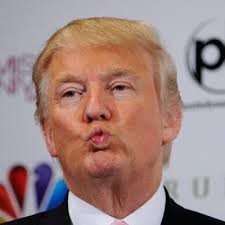
Donald Trump
When the Washington Post broke the story on October 7, the reaction was immediate–and explosive.
The Trump campaign quickly released a statement: “This was locker room banter, a private conversation that took place many years ago. Bill Clinton has said far worse to me on the golf course–not even close. I apologize if anyone was offended.”
During the second Presidential debate on October 9, moderator Anderson Cooper asked Trump: “Have you ever done those things?”
Trump: “And I will tell you–no I have not.”
On October 12, The Palm Beach Post, The New York Times and People all published stories of women claiming to have been sexually assaulted by Trump.
Mindy McGillivray told the Post that Trump groped her buttocks when she visited Mar-a-Lago in Palm Beach, Florida, in 2013.
In December, 2005, People magazine writer Natasha Stoynoff went to Mar-a-Lago to interview Donald and Melania Trump for a first-wedding-anniversary feature story.
During a break in the interview, Trump said he wanted to show Stoynoff around his mansion. There was one “tremendous” room he especially wanted to show her.
According to her account: “We walked into that room alone, and Trump shut the door behind us. I turned around, and within seconds he was pushing me against the wall and forcing his tongue down my throat.”
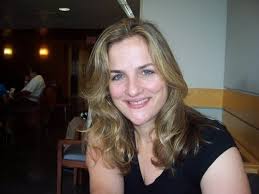
Natasha Stoynoff
Fortunately, Trump’s butler soon entered the room, and Trump acted as though nothing had happened. But as soon as he and Stoynoff were alone again, Trump said: “You know we’re going to have an affair, don’t you?”
Stoynoff asked her editors–and received permission–to be removed from writing any further Trump features.
The Times reported that, more than 30 years ago, Trump had made equally unwelcome advances toward businesswoman Jessica Leeds, then 38.
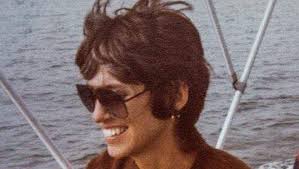
Jessica Leeds
She said she was sitting next to Trump in the first-class cabin of a New York-bound flight when Trump lifted the armrest, grabbed her breasts and tried to put his hand up her skirt.
She fled to the back of the plane.
Another woman who spoke to the Times was Rachel Crooks. She was a 22-year-old receptionist at Bayrock Group, a real estate investment and development company in Trump Tower in Manhattan in 2005.
One morning she came face-to-face with Trump outside an elevator in the building. Knowing that her company did business with him, she introduced herself. They shook hands. But instead of letting go, Trump kissed her cheeks, and then “kissed me directly on the mouth.”
On October 11, questioned by a Times reporter about the women’s claims, Trump shouted: “None of this ever took place.”
He accused the newspaper of inventing accusations to hurt his Presidential candidacy. And he threatened to sue for libel if the Times reported the women’s stories.
On October 13, Trump used Twitter to deny the allegations in the Times and People.
On October 14, at a rally in North Carolina, Trump attacked the character of the women accusing him.
Of Stoynoff, he said: “Take a look. You take a look. Look at her. Look at her words. You tell me what you think. I don’t think so. I don’t think so.”
Calling Jessica Leeds “that horrible woman,” he said: “Believe me, she would not be my first choice, that I can tell you. Whoever she is, wherever she comes from, the stories are total fiction. They’re 100% made up. They never happened.”
At one point during his lengthy outburst, Trump–who’s been married three times and often boasted of his sexual prowess–asked why President Barack Obama hasn’t had similar claims leveled against him.
By October 14, at least 12 women had publicly accused Trump of sexually inappropriate behavior.
2016 PRESIDENTIAL CAMPAIGN, 2016 PRESIDENTIAL DEBATES, ABC NEWS, ACCESS HOLLYWOOD, ADOLF HITLER, ADRIANNE ZUCKER, ANDERSON COOPER, ANTI-SEMITISM, BARACK OBAMA, BILL CLINTON, BILLY BUSH, CBS NEWS, CNN, DAVID IRVING, DAYS OF OUR LIVES, DEBORAH LIPSTADT, DENIAL, DONALD TRUMP, FACEBOOK, HEINRICH HIMMLER, HILLARY CLINTON, HITLER’S WAR, HOLOCAUST, HOLOCAUST DENIAL, JESSICA LEEDS, LIBEL, MAR-A-LAGO, MELANIA TRUMP, MINDY MCGILLIVRAY, NATASHA STOYNOFF, NBC NEWS, PENGUIN BOOKS, PEOPLE MAGAZINE, RACHEL CROOKS, REINHARD HEYDRICH, RICHARD J. EVANS, SEXUAL HARASSMENT, THE CHICAGO SUN-TIMES, THE CHICAGO TRIBUNE, THE HUFFINGTON POST, THE LOS ANGELES, THE NEW YORK TIMES, THE PALM BEACH POST, THE WALL STREET JOURNAL, THE WASHINGTON POST, THIRD REICH, TWITTER, USA TODAY, WORLD WAR 11
In History, Law, Military, Politics, Social commentary on October 24, 2016 at 12:22 am
“Certain things are true,” says the American historian Deborah Lipstadt in the newly-released movie, Denial. “Elvis is dead. The ice caps are melting. And the Holocaust did happen.
“Millions of Jews went to their deaths in camps and open pits in a brutal genocide which was sanctioned and operated by the leaders of the Third Reich. There are some subjects about which two points of view are not equally valid.”
On September 5, 1996, the British author and Holocaust denier David Irving (Timothy Spall in the movie) filed a libel suit against Lipstadt (Rachel Weisz) and her British publisher Penguin Books.

In 1993, in her book, Denying the Holocaust, Lipstadt had called Irving a Holocaust denier and accused him of distorting evidence and manipulating historical documents.
Irving had authored a series of books about the Third Reich and World War II. Among these: The War Path; Hitler’s War; The Trail of the Fox (a biography of Erwin Rommel); and The War Between the Generals (on the infighting among the Allied high command).
Of these, Hitler’s War (1977) was–and remains–the most controversial. Although Irving admitted that the Holocaust had occurred, he claimed that Hitler hadn’t ordered it–or even known about it. He blamed Reichsfuhrer-SS Henirich Himmler and his number-two deputy, Reinhard Heydrich, as its architects.
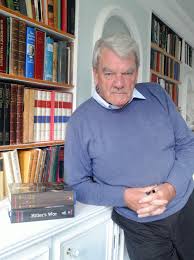
David Irving
For decades, Irving boasted that no one had ever found a written order from Hitler ordering the Holocaust–and offered to pay £1000 to anyone who could find such an order.
In later years, Irving completely denied that the Holocaust had occurred. He claimed that gas chambers had never been used to exterminate Jews and there was no officially-sanctioned Third Reich plan to slaughter European Jewry.
But Irving claimed that Lipstadt’s labeling him a Holocaust denier had tarred him as a disreputable historian–and had thus damaged his professional reputation.
Irving sued in a British court because the burden would be on the defendant to prove that s/he had not committed libel. (In American courts, the plaintiff must not only prove s/he has been libeled, but with actual malice.)
Lipstadt faced a second hurdle: Her lawyers ordered her to not take the witness stand. They wanted to put and keep the focus entirely on Irving–and to make his virulent anti-Semitism the issue in the case.
In her 2005 autobiography, Denial, Lipstadt described the agonies she endured in preparing for–and sitting through–this trial:
“For four years I immersed myself in the works of a man who exuded contempt for me and much of what I believed. I lost many nights of sleep, worried that because of some legal fluke Irving might prevail.”

Deborah Lipstadt
For Lipstadt, more was at stake than the possibility of losing a big chunk of money.
Above all, she feared that an Irving victory would give anti-Semites a legal precedent for “proving” that the extermination of six million Jewish men, women and children hadn’t occurred.
The case was tried in a London court from January to March, 2000.
Entering court on the first morning of trial, Irving assured the assembled reporters that he would be victorious.
Asked where his legal team was, he said he had chosen to represent himself: They might know the law, but he knew the topic–Hitler and the Third Reich.
The outcome was a disaster–for Irving.
Among the expert witnesses testifying on behalf of Lipstadt was Richard J. Evans, professor of modern history at Cambridge University and author of a three-volume history on the Third Reich. In his examination of Irving’s work, Evans found:
“Not one of [Irving’s] books, speeches or articles, not one paragraph, not one sentence in any of them, can be taken on trust as an accurate representation of its historical subject.
“All of them are completely worthless as history, because Irving cannot be trusted anywhere, in any of them, to give a reliable account of what he is talking or writing about. … if we mean by historian someone who is concerned to discover the truth about the past, and to give as accurate a representation of it as possible, then Irving is not a historian.”
Judge Charles Gray found that:
“Irving had for his own ideological reasons persistently and deliberately misrepresented and manipulated historical evidence” and that “for the same reasons, he had portrayed Hitler in an unwarrantedly favorable light, principally in relation to his attitude towards and responsibility for the treatment of the Jews.”
The judge also found that Irving was “an active Holocaust denier; that he was anti-Semitic and racist and that he associated with right-wing extremists who promoted neo-Nazism.”
Irving was discredited as a historian and ordered to pay all of Penguin’s costs of the trial, estimated to be as much as £2 million ($3.2 million in American currency). When Irving didn’t pay, he was forced into bankruptcy and lost his home.
Asked by a reporter, “Will you stop denying the Holocaust on the basis of this judgment?” Irving replied, “Good Lord, no.”
Denying the truth about the past didn’t work for David Irving. Soon America will discover if it works for Donald Trump.
ABC NEWS, ADOLF HITLER, CBS NEWS, CNN, FACEBOOK, FBI, GENOCIDE, HITLER-STALIN NONAGGRESSION PACT, HOLOCAUST, HOLOCAUST MUSEUM, JAMES COMEY, JEWS, JOSEPH STALIN, NATO, NAZI GERMANY, NBC NEWS, POLAND, POLITICAL CORRECTNESS, THE CHICAGO SUN-TIMES, THE CHICAGO TRIBUNE, THE LOS ANGELES TIMES, THE NEW YORK TIMES, THE WASHINGTON POST, TWITTER, U.S. DEPARTMENT OF STATE, USA TODAY
In Bureaucracy, History, Law Enforcement, Military, Politics, Social commentary on September 2, 2016 at 1:07 am
Everybody, it seems, hates genocide. But not everybody owns up to it.
FBI Director James Comey found this out firsthand.
On April 16, 2015, he published an Opinion piece in The Washington Post, entitled: “Why I Require FBI agents to Visit the Holocaust Museum.”
Comey wants them to see the horrors that result when those who are entrusted with using the law to protect instead turn it into an instrument of evil.

FBI Director James Comey
And he wants agents to “see humanity and what we are capable of.”
“Good people helped murder millions,” he wrote.
“And that’s the most frightening lesson of all–that our very humanity made us capable of, even susceptible to, surrendering our individual moral authority to the group, where it can be hijacked by evil.
“Of being so cowed by those in power. Of convincing ourselves of nearly anything.
“In their minds, the murderers and accomplices of Germany, and Poland, and Hungary, and so many, many other places didn’t do something evil.
“They convinced themselves it was the right thing to do, the thing they had to do. That’s what people do. And that should truly frighten us.”
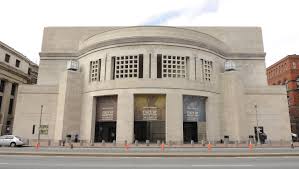
U.S. Holocaust Memorial Museum
It was these paragraphs that landed Comey in diplomatic hot water.
Click here: Why I require FBI agents to visit the Holocaust Museum – The Washington Post
On April 19–three days after the editorial appeared–Poland’s Foreign Ministry urgently summoned Stephen Mull, the U.S. Ambassador to Warsaw, to “protest and demand an apology.”
The reason: The FBI director had dared to say that Poles were accomplices in the Holocaust!
Poland’s ambassador to the United States said in a statement the remarks were “unacceptable.”
And he added that he had sent a letter to Comey “protesting the falsification of history, especially …accusing Poles of perpetuating crimes which not only they did not commit, but which they themselves were victims of.”
Shortly after Poland’s announcement, Stephen Mull, the U.S. Ambassador in Warsaw, told reporters he would contact the FBI about the situation.
“Suggestions that Poland, or any other country apart from the Nazi Germany was responsible for the Holocaust are wrong, harmful and offensive,” he said, speaking in Polish.
And he emphasized that Comey’s remarks didn’t reflect the views of the Obama administration.
In fact, Comey’s remarks were dead-on accurate.
And Mull’s were a craven act of Political Correctness.
But at least one Polish citizen was not offended by Comey’s editorial.
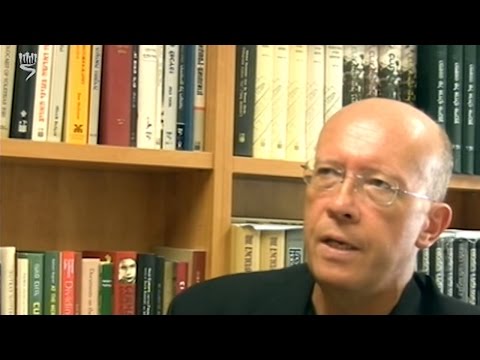
Jan Grabowski
Jan Grabowski, 50, is a graduate of Warsaw University and is currently a history professor at University of Ottawa. He is also the son of a Holocaust survivor.
He has suffered death threats, is boycotted in the Canadian Polish community where he lives today, and is not always welcome even in his homeland.
But he will not be intimidated from speaking and writing the truth about those in Poland who enthusiastically collaborated with Nazis to slaughter Jews during World War II.
Over the years, he has published several books on this subject. And his latest one is certain to outrage many of his countrymen. His new book, Hunt for the Jews: Betrayal and Murder in German-Occupied Poland, was published in October, 2014.
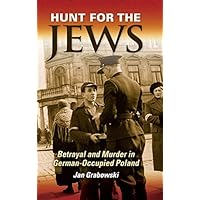
“I tried to understand how only very few of those Jews who decided to hide were able to stay alive until 1945,” said Grabowski in an interview with The Times of Israel.
“The purpose of my research was to discover the condition of the Jews who managed to avoid being sent to death camps and chose to live in hiding. My research brought me to the level of individual cases of people who chose to hide.”
It took Grabowski more than three years to research and write his book. He interviewed Holocaust survivors and local residents, primarily in Poland, Israel and Germany.
“It is more complicated than just blaming the Poles for betraying their Jewish neighbors,” said Grabowski.
“On the one hand there were extraordinarily brave Poles who risked their lives to save Jews, and on the other hand there was no great love between Poles and Jews before World War II.
“During the war these relationships became even more hostile. A large segment of the Polish population was displeased with their neighbors’ help to the Jews during the war, and for many it seemed even as an unpatriotic step.
“Therefore, some segments of the Polish population took an active part in the hunt for the Jews, and that is what the new book deals with.”
Many Poles still refuse to acknowledge the the collaboration of so many of their countrymen with the perpetrators of the Holocaust. It’s a role often played by nations that don’t want to acknowledge their past criminality.
During the Nuremberg war crimes trials, Russian judges representing the Soviet Union successfully lobbied to conceal a vital historical truth.
In late August, 1939, Soviet dictator Joseph Stalin had negotiated a “non-aggression pact” with Adolf Hitler. That was known.
But a secret protocol of that agreement dictated that Germany could conquer only the western half of Poland. The eastern half of that country would be occupied by the Red Army.
As long as politicians’ fragile egos are at stake, genocide will continue to be a matter of state policy–and a disowned one.
2016 PRESIDENTIAL CAMPAIGN, ABC NEWS, ADOLF HITLER, CBS NEWS, CLAUS VON STAUFFENBERG, CNN, DAVID BROOKS, DONALD TRUMP, FACEBOOK, HOLOCAUST, JOHN KASICH, MARTIN NIEMOELLER, MSNBC, NAZI GERMANY, NBC NEWS, PBS NEWSHOUR, RAFAEL "TED" CRUZ, ROBERT PAYNE, SOVIET UNION, THE CHICAGO SUN-TIMES, THE CHICAGO TRIBUNE, THE LIFE AND DEATH OF ADOLF HITLER, THE LOS ANGELES TIMES, THE NEW YORK TIMES, TWITTER, WORLD WAR 11
In Bureaucracy, History, Military, Politics, Social commentary on May 6, 2016 at 12:05 am
On July 20, 1944, Colonel Claus Shenk von Stauffenberg appeared at Hitler’s well-guarded military headquarters in East Prussia. Like all his other outposts, Hitler had named it–appropriately enough–“Wolf’s Lair.”

“Wolf’s Lair”
Stauffenberg entered the large, concrete building while the conference was in session. He placed his yellow briefcase next to Hitler–who was standing with his generals at a heavy oaken table.
Then Stauffenberg excused himself to take an “urgent” phone call.
At 12:42 p.m. on July 20, 1944, Stauffenberg’s briefcase bomb erupted.
But the Third Reich didn’t come to an end–because, as if miraculously, Hitler had survived.

Hitler shows off the site of the explosion
What had happened?
First, the conference location had been changed–from a wooden building to a concrete one. The concrete absorbed much of the blast.
Second, owing to the summer’s heat, Hitler had ordered all the windows–about ten–opened to let in a breeze. This allowed much of the force of the blast to be dispersed.
Third, and perhaps most important: Stauffenberg had carefully placed his briefcase near Hitler, who was standing next to a heavy oaken support of the conference table.
But after Stauffenberg left the room, Colonel Heinz Brandt, who stood next to Hitler, found the briefcase blocking his legs. So he moved it–to the other side of the heavy oaken support.
When the bomb exploded, Hitler was partially shielded from its full blast. Brandt died, as did two other officers and a stenographer.
Not only did Hitler survive, but the plotters failed to seize the key broadcast facilities of the Reich.
This allowed Hitler to make a late-night speech to the nation, revealing the failed plot and assuring Germans that he was alive. And he swore to flush out the “traitorous swine” who had tried to kill him.
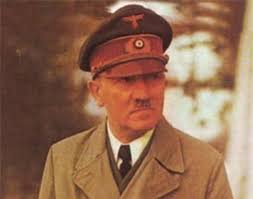
Adolf Hitler
Mass arrests quickly followed. Among the first victims discovered and executed was the conspiracy’s leader, Colonel Claus von Stauffenberg. Standing before a makeshift firing squad at midnight, he cried: “Long live our sacred Germany!”
At least 7,000 persons were arrested by the Gestapo–of which 4,980 were executed.
Had the conspiracy succeeded, history would have turned out differently:
Thus, history can be altered by the appearance or disappearance of a single individual.
Which brings us back to Donald Trump.

Donald Trump
Since declaring his candidacy for the Presidency on June 16, 2015, Trump has been the first choice among the Republican base.
At first, he was dismissed as a bad joke–by Republican Presidential candidates as well as by Democrats.
Surely voters would reject a bombastic, thrice-married “reality show” host who had filed for corporate bankruptcy four times.
Yet from the outset Trump dominated the field–and a series of Republican debates. The other Republican candidates watched him with envy–and tried to out-do his hate-filled rhetoric and agenda.
But none of them succeeded–and, one after another, they dropped out of the race: Marco Rubio, Ben Carson, Jeb Bush, Chris Christie, Rick Santorum, Carly Fiorina, Mike Huckabee, Rand Paul.
Eventually, only two were left to deny Trump the Republican nomination–Texas U.S. Senator Rafael “Ted” Cruz and Ohio Governor John Kasich.
On May 3, 2016, Trump captured 53.3% of the votes in the Indiana primary, compared to 36.7% for Cruz and 7.5% for Kasich.
That night, Cruz bowed out of the race. The next day, so did Kasich–the man who had dared compare Trump to Adolf Hitler.
For conservative columnist David Brooks, a Trump Presidency would be disastrous. On the March 25 edition of the PBS Newshour, he offered this assessment of Trump’s character:
“The odd thing about [Trump’s] whole career and his whole language, his whole world view is there is no room for love in it. You get a sense of a man who received no love, can give no love, so his relationship with women, it has no love in it. It’s trophy.
“And so you really are seeing someone who just has an odd psychology unleavened by kindness and charity, but where it’s all winners and losers, beating and being beat. And that’s part of the authoritarian personality.”
In his bestselling 1973 biography, The Life and Death of Adolf Hitler, British historian Robert Payne harshly condemned the “Army bomb plot” conspirators who failed to kill Hitler:
“The conspirators died heroically, but they were not heroes. They bungled the most necessary assassination of their time when it was within their power to do the job well….They were amateurs when professionals were needed.”
There is a very real danger that Donald Trump will assume the Presidency–and all the awesome power that goes with that office.
If that happens, future historians–if there are any–may similarly condemn those Americans who stood by like “good Germans”–and allowed their country to fall into the hands of a ruthless tyrant.
2016 PRESIDENTIAL CAMPAIGN, ABC NEWS, ADOLF HITLER, CBS NEWS, CLAUS VON STAUFFENBERG, CNN, DAVID BROOKS, DONALD TRUMP, FACEBOOK, HOLOCAUST, JOHN KASICH, MARTIN NIEMOELLER, MSNBC, NAZI GERMANY, NBC NEWS, PBS NEWSHOUR, RAFAEL "TED" CRUZ, ROBERT PAYNE, SOVIET UNION, THE CHICAGO SUN-TIMES, THE CHICAGO TRIBUNE, THE LIFE AND DEATH OF ADOLF HITLER, THE LOS ANGELES TIMES, THE NEW YORK TIMES, THE WALL STREET JOURNAL, TWITTER, WORLD WAR 11
In Bureaucracy, History, Military, Politics, Social commentary on May 5, 2016 at 11:49 am
The ad opened with ominous music–and the face of a snarling Donald Trump.
“I would like anyone who is listening to consider some thoughts that I’ve paraphrased from the words of German pastor Martin Niemoeller.”
The voice belonged to Tom Moe, a retired colonel in the U.S. Air Force–and a former Vietnam prisoner-of-war.
It was a video produced by the 2016 Presidential campaign for John Kasich, the governor of Ohio. He had been peddling a message of creating jobs, balancing the Federal budget and disdain for Washington, D.C.
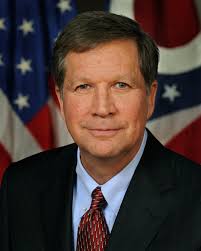
John Kasich
But he remained far behind in the polls. Meanwhile, Trump, the New York billionaire developer, was backed by increasingly large numbers of Republican primary voters.
So, with nothing to lose, Kasich decided to take off the gloves.
“You might not care if Donald Trump says Muslims must register with the government, because you’re not one,” continued Moe.
“And you might not care if Donald Trump says he’s going to round up all the Hispanic immigrants, because you’re not one.
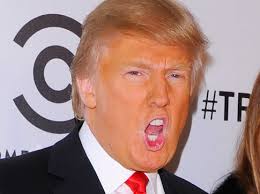
Donald Trump
“And you might not care if Donald Trump says it’s OK to rough up black protesters, because you’re not one.
“And you might not care of Donald Trump wants to suppress journalists, because you’re not one.
“But think about this:
“If he keeps going, and he actually becomes President, he might just get around to you. And you’d better hope that there’s someone left to help you.”
The above is indeed a paraphrase of a famous quote by Martin Niemoeller (1892–1984), a prominent Protestant pastor. Although he had been a U-boat commander during World War 1, he became a bitter public foe of Adolf Hitler.
A staunch anti-Communist, he had initially supported the Nazis as Germany’s only hope of salvation against the Soviet Union. But when the Nazis made the church subordinate to State authority, Niemoeller created the Pastors’ Emergency League to defend religious freedom.
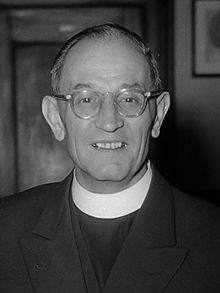
Martin Niemoeller
For his opposition to the Third Reich, Niemoeller spent seven years in concentration camps. With the collapse of the Reich in 1945, he was freed–and elected President of the Protestant church in Hesse and Nassau in 1947.
During the 1960s, he was a president of the World Council of Churches.
He is best remembered for his powerful condemnation of the failure of Germans to protest the increasing oppression of the Nazis:
First they came for the Communists, but I was not a Communist, so I did not speak out.
Then they came for the Socialists, but I was not a Socialist, so I did not speak out.
Then they came for the trade unionists, but I was not a trade unionist, so I did not speak out.
Then they came for the Jews, but I was not a Jew, so I did not speak out.
And when they came for me, there was no one left to speak out for me.
Neither “Adolf Hitler” nor “Nazi Party” was mentioned during the one-minute Kassich video. But it infuriated Trump, who threatened to sue Kasich if he found anything “not truthful” in the ad.
The Kasich ad was the darkest attack made against Trump by any candidate–Republican or Democrat. And it raises a disturbing question:
If Donald Trump is America’s Adolf Hitler, who will be its Claus von Stauffenberg?
Colonel Claus Schenk von Stuaffenberg was the German army officer who, on July 20, 1944, tried to assassinate Adolf Hitler.
He had served with the Wehrmacht in Poland (1939), France (1940) and the Soviet Union (1941).
While serving in Tunisa, he was seriously wounded on April 7, 1943 when Allied fighters strafed his vehicle. He lost his left eye, right hand and two fingers of his left hand after surgery.
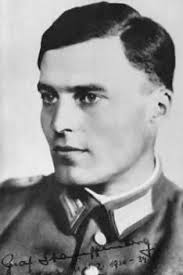
Colonel Claus Schenk von Stuaffenberg
Nevertheless, he now acted as the prime mover for the conspiracy among a growing number of German high command officers to arrest or assassinate Germany’s Fuehrer.
His reason: His disgust at the horrors he had seen committed by his fellow Wehrmacht soldiers upon defenseless POW’s and civilians in Russia.
Something must be done, he believed, to prove to the world that not all Germans–even members of the Wehrmacht–were criminals.
Stauffenberg wanted Hitler dead. A live Fuehrer might eventually be rescued by his Nazi colleagues.
But–how to do it?
Hitler was a closely-guarded target. He was surrounded by fanatical bodyguards who were expert marksmen. He often wore a bulletproof vest and a cap lined with three pounds of laminated steel.
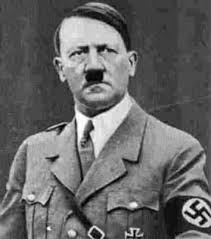
Adolf Hitler
Several attempts had already been made on Hitler’s life–all of them with time-bombs. But one of the bombs–smuggled onto Hitler’s plane–hadn’t exploded. Another bomb had–45 minutes after Hitler left the beer hall where he had been making a speech.
Stauffenberg decided to carry his bomb–hidden in a briefcase–into a “Hitler conference” packed with military officers.
But Stauffenberg didn’t intend to be a suicide bomber. He intended to direct the government that would replace that of the Nazis. He would plant his time-bomb in the conference room–and find an excuse to leave.
Then, the coup–“Operation Valkyrie”–would be on.
Anti-Nazi conspirators would seize control of key posts of the government. The British and Americans would then be informed of Germany’s willingness to surrender.
2016 PRESIDENTIAL CAMPAIGN, ABC NEWS, ADOLF HITLER, ANNE FRANK, ANTONIN SCALIA, AUSCHWITZ, BARACK OBAMA, BERGEN-BELSEN, CBS NEWS, CNN, DONALD TRUMP, EVA SCHLOSS, FACEBOOK, HOLOCAUST, illegal immigration, ISIS, MEXICO, NAZI GERMANY, NBC NEWS, POPE FRANCIS, SUPREME COURT, SYRIAN REFUGEES, THE CHICAGO SUN-TIMES, THE CHICAGO TRIBUNE, THE LOS ANGELES TIMES, THE NEW YORK TIMES, THE WASHINGTON POST, TWITTER, VATICAN
In Bureaucracy, History, Politics, Social commentary on February 22, 2016 at 9:48 am
Ironically, Right-wingers, who support many of the same policies of Adolf Hitler, often attack liberals as Nazis–especially President Barack Obama.
But now a genuine authority on Fascism has come forward to assess the front-runner for the Republican Presidential nomination.
“If Donald Trump become[s] the next president of the US it would be a complete disaster. I think he is acting like another Hitler by inciting racism.”
So says Eva Schloss, the stepsister of Holocaust victim Anne Frank. As a survivor of Auschwitz, Schloss should know something about Nazis.
Eva Schloss
Now 86, Schloss met Anne in Amsterdam as a fellow refugee. Both their families had taken refuge there after fleeing Nazi Germany.
Anne Frank spent four years hiding in an attic and keeping a diary. But in 1944 she was discovered by the Nazis and sent to the Bergen-Belsen concentration camp.
She was 15 when she died there of typhus in March 1945. After the war, Eva Schloss’ mother, Fritzi, married Otto Frank, Anne’s father.
Anne Frank
Eva was detained at the same time as Anne and sent to Auschwitz. She survived when the camp was liberated on January 27,1945.
In a January 27th essay for Newsweek, Schloss warned of dire consequences if Donald Trump became President.
“During his U.S. presidential campaign he has suggested the ‘total and complete shutdown of Muslims entering the United States,’ as well as pledging to build a wall between the U.S. and Mexico to keep illegal immigrants out.”
She was 11 when her family immigrated to Belgium after Hitler forcibly Annexed Austria in 1938.
“We were treated as if we had come from the moon. I felt as if I wasn’t wanted and that I was different to everybody. It is even harder for today’s Syrian refugees who have a very different culture….
“I am very upset that today again so many countries are closing their borders,” said Schloss, who lives in London. “Fewer people would have died in the Holocaust if the world had accepted more Jewish refugees.”
And on February 18, Pope Francis also waded into the 2016 Presidential race with his own assessment of Trump.
The comment came in answer to a question by one of several reporters who were accompanying the Pope to Rome from a six-day trip to Mexico.
What, a reporter asked the Pontiff, did he think of Trump’s campaign pledge to build a wall along the entire length of the U.S.-Mexican border and expel millions of illegal aliens now living in the United States?
“A person who only thinks about building walls, wherever they are, and not in building bridges, is not Christian,” replied the Pope. “This is not the gospel.”
Pope Francis
Francis said he would “give the benefit of the doubt” to Trump because he had not heard Trump’s border plans independently.
But he added: “I say only that this man is not a Christian if he has said things like that.”
Trump, a Presbyterian, responded minutes later: “For a religious leader to question a person’s faith is disgraceful.”
Trump has repeatedly accused President Barack Obama–a self-described Christian–as a secret Muslim.
Donald Trump
On February 21, for example, he tweeted: “I wonder if President Obama would have attended the funeral of [Supreme Court] Justice [Antonin] Scalia if it were held in a mosque.”
Obama had paid tribute to Scalia at the Supreme Court on the day prior to the funeral. He declined to attend the service because his heavy security detail might disrupt the ceremony.
“I am proud to be a Christian,” added Trump, “and as president I will not allow Christianity to be consistently attacked and weakened.”
Nor did he stop there: “If and when the Vatican is attacked by the ISIS, which as everyone knows is ISIS’s ultimate trophy, I can promise you that the pope would have only wished and prayed that Donald Trump would have been president.
“ISIS would have been eradicated unlike what is happening now with our all talk, no action politicians.”
Trump thus implied that the Pope’s future security depended on the United States generally–and on Donald Trump in particular.
And he clearly ignored the fact that, since September, 2014, the United States Air Force has been bombing ISIS convoys in Iraq and Syria.
Trump has long been critical of the Pope’s stand on immigration.
As the Pope undertook his trip to Mexico, Trump told Fox Business Network that he didn’t think Francis understood “the danger of the open border we have with Mexico.
“I think Mexico got him to do it because they want to keep the border just the way it is,” he said. “They’re making a fortune, and we’re losing.”
A Vatican spokesman replied: “The pope always talks about migration problems all around the world, of the duties we have to solve these problems in a humane manner, of hosting those who come from other countries in search of a life of dignity and peace.”
For millions of Jews and Catholics, the election of 2016 may turn on how they answer the question: Am I serving the Lord–or the devil?
ABC NEWS, ADOLF HITLER, ARMENIA, CBS NEWS, CNN, FACEBOOK, FBI, GENOCIDE, HITLER-STALIN NONAGGRESSION PACT, HOLOCAUST, HOLOCAUST MUSEUM, ISLAMIC STATE OF IRAQ AND SYRIA (ISIS), JAMES COMEY, JEWS, JOSEPH STALIN, KATYN MASSACRE, LAVRENTI BERIA, NATO, NAZI GERMANY, NBC NEWS, NKVD, POLAND, POLITICAL CORRECTNESS, PRESIDENT BARACK OBAMA, THE CHICAGO SUN-TIMES, THE CHICAGO TRIBUNE, THE LOS ANGELES TIMES, THE NEW YORK TIMES, THE PENTAGON, THE WASHINGTON POST, TURKEY, TWITTER, U.S. DEPARTMENT OF STATE, USA TODAY
In Bureaucracy, History, Law Enforcement, Politics, Social commentary on April 28, 2015 at 12:04 am
Everybody, it seems, hates genocide. But not everybody owns up to it.
FBI Director James Comey recently found this out firsthand.
On April 16, he published an Opinion piece in the Washington Post: “Why I Require FBI Agents to Visit the Holocaust Museum.”
It was the following paragraphs that touched off an international uproar:
“In their minds, the murderers and accomplices of Germany, and Poland, and Hungary, and so many, many other places didn’t do something evil.
“They convinced themselves it was the right thing to do, the thing they had to do. That’s what people do. And that should truly frighten us.”
On April 19–three days after the editorial appeared–Poland’s Foreign Ministry urgently summoned Stephen Mull, the U.S. Ambassador to Warsaw, to “protest and demand an apology.”
The reason: The FBI director had dared to say that Poles were accomplices in the Holocaust!
Poland’s ambassador to the United States said in a statement the remarks were “unacceptable.”
And he added that he had sent a letter to Comey “protesting the falsification of history, especially…accusing Poles of perpetuating crimes which not only they did not commit, but which they themselves were victims of.”
But at least one Polish citizen was not offended by Comey’s editorial.
Jan Grabowski 50, is a graduate of Warsaw University and is currently a history professor at University of Ottawa. He is also the son of a Holocaust survivor.

Jan Grabowski
He has suffered death threats, is boycotted in the Canadian Polish community where he lives today, and is not always welcome even in his homeland.
But he will not be intimidated from speaking and writing the truth about those in Poland who enthusiastically collaborated with Nazis to slaughter Jews during World War II.
Over the years, he has published several books on this subject. And his latest one is certain to outrage many of his countrymen.
His new book, Hunt for the Jews: Betrayal and Murder in German-Occupied Poland, was published in October, 2014.
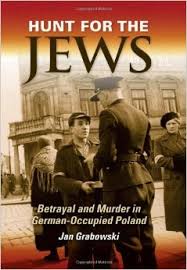
“I tried to understand how only very few of those Jews who decided to hide were able to stay alive until 1945,” said Grabowski in an interview with The Times of Israel.
“The purpose of my research was to discover the condition of the Jews who managed to avoid being sent to death camps and chose to live in hiding. My research brought me to the level of individual cases of people who chose to hide.
It took Grabowski more than three years to research and write his book. He interviewed Holocaust survivors and local residents, primarily in Poland, Israel and Germany.
“It is more complicated than just blaming the Poles for betraying their Jewish neighbors,” Grabowski.
“On the one hand there were extraordinarily brave Poles who risked their lives to save Jews, and on the other hand there was no great love between Poles and Jews before World War II.
“During the war these relationships became even more hostile. A large segment of the Polish population was displeased with their neighbors’ help to the Jews during the war, and for many it seemed even as an unpatriotic step.
“Therefore, some segments of the Polish population took an active part in the hunt for the Jews, and that is what the new book deals with.”
Click here: Hunt for the Jews: Betrayal and Murder in German-Occupied Poland: Jan Grabowski: 9780253010742: Amazon.com: Books
Ironically, even as many Poles aided the Germans in shipping Jews to extermination camps, the Nazis were turning Poland into a graveyard for non-Jewish Poles.
According to the Jewish Virtual Library:
“Of the 11 million people killed during the Holocaust, six million were Polish citizens. Three million were Polish Jews and another three million were Polish Christians.”
Many Poles still refuse to face up to the ugly truth about the collaboration of so many of their countrymen with the perpetrators of the Holocaust.
It’s a role often played by nations that don’t want to acknowledge their past criminality.
During the Nuremberg war crimes trials, Russian judges representing the Soviet Union successfully lobbied to conceal a vital historical truth.
While they readily charged Nazi Germany with aggressively invading Poland on September 1, 1939, they balked at admitting the role the Soviet Union had played in this.
In late August, 1939, Soviet dictator Joseph Stalin had negotiated a “non-aggression pact” with Adolf Hitler.
But a secret protocol of that agreement dictated that Germany could conquer only the western half of Poland. The eastern half of that country would be occupied by the Red Army.
Similarly, the Katyn massacre remained–until recently–one of the great mysteries of World War II.
The Nazis announced the discovery of mass graves in the Katyn Forest of Poland in 1943. The number of victims is estimated at about 22,000.
Of these, about 8,000 were officers taken prisoner after the Soviet invasion. Another 6,000 were police officers, and the rest were members of the intelligentsia.

NKVD secret police
The USSR blamed the Nazis, and denied responsibility for the massacres until 1990.
The executioners belonged to the NKVD, the Soviet secret police (later renamed the KGB).
Its chief, Lavrenty Beria, urged the execution of all captive members of the Polish Officer Corps. And Stalin had approved.
As long as politicians’ fragile egos are at stake, genocide will continue to be a matter of state policy–and a disowned one.
ABC NEWS, ADOLF HITLER, ARMENIA, CBS NEWS, CNN, FACEBOOK, FBI, GENOCIDE, HITLER-STALIN NONAGGRESSION PACT, HOLOCAUST, HOLOCAUST MUSEUM, ISLAMIC STATE OF IRAQ AND SYRIA (ISIS), JAMES COMEY, JEWS, JOSEPH STALIN, KATYN MASSACRE, LAVRENTI BERIA, NATO, NAZI GERMANY, NBC NEWS, NKVD, POLAND, POLITICAL CORRECTNESS, PRESIDENT BARACK OBAMA, THE CHICAGO SUN-TIMES, THE CHICAGO TRIBUNE, THE LOS ANGELES TIMES, THE NEW YORK TIMES, THE PENTAGON, THE WASHINGTON POST, TURKEY, TWITTER, U.S. DEPARTMENT OF STATE, USA TODAY
In Bureaucracy, History, Law Enforcement, Politics, Social commentary on April 27, 2015 at 6:57 am
“Genocide” is defined by the Merriman-Webster Dictionary as “the deliberate killing of people who belong to a particular racial, political, or cultural group.”
And the Oxford Advanced Learner’s Dictionary defines it as “the deliberate killing of a large group of people, especially those of a particular ethnic group or nation.”
While dictionaries have no trouble agreeing on what “genocide” means, nations do.
Consider these two examples:
Example 1: Turkey
One hundred years ago, in what’s been called the first genocide of modern times, up to 1.5 million Armenians died at Turkish hands in massacres and deportations.
But don’t tell that to the Turks.
Turkey has long insisted that the wartime killings were not genocide.
According to the Turks, those killed–mostly Christian Armenians and Muslim Turks–were victims of civil war and unrest as the Ottoman Empire collapsed during World War I.
“The Armenian claims on the 1915 events, and especially the numbers put forward, are all baseless and groundless,” President Recep Tayyip Erdogan said. “Our ancestors did not persecute.”
Naturally, Armenians see it differently, viewing Turkey’s denial as an affront to their national identity.
“There is a question of political recognition of the genocide, but ultimately, it’s about the Armenian story and history being incorporated into the collective memory of the countries where we live,” said Nicolas Tavitian, director of the Armenian General Benevolent Union.

Armenians protesting Turkish genocide
The United States has long recognized the genocide of the Holocaust–and even opened a U.S. Holocaust Museum in Washington, D.C. But its position on the Armenian slaughter remains one of–silence.
As a U.S. senator, Barack Obama pledged to use the term “genocide” to describe the mass killings of Armenians. As president, he’s avoided the word.
Why?
Because Turkey remains a member of NATO–and one of America’s few reliable allies in the Islamic world.
Both the Pentagon and State Department have argued that Turkey plays a vital role in fighting the Islamic State group in Syria and Iraq. And the safety of American diplomats and troops in Turkey would be compromised.
Example 2: Poland
On April 16, the Washington Post published an Opinion piece by James Comey, director of the FBI, entitled: “Why I Require FBI agents to Visit the Holocaust Museum.”
FBI Director James Comey
Click here: Why I require FBI agents to visit the Holocaust Museum – The Washington Post
Comey wants them to see the horrors that result when those who are entrusted with using the law to protect instead turn it into an instrument of evil.
U.S. Holocaust Memorial Museum
And he wants agents to “see humanity and what we are capable of.”
“Good people helped murder millions.
“And that’s the most frightening lesson of all–that our very humanity made us capable of, even susceptible to, surrendering our individual moral authority to the group, where it can be hijacked by evil.
“Of being so cowed by those in power. Of convincing ourselves of nearly anything.
“In their minds, the murderers and accomplices of Germany, and Poland, and Hungary, and so many, many other places didn’t do something evil.
“They convinced themselves it was the right thing to do, the thing they had to do. That’s what people do. And that should truly frighten us.”
It was these paragraphs that landed Comey in diplomatic hot water.
On April 19–three days after the editorial appeared–Poland’s Foreign Ministry urgently summoned Stephen Mull, the U.S. Ambassador to Warsaw, to “protest and demand an apology.”
The reason: The FBI director had dared to say that Poles were accomplices in the Holocaust!
Poland’s ambassador to the United States said in a statement the remarks were “unacceptable.”
And he added that he had sent a letter to Comey “protesting the falsification of history, especially … accusing Poles of perpetuating crimes which not only they did not commit, but which they themselves were victims of.”
Shortly after Poland’s announcement, Stephen Mull, the U.S. Ambassador in Warsaw, told reporters he would contact the FBI about the situation.
“Suggestions that Poland, or any other country apart from the Nazi Germany was responsible for the Holocaust are wrong, harmful and offensive,” he said, speaking in Polish.
And he emphasized that Comey’s remarks didn’t reflect the views of the Obama administration.
In fact, Comey’s remarks were dead-on accurate. And Mull’s were a craven act of Political Correctness.
But at least one Polish citizen was not offended by Comey’s editorial.
Jan Grabowski 50, is a graduate of Warsaw University and is currently a history professor at University of Ottawa. He is also the son of a Holocaust survivor.
He has suffered death threats, is boycotted in the Canadian Polish community where he lives today, and is not always welcome even in his homeland.
But he will not be intimidated from speaking and writing the truth about those in Poland who enthusiastically collaborated with Nazis to slaughter Jews during World War II.


.jpg)


.jpg&imgrefurl=https%3A%2F%2Fen.wikipedia.org%2Fwiki%2FPope_Francis'_visit_to_the_Philippines&docid=MrlhHX0IDhYhuM&tbnid=wAeMK3JqWfBmtM%3A&w=1297&h=1638&ved=0ahUKEwjmqo7njIvLAhVL6WMKHf_xBUYQxiAIAg&iact=c&ictx=1)


 Bureaucracybuster's Blog
2016 PRESIDENTIAL CAMPAIGN, ABC NEWS, ADOLF HITLER, ALTERNET, ANNE FRANK, ANTONIN SCALIA, AP, AUSCHWITZ, BARACK OBAMA, BERGEN-BELSEN, BUZZFEED, CBS NEWS, CNN, CROOKS AND LIARS, DAILY KOZ, DONALD TRUMP, EVA SCHLOSS, FACEBOOK, HOLOCAUST, illegal immigration, ISIS, MEXICO, MOTHER JONES, MOVEON, MSNBC, NAZI GERMANY, NBC NEWS, NEWSWEEK, NPR, PBS NEWSHOUR, POLITICO, POPE FRANCIS, RAW STORY, REUTERS, SALON, SEATTLE TIMES, SLATE, SRI LANKA EASTER BOMBINGS, SUPREME COURT, SYRIAN REFUGEES, TERRORISM, THE ATLANTIC, THE CHICAGO SUN-TIMES, THE CHICAGO TRIBUNE, THE DAILY BEAST, THE GUARDIAN, THE HILL, THE HUFFINGTON POST, THE LOS ANGELES TIMES, THE NATION, THE NEW YORK TIMES, THE WASHINGTON POST, TIME, TWITTER, U.S. NEWS & WORLD REPORT, UPI, USA TODAY, VATICAN
SERVING THE LORD—OR THE DEVIL
In History, Law, Military, Politics, Social commentary on May 17, 2019 at 12:06 amRight-wingers, who support many of the same policies of Adolf Hitler, often attack liberals as Nazis.
This was especially true when President Barack Obama held office.
But in 2016 a genuine authority on Fascism came forward to assess the front-runner for the Republican Presidential nomination.
“If Donald Trump become[s] the next president of the United States it would be a complete disaster. I think he is acting like another Hitler by inciting racism.”
So said Eva Schloss, the stepsister of Holocaust victim Anne Frank. As a survivor of Auschwitz, Schloss knows something about Nazis.
Eva Schloss
Then 86, Schloss met Anne in Amsterdam as a fellow refugee. Both their families had taken refuge there after fleeing Nazi Germany.
Anne Frank spent four years hiding in an attic and keeping a diary. But in 1944 she was discovered by the Nazis and sent to the Bergen-Belsen concentration camp.
She was 15 when she died there of typhus in March, 1945. After the war, Eva Schloss’ mother, Fritzi, married Otto Frank, Anne’s father.
Anne Frank
Eva was detained at the same time as Anne and sent to Auschwitz. She survived when the camp was liberated on January 27,1945.
In a January 27, 2016 essay for Newsweek, Schloss warned of dire consequences if Donald Trump became President:
“During his U.S. presidential campaign he has suggested the ‘total and complete shutdown of Muslims entering the United States,’ as well as pledging to build a wall between the U.S. and Mexico to keep illegal immigrants out.”
She was 11 when her family immigrated to Belgium after Hitler forcibly annexed Austria in 1938.
“We were treated as if we had come from the moon. I felt as if I wasn’t wanted and that I was different to everybody. It is even harder for today’s Syrian refugees who have a very different culture….
“I am very upset that today again so many countries are closing their borders,” said Schloss, who lives in London. “Fewer people would have died in the Holocaust if the world had accepted more Jewish refugees.”
And on February 18, 2016, Pope Francis also waded into the 2016 Presidential race with his own assessment of Trump.
During a six-day trip to Mexico, a reporter asked the Pontiff: What did he think of Trump’s campaign pledge to build a wall along the entire length of the U.S.-Mexican border and expel millions of illegal aliens now living in the United States?
“A person who only thinks about building walls, wherever they are, and not in building bridges, is not Christian,” replied the Pope. “This is not the gospel.”
Pope Francis
Francis said he would “give the benefit of the doubt” to Trump because he had not heard Trump’s border plans independently.
But he added: “I say only that this man is not a Christian if he has said things like that.”
Trump, a Presbyterian, responded minutes later: “For a religious leader to question a person’s faith is disgraceful.”
Trump has repeatedly accused President Barack Obama—a self-described Christian—as a secret Muslim.
Donald Trump
On February 21, 2016, for example, he tweeted: “I wonder if President Obama would have attended the funeral of [Supreme Court] Justice [Antonin] Scalia if it were held in a mosque.”
Obama had paid tribute to Scalia at the Supreme Court on the day prior to the funeral. He declined to attend the service because his heavy security detail might disrupt the ceremony.
“I am proud to be a Christian,” added Trump, “and as president I will not allow Christianity to be consistently attacked and weakened.”
Nor did he stop there: “If and when the Vatican is attacked by the ISIS [Islamic State of Iraq and Syria], which as everyone knows is ISIS’s ultimate trophy, I can promise you that the pope would have only wished and prayed that Donald Trump would have been president.
“ISIS would have been eradicated, unlike what is happening now with our all talk, no action politicians.”
Trump thus implied that the Pope’s future security depended on the United States generally—and on Trump in particular.
And he ignored the fact that, since September, 2014, the United States Air Force had been bombing ISIS convoys in Iraq and Syria.
On Easter Sunday, 2019—more than two years into Trump’s Presidency—ISIS bombed a series of churches and hotels in Sri Lanka, killing at least 321 people.
Trump has long been critical of the Pope’s stand on immigration.
As the Pope undertook his trip to Mexico, Trump told Fox Business Network that he didn’t think Francis understood “the danger of the open border we have with Mexico.
“I think Mexico got him to do it because they want to keep the border just the way it is,” he said. “They’re making a fortune, and we’re losing.”
A Vatican spokesman replied: “The pope always talks about migration problems all around the world, of the duties we have to solve these problems in a humane manner, of hosting those who come from other countries in search of a life of dignity and peace.”
For millions of Jews and Christians, the election of 2016 has turned into a referendum: Am I serving the Lord—or Satan?
Share this: