bureaucracybusters

Posts Tagged ‘FOOD STAMPS’

PRIORITIES OF THE POWERFUL

In Bureaucracy, History, Military, Politics, Social commentary on June 30, 2016 at 12:17 am

In the 1970 film, Patton, General George S. Patton is a man driven by his obsession to be the best field commander in the war–and to be recognized for it.

George C. Scott as George S. Patton

And he sees British General Bernard Montgomery–his equally egotistical rival–as a potential obstacle to that latter ambition.

So, in Algeria, he conjures up a plan that will sideline “Monty” while he, Patton, defeats the Germans–and bags the glory.

The trick lies in throwing a sumptuous dinner–in the middle of the African desert–for a visiting British general: Harold Alexander.

As Patton (George C. Scott, in an Oscar-winning performance) tells his aide: “I want to give a dinner for General Alexander. I want to get to him before Montgomery does.  I want the finest food and the best wine available. Everything.”

The aide pulls off the dinner–where, indeed, “the finest food and the best wine” are on full display, along with attentive waiters and a candelabra.

So think about it:

  • In the middle of the desert
  • while American and British forces are forced to subsist on C-rations
  • and are under repeated air attack by the Luftwaffe
  • and tank attack by the Afrika Korps

a handful of ultra-pampered American and British military officers find the time–and luxuries–to throw themselves a fine party.

Now, fast-forward from Algeria in 1943 to Washington, D.C. in 2016.

Returning to Congress after their traditional summer recess, House Republicans planned to cut $23 billion in food stamps for the poor. This would include include ending waivers that allow some adults to get temporary assistance, while they are in school or training for a job.  

The cuts could include drug tests of applicants and tougher work rules. As Republicans see it: There’s no point in “helping” the poor if you can’t humiliate them.
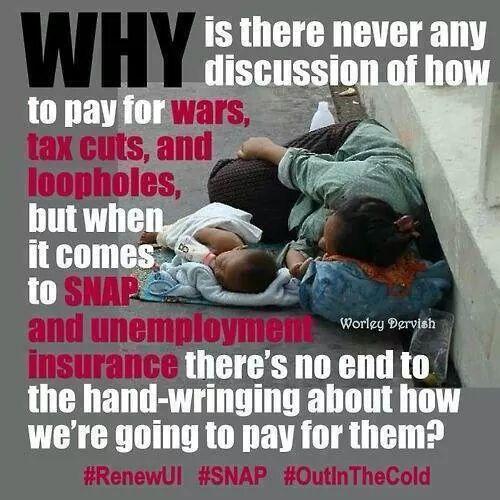
The food stamp program, now called the Supplemental Nutrition Assistance Program, or SNAP, served more than 46 million Americans and cost $74 billion in 2015. 

A single person is eligible for food stamps if his total monthly income is under $1,265 ($15,180 per year).  A family of four is eligible if their total income is less than $2,584 per month ($31,008 per year).

Republicans claim the program is unbearably expensive at $74.1 billion a year.

Meanwhile, Republicans are eager to spend billions of dollars for another project: An unnecessary war with Syria.

One of these right-wingers is Bill Kristol, editor of the Weekly Standard–and one of the leading instigators of the 2003 war with Iraq.

Related image

Bill Kristol

He–like senior officials on the George W. Bush administration–falsely claimed that Iraqi dictator Saddam Hussein had weapons of mass destruction and planned to use them against the United States.

Another Kristol lie: Hussein planned 9/11 with Osama bin Laden.

He has never apologized for either lie–or the resulting war that killed 4,487 American soldiers and wounded another 32,226.

In a September, 2013 column, Kristol called for a return to slaughter–not only in Syria but Iran as well:

“…Soon after voting to authorize the use of force against the Assad regime, Republicans might consider moving an authorization for the use of force against the Iranian nuclear weapons program.

“They can explain that Obama’s dithering in the case of Syria shows the utility of unequivocally giving him the authority to act early with respect to Iran.”

Former Secretary of State Condoleeza Rice–who also helped lie the nation into the needless 2003 Iraq war–is another big promoter of “give war a chance:”

“My fellow Americans, we do not have a choice. We cannot be reluctant to lead–and one cannot lead from behind.”

Among Republican U.S. Senators calling for war are John McCain (Arizona) and Lindsey Graman (South Carolina), who issued a joint statement:

“Using stand-off weapons, without boots on the ground, and at minimal risk to our men and women in uniform, we can significantly degrade Assad’s air power and ballistic missile capabilities and help to establish and defend safe areas on  the ground.

“In addition, we must begin a large-scale effort to train and equip moderate, vetted elements of the Syrian opposition with the game-changing weapons they need to shift the military balance against [Syrian dictator Bashar] Assad’s forces.”

Except that there are no “moderate, vetted elements” of the Syrian opposition.  The opposition is just as murderous as the Assad regime–and eager to replace one dictator with another.

In addition: A major weapon for “degrading Assad’s air power” would be Tomahawk Cruise missiles.  A single one of these costs $1,410,000.

Firing of a Tomahawk Cruise missile

A protracted missile strike would rain literally billions of dollars’ worth of American missiles on Syria.

Meanwhile, the Pentagon is spending about $27 million a week to maintain the increased U.S. Navy presence in the Mediterranean Sea and Middle East region to keep watch over Syria and be prepared to strike.

Navy officials say it costs about $25 million a week for the carrier group and $2 million a week for each destroyer.

Is there a lesson to be learned from all this?

Yes.

Powerful people–whether generals, politicians or the wealthy–will always find abundant money and resources available for projects they consider important.

It’s only when it comes to projects that other people actually need that the powerful will claim there is, unfortunately, a cash shortage.

REPUBLICANS: KILLING IS GOOD, FOOD STAMPS ARE BAD

In Bureaucracy, History, Military, Politics, Social commentary on October 3, 2014 at 12:45 pm

In the 1970 film, Patton, General George S. Patton is a man driven by his obsession to be the best field commander in the war–and to be recognized for it.

George C. Scott as George S. Patton

And he sees British General Bernard Montgomery–his equally egotistical rival–as a potential obstacle to that latter ambition.

So, in Algeria, he conjures up a plan that will sideline “Monty” while he, Patton, defeats the Germans–and bags the glory.

The trick lies in throwing a sumptuous dinner-–in the middle of the African desert-–for a visiting British general: Harold Alexander.

As Patton (George C. Scott, in an Oscar-winning performance) tells his aide: “I want to give a dinner for General Alexander. I want to get to him before Montgomery does.  I want the finest food and the best wine available. Everything.”

The aide pulls off the dinner–where, indeed, “the finest food and the best wine” are on full display, along with attentive waiters and a candelabra.

So think about it:

  • In the middle of the desert
  • while American and British forces are forced to subsist on C-rations
  • and are under repeated air attack by the Luftwaffe
  • and tank attack by the Afrika Korps

a handful of ultra-pampered American and British military officers find the time–and luxuries–to throw themselves a fine party.

Now, fast-forward from Algeria in 1943 to Washington, D.C., in 2013.

Returning to Congress after their traditional summer recess, House Republicans planned to cut $40 billion in food stamps for the poor.  That’s double the amount previously sought by Right-wingers.

The cuts would include drug tests of applicants and tougher work rules.  As Republicans see it: There’s no point in “helping” the poor if you can’t humiliate them.

Food stamps, the largest U.S. anti-hunger program, are the pivotal issue for a new U.S. farm law costing $80 billion a year.

One in seven Americans–15% of U.S. households–received food stamps at latest count.  Enrollment in the program soared after the 2008-09 recession–a direct consequence of the Bush administration’s refusal to regulate powerful, greed-fueled corporations.

Republicans claim the program is unbearably expensive at $78 billion a year.

Meanwhile, as 49 million Americans have trouble putting meals on the table, Republicans are eager to spend billions of dollars for another project.

An unnecessary war with Syria.

One of these right-wingers is Bill Kristol, editor of the Weekly Standard–and one of the leading instigators of the 2003 war with Iraq.

He–like senior officials on the George W. Bush administration–claimed that Iraqi dictator Saddam Hussein had weapons of mass destruction and planned to use them against the United States.

That proved to be a lie.

He also pushed the lie that Hussein planned 9/11 with Osama bin Laden.

He has never apologized for either lie–or the resulting war that killed 4,487 American soldiers and wounded another 32,226.

In a recent column, Kristol called for a return to slaughter–not only in Syria but Iran as well:

“…Soon after voting to authorize the use of force against the Assad regime, Republicans might consider moving an authorization for the use of force against the Iranian nuclear weapons program.

“They can explain that Obama’s dithering in the case of Syria shows the utility of unequivocally giving him the authority to act early with respect to Iran.”

Former Secretary of State Condoleeza Rice–who also helped lie the nation into the needless 2003 Iraq war–is another big promoter of “give war a chance”:

“My fellow Americans, we do not have a choice. We cannot be reluctant to lead–and one cannot lead from behind.”

Among Republican U.S. Senators calling for war are John McCain (Arizona) and Lindsey Graman (South Carolina), who issued a joint statement:

“Using stand-off weapons, without boots on the ground, and at minimal risk to our men and women in uniform, we can significantly degrade Assad’s air power and ballistic missile capabilities and help to establish and defend safe areas on  the ground.

“In addition, we must begin a large-scale effort to train and equip moderate, vetted elements of the Syrian opposition with the game-changing weapons they need to shift the military balance against [Syrian dictator Bashir] Assad’s forces.”

Except that there are no “moderate, vetted elements of the Syrian opposition.  The opposition is just as murderous as the Assad regime–and eager to replace one dictator with another.

In addition: A major weapon for “degrading Assad’s air power” would be Tomahawk Cruise missiles.  A single one of these costs $1,410,000.

Firing of a Tomahawk Cruise missile

A protracted missile strike would rain literally billions of dollars’ worth of American missiles on Syria.

Meanwhile, the Pentagon is spending about $27 million a week to maintain the increased U.S. Navy presence in the Mediterranean Sea and Middle East region to keep watch over Syria and be prepared to strike.

Navy officials say it costs about $25 million a week for the carrier group and $2 million a week for each destroyer.

Is there a lesson to be learned from all this?

Yes.

Powerful people–whether generals, politicians or the wealthy–will always find abundant money and resources available for projects they consider important.

It’s only when it comes to projects that other people actually need that such people will claim there is, unfortunately, a cash shortage.

WHY THE POOR SUPPORT THE RICH: PART TWO (END)

In Bureaucracy, History, Law, Politics, Social commentary on August 1, 2014 at 10:53 am

Republicans have long tried to prevent or eliminate programs that aid the poor and middle-class, including:

  • Social Security – since it began in 1935
  • Medicare  – since it began in 1965
  • Food stamps – since it began in 1964
  • WIC (Women, Infants, Children) – since 1972
  • The Affordable Care Act (Obamacare) – since 2010

So why are so many poor Americans now flocking to this party’s banner?

Two reasons: Racism and greed.  There are historical parallels for both.

Racism:

In 1999, historian Victor Davis Hanson noted the huge gap in wealth between the aristocratic, slave-owning minority of the pre-Civil War South and the vast majority of poor white Southerners.

“Before the war in the counties Sherman would later ruin, the top 10% of the landowners controlled 40% of the assessed wealth.”

In contrast, “more than half of those who were lucky enough to own any property at all still possessed less than 15% of the area’s valuation.”

So Hanson asked: “Why did the millions of poor whites of the Confederacy fight at all?”

He supplied the answer in his brilliant work on military history, The Soul of Battle: From Ancient Times to the Present Day, How Three Great Liberators Vanquished Tyranny.

One of those liberators was General William Tecumseh Sherman, who led 62,000 Union troops in a victorious “March to the Sea” through the Confederacy in 1864.

So why did so many poor Southern whites literally lay down their lives for the wealthy planter class, which despised them?

According to Hanson: “Behind the entire social fabric of the South lay slavery.

“If slavery eroded the economic position of the poor free citizens, if slavery encouraged a society of haves and have-nots…then it alone offered one promise to the free white man–poor, ignorant and dispirited–that he was at least not black and not a slave.”

And the planter class and its allies in government easily fobbed off their poor white countrymen with cheap flattery.  Said Georgia Governor Joseph Brown:

“Among us the poor white laborer is respected as an equal.  His family is treated with kindness, consideration, and respect.  He does not belong to the menial class.  The negro is in no sense his equal.   He belongs to the only true aristocracy, the race of white men.”

The reality of slavery

Similarly, poor whites now flock to the Republican Party–which holds them in equal contempt– in large part to protest the 2008 election of the first black President of the United States.

According to a Pew Research Center study released on July 22, 2011: “Notably, the GOP gains have occurred only among white voters; a 2-point Republican edge among whites in 2008 (46% to 44%) has widened to a 13-point lead today (52% to 39%).”

GOP Makes Big Gains among White Voters | Pew Research Center for the People and the Press

Since the 1960s, Republicans have pursued a campaign policy of “divide and rule”–divide the nation along racial lines and reap the benefits at election time.

  • Republicans opposed the Civil Rights Act of 1964.
  • Republicans opposed the Voting Rights Act of 1965.
  • Republicans, with Richard Nixon as their Presidential candidate in 1968 and 1972, pursued what they called a “Southern strategy”: Use “code language” to stoke fear and hatred of blacks among whites.
  • Republicans have falsely identified welfare programs exclusively with non-whites.  (Of the six million Americans receiving food stamps, about 42 percent are white, 32 percent are black, and 22 percent are Latino—with the growth fastest among whites during the recession.)

Thus, in voting Republican, many of these poor whites believe they are “striking a blow for the white race.”

And they can do so in a more socially acceptable way than joining a certified hate group such as the American Nazi Party or Ku Klux Klan.

Greed:

In the hit play, 1776, on the creation and signing of the Declaration of Independence, there is a telling exchange between John Dickinson and John Hancock.  It comes during the song, “Cool, Cool, Considerate Men.”

Dickinson, the delegate from Pennsylvania, urges Hancock, president of the Second Continental Congress, “to join us in our minuet.”

By “us” he means his fellow conservatives who fear losing their property and exalted status by supporting American independence from Great Britain.

Hancock declines, saying: “Fortunately, there are not enough men of property in America to dictate policy.”

To which Dickinson replies:  “Perhaps not.  But don’t forget that most men with nothing would rather protect the possibility of becoming rich than face the reality of being poor.  And that is why they will follow us.”

Today, poor whites generally identify with the CEOs of powerful corporations.  They believe the Republican gospel that they can attain such wealth–if only the government will “get out of my way.”

They forget–or ignore–the brutal truth that government, for all its imperfections, is sometimes all that stands between them and a wide range of predators.

In return, the CEOs despise them as the privileged have always despised their social and economic “inferiors.”

Unless the Democratic Party can find ways to directly address these bitter, Politically Incorrect truths, it will continue its decline into insignificance.

WHY THE POOR SUPPORT THE RICH: PART ONE (OF TWO)

In Bureaucracy, History, Law, Politics, Social commentary on July 31, 2014 at 3:44 pm

On July 22, 2011, the Pew Foundation, analyzing voter identification, found that the GOP had gained strength among white voters, most specifically “the young and poor.”

A seven-point Democratic advantage among whites under age 30 three years earlier had turned into an 11-point GOP advantage.

And a 15-point Democratic advantage among whites earning less than $30,000 annually had swung to a slim four-point Republican edge.

In addition:

  • The GOP gains have occurred only among white voters.
  • Republicans have made sizable gains among white voters since 2008.
  • Fifty-two percent of white voters now call themselves Republicans or lean to the GOP, compared with 39% who affiliate with the Democratic Party or lean Democratic.
  • Democrats have lost their edge among lower income white voters.
  • In 2008, Democrats had a 15 point lead among white voters with family incomes less than $30,000.  Republicans now have a four-point edge among this group.
  • The GOP’s lead among middle income white voters also has grown since 2008, and Republicans hold a substantial advantage with higher income white voters.
  • Republicans have made gains among whites with a high school education or less.
  • The GOP’s advantage over Democrats grew from one point in 2008 to 17 points in 2011 among less educated whites.
  • Republicans have made smaller gains among whites voters who have college degrees.

What is fascinating about these findings is this: The Republicans have, since 1980, pursued a policy of gutting programs aimed at helping the poor–while repeatedly creating tax-breaks for the wealthiest 1% of the population.

For Republicans, the patron saint of this “love-the-rich-screw-the-poor” ideology remains Ronald Reagan.  Reagan served as governor of California (1967-1974) and President of the United States (1981-1989).

Ronald Reagan

Among those charting Reagan’s legacy as President was former CBS Correspondent David Schoenbrun In his bestselling autobiography, America Inside Out: At Home and Abroad from Roosevelt to Reagan, he noted:

  • On January 28, 1981, keeping a pledge to his financial backers in the oil industry, Reagan abolished Federal controls on the price of oil.
  • Within a week, Exxon, Texaco and Shell raised gasoline prices and prices of home heating oil.
  • Reagan saw it as his duty to put a floor under prices, not a ceiling above them.
  • Reagan believed that when government helped business it wasn’t interfering.   Loaning money to bail out a financially incompetent Chrysler was “supporting the free enterprise system.”
  • But putting a high-profits tax on price-gouging corporations or filing anti-trust suits against them was “Communistic” and therefore intolerable.
  • Tax-breaks for wealthy businesses meant helping America become stronger.
  • But welfare for the poor or the victims of a predatory marketplace economy weakened America by sapping its morale.

“In short,” wrote Schoenbrun,”welfare for the rich is good for America.  But welfare for the poor is bad for America, even for the poor themselves, for it encourages them to be shiftless and lazy.

“Somehow, loans to the inefficient management of American corporations would not similarly encourage them in their inefficient methods.”

Republicans have sought to dismantle Social Security ever since that program began in 1935.  And Republicans have furiously opposed other programs aiding the poor and middle-class–such as Medicare, food stamps and WIC (Women, Infants, Children).

In short, this is not a political party with a history of rushing to the defense of those most in need.

So the question remains: Why are so many poor Americans now flocking to its banner?

Two reasons: Racism and greed.  There are historical parallels for both.

Racism:

In 1999, historian Victor Davis Hanson noted the huge gap in wealth between the aristocratic, slave-owning minority of the pre-Civil War South and the vast majority of poor white Southerners.

“Before the war in the counties Sherman would later ruin, the top 10% of the landowners controlled 40% of the assessed wealth.”

In contrast, “more than half of those who were lucky enough to own any property at all still possessed less than 15% of the area’s valuation.”

So Hanson asked: “Why did the millions of poor whites of the Confederacy fight at all?”

He supplied the answer in his brilliant work on military history, The Soul of Battle: From Ancient Times to the Present Day, How Three Great Liberators Vanquished Tyranny.

One of those liberators was General William Tecumseh Sherman, who led 62,000 Union troops in a victorious “March to the Sea” through the Confederacy in 1864.

So why did so many poor Southern whites literally lay down their lives for the wealthy planter class, which despised them?

REPUBLICAN PRIORITIES: BOMBING IS GOOD, FOOD STAMPS ARE BAD

In Bureaucracy, History, Military, Politics, Social commentary on September 17, 2013 at 12:00 am

In the 1970 film, Patton, General George S. Patton is a man driven by his obsession to be the best field commander in the war–and to be recognized for it.

George C. Scott as George S. Patton

And he sees British General Bernard Montgomery–his equally egotistical rival–as a potential obstacle to that latter ambition.

So, in Algeria, he conjures up a plan that will sideline “Monty” while he, Patton, defeats the Germans–and bags the glory.

The trick lies in throwing a sumptuous dinner-–in the middle of the African desert-–for a visiting British general: Harold Alexander.

As Patton (George C. Scott, in an Oscar-winning performance) tells his aide: “I want to give a dinner for General Alexander. I want to get to him before Montgomery does.  I want the finest food and the best wine available. Everything.”

The aide pulls off the dinner–where, indeed, “the finest food and the best wine” are on full display, along with attentive waiters and a candelabra.

So think about it:

  • In the middle of the desert
  • while American and British forces are forced to subsist on C-Rations
  • and are under repeated air attack by the Luftwaffe
  • and tank attack by the Afrika Korps

a handful of ultra-pampered American and British military officers find the time–and luxuries–to throw themselves a fine party.

Now, fast-forward from Algeria in 1943 to Washington, D.C., in 2013.

Returning to Congress after their traditional summer recess, House Republicans plan to cut $40 billion in food stamps for the poor.  That’s double the amount previously sought by right-wingers.

The cuts would include drug tests of applicants and tougher work rules.  As Republicans see it: There’s no point in “helping” the poor if you can’t humiliate them.

Food stamps, the largest U.S. anti-hunger program, are the pivotal issue for a new U.S. farm law costing $100 billion a year.

One in seven Americans–15% of U.S. households–received food stamps at latest count.  Enrollment in the program soared after the 2008-09 recession–a direct consequence of the Bush administration’s refusal to regulate powerful, greed-fueled corporations.

Republicans claim the program is unbearably expensive at $78 billion a year.

Meanwhile, as 49 million Americans havetrouble putting meals on the table, Republicans are eager to spend billions of dollars for another project.

An unnecessary war with Syria.

One of these right-wingers is Bill Kristol, editor of the Weekly Standard–and one of the leading instigators of the 2003 war with Iraq.

He–like senior officials on the George W. Bush administration–claimed that Iraqi dictator Saddam Hussein had weapons of mass destruction and planned to use them against the United States.

He also pushed the lie that Hussein planned 9/11 with Osama bin Laden.

He has never apologized for either lie–or the resulting war that killed 4,487 American soldiers and wounded another 32,226.

In a recent column, Kristol called for a return to slaughter–not only in Syria but Iran as well:

“…Soon after voting to authorize the use of force against the Assad regime, Republicans might consider moving an authorization for the use of force against the Iranian nuclear weapons program.

“They can explain that Obama’s dithering in the case of Syria shows the utility of unequivocally giving him the authority to act early with respect to Iran.”

Former Secretary of State Condoleeza Rice–who also helped lie the nation into the needless 2003 Iraq war–is another big promoter of “give war a chance”:

“My fellow Americans, we do not have a choice. We cannot be reluctant to lead–and one cannot lead from behind.”

Among Republican Senators calling for war are John McCain (Arizona) and Lindsey Graman (South Carolina), who issued a joint statement:

“Using stand-off weapons, without boots on the ground, and at minimal risk to our men and women in uniform, we can significantly degrade Assad’s air power and ballistic missile capabilities and help to establish and defend safe areas on  the ground.

“In addition, we must begin a large-scale effort to train and equip moderate, vetted elements of the Syrian opposition with the game-changing weapons they need to shift the military balance against [Syrian dictator Bashir] Assad’s forces.”

Except that there are no “moderate, vetted elements of the Syrian opposition.  The opposition is just as murderous as the Assad regime–and eager to replace one dictator with another.

In addition: A major weapon for “degrading Assad’s air power” would be Tomahawk Cruise missiles.  A single Tomahawk Cruise missile costs $1,410,000.

Firing of a Tomahawk Cruise missile

A protracted missile strike would rain literally billions of dollars’ worth of American missiles on Syria.

Meanwhile, the Pentagon is spending about $27 million a week to maintain the increased U.S. Navy presence in the Mediterranean Sea and Middle East region to keep watch over Syria and be prepared to strike.

Navy officials say it costs about $25 million a week for the carrier group and $2 million a week for each destroyer.

Is there a lesson to be learned from all this?

Yes.

Powerful people–-whether generals, politicians or the wealthy-–will always find abundant money and resources available for those projects they consider important.

It’s only when it comes to projects that other people actually need that such officials will claim there is, unfortunately, a cash shortage.