bureaucracybusters

Posts Tagged ‘FBI’

TRAYVON’S REAL KILLER: THE NRA (PART TWO OF THREE)

In Bureaucracy, Law Enforcement, Politics, Social commentary on July 30, 2013 at 12:00 am

Among the major accomplishments of the National Rifle Association:

  • In July, 2005, George Zimmerman was arrested for shoving a police officer during an underage drinking raid. The charges were dropped after he completed an alcohol education program. That same summer, his ex-fiancée filed a restraining order against him, alleging that Zimmerman hit her.
  • Yet he was allowed to carry a loaded, hidden handgun as a Florida resident–under the 2005 “Stand Your Ground” law the NRA had rammed through the legislature.
  • Under that law: A Concealed Carry Permit is revoked only if a gun owner is convicted of a felony.  It is not suspended if he’s being investigated for a felony.  It is suspended only if he is actually charged.

George Zimmerman

  • On February 26, 2012, Zimmerman shot unarmed, 17-year-old Trayvon Martin, who was wearing a “hoodie.”
  • In March, the NRA issued its own version of a “hoodie”–the Concealed Carry Hooded Sweatshirt, designed to hide firearms.  Selling on the NRA’s website for $60 to $65, it is advertised thusly:
  • “Inside the sweatshirt you’ll find left and right concealment pockets.  The included Velcro®-backed holster and double mag pouch can be repositioned inside the pockets for optimum draw.  Ideal for carrying your favorite compact to mid-size pistol, the NRA Concealed Carry Hooded Sweatshirt gives you an extra tactical edge, because its unstructured, casual design appears incapable of concealing a heavy firearm – but it does so with ease!”     http://www.nrastore.com/nrastore/ProductDetail.aspx?c=11&p=CO+635&ct=e

  • Anyone—including convicted criminals—can buy these “hide-a-gun” sweatshirts, putting both the public and law enforcers at deadly risk.
  • On July 13, 2013, a Florida jury found George Zimmerman not guilty of second-degree murder of Trayvon Martin–largely through the “Stand-Your-Ground” law the NRA had rammed through the Florida legislature.
  • The NRA often claims that law-abiding citizens defend themselves with guns millions of times every year. But the FBI has determined that, of the approximately 11,000 gun homicides every year, fewer than 300 are justifiable self-defense killings.
  • The NRA supports loopholes that allow criminals to buy guns without background checks, or allow terrorists to buy all the AK-47s they desire.
  • In 2012, the NRA’s executive vice president, Wayne LaPierre, said the NRA was “all in” to defeat Barack Obama.  Yet the President has meekly signed legislation allowing guns to be brought into national parks and onto trains.  Since becoming Chief Executive, he has made no effort to curb gun violence.
  • High-capacity magazines were prohibited under the 1994 Federal Assault Weapons Ban.  It expired in 2004. The NRA–aided by the Bush administration and Republicans generally–easily overcame efforts to renew the ban.
  • Political scientist Robert Spitzer, author of the book The Politics of Gun Control, notes that since the passage of the 1993 Brady Handgun Violence Prevention Act and the assault weapons ban in 1994, state and national laws have been drifting toward more open gun access:
  • “In 1988, there were about 18 states that had state laws that made it pretty easy for civilians to carry concealed hand guns around in society. By 2011, that number is up to 39 or 40 states having liberalized laws, depending on how you count it, and the NRA has worked very diligently at the state level to win political victories there, and they’ve really been quite successful.”
  • On January 8, 2011, Democratic Rep. Gabrielle Giffords was shot in the head while meeting with constituents outside a,Tucson, Arizona, grocery store.  Also killed was Arizona’s chief U.S. District judge, John Roll, who had just stopped by to see his friend Giffords after celebrating Mass.  The total number of victims: 6 dead, 13 wounded.
  • “The NRA’s response to the Tucson shootings has been to say as little as possible and to keep its head down,” says Spitzer.  “And their approach even more has been to say as little as possible and to simply issue a statement of condolence to the families of those who were injured or killed and to wait for the political storm to pass over and then to pick up politics as usual.”
  • In the spring of 2012, the House Oversight Committee prepared to vote on whether to hold U.S. Attorney General Eric Holder in contempt for allegedly refusing to provide documents related to “Fast and Furious.”  This was an undercover operation launched by the Bush administration to track firearms being sold to Mexican drug cartels.
  • The NRA notified Congressional members that how they voted would reflect how the NRA rated them in “candidate evaluations” for the November elections.  This amounted to blatant extortion, since the NRA has long accused Holder of having an “anti-gun” agenda.

Summing up the current state of gun politics in America, the April 21, 2012 edition of The Economist noted:

“The debate about guns is no longer over whether assault rifles ought to be banned, but over whether guns should be allowed in bars, churches and colleges.”

That is precisely the aim of the NRA–an America where anyplace, anytime, can be turned into the O.K. Corral.

So what should the surviving victims of gun violence do to seek redress?  And how can the relatives and friends of those who don’t survive seek justice for those they loved?

TRAYVON’S REAL KILLER: THE NRA (PART ONE OF THREE)

In Bureaucracy, Law Enforcement, Politics, Social commentary on July 29, 2013 at 12:05 am

On September 11, 2001, Islamic terrorists snuffed out the lives of 3,000 Americans in New York, Washington, D.C. and Pennsylvania.

But within less than a month, American warplanes began carpet-bombing Afghanistan, whose rogue Islamic “government” refused to surrender Osama bin Laden, the mastermind of the attacks.

By December, the power of the Taliban was broken–and bin Laden was driven into hiding in Pakistan.

For more than ten years, the United States–through its global military and espionage networks–has relentlessly hunted down most of those responsible for that September carnage.

On May 1, 2011, U.S. Navy SEALS invaded bin Laden’s fortified mansion in Abbottabad, Pakistan–and shot him dead.

Now, consider these statistics of death, supplied by the Brady Campaign to Prevent Gun Violence:

Every day–365 days a year

  • 270 people in America, 47 of them children and teens, are shot in murders, assaults, suicides, accidents and police intervention;
  • 87 people die from gun violence, 33 of them murdered;
  • 8 children and teens die from gun violence;
  • 183 people are shot, but survive their gun injuries;
  • 38 children and teens are shot, but survive their gun injuries.

And what does all of this add up to?

  • In one year, almost 100,000 people in America are shot in murders, assaults, suicides, accidents, or by police intervention.
  • Over a million Americans have been killed with guns since 1968, when Dr.  Martin Luther King, Jr. and Robert F. Kennedy were assassinated.
  • U.S. homicide rates are 6.9 times higher than rates in 22 other populous high-income countries combined, despite similar non-lethal crime and violence rates.  The firearm homicide rate in the U.S. is 19.5 times higher.
  • Gun violence impacts society in numerous ways: medical costs; costs of the criminal justice system; security precautions; and reductions in quality of life owing to fear of gun violence.
  • An estimated 41% of gun-related homicides would not occur under the same circumstances had no guns been present.

(This average annual estimated composite picture of gun violence is based on death certificates and estimates from emergency room admissions.)

And who, more than anyone (including the actual killers themselves) has made all this carnage possible?

The National Rifle Association, of course.

But unlike the leadership of Al Qaeda, that of the NRA is not simply known, but celebrated.

Its director, Wayne LaPierre, is courted as a rock star by Democrats and Republicans seeking NRA endorsements–and campaign contributions.

Wayne La Pierre

He frequently appears as an honored guest at testimonial dinners and political conventions.

The largest of the 13 national pro-gun groups, the NRA has nearly 4 million members, who focus most of their time lobbying Congress for unlimited “gun rights.”

The NRA claims that its mission is to “protect” the Second Amendment to the United States Constitution, which states:

“A well regulated Militia, being necessary to the security of a free State, the right of the people to keep and bear Arms, shall not be infringed.”

NRA members conveniently ignore the first half of that sentence: “A well regulated Militia, being necessary to the security of a free State….”

For the NRA, the Second Amendment is the Constitution, and the rest of the document is a mere appendage.

At the time Congress ratified the Constitution in 1788, the United States was not a world power.  Only after World War II did the country maintain a powerful standing army during peacetime.

But World War II ended 68 years ago, and today the United States is a far different country than it was in 1788:

  • It boasts a nuclear arsenal that can turn any country into thermonuclear ash–anytime an American President decides to do so.
  • It boasts an Army, Navy, Air Force and Marine Corps that can target any enemy, anywhere in the world.
  • Its Special Forces–Green Berets, Delta Force and Navy SEALS–are rightly feared by international terrorists.
  • If a criminal flees or conducts business across state lines, powerful Federal law enforcement agencies–such as the FBI and Drug Enforcement Administration–can put him out of business.

But apparently the NRA hasn’t gotten the word.

  • The NRA has steadfastly defended the right to own Teflon-coated “cop killer” bullets,” whose only purpose is to penetrate bullet-resistant vests worn by law enforcement officers.

  • The NRA and its lobbying arm, the Institute for Legislative Action, is responsible for the “Stand-Your-Ground” ordinances now in effect in more than half the states. These allow for the use of deadly force in self-defence, without any obligation to attempt to retreat first.
  • The NRA rushed to the defense of accused murderer George Zimmerman, the self-appointed “community watchman” who  ignored police orders to stop following 17-year-old Trayvon Martin and ended up shooting him to death.
  • Police did not initially charge Zimmerman because of Florida’s “Stand-Your-Ground” law, which the NRA had rammed through the legislature.
  • The same “Stand-Your-Ground” law will play a major role in the coming trial of Michael Dunn, a white software engineer, for the first-degree murder of Jordan Davis.  The shooting occurred on November 23, 2012, in Jacksonville, Florida.
  • Dunn claimed that he argued with three young black men over the volume of their music in their SUV.  He said that he saw a shotgun appear in one of the SUV’s windows and he fired his handgun eight or nine times before fleeing.
  • Three of Dunn’s bullets killed Davis.  Police said that the men in the SUV were unarmed.

WITNESS-SECURITY: A BLOODSTAINED HISTORY: PART SIX (OF TEN)

In Bureaucracy, History, Law, Law Enforcement on June 17, 2013 at 12:16 am

Mafia Hitman Joseph Barboza had become known throughout the New England underworld as “The Animal.”

He relished his new alias and his reputation as a temperamental killer.

Everyone who dealt with Barboza—including Mafia Boss Raymond Patriarca—feared his explosive temper.

Granted an audience with Patriarca, Barboza was transfixed by the capo’s diamond ring.  Later, he bragged that he had thought of biting off Patriarca’s finger to get the ring.

“He’s crazy,” Patriarca often told his closest associates.  “Someday we’ll have to whack him out.”

Only one other mob gunman could match Barboza’s reputation for deadliness: Steve Hughes, the top triggerman for the McLaughlins.

Barboza spent more than a year trying to eliminate Hughes, until his chance finally came on September 23, 1966.

On that day, Hughes and a loanshark friend, Sammy Lindenbaum, went for a drive along Route 114 in Middleton, Massachusetts.

They paid no attention as another car—carrying Barboza and a crony, Joseph Amico—rapidly closed on them.

With Amico behind the wheel, Barboza aimed a high-powered rifle out the window and dropped Hughes and Lindenbaum in their seats.

Barboza’s moment of supreme triumph was short-lived.  His rising notoriety disturbed Patriarca, who believed in taking a low profile and avoiding the antagonism of the press and police.

Patriarca began searching for an excuse to part with his top muscleman.   He found it on October 6, 1966, when Boston police arrested Barboza and three companions.

Inside Barboza’s car, police found a loaded .45 automatic and an M-1 carbine.  Barboza, then out on bail on a stabbing charge, was shipped off to Walpole State Prison for parole violation.

There he waited vainly for the Patriarca Family to post the $50,000 bond demanded for his release.

Tired of waiting, two of his fellow enforcers decided to lend a hand: Thomas DePrisco and Arthur Bratsos began raiding Patriarca gambling dens to collect the money.

Their fund-raising efforts ended violently one night when their intended victims drew pistols and shot Bratsos and DePrisco to death.

When he learned of the deaths of his friends, Barboza exploded.  He damned Patriarca as a “fag” and swore to kill several of the capo’s top associates, whom he blamed for the slayings.

Word of this outburst reached Patriarca, who sent back a threat of his own: Barboza was a dead man, in or out of prison.

Fearing for his own life, Barboza yielded to the proddings of two FBI agents seeking evidence against Patriarca.  He agreed to act as a federal witness against his former mob cronies.

In exchange, he demanded protection for himself, his wife and young daughter, and the dropping of his parole and all charges now facing him.

Although Barboza’s terms were stiff, Boston District Attorney Gary Byrne and the prosecutors of the Justice Department felt they were getting the best of the bargain.

They saw in Barboza a dramatic, unprecedented opportunity to strike down a powerful crime cartel.

This, in turn, would enable federal lawmen to recruit new informants and witnesses for additional—and successful—prosecutions..

To achieve these goals, however, the Justice Department had to prove it could protect Barboza against mob reprisals.

As a first step in this process, Byrne released the ex-hitman to the protective custody of the FBI.  But the FBI found its budget and manpower strained by the assignment.

Realizing that a combined effort was necessary, the Bureau called in a handpicked security detail of sixteen deputy U.S. marshals.

Heading the detail was Deputy Marshal John Partington, a former agent with the IRS Intelligence Division and a specialist in organized crime.

John Partington (on right)

Equally important, Partington understood the criminal mentality: Not only did Barboza need to be protected, he needed to be kept in a proper state of mind to testify in court.

The marshals transferred Barboza to Thatcher’s Island, an isolated lighthouse station off the coast of Gloucester.  Occupied by two houses and approachable only by sea, the island seemed a perfect security spot.

Every two weeks, a new detail of marshals arrived to relieve the sixteen men on duty.  Food and supplies were regularly shipped in aboard Coast Guard vessels.

Eventually, the press learned of the security detail on ”Baron’s Island”—so  nicknamed because “Baron” had once been a Barboza alias.

The disclosure led to a series of attempts by mob hitmen to eliminate Barboza.

Thatcher’s Island

The first attempt came in September, 1967.  Patriarca ordered a 325-pound stock swindler named Vincent Teresa to take a crew of hitman, infiltrate the island and dispose of Barboza.

But the FBI learned of the plot and tipped off the security detail.

When Teresa’s $112,000, forty-three foot yacht, The Living End, cruised around the island, the hitman couldn’t find an unprotected spot to land.

Everywhere they looked they saw deputy U.S. marshals, armed with pistols and carbines, patrolling the beach.  Barboza never appeared in sight.

Then a Patriarca assassin, Maurice “Pro” Lerner, thought of making a one-man, commando-style assault on the island.  An experienced skindiver, he brought along his own scuba gear for just such an attack.

But he quickly dropped the idea: he estimated the odds of getting a successful shot at Barboza were a million to one.

Copyright@1984 Taking Cover: Inside the Witness Security Program, by Steffen White and Richard St. Germain

WITNESS-SECURITY: A BLOODSTAINED HISTORY: PART FIVE (OF TEN)

In Bureaucracy, History, Law, Law Enforcement on June 14, 2013 at 12:05 am

The Witness Security Program owes its creation to one of the most-feared assassins the Mafia has ever produced: Joseph Barboza, who took pride in his underworld alias, “The Animal.”

It was a nickname he had lived up to.  “I was an enforcer,” he boasted to the House Select Committee on Crime in 1972, “who kept the other enforcers in line.”

Barboza had done so as a top hitman earning $900 a week from the most powerful Mafia family in New England.  Ruling that family was Raymond Patriarca, based in Providence, Rhode Island.

Joseph “The Animal” Barboza

But even before entering the Mafia, Joseph Barboza had spent most of his life as a career criminal.  He was born in 1932, in New Bedford, Massachusetts, to Portuguese immigrant parents.

By the time he was thirty, he had served two prison sentences—one for burglary, the other for assault with a deadly weapon.

Even his jailers couldn’t restrain him.  At Norfolk Prison Colony, he got drunk on illicit “hooch” and led an inmates’ riot, culminating in a short-lived escape-attempt.

When Barboza wasn’t serving time in prison, he made his living as a boxer (winning three professional matches and earning a rating in Ring magazine).  He supplemented his income through a career as a freelance loanshark and extortionist.

By 1963, his growing notoriety had brought him to the attention of Enrico Henry Tameleo, the underboss, or second-in-command, to Raymond Patriarca.

Since 1948, Patriarca had been “the policymaker, judge and overlord of organized crime” throughout New England, according to a 1966 FBI report.

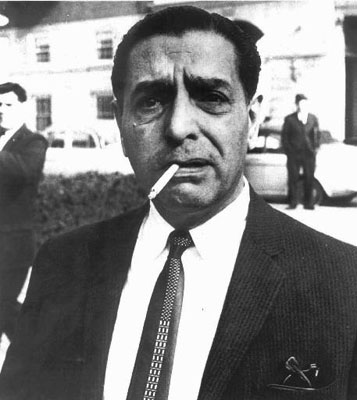
Raymond Patriarca

Tameleo offered a Barboza a job and fulltime income as an enforcer for the Patriarca Family.  Barboza instantly agreed.  He had always dreamed of becoming a “made man” of the Mafia.

(Tameleo didn’t warn him that this was impossible.  Barboza was of Portuguese descent, and only full-blooded Sicilians and Italians could hold Mafia membership.)

Tameleo sent Barboza to shake down 20 nightclubs whose owners had refused to pay “protection insurance” to the mob.

The owners changed their minds after one or two visits from Barboza and his wrecking crew.  Furniture would be smashed and customers terrorized until the owners began paying $1,000 a month to Patriarca’s collectors.

Meanwhile, the always fragile peace of the New England underworld was being shattered by an escalating wave of gangland violence.

In 1961, the two most powerful factions of the region’s “Irish Mafia” had gone to war.  On one side was the Charleston mob of Bernard McLaughlin.  On the other was the Winter Hill gang of James “Buddy” McLean.

The “Irish Gang War” triggered a police crackdown on all the New England organized crime groups—including Patriarca’s.  That was when Patriarca demanded that the fighting stop.

To ensure that it did, he sent his underboss, Tameleo, to arrange a peace conference between the McLeans and McLaughlins.  Both sides agreed to a truce because Tameleo was widely respected for his skills as a negotiator.

But when the conference opened in January, 1965, Tameleo was outraged to find the McLaughlins had come armed–a direct violation of the “rules of order.”  Patriarca also grew furious at this spurning of his efforts as underworld peacemaker.

As a result, the Patriarca Family threw its full weight behind the McLeans.

During 1965, Joseph Barboza moved from being a “mere” legbreaker for the Patriarca Family to becoming its top assassin.  His first important victim was Edward Deegan, a McLaughlin member who had raided several Patriarca gambling dens.

Barboza invited Deegan to join him in a burglary of the Lincoln National Bank in Boston.  Unaware that he had been marked for death, Deegan agreed.

On the night of March 12, 1965, the burglars struck.  As the four men emerged from the bank, Barboza and two cronies emptied their pistols into Deegan.

This killing proved a turning point for Barboza.  He became the top hitman for the Patriarca Family and the McLean mob.  He carried out more  hits than any other assassin during the war.  Later, in a hastily-written autobiography, he would boast of his string of killings.

(But he was always careful to describe his actions in the third-person, as though someone else had actually been responsible.  In this way he protected himself against prosecution for murder, where no immunity existed.)

In June, Jimmy “The Bear” Flemmi, a close friend of Barboza’s, was gravely wounded by a shotgun blast.  Barboza soon learned that the attackers had been Steve Hughes and Edward “Punchy” McLaughlin.

Swearing vengeance, Barboza quickly set out to claim his next victim.  He was especially intent on disposing of Hughes, who had become the top triggerman of the McLaughlins.

On October 20, 1963, Edward McLaughlin was waiting at a bus stop when Barboza casually walked up behind him.  Disguised in a wig and glasses, Barboza drew his pistol and pumped five bullets into McLaughlin.

Less than a month later, on November 11, the hitman visited the Mickey Mouse Club, a tavern in Revere Reach.  This time his intended target was a bartender and McLaughlin member named Ray DiStassio.

Talking with DiStassio at that moment was an innocent bystander, John R. O’Neill.  Barboza simply drew and shot both men dead.

Copyright@1984 Taking Cover: Inside the Witness Security Program, by Steffen White and Richard St. Germain

WITNESS-SECURITY: A BLOODSTAINED HISTORY: PART FOUR (OF TEN)

In Bureaucracy, History, Law, Law Enforcement on June 8, 2013 at 12:05 am

Joseph Valachi was the first member of the Mafia to talk publicly about its secrets.

But before that happened, he had to be persuaded to open up.  The men who first got that assignment were agents of the Federal Bureau of Narcotics and Dangerous Drugs.

But the sessions between him and the agents went badly.  He blamed them for his imprisonment on drug charges in 1960.  And he believed they had deliberately created a rift between him and his cellmate, “Boss of all Bosses” Vito Venovese.

Then the FBI intervened.  Under pressure from Attorney General Robert Kennedy to combat the crime syndicates, the Bureau took an aggressive interest in Valachi.

Seeing him as a potential breakthrough in organized crime intelligence, the FBI cited its greater area of jurisdiction and successfully lobbied the Justice Department to take charge of the new informant.

Valachi’s disclosures proved worthless as prosecution evidence.  They were too dated, and too many of the leading mobsters who figured in them were now dead or retired.

But as strategic intelligence, they were invaluable.

Valachi provided federal lawmen, for the first time, with an insider’s account of the history, membership and operations of organized crime.

Many veteran law enforcement agents were shocked: The shadowy world of the Cosa Nostra was far more extensive and powerful than they had dared imagine.

More important, in Joseph Valachi himself, the Justice Department finally had tangible proof of an organized crime network.  The very existence of the Mafia had long been hotly debated within law enforcement.

Chief among the believers in such a criminal empire had been Harry Anslinger, director of the Federal Bureau of Narcotics.

Anslinger’s certainty that the Mafia existed grew out of his agents’ constant struggles against mobsters importing narcotics into the United States.  His agency had compiled elaborate dossiers on many of these mobsters, and had sent many others to prison.

By far the most important “debunker” of this belief was J. Edgar Hoover, director of the Federal Bureau of Investigation.  Hoover insisted that there was no “national crime confederation,” only loosely-knit groups of criminals whose apprehension was best left to local law enforcers.

J. Edgar Hoover

Hoover’s refusal to admit the existence of the Mafia has long been the subject of heated debate.  Some theorists believe he feared that his “Boy Scout” agents would be corrupted by Mafia bribes.

Others argue that he had been compromised by Mafia bribes or blackmail (the latter through his alleged homosexual relationship with Clyde Tolson, his second-in-command at the FBI).

Still others claim that Hoover simply couldn’t accept that other federal, state and local police agencies had discovered a criminal empire that his own agents had somehow overlooked.

A major reason for the continuing debate over the existence of organized crime lay in the refusal of mob informants to testify as courtroom witnesses.  Abe Reles had been an exception, but he had given his testimony twenty years ago, and only for the State of New York.

More importantly, Reles never appeared before a Senate investigating committee—and on live television.

Joseph Valachi did.  In September, 1963, he became the Senate’s star witness in its hearings on organized crime and narcotics trafficking.

By that time, the mob was offering $100,000 for his life.  To guarantee that no one collected on this contract, federal lawmen turned the Senate Caucus Room into a bodyguards’ convention.

Before Valachi entered the room, FBI agents and deputy U.S. marshals screened the audience for suspicious types or known underworld figures.  While Valachi testified, marshals and capital police filled most of the first eight rows behind him.  Other lawmen were scattered throughout the building.

Joseph Valachi

Whenever Valachi left the witness chair, twenty deputy marshals accompanied him everywhere—even  during trips to the restroom.  And after each day’s proceedings, a fast-moving caravan of police cars returned him to his heavily-guarded cell at the District of Columbia Jail.

During the nearly three years that federal agents interrogated Joseph Valachi, the Justice Department spent more than $167,908 guarding, transporting and maintaining him.

But the money was well-spent: when Valachi died in 1971 at La Tuna Federal Prison, near El Paso, the cause was a heart attack.  And federal lawmen had proven they could guarantee protection for those who betrayed the secrets of the Mafia.

Other organized crime witnesses for the Justice Department didn’t fare so well.

In 1965, two years after Valachi’s appearance before the Senate, Attorney General Nicholas deB. Katzenbach, who had succeeded Robert Kennedy, informed a shocked Congress: “We must dismiss [organized crime cases] because key witnesses or informants suffer ‘accidents’ and turn up, for example, in a river wearing concrete boots.

“Such accidents are not unusual.  We have lost more than twenty-five informants in this and similar ways in the last four years.  We have been unable to bring hundreds of other cases because key witnesses would not testify for fear of the same fate.”

Copyright@1984 Taking Cover: Inside the Witness Security Program, by Steffen White and Richard St. Germain

WITNESS-SECURITY: A BLOODSTAINED HISTORY: PART THREE (OF TEN)

In Bureaucracy, History, Law, Law Enforcement on June 7, 2013 at 12:03 am

Eight years after the death of Arnold Schuster in 1952, the lack of a witness security program cost the life of James V. Delmont, a member of the Stefano Magaddino Mafia Family of Buffalo, New York.  After slipping from underworld grace, Delmont went on the run for his life.

On June 25, 1959, he appeared at the Miami field office of the FBI, offering a rare trade: Mafia secrets for any intelligence the Bureau had on his pursuers.  But the FBI didn’t know what to do with its would-be informant.  One agent advised Delmont to re-enter the Mafia as an FBI plant.  Delmont angrily rejected that idea, and again took flight.

On May 25, 1960, he made a similar offer to agents of the FBI’s Los Angeles office.  They wrote him off as a crank.

Ten days later, Delmont’s body, bearing the marks of a classic Mafia execution (several bullets fired directly into the back of the head), turned up in a field in East Los Angeles.  The Intelligence Division of the Los Angeles Police Department conducted a vigorous probe into the slaying, but couldn’t positively identify Delmont’s killers.

Commenting on the significance of the Delmont case, LAPD Sergeant Peter N. Bagoye, an expert on organized crime, noted: “If any police officer still doubts the existence and power of the Mafia, the Cosa Nostra, or whatever you want to call it, just let him read this case.

“This man Delmont spent a year and traveled thousands of miles to escape the vengeance of the Mafia.  He left a trail of letters and conversations behind-the first known case in which there is any existing blueprint of how the Syndicate works.”

In 1961, after Robert F. Kennedy became Attorney General, the Justice Department mounted the first effective campaign in its history against organized crime.  As part of this effort, the agency began wrestling for the first time with the complex difficulties of creating a protection program for organized crime witnesses.

Robert F. Kennedy

By September, 1963, Kennedy—appearing as a witness during Senate hearings on organized crime and narcotics trafficing—could  cite a number of successes by federal lawmen in safeguarding witnesses.

“How long,” asked Maine Senator Edmund S. Muskie, “can the Justice Department protect people who agree to testify?”

“We have taken steps, Senator, to even move people out of the country,” answered Kennedy.  “We have provided them with positions and work in other cities where nobody will really have any contact with them.  We have arranged to move their families and have their names changed.

“I think we have procedures now where, if an important individual comes forward and is willing to testify, we can give him that kind of protection.”

Such an individual proved to be Joseph Valachi, an aging Cosa Nostra hitman and narcotics trafficker.  In 1962, Valachi was an inmate at Atlanta Federal Prison, serving two concurrent sentences totaling thirty-five years for narcotics trafficking.  His cellmate was Vito Genovese, then the most powerful Mafia boss in the country.

Vito Genovese

Genovese had been convicted of narcotics conspiracy in 1959 and sentenced to fifteen years’ imprisonment.  Now he began suspecting—wrongly—that Valachi was an informer.  The reason: After Valachi’s second trial for narcotics trafficking, he had been repeatedly interviewed—against his will—by federal narcotics agents.

One night, in a scene right out of a B-grade Mafia movie, Genovese summoned Valachi to his cell for a private talk.

“You know,” said Genovese, “we take a barrel of apples.  And in this barrel of apples, there might be a bad apple.  Well, this apple has to be removed.  And if it ain’t removed, it would hurt the rest of the apples.”  Then he gave Valachi the fabled “kiss of death,” signifying that he was now marked for murder.

Valachi survived what he believed were attempts to poison his food and lure him alone into a shower where he could be stabbed to death.   But he knew his luck could not last forever.  He decided to take at least one of his enemies with him.

On June 22, 1963, he beat another inmate to death with an iron pipe.  Only later did he learn that he had killed the wrong man: John Joseph Saupp, a forger without ties to the mob.  It had been Saupp’s bad luck to bear a striking resemblance to another prisoner whom Valachi believed had the contract to kill him.

Valachi grew depressed over having killed the wrong man.  He also knew he couldn’t spend the rest of his life in solitary confinement.  Desperate, he offered himself as an informant to Robert Morgenthau, the New York U.S. Attorney.  Morgenthau, in turn, put him in contact with agents of the Federal Bureau of Narcotics.

The agents quickly transferred Valachi from Atlanta Federal Prison to the first of a series of military bases.  But the sessions between him and the agents went badly.  He still blamed them for his imprisonment in 1960.  And he believed they had deliberately created a rift between him and Geno

Copyright@1984 Taking Cover: Inside the Witness Security Program, by Steffen White and Richard St. Germain

WITNESS-SECURITY: A BLOODSTAINED HISTORY: PART TWO (OF TEN)

In History, Law, Law Enforcement on June 5, 2013 at 12:00 am

The testimony of Abe “Kid Twist” Reles’ propelled seven Mafia assassins or lieutenants into the electric chair—a feat never before or since equaled.  Among these was Louis “Lepke” Buchalter, whose execution, in 1944, makes him to date the only mob boss to suffer the fullest penalty of the law.

Reles’ career as a witness earned him the hatred of mobsters throughout the nation.  The Mafia put out a $100,000 contract on him and hoped that one of its hitmen proved lucky or skillful enough to collect on it.  But no hitman ever tried, for Reles was too carefully guarded, and the mobsters knew it.

When he wasn’t testifying in court, Reles was quartered in a secured room on the sixth floor of the Half Moon Hotel on Coney Island.  There he dined on thick steaks and cold beers and listened to ballgames on the radio.  Eighteen officers of the NYPD, working in three, eight-hour, six-man shifts, protected him at all times.

Despite these precautions, the witnessing career of Abe “Kid Twist” Reles ended abruptly on November 12, 1941.  Sometime around dawn, Reles “fell” to his death from one of the windows of his sixth-floor room.

Abe Reles in death

The sudden death of the prosecution’s star witness scandalized the NYPD.  Local newspapers questioned the integrity of the officers on the Reles security detail.  Both the police and the Brooklyn District Attorney’s office launched investigations to learn whether Reles had died as the result of an accident—or  murder.

But the NYPD quickly moved to protect itself from blame.  Its final report shifted blame for Reles’ death from his bodyguards to the victim himself.  According to this version: Reles, a “notorious” practical joker, had tied two bedsheets together and slipped out of his window to play a trick on his guards.

He intended to enter a vacant room, just below his own, and then walk back upstairs to surprise his protectors.  Unfortunately, his makeshift rope snapped, and he plunged to his death forty-two feet below.

Two bedsheets, knotted together, were in fact discovered near Reles’ corpse.  That seemed to support the police theory of the rope-ladder escape attempt.  But the police could not explain why Reles had landed twenty feet from the wall.

More than twenty years later, Joseph Valachi, an aging Mafia hitman, became the Justice Department’s own version of Abe Reles.  Before dying—of a heart attack—Valachi offered his own view on what had happened to Reles: “I never met anybody yet who thought Reles went out that window on purpose.”

The next important organized crime witnesses to die while under “protective custody” by local police was Peter La Tempa, a cigar store salesman with rackets connections.

His testimony could have supported that of another witness, Ernest “The Hawk”  Rupollo.   Rupollo’s  testimony  linked  Vito Genovese, one of the nation’s most-feared Mafia bosses, with the murder of a Genovese henchman, Ferdinand Boccia, in 1934.

But La Tempa never got the chance to testify.  On January 15, 1945, he swallowed what he thought were pain-killers for his gallstones.  A New York toxicologist later reported there was enough poison in La Tempa’s bloodstream “to kill eight horses.”  At the time of his death, he was being held under police guard in a Brooklyn jail cell.

The circumstances behind La Tempa’s murder were never satisfactorily explained.  The police claimed they couldn’t determine how poison pills had been substituted for the victim’s regular medication.  Nor was anyone ever indicted—exactly the scenario that had followed the equally mysterious death of Abe Reles.

With La Tempa dead, the testimony of Ernest Rupollo could not be corroborated.  The Brooklyn District Attorney’s office dropped the murder charge it had leveled against him to compel his testimony.  Prosecutors declared him a free man, but the Mafia declared him a hunted one.

For eighteen years, Rupollo somehow eluded his pursuers.  Finally, on August 17, 1964, his bullet-riddled body, weighted with chains and concrete blocks, washed ashore in New York.  Four Mafia figures were later fried for the murder, but were acquitted.

Yet another witness to come forward—and die for it—was Arnold Schuster, a shoe salesman. One night in early 1952, he spotted Willie “The Actor” Sutton, a notorious bank robber, on the New York subway.  Schuster tipped off police, who arrested Sutton.

For several days, the mild-mannered Schuster became a minor celebrity.  Then he became a dead one: on March 8, 1952, two gunmen shot him down on the street.

The murder baffled police; Sutton was known as a loner without ties to killers or organized crime.

More than ten years later, the truth finally emerged.  According to Joseph Valachi, the man responsible for Arnold Schuster’s murder was Albert Anastasia, the former boss of Murder, Inc.

Only the untimely death of Abe Reles had prevented Anastasia’s own in the electric chair.  In 1952, he was still one of the most-feared Mafia chieftains in the nation.

Albert Anastasia

Anastasia had seen Schuster being interviewed on television and had flown into a rage.  “I hate squealers!” he had screamed to three of his executioners who were in the room at the time.  “Hit that guy!”

As Valachi saw it, the killing of Arnold Schuster was simply Anastasia’s way of doing a favor for a fellow criminal, even though he had never met Sutton.

Copyright@1984 Taking Cover: Inside the Witness Security Program, by Steffen White and Richard St. Germain

WITNESS-SECURITY: A BLOODSTAINED HISTORY: PART ONE (OF TEN)

In History, Law, Law Enforcement on June 4, 2013 at 12:03 am

Witness-protection has a long and bloodstained history–with the blood belonging to early witnesses against the Mafia.

Fortunately, that has since changed.  Today the Witness Security Program, operated by the U.S. Marshals Service for the Justice Department, is the world’s most sophisticated and effective means of protecting organized crime witnesses.

But before there was the Program (otherwise known as WITSEC), witness-security was provided by local police departments.

Abe “Kid Twist” Reles became the first important mobster to betray the secrets of the Mafia—and the first to die for doing so.

Abe Reles

Since his first arrest at sixteen in 1924, Reles had been in almost constant trouble with the law.  His police record listed forty-two arrests, including six for murder.  He had been sent to prison six times.

What his police record failed to disclose was that, for the last ten years, he had been a highly-paid assassin for Murder, Inc., the execution squad of the New York Mafia.

Then, in early 1940, Reles and two of his fellow killers were arrested and indicted for the 1936 gangland slaying of Alex “Red” Alpert.  Now facing almost certain conviction and death in the electric chair, Reles decided to cut a life-saving deal, even if it came at the Mafia’s expense.

On March 31, 1940, more than forty days after his arrest, Reles sent his wife to the office of Brooklyn District Attorney William O’Dwyer.  Her message: “My husband wants an interview with the law.”

The politically-ambitions O’Dwyer ordered Reles’ immediate release from his cell in the Tombs in Manhattan.  Guards then rushed the killer to the office of the district attorney.

There Reles demanded a private interview with O’Dwyer to propose a nonnegotiable deal: he would tell the prosecutors everything they wanted to know about the Mafia.  More importantly, he agreed to testify in court against his fellow mobsters.

In exchange, he demanded the immediate dropping of all charges against him.  He also insisted on immunity from prosecution on the basis of any testimony that he or anyone else might give.  Finally, once his career as a witnesses ended, he must be granted his complete freedom.

O’Dwyer quickly agreed to these conditions.  Then he ordered that his new prize witness be placed under heavy, constant police guard.

Abe Reles opened his confessions with the details of 50 gangland murders.  His photographic memory cited the names of the victims—and their killers.  He also remembered the names of those who had ordered the killings.  And he supplied names of others who could corroborate his testimony.

Altogether, Reles’ first  gush of testimony lasted 12 days and filled 25 stenographic notebooks.

For the first time, prosecutors learned how the Mafia had turned murder into a lucrative, smoothly-operating business.

In 1930, the chiefs of the five most powerful Mafia “families” in New York had created an execution squad to enforce underworld discipline. Its targets were informers and rival mobsters.

Commanding this squad were the dreaded labor racketeers Albert “The Lord High Executioner” Anastasia and Louis “Lepke” Buchalter.

For ten years, the squad’s killers roamed the nation, carrying out perhaps as many as 9,000 executions.  Police were baffled; there didn’t seem any motive for the killings.  The victims lacked any known ties to their killers, and the assassins usually lived far from the scenes of their carnage.

“Lepke” Buchalter not only turned murder into a business, he adopted business terms to serve as an underworld code.  An assignment to murder was a “contract”; a “hit” was the actual murder; and the “bum” or “mark” was the victim.

Each killer was known as a “hitman,” and earned $1,000 to $5,000 per hit.  The amount depended on the status of the victim and the risks involved in his execution.

The killers drew on their own expense accounts and coverage by generous injury insurance and family-care funds.  In the rare event of their arrest, highly-paid attorneys rushed to their defense.  And they could count on their fellow assassins to remove any troublesome prosecution witnesses.

The Mafia not only had its own execution squad; it also ran a “hideout network” for mobsters on the run from the law.  Such fugitives could quickly obtain jobs—and even new identities—through organized crime groups in other cities or states.

If necessary, they could go permanently underground as “legitimate” employees of mob-owned unions or businesses.  As a result, organized crime boasted a “new identities” program vastly superior to anything existing for organized crime witnesses until 1967.

Copyright@1984 Taking Cover: Inside the Witness Security Program, by Steffen White and Richard St. Germain

“MAN ON FIRE” REVISITED

In Bureaucracy, History, Law Enforcement, Politics on May 31, 2013 at 8:21 pm

Yanira Maldonado has been released from a Mexican jail.

She and her husband, Gary, had traveled from Arizona to Mexico to attend a funeral.

They were returning to Arizona when their bus was stopped and searched.  Mexican soldiers claimed they found 12 pounds of marijuana under her seat.

Gary Maldonado believes the soldiers were seeking a bribe in return for letting his wife go free.

But then the Mormon mother of seven got an unusually lucky break.

On May 30, security camera footage in court showed Maldonado and her husband boarding a bus in Mexico–and carrying a purse, two blankets and two bottles of water.

Her defense attorney, Francisco Benitez, argued that the images proved that nothing they were carrying could hold the amount of marijuana that Maldonado was accused of smuggling.

The Mexican soldiers who arrested Maldonado didn’t appear in court. They were scheduled to appear on May 29  but didn’t show.

Yanira Maldonado said she didn’t think that she was directly targeted: “Someone smuggled those in there, and I probably sat in the wrong seat.”

To anyone who has seen “Man on Fire,” the 2004 Denzel Washington movie, the possibility that Maldonado was framed in an extortion attempt does not seem far-fetched.

In fact, it’s an everyday occurrence in Mexico, where corruption permeates every aspect of that country’s “war on drugs.”

In “Man on Fire,” Washington plays Marcus Creasy, a former Special Forces soldier hired to bodyguard Pita Ramos, the precocious nine-year-old daughter of wealthy parents.

But in a shootout with kidnappers, Creasy is gravely wounded and Pita (Dakota Fanning) is snatched.  Believing her murdered, Creasy sets out to avenge the child he has grown to love as his own.

He draws up a Who’s Who list of criminals engaged in serial kidnapping.  And, in doing so, he learns that the biggest criminal gang of all is the Mexican police.

It’s called “La Hermandad” (The Brotherhood).

Creasy snatches a corrupt cop and tortures him (by cutting off several fingers) into giving up the names of some of his top associates.  Then Creasy shoots him in the head and moves on to his next target.

Watching all this activity is the Mexican version of the FBI: The Agencia Federal de Investigacion (AFI).  Its director, Miguel Manzano, plans to use Creasy to unravel the kidnappers’ network.

While Creasy coolly disposes of one kidnapper or corrupt cop after another, Manzano and his agents keep close tabs on the action.  They will let Creasy do the dirty work and move in when the time is right.

After several grisly action sequences–including one where Creasy ambushes police with a Rocket Propelled Grenade (RPG) launcher–Creasy learns the unthinkable: Pita is actually alive.

He kidnaps the brother of the leader of “La Hermandad”–Daniel Sanchez–and offers him a trade: You give me Pita and I’ll give you your brother.

Just as he has brutally traded on the love of others for the lives of their snatched relatives, so, too, must Sanchez now accept such an arrangement.

The trade-off goes down, with Pita rushing into the arms of her overjoyed mother, and with Creasy surrendering himself to members of the Agencia Federal de Investigacion.

Daniel Sánchez is later killed by Miguel Manzano during an AFI raid.

“Man on Fire” is an unrelentingly brutal portrait of a thoroughly corrupt nation.

  • Pita’s Mexican father sets up his own daughter for a bogus kidnapping to cheat the insurance company out of the money it’s prepared to pay for “kidnapping insurance.”
  • His attorney cheats the kidnappers of the ransome money they had demanded, intending to keep this for himself.
  • Two Mexican policemen make up the kidnapping gang that snatches Pita.
  • A member of the Mexican Attorney General’s office–who’s assigned to its anti-kidnapping squad, no less–is in on the plot to seize Pita.
  • Other members of the Mexican police routinely assist kidnapping gangs in return for a portion of the ransom money.
  • Even the Agencia Federal de Investigacion, while portrayed as incorruptable, llows Creasy to eliminate cops and kidnappers as he leads the AFI closer to the head of the criminal network.

One of the few moments of levity–no doubt unintended–in an otherwise humorless movie comes at the start of its end-credits: “A SPECIAL THANKS TO MEXICO CITY, A VERY SPECIAL PLACE.”

“I love Mexico,” Maldonado told reporters after safely arriving in Nogales, Ariz.  “My family is still there. So Mexico… it’s not Mexico’s fault. It’s a few people who you know did this to me,” she said.

Perhaps a more accurate analysis of the conditions prevailing in Mexico was given by William von Raab, the U.S. Commissioner of Customs from 1981 to 1989.

In 1986, testifying before a Senate committee on the extent of narcotics corruption in Mexico, Raab said: “There is an ingrained corruption in the Mexican law-enforcement establishment.

“Corruption is so pervasive, that one has to assume every Mexican official is corrupt unless proven otherwise.”

Raab’s assessment should be required reading for every American planning to vacation “down Mexico way.”

GREED-TESTING FOR CEOS: PART TWO (END)

In Bureaucracy, Business, History, Politics on May 22, 2013 at 12:34 am

Robert Benmosche, the CEO of American International Group (AIG) recently offered some blunt advice to college graduates searching for work.

“You have to accept the hand that’s been dealt you in life,” Benmosche said in an interview on Bloomberg Television. “Don’t cry about it. Deal with it.”

As is typical of one-percenters, Benmosche blames willing-to-work college graduates for the refusal of rich employers to offer jobs instead of excuses.

AIG’s way of “accepting the hand that’s been dealt you in life” was to go crying to the Federal Government for a bailout loan–which eventually ballooned to $182 billion.

If college graduates should “deal with” the hardships of finding a responsible, hiring-inclined employer with a stiff upper lip, as Benmosche advises, the same advice should work wonders on greed-fueled CEOs.

Greed-test CEOs for future government loans.

After all, drug-testing welfare recipients has become the new mantra for Republicans.

Some bills have even targeted people who seek unemployment insurance and food stamps, despite scanty evidence that the poor and jobless are disproportionately on drugs.

The concept of background screening is actually sound. But Republicans are aiming it at the wrong end of the economic spectrum.

Since 2008, the government has handed out billions of dollars in bailouts to CEOs of the wealthiest corporations in the country.

The reason: To rescue the economy from the calamity produced by the criminal greed and recklessness of those same corporations.

In 2008, Alan Greenspan, the former chairman of the Federal Reserve, testified before Congress about the origins of the Wall Street “meltdown.”

He admitted that he was “shocked” at the breakdown in U.S. credit markets and said he was “partially” wrong to resist regulation of some securities.

“Those of us who have looked to the self-interest of lending institutions to protect shareholder’s equity–myself especially–are in a state of shocked disbelief,” said Greenspan, who had ruled the Fed from 1987 to 2006.

As a disciple of the right-wing philosopher, Ayan Rand, Greenspan had fiercely held to her belief that “The Market” was a divine institution. As such, “it” alone knew what was best for the nation’s economic prosperity.

“Enlightened self-interest,” he believed, would guarantee that those who dedicated their lives to making money would not allow mere greed to steer them–and the country–into disaster.

As he saw it, any attempt to regulate greed-based appetites could only harm that divine institution.

Greenspan proved wrong. And the nation will be literally paying for such misguided confidence in profit-addicted men for decades to come.

So if Republicans want to protect the “poor, oppressed taxpayer,” they should demand background investigations for those whose addiction truly threatens the economic future of this country.

That is–the men (and occasionally women) who run the nation’s most important financial institutions, such as banks, insurance and mortgage companies.

Thus, in the future, all CEOs–and their topmost executives–of financial institutions seeking Federal bailouts should be required to:

  • Undergo “full field investigations” by the FBI and IRS.
  • Submit full financial disclosure forms concerning not only themselves but all members of their immediate families.
  • Be subject to Federal prosecution for perjury if they provide false information or conceal evidence of criminal violations.
  • Periodically submit themselves for additional background investigation.
  • Be subject to arrest, indictment and prosecution if the background investigation turns up evidence of criminal activity.

In addition:

  • If a bailout-seeking financial institution refuses to comply with these criteria, it should be refused the loan.
  • If a CEO and/or other top officials are judged ineligible for a loan, the company should be asked to replace those executives with others who might qualify.
  • Those alternative executives should be subject to the same background investigation requirements as just outlined.
  • If the institution refuses to replace those executives found ineligible, the Government should refuse the loan.
  • If the Government is forced to take over a troubled financial institution, its CEO and top executives should be replaced with applicants who have passed the required security screening.

The United States has a long and embarrassing history in worshipping wealth for its own sake. Part of this can be traced to the old Calvinistic doctrine that wealth is a proof of salvation, since it shows evidence of God’s favor.

Another reason for this worship of mammon is the belief that someone who is wealthy is automatically endowed with wisdom and integrity.

Following these beliefs to their ultimate conclusion will transform the United States into a plutocracy–a government of the wealthy, by the wealthy, for the wealthy.

Every day we see fresh evidence of the destruction wrought by the unchecked greed of wealthy, powerful men.

When they–and their paid shills in Congress–demand, “De-regulate business,” it’s essential to remember what this really means.

It means: “Let criminals be criminals.”