bureaucracybusters

Archive for the ‘History’ Category

EVERY PASSENGER AN AIR MARSHAL

In Bureaucracy, History, Law Enforcement, Politics, Social commentary on July 15, 2013 at 1:19 am

On June 5, the Transportation Safety Administration (TSA) finally came face-to-face with reality.

It announced that it was abandoning its plan to let passengers carry small knives, baseball bats, golf clubs and other sports equipment onto planes after all.

Of course, TSA didn’t drop this plan because it wanted to.  It did so because of fierce opposition from passengers, Congressional leaders and airline industry officials.

TSA Administrator John Pistole unveiled the proposal in March, saying that in these days of hardened cockpit doors, armed off-duty pilots traveling on planes and other preventive measures, small folding knives could not be used by terrorists to take over a plane.

He said that intercepting them takes time that would be better used searching for explosives and other more serious threats.

TSA screeners confiscate over 2,000 small folding knives a day from passengers.

The proposal would have permitted folding knives with blades that are 2.36 inches (6 centimeters) or less in length and are less than 1/2 inch (1 centimeter) wide. The aim was to allow passengers to carry pen knives, corkscrews with small blades and other knives.

Passengers also would also have been allowed to bring onboard novelty-sized baseball bats less than 24 inches long, toy plastic bats, billiard cues, ski poles, hockey sticks, lacrosse sticks and two golf clubs.

The United States has gradually eased airline security measures that took effect after 9/11.

In 2005, TSA said it would let passengers carry on small scissors, knitting needles, tweezers, nail clippers and up to four books of matches.  The agency began focusing on keeping explosives off planes, because intelligence officials believed that was the greatest threat to commercial aviation.

With regard to the use of edged weapons as terrorist tools:

  • The terrorists who highjacked four jetliners and turned them into flying bombs on September 11, 2001, used only boxcutters to cut the throats of stewards and stewardesses; and
  • They then either forced their way into the cockpits and overpowered and murdered the pilots, or lured the pilots to leave the cabins and murdered them.

It’s also worth remembering that for all the publicity given the TSA’s “Air Marshal” program, it’s been airline passengers who have repeatedly been the ones to subdue unruly fliers.

Consider the following incidents:

  • On August 11, 2000, Jonathan Burton, a passenger aboard a Southwest Airlines flight tried to break into the cockpit was killed by other passengers who restrained him.
  • On May 9, 2011, crew members and passengers wrestled a 28-year-old man to the cabin floor after he began pounding on the cockpit door of a plane approaching San Francisco.
  • On February 21, 2012, passengers aboard a Continental Airlines flight from Portland to Houston rushed to aid a flight attendant subdue a Middle Eastern man who began shouting, “Allah is great!”
  • On March 27, 2012, a JetBlue flight from new York to Las Vegas was forced to land in Texas after the pilot started shouting about bombs and al-Qaeda and had to be subdued by passengers.
  • On January 9, 2013, passengers on board an international flight from Reykjavik to New York’s John F. Kennedy Airport subdued an unruly passenger by tying him to his seat with duct tape and zip ties after he began screaming and hitting other passengers.
  • On May 27, 2013, a passenger aboard an Alaska Airlines flight from Anchorage to Portland, Oregon, tried to open an airplane door in-flight and was subdued by passengers and crew members until the plane landed in Portland.

In every one of these incidents, it’s been passengers–not Air Marshals–who have been the first and major line of defense against mentally unstable or terroristically inclined passengers.

In opposing TSA’s proposal to loosen security restrictions, skeptical lawmakers, airlines, labor unions and law enforcement groups argued that knives and other items could be used to injure or kill passengers and crew.

Such weapons would have increased the dangers posed by the above-cited passengers (and a pilot) who erupted in frightening behavior.

Prior to 9/11, commercial airline pilots and passengers were warned: If someone tries to highjack the plane, just stay calm and do what he says.

So many airplanes were directed by highjackers to land in Fidel Castro’s Cuba that these incidents became joke fodder for stand-up comedians.

And, up to 9/11, the advice to cooperate fully with highjackers and land the planes where they wanted worked.  No planes and no lives were lost.

But during 9/11, passengers and crew–with one exception–cooperated fully with the highjackers’ demands.  And all of them died horiffically when three of those jetliners were deliberately crashed into the Twin Towers of the World Trade Center and the Pentagon.

World Trade Center under airplane attack

Only on United Flight 93 did the passengers and crew fight back. In doing so, they accomplished what security guards, soldiers, military pilots, the CIA and FBI could not: They thwarted the terrorists, sacrificing their own lives and preventing the fourth plane from destroying the White House or the Capital Building.

Memorial to the passengers and crew of United Flight 93

Since every airline passenger must now become his or her own Air Marshal, it seems only appropriate that the criminals they face be rendered as harmless as possible.

JAMES BOND FOR HIRE: PART TWO (END)

In Bureaucracy, History, Military, Politics, Social commentary on July 12, 2013 at 9:00 pm

The 1960 Kirk Douglas epic, Spartacus, may soon prove to be more than great entertainment. It may also turn out to be a prophecy of the end of the American Republic.

Throughout the movie, wealthy Romans assume they can buy anything–or anyone.  When seeking a favor, Marcus Licinius Crassus (Laurence Oliver) says bluntly: “Name your price.”

Today, “Name your price” has become the password for entry into America’s Intelligence community.

Althugh not portrayed in Spartacus, one of the reasons for the fall of the Roman empire lay in its reliance on foreign mercenaries.

Roman citizens, who had for centuries manned their city’s legions, decided to outsource these hardships and dangers to hired soldiers from Germany and Gaul (now France).

Although Germans and Gauls had proven capable fighters when defending their own countries, they proved highly unrelible as paid mercenaries.

Niccolo Machiavelli, the father of political science, drew heavily on ancient history for his examples of how liberty could best be preserved within a republic.

Fully aware of the Romans’ disastrous experience with mercenaries, Machiavelli believed that a nation’s army should be driven by patriotism, not greed.  Speaking of mercenaries, he warned:

“Mercenaries…are useless and dangerous. And if a prince holds on to his state by means of mercenary armies, he will never be stable or secure; for they are disunited, ambitious, without discipline, disloyal; they are brave among friends, among enemies they are cowards.

“They have neither the fear of God nor fidelity to men, and destruction is deferred only so long as the attack is. For in peace one is robbed by them, and in war by the enemy.”

Americans–generally disdainful of history–have blatantly ignored both the examples of history and the counsel of Machiavelli.  To their own peril.

Mark Mazzetti, author of the bestselling The Way of the Knife, chronicles how the CIA has been transformed from a primarily fact-finding agency into a terrorist-killing one.

Along with this transformation has come a dangerous dependency on private contractors to supply information that government agents used to dig up for themselves.

America’s defense and intelligence industries, writes Mazzetti, once spread across the country, have relocated to the Washington area.

They want to be close to “the customer”: The National Security Agency, the Pentagon, the CIA and an array of other Intelligence agencies.

The U.S. Navy SEALS raid that killed Osama bin Laden has been the subject of books, documentaries and even an Oscar-nominated movie: “Zero Dark Thirty.”

Almost unknown by comparison is a program the CIA developed with Blackwater, a private security company, to locate and assassinate Islamic terrorists.

“We were building a unilateral, unattributable capability,” Erik Prince, CEO of Blackwater, said in an interview.  “If it went bad, we weren’t expecting the [CIA] chief of station, the ambassador or anyone to bail us out.”

But the program never got past the planning stage.  Senior CIA officials feared the agency would not be able to  permanently hide its own role in the effort.

“The more you outsource an operation,” said a CIA official, “the more deniable it becomes.  But you’re also giving up control of the operation.  And if that guy screws up, it’s still your fault.”

Increased reliance on “outsourcing” has created a “brain-drain” within the Intelligence community. Jobs with private security companies usually pay 50% more than government jobs.

Many employees at the CIA, NSA and other Intelligence agencies leave government service–and then return to it as private contractors earning far higher salaries.

Many within the Intelligence community fear that too much Intelligence work has been outsourced and the government has effectively lost control of its own information channels.

And, as always with the hiring of mercenaries, there is an even more basic fear: How fully can they be trusted?

“There’s an inevitable tension as to where the contractor’s loyalties lie,” said Jeffrey Smith, a former general counsel for the CIA.  “Do they lie with the flag?  Or do they lie with the bottom line?”

Yet another concern: How much can Intelligence agencies count on private contractors to effectively screen the people they hire?

Edward Snowden, it should be remembered, was an employee of Booz Allen Hamilton, a consulting/security firm.  It was through this company that Snowden gained access to a treasury of NSA secrets.

In March 2007, the Bush administration revealed that it paid 70% of its intelligence budget to private security contractors.  That remains the case today–and the Intelligence budget for 2012 was $75.4 billion.

A 2010 investigative series by the Washington Post found that “1,931 private companies work on programs related to counterterrorism, homeland security and intelligence in about 10,000 locations across the country.”

Jesus never served as a spy or soldier.  But he clearly understood a truth too many officials within the American Intelligence community have forgotten:

“For where your treasure is, there will your heart be also.”

JAMES BOND FOR HIRE: PART ONE (OF TWO)

In Bureaucracy, History, Military, Politics, Social commentary on July 11, 2013 at 10:33 pm

A movie critic, reviewing John Wayne’s 1968 gung-ho film, “The Green Berets,” said that Wayne had reduced the complex issues behind the Vietnam war to the simplicity of a barroom brawl.

In the same vein, the American news media displays a genius for ignoring the complexities of a major news story and focusing on just a single, sensationalistic aspect of it.

Take the Paula Deen scandal.  The media have universally focused on Deen’s admitted use of the “N-word”–and utterly ignored far more important aspects of the story.

According to the complaint, employees at the restaurant were routinely subjected to violent behavior, racial and sexual harassment, assault, bettery and sexual discrimination in pay.

Similarly, in covering the odyssey of Edward Snowden, the former NSA worker turned mass secret leaker, the media have followed the same path.

Edward Snowden

In an updated version of “Where’s Waldo?” the media have focused their attention on charting the almost daily whereabouts of Snowden.

Will Snowden receive amnesty in Hong Kong?  In Russia?  In Cuba?  China?  Venezuela?  Nicaragua?

The blunt truth is that Snowden, as an individual, doesn’t matter.

Either he will obtain aslym in a country that hates the United States–or he won’t.

Even if he obtains such asylum, there’s no guarantee it will last.

Ilich Ramírez Sánchez, the international terrorist better known as “Carlos the Jackal,” can attest to that.

By 1994, he had spent almost 20 years on the run from the French Intellilgence agents.  They were seeking him for a series of terrorist attacks across France–and for the 1975 murders of two counter-intellilgence agents and their informant.

Carlos “The jackal”

After living in a series of countries that had no extradition treaty with France–such as Syria, Iraq and Jordan–he settled down in the Sudanese city of Khartoum.

He felt utterly safe, since he had been accorded official protection by the Sudanese government.  But he had misjudged his protectors.

French and American Intelligence agencies offered a number of deals to the Sudanese authorities. In 1994, Carlos was scheduled to undergo a minor testicular operation in a Sudanese hospital.

Two days after the operation, Sudanese officials warned him of an assassination plot–and moved him to a villa for protection.  They also provided him with bodyguards.

One night later, the bodyguards entered his room while he slept, tranquilized and tied him up–and slipped him into the custody of his longtime pursuers.

On August 14, 1994, Sudan transferred him to French Intelligence agents, who flew him to Paris for trial.  He is now serving two sentences of life imprisonment.

There is no guarantee that any nation that guarantees the security of Edward Snowden today won’t decide, in the future, to betray him.

So for all the efforts of the news media to treat him like the Flying Dutchman, he is just one man.

And, eventually he will run out of secrets to spill.  That’s assuming that Russian and/or Chinese Intelligence agents haven’t already helped themselves to the secrets on his laptop.

As Mr. Spock once famously said during an episode of “Star Trek”: “Military secrets are the most fleeting of all.”

So where does the significance of the Snowden story lie?

In the fact that Americans have become too lazy or fearful to do most of their own spying.

Yes, that’s right–60 to 70% of America’s Intelligence budget doesn’t go to the CIA or the National Security Agency (NSA) or the Defense Intelligence Agency (DIA).

Instead, it goes to private contractors who supply secrets or “soldiers of fortune.”

One such contractor is Booz Allen Hamilton–which employed Snowden and gave him access to the super-secret NSA.

The outsourcing of government intelligence work to private contractors took off after 9/11.

This was especially true after the United States invaded Iraq in 2003–and found its Intelligence and armed services stretched to their furtherest limits.

The DIA estimates that, from the mid-1990s to 2005, the number of private contracts awarded by Intelligence agencies rose by 38%.

During that same period, government spending on “spies/guns for hire” doubled, from about $18 billion in 1995 to about $42 billion in 2005.

Many tasks and services once performed only by government employees are being “outsourced” to civilian contractors:

  • Analyzing Intelligence collected by drones and satellites;
  • Writing reports;
  • Creating and maintaining software programs to manipulate data for tracking terrorist suspects;
  • Staffing overseas CIA stations;
  • Serving as bodyguards to government officials stationed overseas;
  • Providing disguises used by agents working undercover.

More than 500 years ago, Niccolo Machiavelli warned of the dangers of relying on mercenaries:

“There are two types of armies that a prince may use to defend his state: armies made up of his own people or mercenaries….

“Mercenaries…are useless and dangerous. And if a prince holds on to his state by means of mercenary armies, he will never be stable or secure; for they are disunited, ambitious, without discipline, disloyal; they are brave among friends, among enemies they are cowards.

“They have neither the fear of God nor fidelity to men, and destruction is deferred only so long as the attack is. For in peace one is robbed by them, and in war by the enemy.”

Machiavelli, on meeting Edward Snowden, would no doubt find his judgment confirmed.

OBAMA FLUNKS, MACHIAVELLI REIGNS

In Bureaucracy, History, Law, Politics, Social commentary on July 10, 2013 at 10:00 pm

Barack Obama is one of the most highly educated men to occupy the White House.

In 1988, he entered Harvard Law School, graduating in 1991.  He was selected as an editor of the Harvard Law Review at the end of his first year, and president of the journal in his second year.

In 1991, he accepted a two-year position as Visiting Law and Government Fellow at the University of Chicago Law School to work on his first book, Dreams of My Father, published in 1995.

He then taught constitutional law at the University of Chicago Law School for twelve years—as a Lecturer from 1992 to 1996, and as a Senior Lecturer from 1996 to 2004.

President Barack Obama

And yet, for all his experience as a scholar, there remains a truth about which he remains woefully ignorant.

It is a truth that Niccolo Machiavelli, the father of modern political science, understood all too well.

In his pamphlet, The Prince, Machiavelli laid out the qualities that a successful ruler must possess.  There were some to be cultivated, and others to be avoided at all costs.  For example:

He is rendered despicable by being thought changeable, frivolous, effeminate, timid and irresolute—which a prince must guard against as a rock of danger…. 

[He] must contrive that his actions show grandeur, spirit, gravity and fortitude.  As to the government of his subjects, let his sentence be irrevocable, and let him adhere to his decisions so that no one may think of deceiving or cozening him.

Niccolo Machiavelli

So how has Obama fared by this standard?

Consider the July 2 press release from the Treasury Department on the signature achievement of his administration, the passage of the Affordable Care Act (ACA), better known as Obamacare:

“Over the past several months, the Administration has been engaging in a dialogue with businesses – many of which already provide health coverage for their workers – about the new employer and insurer reporting requirements under the Affordable Care Act (ACA).

“We have heard concerns about the complexity of the requirements and the need for more time to implement them effectively….We have listened to your feedback.  And we are taking action.

“The Administration is announcing that it will provide an additional year before the ACA mandatory employer and insurer reporting requirements begin.”

[Boldface in the original document.]

* * * * *

In short: The administration is delaying until 2015 the law’s requirement that medium and large companies provide coverage for their workers or face fines.

Now consider how Obama’s self-declared enemies reacted to this announcement.

Since 2011, right-wing Republicans in the House of Representatives have voted 37 times to repeal or defund all or parts of ObamaCare, most recently in May.

They can only be encouraged at this latest show of timidity on Obama’s part.

And thousands of employers bitterly resent having to provide medical coverage for the men and women whom they would prefer to own rather than pay at all.

This can only convince them to dig in their heels and evade or sabotage the law any way they can.

Susan Collins, the U.S. Senator from Maine, recently confessed as much:

“I’ve heard from countless employers…who say that the onerous penalties and provisions in ObamaCare provide perverse and powerful incentives to not hire new workers or to cut back on the hours that their employees are allowed to work.”

This comment points to a self-defeating part of the legislation:

The health care law requires companies with 50 or more employees to provide affordable insurance coverage to workers. For part-time employees, who work fewer than 30 hours, the company isn’t penalized for refusing to provide health insurance.

Thus, greed-fueled employers will move even more employees into part-time positions.  They can dodge the requirement to provide health insurance and avoid paying a fine.

Obama’s enemies have called him a practitioner of hard-knuckled Chicago-style politics.  But, in reality, he is precisely the sort of other-worldly political leader Machiavelli warned against:

Many have imagined republics and principalities which have never been seen or known to exist in reality. 

For how we live is so far removed from how we ought to live, that he who abandons what is done for what ought to be done, will rather learn to bring about his own ruin rather than his preservation.

Long before he took the Presidential oath, Obama should have committed to memory this famous passage from Machiavelli:

From this arises the question whether it is better to be loved than feared, or feared more than loved. 

The reply is, that one ought to be both feared and loved, but as it is difficult for the two to go together, it is much safer to be feared than loved….

I conclude, therefore, with regard to being loved and feared, that men love at their own free will, but fear at the will of the prince, and that a wise prince must rely on what is in his power and not on what is in the power of others….

GREED? THY NAME IS UNION: PART TWO (END)

In Bureaucracy, History, Social commentary on July 9, 2013 at 11:30 pm

On April 18, 1946, the railroads’ two key brotherhoods announced that they would withdraw all their men in 30 days.  The nation’s transportation grid would collapse.

The two unions had been longtime allies of the Democratic Party.  And a Democrat–Harry S. Truman–was then sitting in the White House.

Harry S. Truman

Calling them to the White House three days before the strike deadline, Truman offered them generous arbitration awards.  And expected them to accept.

To his surprise–and outrage–they didn’t.

“If you think I’m going to sit here and let you tie up this whole country,” said Truman, “you’re crazy as hell.”

“We’ve got to go through with it, Mr. President,” one of the labor leaders replied.  “Our men are demanding it.”

“All right,” said Truman, rising.  “I’m going to give you the gun.  You’ve got just 48 hours to reach a settlement.  If you don’t, I’m going to take over the railroads in the name of the government.”

Two days passed and, true to his word, Truman acted.

On May 17, 1946, he signed an executive order seizing the railroads.  He gave the unions another five days of reprieve.

And what did he get in return?  A brief note saying, “Your offer is unacceptable.”

Summoning his cabinet, he announced that he would appear before a joint session of Congress on May 18.  He would then ask for authority to draft all railroad men, regardless of age, into the Army.

Tom Clark, Truman’s Attorney General, declared such a move unconstitutional.

“We’ll draft ’em first and think about the law later,” said Truman.

Then he ordered his press secretary to clear all the radio networks for a major fireside address that same night.

He planned to tell Americans that while their military had faced bullets, bombs and disease to win the victory” in World War II, the leaders of the railroad unions had virtually “fired bullets into the backs of our soldiers.”

They were all liars, and he personally attacked John L. Lewis, head of the United Mine Workers of America (the coal miners were on strike, too).

Truman also savaged Philip Murray, president of the United Steel Workers of America: “Mr. Murray and his Communist friends” had intimidated “a week-kneed Congress.”

Finally, Truman meant to rouse the nation to fury against the strikers with these words:

“Let’s give the country back to the people.  Let’s put transportation and production back to work, hang a few traitors, and make our own country safe for democracy.  Come on, boys, let’s do the job!”

What Truman actually said proved less blazing.  But only slightly less.

Truman’s press secretary, Charles G. Ross, warned the President that the “hang a few traitors” line might lead to wholesale lynchings of union leaders.  And Clark Clifford, already an influential Washington attorney and power-broker, agreed.

Together, they persuaded Truman to tone down his address.  Even so, it proved devastating.

“The crisis at Pearl Harbor was the result of action by a foreign enemy,” said Truman.  “The crisis tonight is caused by a group of men within our own country who place their private interests above the welfare of the nation.”

He said that he would call Congress into session the next day, May 19,  if the railroad workers weren’t back on the job by then, he would call in the military.

With union leaders still refusing to budge, Truman carried out his threat.  He entered Congress, mounted the podium, and asked for authority “to draft into the Armed Forces of the United States all workers who are on strike against their own government.”

Five minutes into the President’s speech, the labor leaders capitulated, signing an agreement drawn up by Truman’s negotiator.

Clifford handed Truman–still at the podium–a note: “Mr. President, agreement signed, strike over.”

Departing from his speech, Truman announced: “Gentlemen, the strike has been settled.”

An ovation resounded.  And when Truman asked for authority to draft future strikers who endangered public safety, the House of Representatives passed it at once.

That was the Truman way–and it worked.

Contrast his decisive and public-spirited approach with that of “leaders” of cities and states who lack the spine to stand up to greedy and arrogant labor leaders.

While 2,400 highly-paid train operators, station agents, mechanics, maintenance workers and professional staff refused to work, public transit within the Bay Area came dangerously close to a standstill.

Only the Herculean efforts of other transit agencies such as the San Francisco ferry service and the MUNI bus lines prevented a total collapse.

Not that BART management should escape criticism.  On the contrary, its managers receive far too many paid holidays and far too much severence pay.

And allowing them to save unused vacation and holidays without any limits is a disgraceful practice that should be immediately abolished.

These people–so-called managers and workers–aren’t “public servants.”  They serve only their own selfish interests, and invite only public contempt and outrage.

But this disgraceful situation can change.

“One man with courage,” said Andrew Jackson, “makes a majority.”  And as Harry S. Truman proved during a far more dangerous time.

GREED? THY NAME IS UNION: PART ONE (OF TWO)

In Bureaucracy, History, Social commentary on July 8, 2013 at 12:54 pm

On July 1, the two largest unions for the San Francisco Bay Area Rapid Transit (BART) system went on strike after talks with BART management failed to produce a new contract.

The heavy-rail public transit and subway system connects San Francisco with cities in the East Bay and suburbs in northern San Mateo County.  It’s the fifth-busiest heavy rail transit system in the United States.

BART spokesman Rick Rice said BART had increased its original offer of a four percent pay raise over the next four years to eight percent. The proposed salary increase would come in addition to a one percent raise employees were already scheduled to receive on July 1.

The unions–Service Employees International Union Local 1221 and Amalgamated Transit Union Local 1555–represent nearly 2,400 train operators, station agents, mechanics, maintenance workers and professional staff.

And they were demanding a five percent annual raise over the next three years.

Five percent might seem a small amount–until you look at the salaries now paid to BART train operators and station agents.

According to an analysis of BART payroll records by the San Jose Mercury News:

  • The average BART worker–including management and non-union employees–made $83,157 in gross pay in 2012, up from $80,588 in 2010
  • An eight percent wage increase–as offered by BART–in addition to a one percent increase already set to kick in on July 1, would push the average BART employee’s gross pay to about $90,600 in 2016.
  • Currently, BART workers don’t pay toward their pensions.
  • They pay only $92 a month toward their medical benefits–no matter how many dependents they have.
  • Including pay and benefits, the average cost for BART for each employee was $116,309 last year, up from $110,017 in 2010.

BART strike: With a day left, labor talks fail again Saturday but pay proposal doubled – San Jose Mercury News

On July 1, while at least 12 million willing-to-work Americans were desperately searching for willing-to-hire employers, and while millions more barely survived at part-time jobs, BART employees walked off their posts.

  • More than 400,000 riders found the nation’s fifth-largest rail system shut down.
  • Commuters who work in San Francisco for its higher wages but live outside it for its lower rents found themselves desperately seeking some alternative way to reach their jobs.
  • Other transit agencies in the region urged commuters to carpool, take buses or ferries, work from home and, if they must drive to work, to leave earlier or later than usual.
  • San Francisco Mayor Ed Lee said the city would offer increased transportation options, including at the airport, and increase staff for traffic management. BART said it would allow carpoolers to use parking lots at its 33 stations free of charge.
  • Highways and bridges throughout the Bay Area were crammed with cars.  The San Francisco ferry pressed its 11 boats into service. taking on 7,835 commuters during the morning rush, up from its normal number of 2,500.
  • Finding parking space became a nightmare in downtown San Francisco, especially for those who arrived near the end of the commute. Several lots had “full” signs up by 8 a.m., almost three hours earlier than a regular day.
  • Hundreds of people lined up at the temporary Transbay Terminal in San Francisco hoping to catch a ride back to the East Bay.
  • Within San Francisco, the regular MUNI bus lines were crammed with riders–to the point where, on must bus lines, there was literally standing room only.

After four days of this nightmare, BART and the unions reached a temporary agreement: BART employees would return to work, and the current contract would be extended for 30 days–until August 4.

Of course, after August 4, if the unions don’t get their way, they’ll almost certainly go on strike again.

A July 3 Cal Watchdog editorial brutally sums up the situation: “BART Pay, Benefits So Lavish That Workers Deserve 0% Raise.”

Among its revelations:

  • Former BART General Manager Dorothy Dugger was forced to retire in 2011.
  • Yet she collected more pay than any other BART employee in 2012.
  • When she left, she received a check for $934,000 severance.
  • In 2013, she drew annual salary and benefits worth $420,000.

How did this happen?

  • BART management employees can collect “terminal leave benefits.”
  • When managers are hired, they earn three weeks’ vacation each year.  After 19 years, this increases to six weeks.
  • They also get 13 paid holidays.
  • They’re allowed to save unused vacation and holidays without any limits.  They can also add some unused sick leave days.
  • After they leave BART, they can even use that accrued time to stay on the payroll.
  • This gives them their full salary, incentive pay and health benefits and work credit that increases their pensions.
  • They continue to receive holiday pay and vacation time, which they can use to extend their time on the payroll.

BART pay, benefits so lavish that workers deserve 0% raise | CalWatchDog

Worried commuters have less than a month to count down the days remaining to a longer strike.  As they do so, they might want to recall a time when strikes against public safety were handled in a very different way.

The year was 1946.  And the man who intervened to restore safety was a Democratic President named Harry S. Truman.

LET ALLAH SORT IT OUT

In Bureaucracy, History, Military, Politics, Social commentary on June 18, 2013 at 12:05 am

Even confirmed imbeciles can sometimes get it right.

Or, in the case of former Alaska Governor Sarah Palin, partially right.

Speaking at the annual meeting of the Faith and Freedom Coalition on June 15, Palin said the United States should not intervene in Syria while Barack Obama holds the Presidency:

“Until we have a commander in chief who knows what he is doing… let Allah sort it out!”

Actually, she got it half-right: “Let Allah sort it out”–regardless of who is President.

Recently, noted draft-dodger and former President Bill Clinton had different advice for President Obama.

Clinton urged Obama to intervene in Syria:

“Suppose I had let a million people, two million people be refugees out of Kosovo, a couple hundred thousand people die, and they say, ‘You could have stopped this by dropping a few bombs. Why didn’t you do it?’ And I say, ‘because the House of Representatives voted 75% against it?’

“You look like a total wuss, and you would be.”

This is truly heady stuff, coming from a man who has proudly boasted how he outwitted his draft board and thus escaped military service in Vietnam.

Apparently, it’s OK for other Americans to put on a military uniform and risk their lives in pointless missions on behalf of foreigners who hate us.  It’s just not OK for bullet-shy types like Bill Clinton to do it.

Clinton doesn’t seem aware, or concerned, that, in Syria, two of America’s most deadly enemies are now waging war–with each other.

Yes, it’s Hezbollah (Party of God) vs. Al-Qaeda (The Base).

Hezbollah is comprised of Shiite Muslims, who form a minority of Islamics.  A sworn enemy of Israel, it has  kidnapped scores of Americans suicidal enough to visit Lebanon and truck-bombed the Marine Barracks in Beirut in 1983, which killed 299 Americans.

Flag of Hezbollah

Al-Qaeda, on the other hand, is made up of Sunni Muslims, who form the majority of that religion.  It is intolerent of non-Sunni Muslims and has instigated violence against them.  It denounces them as “takfirs”–heretics–and thus worthy of extermination.

Al Qaeda has attacked the mosques and gatherings of liberal Muslims, Shias, Sufis and other non-Sunnis.   Examples of sectarian attacks include the Sadr City bombings, the Ashoura massacre and the April, 2007 Baghdad bombings.

Flag of Al Qaeda

In a June 1 column entitled, “Stop the Madness,” Dr. James J. Zogby, the founder and president of the Arab American Institute, warns:

“What began as a popular revolt against a brutal and ossified dictatorship, Syria has now degenerated into a bloody battlefield pitting sects and their regional allies against each other in a ‘dance unto death.’

“On the one side, is the Ba’ath regime, supported by Russia, Iran, Hizbullah, and elements in the Iraqi government.

“Arrayed against them are a host of Syrians (some of whom have defected from the armed forces and others who have formed militias receiving arms and support from a number of Arab states and Turkey) and a cast of thousands of foreign Sunni fighters (some of whom have affiliated with al Qaeda) who have entered Syria to wage war on behalf of their brethren.”

Clinton, of course, isn’t the only one urging Obama to put American lives on the line for a cause that only Islamic terror groups and right-wing Americans find compelling.

Arizona U.S. Senator John McCain has repeatedly urged the Obama administration to militarily intervene in Syria.  He has demanded that the United States create a “no-fly” zone over Syria to deny Syrian dictator Bashar al Assad the use of his air force against his rebellious subjects.

McCain, unlike Clinton, did serve in Vietnam–as a U.S. Navy pilot.  In October 1967, while on a bombing mission over Hanoi, he was shot down, seriously injured, and captured by the North Vietnamese.  He remained a prisoner of war until his release in 1973.

Now McCain apparently wants today’s young servicemen to have the same opportunities he did–to be blown out of the sky and taken prisoner for another worthless cause.

Just as Sarah Palin was partially correct in urging “let Allah sort it out,” so, too, was Clinton partially correct in his “total wuss” remarks.

President Obama can rightly be called a “total wuss”–but not for keeping Americans out of harm’s way in a war they have no stake in.

He can legitimately be called a “total wuss”–for surrendering to the demands of the same neocons who lied America into a needless 10-year war in Iraq. 

But it’s not too late for Obama to recover from his mistake.

He can establish an all-volunteer brigade for those Americans willing to fight and possibly die in yet another pointless war.  And he can offer to fly them to the border of Syria so they can carry out their self-appointed “conquer or die” mission.

If these armchair strategists refuse to put their own lives on the line in defense of a “cause” they claim to believe in, Obama should have the courage to brutally–and repeatedly–point this out.

WITNESS-SECURITY: A BLOODSTAINED HISTORY: PART SIX (OF TEN)

In Bureaucracy, History, Law, Law Enforcement on June 17, 2013 at 12:16 am

Mafia Hitman Joseph Barboza had become known throughout the New England underworld as “The Animal.”

He relished his new alias and his reputation as a temperamental killer.

Everyone who dealt with Barboza—including Mafia Boss Raymond Patriarca—feared his explosive temper.

Granted an audience with Patriarca, Barboza was transfixed by the capo’s diamond ring.  Later, he bragged that he had thought of biting off Patriarca’s finger to get the ring.

“He’s crazy,” Patriarca often told his closest associates.  “Someday we’ll have to whack him out.”

Only one other mob gunman could match Barboza’s reputation for deadliness: Steve Hughes, the top triggerman for the McLaughlins.

Barboza spent more than a year trying to eliminate Hughes, until his chance finally came on September 23, 1966.

On that day, Hughes and a loanshark friend, Sammy Lindenbaum, went for a drive along Route 114 in Middleton, Massachusetts.

They paid no attention as another car—carrying Barboza and a crony, Joseph Amico—rapidly closed on them.

With Amico behind the wheel, Barboza aimed a high-powered rifle out the window and dropped Hughes and Lindenbaum in their seats.

Barboza’s moment of supreme triumph was short-lived.  His rising notoriety disturbed Patriarca, who believed in taking a low profile and avoiding the antagonism of the press and police.

Patriarca began searching for an excuse to part with his top muscleman.   He found it on October 6, 1966, when Boston police arrested Barboza and three companions.

Inside Barboza’s car, police found a loaded .45 automatic and an M-1 carbine.  Barboza, then out on bail on a stabbing charge, was shipped off to Walpole State Prison for parole violation.

There he waited vainly for the Patriarca Family to post the $50,000 bond demanded for his release.

Tired of waiting, two of his fellow enforcers decided to lend a hand: Thomas DePrisco and Arthur Bratsos began raiding Patriarca gambling dens to collect the money.

Their fund-raising efforts ended violently one night when their intended victims drew pistols and shot Bratsos and DePrisco to death.

When he learned of the deaths of his friends, Barboza exploded.  He damned Patriarca as a “fag” and swore to kill several of the capo’s top associates, whom he blamed for the slayings.

Word of this outburst reached Patriarca, who sent back a threat of his own: Barboza was a dead man, in or out of prison.

Fearing for his own life, Barboza yielded to the proddings of two FBI agents seeking evidence against Patriarca.  He agreed to act as a federal witness against his former mob cronies.

In exchange, he demanded protection for himself, his wife and young daughter, and the dropping of his parole and all charges now facing him.

Although Barboza’s terms were stiff, Boston District Attorney Gary Byrne and the prosecutors of the Justice Department felt they were getting the best of the bargain.

They saw in Barboza a dramatic, unprecedented opportunity to strike down a powerful crime cartel.

This, in turn, would enable federal lawmen to recruit new informants and witnesses for additional—and successful—prosecutions..

To achieve these goals, however, the Justice Department had to prove it could protect Barboza against mob reprisals.

As a first step in this process, Byrne released the ex-hitman to the protective custody of the FBI.  But the FBI found its budget and manpower strained by the assignment.

Realizing that a combined effort was necessary, the Bureau called in a handpicked security detail of sixteen deputy U.S. marshals.

Heading the detail was Deputy Marshal John Partington, a former agent with the IRS Intelligence Division and a specialist in organized crime.

John Partington (on right)

Equally important, Partington understood the criminal mentality: Not only did Barboza need to be protected, he needed to be kept in a proper state of mind to testify in court.

The marshals transferred Barboza to Thatcher’s Island, an isolated lighthouse station off the coast of Gloucester.  Occupied by two houses and approachable only by sea, the island seemed a perfect security spot.

Every two weeks, a new detail of marshals arrived to relieve the sixteen men on duty.  Food and supplies were regularly shipped in aboard Coast Guard vessels.

Eventually, the press learned of the security detail on ”Baron’s Island”—so  nicknamed because “Baron” had once been a Barboza alias.

The disclosure led to a series of attempts by mob hitmen to eliminate Barboza.

Thatcher’s Island

The first attempt came in September, 1967.  Patriarca ordered a 325-pound stock swindler named Vincent Teresa to take a crew of hitman, infiltrate the island and dispose of Barboza.

But the FBI learned of the plot and tipped off the security detail.

When Teresa’s $112,000, forty-three foot yacht, The Living End, cruised around the island, the hitman couldn’t find an unprotected spot to land.

Everywhere they looked they saw deputy U.S. marshals, armed with pistols and carbines, patrolling the beach.  Barboza never appeared in sight.

Then a Patriarca assassin, Maurice “Pro” Lerner, thought of making a one-man, commando-style assault on the island.  An experienced skindiver, he brought along his own scuba gear for just such an attack.

But he quickly dropped the idea: he estimated the odds of getting a successful shot at Barboza were a million to one.

Copyright@1984 Taking Cover: Inside the Witness Security Program, by Steffen White and Richard St. Germain

WITNESS-SECURITY: A BLOODSTAINED HISTORY: PART FIVE (OF TEN)

In Bureaucracy, History, Law, Law Enforcement on June 14, 2013 at 12:05 am

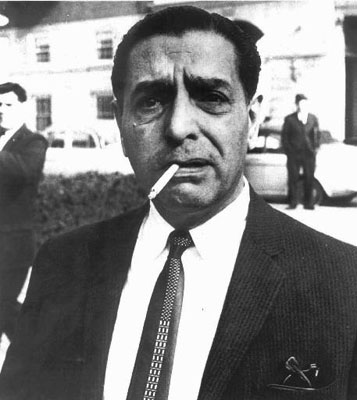
The Witness Security Program owes its creation to one of the most-feared assassins the Mafia has ever produced: Joseph Barboza, who took pride in his underworld alias, “The Animal.”

It was a nickname he had lived up to.  “I was an enforcer,” he boasted to the House Select Committee on Crime in 1972, “who kept the other enforcers in line.”

Barboza had done so as a top hitman earning $900 a week from the most powerful Mafia family in New England.  Ruling that family was Raymond Patriarca, based in Providence, Rhode Island.

Joseph “The Animal” Barboza

But even before entering the Mafia, Joseph Barboza had spent most of his life as a career criminal.  He was born in 1932, in New Bedford, Massachusetts, to Portuguese immigrant parents.

By the time he was thirty, he had served two prison sentences—one for burglary, the other for assault with a deadly weapon.

Even his jailers couldn’t restrain him.  At Norfolk Prison Colony, he got drunk on illicit “hooch” and led an inmates’ riot, culminating in a short-lived escape-attempt.

When Barboza wasn’t serving time in prison, he made his living as a boxer (winning three professional matches and earning a rating in Ring magazine).  He supplemented his income through a career as a freelance loanshark and extortionist.

By 1963, his growing notoriety had brought him to the attention of Enrico Henry Tameleo, the underboss, or second-in-command, to Raymond Patriarca.

Since 1948, Patriarca had been “the policymaker, judge and overlord of organized crime” throughout New England, according to a 1966 FBI report.

Raymond Patriarca

Tameleo offered a Barboza a job and fulltime income as an enforcer for the Patriarca Family.  Barboza instantly agreed.  He had always dreamed of becoming a “made man” of the Mafia.

(Tameleo didn’t warn him that this was impossible.  Barboza was of Portuguese descent, and only full-blooded Sicilians and Italians could hold Mafia membership.)

Tameleo sent Barboza to shake down 20 nightclubs whose owners had refused to pay “protection insurance” to the mob.

The owners changed their minds after one or two visits from Barboza and his wrecking crew.  Furniture would be smashed and customers terrorized until the owners began paying $1,000 a month to Patriarca’s collectors.

Meanwhile, the always fragile peace of the New England underworld was being shattered by an escalating wave of gangland violence.

In 1961, the two most powerful factions of the region’s “Irish Mafia” had gone to war.  On one side was the Charleston mob of Bernard McLaughlin.  On the other was the Winter Hill gang of James “Buddy” McLean.

The “Irish Gang War” triggered a police crackdown on all the New England organized crime groups—including Patriarca’s.  That was when Patriarca demanded that the fighting stop.

To ensure that it did, he sent his underboss, Tameleo, to arrange a peace conference between the McLeans and McLaughlins.  Both sides agreed to a truce because Tameleo was widely respected for his skills as a negotiator.

But when the conference opened in January, 1965, Tameleo was outraged to find the McLaughlins had come armed–a direct violation of the “rules of order.”  Patriarca also grew furious at this spurning of his efforts as underworld peacemaker.

As a result, the Patriarca Family threw its full weight behind the McLeans.

During 1965, Joseph Barboza moved from being a “mere” legbreaker for the Patriarca Family to becoming its top assassin.  His first important victim was Edward Deegan, a McLaughlin member who had raided several Patriarca gambling dens.

Barboza invited Deegan to join him in a burglary of the Lincoln National Bank in Boston.  Unaware that he had been marked for death, Deegan agreed.

On the night of March 12, 1965, the burglars struck.  As the four men emerged from the bank, Barboza and two cronies emptied their pistols into Deegan.

This killing proved a turning point for Barboza.  He became the top hitman for the Patriarca Family and the McLean mob.  He carried out more  hits than any other assassin during the war.  Later, in a hastily-written autobiography, he would boast of his string of killings.

(But he was always careful to describe his actions in the third-person, as though someone else had actually been responsible.  In this way he protected himself against prosecution for murder, where no immunity existed.)

In June, Jimmy “The Bear” Flemmi, a close friend of Barboza’s, was gravely wounded by a shotgun blast.  Barboza soon learned that the attackers had been Steve Hughes and Edward “Punchy” McLaughlin.

Swearing vengeance, Barboza quickly set out to claim his next victim.  He was especially intent on disposing of Hughes, who had become the top triggerman of the McLaughlins.

On October 20, 1963, Edward McLaughlin was waiting at a bus stop when Barboza casually walked up behind him.  Disguised in a wig and glasses, Barboza drew his pistol and pumped five bullets into McLaughlin.

Less than a month later, on November 11, the hitman visited the Mickey Mouse Club, a tavern in Revere Reach.  This time his intended target was a bartender and McLaughlin member named Ray DiStassio.

Talking with DiStassio at that moment was an innocent bystander, John R. O’Neill.  Barboza simply drew and shot both men dead.

Copyright@1984 Taking Cover: Inside the Witness Security Program, by Steffen White and Richard St. Germain

NICCOLO MACHIAVELLI VS. OSCAR PISTORIUS

In Entertainment, History, Law, Politics, Social commentary on June 10, 2013 at 12:00 am

He’s the O.J. Simpson of South Africa–a gifted athlete charged with cold-blooded murder.

For Oscar Pistorius, life began as a struggle, on November 22, 1986.  Born with fibular hemimelia (congenital absence of the fibula) in both legs, at 11 months old, he was forced to undergo the amputation of both legs below the knee.

But still he persisted to lead an active–even an extraordinary–life.  As a child and teenager, he played rugby union, water polo and tennis, and took part in Olympic wrestling.

After a serious rugby knee injury, Pistorius was introduced to running in January, 2004, while undergoing rehabilitation at the University of Pretoria’s High Performance Centre.

Fitted with racing blades, he has been dubbed “Blade Runner” and “the fastest man with no legs.”   He took part in the 2004 Summer Paralympics in Athens and came in third in the 100-metere event.

At the 2012 Summer Olympics, he became the first double leg amputee to participate in the Olympics.  He entered the men’s 400-meters and 4 x 400 meters relay races.

Oscar Pistorius

At the 2012 Summer Paralympics, he won gold medals in the men’s 400-metre race and the 4 X 100 metres relay.

And then, having achieved so much against so much adversity, he found himself facing trial for a ghastly crime: The February 14 murder of his 29-year-old girlfriend, model and paralegal Reeva Steenkamp, whom he shot three times through a locked bathroom door.

Reeva Steenkamp

Pistorius claims he thought Steenkamp was a nighttime intruder. The state alleges that he and his girlfriend  argued before her death and he intentionally killed her.

The case has been postponed to August 19, 2013.

Throughout South Africa, women believe the odds are high that Pistorius will escape justice for murder owing to his sports celebrity status.  And those women may well turn out to be right.

According to one study, South Africa has “the highest rate [of violence against women] ever reported in research anywhere in the world.”

According to statistics, a woman gets raped in South Africa every four minutes. Only 66,196 incidents were reported to police in 2012 and their investigations led to only 4,500 convictions.

In fact, the murder of Pistorius’ girlfriend happened one day before she planned to wear black in a “Black Friday” protest against the country’s disgracefully high number of rapes.

“If data for all violent assaults, rapes and other sexual assaults against women are taken into account, then approximately 200,000 adult women are reported as being attacked in South Africa every year,” said Lerato Moloi of the South African Institute for Race Relations.

The real figure is considerably higher, she said, since most cases never are reported.

The rate of murders of women in South Africa is equally appalling:

  • A woman is killed by an intimate partner every eight hours in South Africa.
  • No perpetrator is identified in 20 percent of killings, according to a study published by the South African Medical Research Council.
  • That is double the rate of such murders in the United States.

If Pistorius wins acquittal because of his status as a celebrity athlete, Niccolo Machiavelli will nce again be proven a relevant prophet for our time.

Niccolo Machiavelli

In The Discourses, his seminal work on how to preserve freedom within a republic, Machiavelli warns: “Well-ordered republics establish punishments and rewards for their citizens, but never set off one against the other.”

Specifically:

“The services of Horatius had been of the highest importance to Rome, for by his bravery he had conquered the Curatii.  But the crime of killing his sister was atrocious, and the Romans were so outraged by this murder that he was put upon trial for his life, notwithstanding his recent great services to the state.”

While Rome might seem guilty of ingratitude, writes Machiavelli, “the people were to blame rather for the acquittal of Horatius than for having him tried.

“And the reason for this is, that no well-ordered republic should ever cancel the crimes of its citizens by their merits….

“Having established rewards for good actions and penalties for evil ones, and having rewarded a citizen for good conduct who afterwards commits a wrong, he should be chastised for that without regard to his previous merits.

“And a state that properly observes this principle will long enjoy its liberty, but if otherwise, it will speedily come to ruin.

“For if a citizen who has rendered some eminent service to the state should add to the reputation and influence which he has thereby acquired the confident audacity of being able to commit any wrong without fear of punishment, he will in a little while become so insolent and overbearing as to put an end to all power of the law.”

Americans learned the truth of this after the 1995 acquittal of O.J. Simpson for the slasher-murders of his ex-wife, Nicole Brown, and a waiter-eyewitness, Ronald Goldman.

In September, 2007, he led a group of men into a hotel room at the Palace Station casino in Las Vegas, Nevada, and, at gunpoint, seized sports memorabilia which he claimed had been stolen from him.

He was arrested and eventually convicted for criminal conspiracy, armed robbery, kidnapping and assault with a deadly weapon.

On December 5, 2008, Simpson was sentenced to 33 years in prison with the chance of parole in  nine years, in 2017.