bureaucracybusters

Archive for March, 2026|Monthly archive page

THE ALAMO: TRAGEDY AND GLORY: PART THREE (END)

In History, Military, Politics, Social commentary on March 6, 2026 at 12:11 am

On the night before the final Mexican assault, one man escaped the Alamo to testify to the defenders’ courage. Or so goes the most famous story of the 13-day siege.  

He was Louis Rose, a veteran of the Napoleonic wars and the dreadful 1812 retreat from Moscow. Unwilling to die in a hopeless battle, he slipped over a wall and sneaked through Mexican siege lines.

At Grimes County, he found shelter at the homestead of Abraham and Mary Ann Zuber. Their son, William, later claimed that his parents told him of Rose’s visit–and his story of Travis’ “line in the sand” speech.

In 1873, he published the tale in the Texas Almanac.

But many historians believe it is a fabrication. The story comes to us third-hand—from Rose to the Zubers to their son. And it was published 37 years after the Alamo fell.  

Even if Travis didn’t draw a line in the sand, every member of the garrison, by remaining to stay, had crossed over his own line.

After a 12-day siege, Santa Anna decided to overwhelm the Alamo.

The first assault came at about 5 a.m. on Sunday, March 6, 1836.

The fort’s riflemen—aided by 14 cannons–repulsed it. And the second assault as well.

But the third assault proved unstoppable. The Alamo covered three acres, and held at most 250 defenders—against 2,000 Mexican soldiers.

When the Mexicans reached the fort, they mounted scaling ladders and poured over the walls.

Travis was among the first defenders to fall—shot through the forehead after firing a shotgun into the Mexican soldiery below.

William Travis — Badass of the Week

Death of William Barrett Travis (waving sword)

Mexicans broke into the room where the ailing James Bowie lay.

In Three Roads to the Alamo, historian William C. Davis writes that Bowie may have been unconscious or delirious. Mistaking him for a coward, the soldiers bayoneted him and blew out his brains.

But some accounts claim that Bowie died fighting—shooting two Mexicans with pistols, then plunging his famous knife into a third before being bayoneted. Nearly every Alamo movie depicts Bowie’s death this way.

As the Mexicans poured into the fort, at least 60 Texans tried to escape over the walls into the surrounding prairie. But they were quickly dispatched by lance-bearing Mexican cavalry.

The death of David Crockett remains highly controversial.

Baby boomers usually opt for the Walt Disney version: Davy swinging “Old Betsy” as Mexicans surround him. Almost every Alamo movie depicts him fighting to the death.

Image result for fall of the alamo

David Crockett’s Death

But Mexican Lieutenant Colonel Jose Enrique de la Pena claimed Crockett was one of seven Texans who surrendered or were captured and brought before Santa Anna after the battle. Santa Anna ordered their immediate execution, and they were hacked to death with sabers.

Only the 2004 remake of The Alamo has dared to depict this version. Although this version is now accepted by most historians, some still believe the de la Pena diary from which it comes is a forgery.

An hour after the battle erupted, it was over.

That afternoon, Santa Anna ordered the bodies of the slain defenders stacked and burned in three pyres.

Contrary to popular belief, some of the garrison survived: 

  • Joe, a black slave who had belonged to William B. Travis, the Alamo’s commander;
  • Susanah Dickinson, the wife of a lieutenant killed in the Alamo, and her baby, Angelina;
  • Several Mexican women and their children.

Also contrary to legend, the bravery of the Alamo defenders did not buy time for Texas to raise an army against Santa Anna. This didn’t happen until after the battle.

But their sacrifice proved crucial in securing Texas’ independence:

  • The Alamo’s destruction warned those Texans who had not supported the revolution that they had no choice: They must win, die or flee their homes to the safety of the United States.
  • It stirred increasing numbers of Americans to enter Texas and enlist in Sam Houston’s growing army.
  • Santa Anna’s army was greatly weakened, losing 600 killed and wounded—a casualty rate of 33%.
  • The nearly two-week siege bought time for the Texas convention to meet at Washington-on-the-Brazos and declare independence from Mexico.

On April 21, 1836, Santa Anna made a crucial mistake: During his army’s afternoon siesta, he failed to post sentries around his camp.

That afternoon, Sam Houston’s 900-man army struck the 1,400-man Mexican force at San Jacinto. In 18 minutes, the Texans—shouting “Remember the Alamo!”—killed about 700 Mexican soldiers and wounded 200 others.

The next day, a Texas patrol captured Santa Anna–wearing the uniform of a Mexican private. Resisting angry demands to hang the Mexican dictator, Houston forced Santa Anna to surrender control of Texas in return for his life.

The victory at San Jacinto won the independence of Texas. But the 13-day siege and fall of the Alamo remains the most famous and celebrated part of that conflict.

In 480 B.C., 300 Spartans won immortality at Thermopylae, a narrow mountain pass in ancient Greece, by briefly holding back an invading Persian army of thousands. 

Although they died to the last man, their sacrifice inspired the rest of Greece to defeat its invaders. 

Like Thermopylae, the battle of the Alamo proved both a defeat—and a victory. 

THE ALAMO: TRAGEDY AND GLORY: PART TWO (OF THREE)

In History, Law Enforcement, Politics, Social commentary on March 5, 2026 at 12:10 am

Friday, March 6, 2026, marks the 190th anniversary of the most famous event in Texas history: The fall of the Alamo, a crumbling former Spanish mission in the heart of San Antonio.        

After a 12-day siege, 180 to 250 Texans were overwhelmed by 2,000 Mexican soldiers.   

Mexican troops advancing on the Alamo

Americans “remember the Alamo”—but usually for the wrong reasons.

Some historians believe the battle should have never been fought.

The Alamo was not Thermopylae—a narrow mountain pass blocking the Persian march into ancient Greece. Santa Anna could have simply bypassed it.

In fact, several of Santa Anna’s generals urged the Mexican dictator to do just that—leave a small guard to hold down the fort’s defenders and wipe out the undefended, widely-separated Texas settlements.

But pride held Santa Anna fast to the Alamo. His brother-in-law, General Perfecto de Cos, had been forced to surrender the old mission to revolting Texans in December, 1835. 

Santa Anna meant to redeem the fort—and his family honor—by force.

In virtually every Alamo movie, its two co-commanders, James Bowie and William Barret Travis, are portrayed as on the verge of all-out war—with each other.

In John Wayne’s heavily fictionalized 1960 film, The Alamo, Bowie and Travis agree to fight a duel as soon as they’ve whipped the Mexicans besieging them.
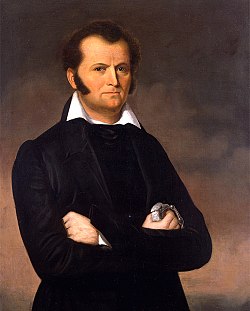
James Bowie

William B. Travis

In fact, the frictions between the two lasted only a short while. Just before the siege, some of Bowie’s volunteers—a far larger group than Travis’ regulars—got drunk. 

Travis ordered them jailed—and Bowie ordered his men to release them. Bowie then went on a roaring drunk. The next day, a sober Bowie apologized to Travis and agreed they should share command. 

This proved a wise decision, for just as the siege started, Bowie was felled by worsening illness—typhoid-pneumonia or tuberculosis.

In almost every Alamo movie, Bowie repeatedly leaves the fort to ambush unsuspecting Mexicans.

In reality, he stayed bed-ridden and lay close to death throughout the 13-day siege.

The Texans intended to make a suicidal stand.

False.

From the first day of the siege-–February 23, almost to the last, March 6, 1836—messengers rode out of the Alamo seeking help. The defenders believed that if they could cram enough men into the three-acre former mission, they could hold Santa Anna at bay.

No reinforcements reached the Alamo.

False.

On March 1, 32 men from Gonzalez—the only ones to answer Travis’ call—sneaked through the Mexican lines to enter the Alamo.

Meanwhile, the largest Texan force lay at Fort Defiance in Goliad, 85 miles away. This consisted of 500 men commanded by James Walker Fannin, a West Point dropout.  

Fannin was better-suited for the role of Hamlet than military commander.

Upon receiving a plea of help from Travis, he set out in a halfhearted attempt to reach the mission. But when a supply wagon broke down, he returned to Fort Defiance and sat out the rest of the siege. 

When the Mexican army approached Fort Defiance, Fannin and 400 of his men panicked and fled into the desert. They were surrounded, forced to surrender, and massacred on March 27

The Alamo garrison was fully prepared to confront the Mexican army.

False.  

When the Mexicans suddenly arrived in San Antonio on the morning of February 23, 1836, they caught the Texans completely by surprise.

The previous night, they had been celebrating the birthday of George Washington. The Texans rushed headlong into the Alamo, hauling all the supplies they could hastily scrounge.

Santa Anna sent a courier under a flag of truce to the Alamo, demanding unconditional surrender. In effect, the Texans were being given the choice of later execution.

Travis replied with a shot from the fort’s biggest cannon, the 18-pounder (so named for the weight of its cannonball).

Santa Anna ordered the hoisting of a blood-red flag and the opening of an artillery salvo. The siege of the Alamo was on.

San Houston, who was elected general of the non-existent army of Texas, desperately tried to relieve the siege.

False. 

At Washington-on-the-Brazos, 169 miles east of San Antonio, Texan delegates assembled to form a new government. When news reached the delegates that Travis desperately needed reinforcements, many of them wanted to rush to his defense.  

But Houston and others declared they must first declare Texas’ independence. On March 2, 1836, they did just that. Meanwhile, Houston spent a good deal of that time drunk.

Sam Houston

Did Travis draw a line?

Easily the most famous Alamo story is that of “the line in the sand.”

On the night of March 5—just prior to the final assault—there was a lull in the near-constant Mexican bombardment. Travis assembled his men and gave them a choice:

They could try to surrender and hope that Santa Anna would be merciful. They could try to escape. Or they could stay and fight.  

With his sword, Travis drew a line in the dirt and invited those who would stay to cross over to him.  

Related image

Travis draws the line

The entire garrison did—except for two men.  

One of these was bed-ridden James Bowie. He asked that his sick-bed be carried over to Travis. The other was a veteran of the Napoleonic wars—Louis Rose.

THE ALAMO: TRAGEDY AND GLORY: PART ONE (OF THREE)

In History, Military, Politics, Social commentary on March 4, 2026 at 12:12 am

On March 2, 1836–190 years ago this year—Texas formally declared its independence from Mexico, of which it was then a province.       

Sixty-one delegates took part in the convention held at Washington-on-the-Brazos.

Their signed statement proclaimed that the Mexican government had “ceased to protect the lives, liberty, and property of the people, from whom its legitimate powers are derived.” 

Meanwhile, 169 miles away, the siege of the Alamo—a crumbling former Spanish mission in the heart of San Antonio—had entered its ninth day.

The mission that became a fortress has since become a shrine. 

The Alamo Chapel

By Daniel Schwen – Own work, CC BY-SA 4.0

The combatants: 180 to 250 Texans (or “Texians,” as many of them preferred to be called) vs. 2,000 Mexican soldiers. 

On the Texan side three names predominate: David Crockett, James Bowie and William Barret Travis. “The Holy Trinity,” as some historians ironically refer to them. 

Crockett, at 49, was the most famous man in the Alamo. He had been a bear hunter, Indian fighter and Congressman. Rare among the men of his time, he sympathized with the Indian tribes he had helped subdue in the War of 1812.

David Crockett

He believed Congress should honor the treaties made with the former hostiles and opposed President Andrew Jackson’s effort to move the tribes further West. Largely because of this, his constituents turned him out of office in November, 1835. He told them they could go to hell; he would go to Texas.

James Bowie, at 40, had been a slave trader with pirate Jean Lafitte and a land swindler. But his claim to fame lay in his skill as a knife-fighter.

James Bowie

This grew out of his participating in an 1827 duel on a sandbar in Natchez, Mississippi. Bowie was acting as a second to one of the duelists who had arranged the event.

After the two duelists exchanged pistol shots without injury, they called it a draw. But those who had come as their seconds had scores to settle among themselves—and decided to do so. A bloody melee erupted.

Bowie was shot in the hip and then impaled on a sword cane wielded by Major Norris Wright, a longtime enemy. Drawing a large butcher knife he wore at his belt, he gutted Wright, who died instantly.

The brawl became famous as the Sandbar Fight, and cemented Bowie’s reputation across the South as a deadly knife fighter.

William Barret Travis, 26, had been an attorney and militia member. Burdened by debts and pursued by creditors, he fled Alabama in 1831 to start over in Texas. Behind him he left a wife, son, and unborn daughter.

William Barret Travis

From the first, Travis burned to free Texas from Mexico and see it become a part of the United States.

In January, 1836, he was sent by the American provisional governor of Texas to San Antonio, to fortify the Alamo. He arrived there with a small party of regular soldiers and the title of lieutenant colonel in the state militia.

On the Mexican side, only one name matters: Antonio Lopez de Santa Anna, president (i.e., absolute dictator) of Mexico. After backing first one general and would-be “president” after another, Santa Anna maneuvered himself into the office in 1833.

Antonio Lopez de Santa Anna

Texas was then legally a part of Mexico. Stephen F. Austin, “the father of Texas,” had received a grant from Spain—which ruled Mexico until 1821—to bring in 300 American families to settle there.

The Spaniards wanted to establish a buffer between themselves and warring Indian tribes like the Comanches. This immigration continued after Mexico threw off Spanish rule and obtained its independence.

But as Americans kept flooding into Texas, the character of its population changed, alarming its Mexican rulers.

The new arrivals did not see themselves as Mexican citizens but as transplanted Americans. They were largely Protestant, as opposed to the Catholic Mexicans. And many of them not only owned slaves but demanded the expansion of slavery—a practice illegal under Mexican law.

In October, 1835, fighting erupted between American settlers and Mexican soldiers.

In November, Mexican forces took shelter in the Alamo, which had been built in 1718 as a mission to convert Indians to Christianity. Since then it had been used as a fort—by Spanish and then Mexican troops.

Texans lay siege to the Alamo from October 16 to December 10, 1835. With his men exhausted, and facing certain defeat, General Perfecto de Cos, Santa Anna’s brother-in-law, surrendered. He gave his word to leave Texas and never take up arms again against its settlers.

Most Texans rejoiced. They believed they had won their “war” against Mexico. But others knew better.

One was Bowie. Another was Sam Houston, a former Indian fighter, Congressman and protégé of Andrew Jackson.

Still another was Santa Anna, who styled himself “The Napoleon of the West.”  In January, 1836, he set out from Mexico City at the head of an army totaling about 7,000.

He planned the 18th century version of a blitzkrieg, intending to arrive in Texas and take its “rebellious foreigners” by surprise.

His forced march proved costly in lives, but met his objective. He arrived in San Antonio with several hundred soldiers on February 23, 1836.

The siege of the Alamo—the most famous event in Texas history—was about to begin.

DONALD TRUMP AND THE OOBLECK

In Bureaucracy, Business, History, Politics, Social commentary on March 3, 2026 at 12:13 am

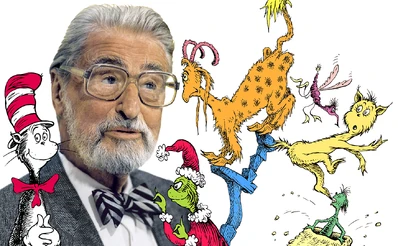
Dr. Seuss (Theodor Geisel) published over 60 children’s books, which were often filled with imaginative characters and rhyme.   

Among his most famous books were Green Eggs and Ham, The Cat in the Hat, and One Fish Two Fish Red Fish Blue Fish. 

Honored in his lifetime (1904-1991) for the joy he brought to countless children, Dr. Seuss may well prove one of the unsung prophets of our environmentally-threatened age.

Image result for images of dr. seuss

Dr. Seuss

In 1949, he penned Bartholomew and the Oobleck, the story of a young page who must rescue his kingdom from a terrifying, man-made substance called Oobleck.

The story is quickly told:

Derwin, the King of Didd, announces he’s bored with sunshine, rain, fog and snow. So he calls in his black magicians and orders them to create a new kind of weather.

The magicians assure him they can create it.

“What will you call it?” asks the king.

“We’ll call it Oobleck,” says one of the magicians.

Three gowned figures with long, grey hair hold forked sticks.

“What will it be like?” asks King Didd.

“We don’t know, Sire,” the magician replies. “We’ve never created Oobleck before.”

The next morning, Oobleck—a greenish, glue-like substance—starts raining.

The king orders Bartholomew, the royal page, to tell the Bell Ringer that today will be a holiday. But the bell doesn’t ring—because it’s filled with Oobleck. 

The Oobleck rain intensifies.

The falling blobs—now as big as buckets full of broccoli—break into the palace, immobilizing the servants and guards. 

Bartholomew warns the Royal Trumpeter about the Oobleck, but the trumpet gets stopped up with the goo.

The Captain of the Guards thinks the Oobleck is pretty and sees no danger in it—until he eats some. Instantly, his mouth is glued shut.

Bartholomew and the Oobleck - Wikipedia

At the climax of the story, Bartholomew confronts King Derwin for giving such a rash order: “If you can’t do anything else,” says Bartholomew, “at least you can say you’re sorry.”   

King Derwin refuses, and Bartholomew says, “If you can look at all the horror you’ve caused and not say you’re sorry, you’re no sort of king at all.” 

In real-life, such a king would have instantly ordered Bartholomew’s execution. But this is a children’s story.

So, overcome with guilt, King Derwin utters the magic words: “You’re right, this is all my fault, and I am sorry.”

Suddenly the Oobleck stops raining and the sun melts away the rest.

With life returning to normal, King Derwin mounts the bell tower and rings the bell. He proclaims a holiday dedicated not to Oobleck, but to rain, sun, fog, and snow, the four elements of Nature—of which Man is but a part.

* * * * *

Flash forward to the following Donald Trump tweets:

November 6, 2012: “The concept of global warming was created by and for the Chinese in order to make U.S. manufacturing non-competitive.” 

December 6, 2013: “Ice storm rolls from Texas to Tennessee – I’m in Los Angeles and it’s freezing. Global warming is a total, and very expensive, hoax!” 

January 1, 2014: “This very expensive GLOBAL WARMING bullshit has got to stop. Our planet is freezing, record low temps, and our GW scientists are stuck in ice.”

QTV - Trump Declares Himself 'Acting President Of Venezuela' In Viral Post. A controversial social media post by U.S. President Donald Trump has sparked fresh debate and confusion across international political circles.

Donald Trump

Upon taking office in 2017, Trump 

  • Released a budget proposal to eliminate $100 million in funding for the Environmental Protection Agency’s climate work, including scientific research;
  • Ordered his administration to rewrite the Clean Power Plan. His objective: To gut former President Barack Obama’s landmark restrictions on power plant emissions;
  • Announced that he would withdraw the United States from the Paris climate-change agreement deal.

Upon taking office again in 2025, Trump:

  • Repealed the EPA’s 2009 Endangerment Finding, which officially determines that greenhouse gases threaten public health;
  • Increased oil and gas exploration on federal land, rolled back methane emission requirements for oil and gas companies, and directed the Department of Defense to buy coal-fired electricity; 
  • Halted, paused, or cut funding for offshore/onshore wind and solar projects, and ended federal tax incentives for electric vehicles (EVs);
  • Reduced the authority of the EPA to regulate pollutants from power plants, cut climate-preparedness grants, and remoed or altered climate data from federal websites.

There are forces in Nature far more powerful than anything Man and his puny strength can defy—or harness. And we invoke the wrath of those forces at our own peril.

In the world of children’s stories, it’s possible for a king to undo the terrible damage he’s unleashed by finding the courage to say: “I’m sorry.”

In real-life, tyrants almost never say “I’m sorry,” no matter how enormous their mistakes and/or crimes.

From 1936 to 1938, Soviet dictator Joseph Stalin slaughtered the cream of his own Army and Air Force. When Nazi Germany invaded the Soviet Union in 1941, Stalin blamed his remaining generals for the massive defeats inflicted by the Wehrmacht.

And as Soviet forces finally closed on Berlin in April, 1945, and Adolf Hitler prepared to commit suicide in his underground bunker, he blamed the German people for losing the war he had started.

Saying “I’m sorry” cannot reverse decades of rampant environmental abuse. To believe that it can is as ridiculous as believing that self-righteous tyrants will ever take responsibility for their own crimes and follies.

THE LIE–AND TRAP–OF “VICTORY THROUGH AIR POWER”

In Bureaucracy, History, Military, Politics, Social commentary on March 2, 2026 at 12:18 am

Victory Through Air Power is a 1943 Walt Disney animated Technicolor feature film released during World War II. It’s based on the book—of the same title––by Alexander P. de Seversky.  

Its thesis: By using bombers and fighter aircraft, the United States can attain swift, stunning victory over its Axis enemies: Germany, Italy and Japan.

Although not explicitly stated, the clear impression given is: By using air power, America can defeat its enemies without deploying millions of ground troops.

The movie has long since been forgotten except by film buffs, but its message has not. Especially by the highest officials within the U.S. Air Force.

The Air Force regularly boasted of the tonnage of bombs its planes dropped over Nazi Germany. But it failed to attain its primary goal: Break the will of the Germans to resist.

Just as the German bombings of England had solidified the will of the British people to resist, so, too, did Allied bombing increase the determination of the Germans to fight on.

Nor did the failure of air power end there.

On June 6, 1944—D-Day—the Allies launched their invasion of Nazi-occupied France.

It opened shortly after midnight, with an airborne assault of 24,000 American, British, Canadian and Free French troops. This was followed at 6:30 a.m. by an amphibious landing of Allied infantry and armored divisions on the French coast.

The operation was the largest amphibious invasion in history. More than 160,000 troops landed—73,000 Americans, 61,715 British and 21,400 Canadians.

Allied air power bombed and strafed German troops out in the open. But it couldn’t dislodge soldiers barricaded in steel-and-concrete-reinforced bunkers or pillboxes.

Those had to be dislodged, one group at a time, by Allied soldiers armed with rifles, dynamite and flamethrowers.

American soldier using flamethrower

This situation proved true throughout the rest of the war.

Then, starting in 1964, the theory of “Victory Through Air Power” once again proved a dud—in Vietnam.

From 1964 to 1975, seven million tons of bombs were dropped on Vietnam, Laos, and Cambodia—more than twice the amount of bombs dropped on Europe and Asia in World War II.

Yet the result proved the same as it had in World War II: The bombing enraged the North Vietnamese and steeled their resolve to fight on to the end.

American bomber dropping its cargo over North Vietnam

The belief that victory could be achieved primarily—if not entirely—through air power had another unforeseen result during the Vietnam war. 

To bomb North Vietnam, the United States needed air force bases in South Vietnam. This required that those bombers and fighters be protected.

So a force to provide round-the-clock security had to be maintained. But there weren’t enough guards to defend themselves against a major attack by North Vietnamese forces.

So more American troops were needed—to guard the guards.

North Vietnam continued to press greater numbers of its soldiers into attacks on American bases. This forced America to provide greater numbers of its own soldiers to defend against such attacks.

Eventually, the United States had more than 500,000 ground troops fighting in Vietnam—with no end in sight to the conflict.

Nor did it work for America in the 1991 and 2003 wars against Iraq.

Both wars opened with massive barrages of American missiles and bombs. The 1991 war—launched by President George H.W. Bush—saw the first use of the vaunted “stealth bomber,” which could avoid detection by enemy radar.

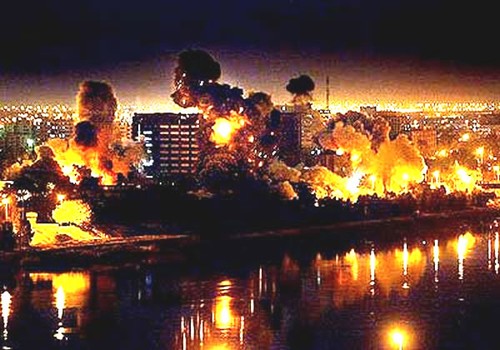
The 2003 war—launched by President George W. Bush—opened with an even greater bombardment intended to “shock and awe” the Iraqis into surrendering. 

They didn’t. 

10 bombings cause many casualties in Baghdad

Baghdad under “shock and awe” bombardment

Nor did air power prove effective on the Iraqi insurgency that erupted after American forces occupied Baghdad and much of the rest of the country.

That war had to be fought by U.S. Army regulars and Special Operations soldiers—especially Navy SEALS. It was a dirty and private effort, marked by nightly kidnappings and torture of suspected Iraqi insurgents.

The war devolved into a long, violent insurgency, occupation and sectarian civil war that lasted until 2011, when American troops were withdrawn. The United States failed to achieve control of Iraqi oil and unite the country under American control.

Then, in 2014, with forces of the Islamic State of Iraq and Syria (ISIS) launching a blitzkrieg throughout Iraq, President Barack Obama caught the “Victory Through Airpower” disease.

ISIS had thrown the American-trained Iraqi Army into a panic, with soldiers dropping their rifles and running for their lives.

This led Republicans to accuse the President of being about to “lose” Iraq.

As a result, he shipped at least 300 American “advisors” to Iraq, to provide support and security for U.S. personnel and the American Embassy in Baghdad.

And he authorized American Predator drones to traverse Iraq, keeping tabs on the advancing ISIS forces. Then, in September, 2014, Obama ordered airstrikes against ISIS in Syria.

Yet that didn’t alter the balance of power in Iraq.

Finally, on February 11, 2015, Obama called on Congress to formally authorize the use of ground forces against ISIS. This would include supporting and training Iraqi forces and Syrian insurgents on the ground.

On February 28, 2026, President Donald Trump ordered a massive bombardment of Iran

The rerun of the Vietnam/Iraq experience will begin showing in the months ahead.