bureaucracybusters

Posts Tagged ‘WITNESS SECURITY PROGRAM’

A “NEW IDENTITIES” PROGRAM FOR JOB-SEEKERS: PART TWO (END)

In Bureaucracy, Business, History, Law Enforcement, Social commentary on January 8, 2016 at 10:42 am

Until recently, only organized crime witnesses with a price on their head could obtain falsified job histories.  But no more.

Thousands–if not millions–of job-seeking Americans are now able to obtain stellar job references to impress potential employer.  And they’re doing it the old-fashioned way: They’re hiring companies to create them.

One such company is CareerExcuse.

CareerExcuse runs 200 fictional companies that don’t exist, have staffs or make money.

But for a fee, you can say you worked at one of them, and they’ll confirm you were an outstanding employee.

For between $100 and $200, you’ll get:

  • One to three false–and positive–references from a company or companies you’ve never worked for.
  • A fake company address.
  • Local phone numbers to give to prospective employers.
  • A guarantee that those employers will receive positive vouchers for you.
  • “Instant” degrees.
  • Landlord reference
  • A “completely legitimate” resume-writing service.

Unlike the Federal Witness Security Program (WITSEC) the clients of CareerExcuse aren’t hardened criminals.

They are legitimate citizens trying to erase gaps in their resumes.  Or they have worked for a long series of short-term employers and want to appear a stable employee.

Click here: CareerExcuse Job References

Or they’ve acquired–deservedly or not–a series of bad job references 

Image result for images of resumes

“Some people see it as unethical,” Jennifer Hatton, senior partner at CareerExcuse, said in a 2015 interview with Business Insider.

But, said Hatten, “I don’t see why you shouldn’t deserve a shot, just like the next person” if you do have the skills and experience required.

“There are many things that happen in people’s lives, with [employers] going out of business, being laid off, managers just unrightfully firing you, sexual harassment suits–you name it, it happens in the workforce.”

And it’s true.

An article in the March, 2011 issue of Reader’s Digest gives the lie to the excuses so many employers use for refusing to hire.

Entitled “22 Secrets HR Won’t Tell You About Getting a Job,” it reveals such truths as:

  • After you’re unemployed more than six months, employers consider you unemployable–no matter your skills/experience. 
  • It’s not what but who you know that counts.
  • Cover letters are often ignored, going directly into “the round file.”
  • Many employers illegally try to screen out parents–such as by checking cars for child safety seats.
  • You’re not protected against age discrimination. Many employers regularly ignore the law. If you are in your 50s or 60s, leave your year of graduation off your resume.

And in its June 8, 2011 cover-story on “What U.S. Economic Recovery?  Five Destructive Myths,” Time magazine warned that profit-seeking corporations can’t be relied on to ”make it all better.”

Wrote Rana Foroohar, Time‘s assistant managing editor in charge of economics and business:

“There may be $2 trillion sitting on the balance sheets of American corporations globally, but firms show no signs of wanting to spend it in order to hire workers at home.”

Meanwhile, CareerExcuse claims to have more than 2,000 job-seeking clients.

“Our main clientele right now is IT executives, and they’re pretty high-level,” Hatton claimed. The average customer seeks a salary of $60,000 to $80,000.

There are areas of employment that CareerExcuse refuses to fill–medicine, government, law enforcement or government.  Jobs where your employment would “put other people in danger,” said Hatten.

Hatton claimed that during the almost two years she had been with CareerExcuse, no one had ever discovered a faked background.

But William Schmidt, who founded the company, admitted to Motherboard that a fake reference could easily be punctured: “All it would take is one person to drive to that address and go to that office.”

And the inevitable result would be immediate termination.

For some users of CareerExcuse, the company has proven an infuriating disappointment.

Click here: 17 CAREER EXCUSE complaints and reports @ Pissed Consumer

Like many clients of the Federal Witness Security Program, they complain of promises not kept. Among their complaints on Pissed Consumer, a consumer-complaint website:

  • “When a serious job opportunity came recently, I realized alot of loop holes in their services, address of company on the website was different, email addresses weren’t valid or active.”
  • “They took my $ and never returned my calls or emails.What a joke!”
  • “Their phone go to voice mail and they dont reply back to calls after a voice mail is left for them to reply …It is easy for the employer to know that the reference is fake.”
  • “When the prospective employers called, Career excuse answered the phone with ‘Career Excuse, how can I help you.’ They were supposed to answer the phone in the name of the fake company they put together.”
  • “They only gave me a cheap looking web page and they don’t even answer the phones to GIVE the service I payed for. They are a scam and complete rip-off.”

Throughout the United States, countless numbers of lazy, greedy, arrogant and/or incompetent employers are refusing to hire. And millions of willing-to-work Americans remain trapped in unemployment or under-employment as a result.

Until this situation changes, companies like CareerExcuse will continue to function–and proliferate.

Such a change isn’t going to happen tomorrow.

A “NEW IDENTITIES” PROGRAM FOR JOB-SEEKERS: PART ONE (OF TWO)

In Bureaucracy, Business, History, Law Enforcement, Social commentary on January 7, 2016 at 1:07 am

In 1966, the U.S. Department of Justice did something it had never before done: Protect a witness against the Mafia during trial, and then relocate him (and his family) to safety under a new identity.

That witness was Joseph “The Animal” Barboza.  Once the most-feared enforcer for the New England Mafia family of Raymond Patriarca, Barboza had run afoul of his boss.

With a mob contract out on him, Barboza felt he had nothing to lose by telling FBI agents and Federal prosecutors everything they wanted to know about the Boston Mafia.

Related image

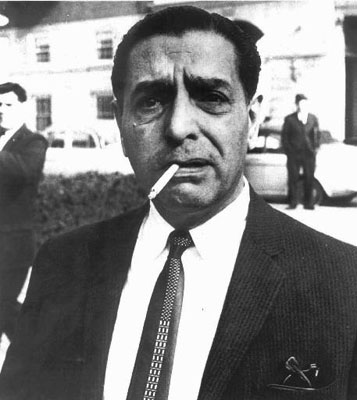
Joseph Barboza

A 16-man security detail of deputy U.S. marshals was immediately assigned to Barboza. The marshals relocated him to Thatcher’s Island, off the coast of Gloucester, Massachusetts. There they foiled two attempts by the mob to kill Barboza with a telescopic-sighted rifle.

Through a series of trials, Barboza sent the top echelons of the Patriarca family–including Patriarca himself–to prison. Then he and his wife and daughter were outfitted with new names and shipped out of New England to begin life over in safety.

The success of the Barboza detail led other Mafia witnesses to come forward. And this, in turn, led to the official creation of the Witness Security Program (WITSEC) by the Organized Crime Control Act of 1970.

To date, the U.S. Marshals Service–which runs WITSEC–has successfully protected, relocated and given new identities to more than 8,500 witnesses and 9,900 of their family members.

Click here: U.S. Marshals Service, Witness Security Program.

It’s been the “new identities” part of the Program that has always attracted the most attention from the press and movie-makers.

Staged photograph of a WITSEC detail

In the early days of WITSEC, a handful of security Inspectors created these in a totally haphazard fashion. These included legal name-changes, Social Security card, driver’s licenses and falsified job histories.

In some cases, marshals would tell prospective employers, “We can vouch for this man’s skills as a(n) ———-, but that’s all we can tell you.”

Witnesses’ children were provided with fictitious school records.  The names of schools would be changed, but the actual grades earned by the children would be retained.

These records would be “backstopped”–supported with documentation placed at those institutions where the witness (or his family) was alleged to have worked or attended school.

Similarly, medical records for witnesses and their children would be partially falsified.  That is, names of hospitals they had obtained care in would be changed, but their actual medical histories would be accurately charted.

Since the 1990s, the Marshals Service has centralized its “re-documentation” program. Parents, spouses, children, siblings and even mistresses are all taken to an orientation center in a Washington suburb

Related image

There, witnesses are debriefed by Federal agents and prosecutors.  They–and their families–are also prepared for the new lives they’ll take on under new identities.

In the early years of the program, witnesses were provided with flimsy aliases that quickly collapsed under even light scrutiny.

In 1973, Gerald Martin Zelmanowitz, a convicted stock swindler, found his new identity of Paul J. Maris easily punctured.

He got into a legal dispute with Creative Capitol, an investment firm that had loaned $2 million to his struggling new business,”The Paul Maris Company.”

Creative Capitol’s president, Milton Stewart, ordered a quiet investigation into Maris’ background.

This quickly turned up the following:

  • Maris and all five members of his family had been issued sequential Social Security numbers.
  • There was no record of Maris’ birth certificate.
  • Maris had claimed a background in Army Intelligence, but his Army service number had never been issued.
  • Maris’ resume said he had attended John Bartram High School in Philadelphia and Baldwin Wallace College in Berea, Ohio.  But officials at both schools denied that he had ever been one of their students.
  • Maris’ alleged home address in Philadelphia turned out to be a vacant lot in an all-black neighborhood.

Finally, the private investigator discovered that Maris had testified against a Angelo “Gyp” DeCarlo, a notorious New Jersey Mafia chieftain.  His testimony had convicted DeCarlo for murder conspiracy.

Fearing for his life, Maris fled with his family from San Francisco. All of them were readmitted to the Witness Security Program and relocated under identities.

Until recently, only organized crime witnesses with a price on their head could obtain falsified job histories.  But no more.

Thousands–if not millions–of job-seeking Americans are now able to obtain stellar job references to impress potential employers.

CareerExcuse runs 200 fictional companies that don’t exist, have staffs or make money.

But for a fee, you can say you worked at one of them, and they’ll confirm you were a stellar employee while you were there.

For between $100 and $200, you’ll get

  • One to three false–and positive–references from a company or companies you’ve never worked for.
  • A fake company address.
  • Local phone numbers to give to prospective employers.
  • A guarantee that those employers will receive positive vouchers for you.
  • A “completely legitimate” resume-writing service.

Unlike WITSEC, the clients of CareerExcuse aren’t hardened criminals. They are legitimate citizens trying to erase gaps in their resumes.  Or they have worked for a long series of short-term employers and want to appear a stable employee.

ALLAH’S DEATH ANGELS: PART FIVE (END)

In Bureaucracy, History, Law Enforcement, Politics, Social commentary on June 17, 2014 at 12:20 am

In San Francisco, the sudden collapse of the citywide police dragnet brought new shivers of panic to an already frightened citizenry.

Many whites stopped going outdoors after dark.  Even police officers frequently looked over their shoulders as evening approached.

Some whites–especially in the heavily Italian North Beach area–began talking about spreading vigilante terror among blacks.

And the murder-spree affected the city financially: The tourist trade–on which San Francisco depended for so much of its revenue–sharply declined.

The reaction of blacks was entirely different.

During the manhunt for the notorious “Zodiac” serial killer in the late 1960s, San Francisco police had relied heavily on dragnets and interrogations of young white men resembling a composite sketch.

But blacks charged racism when the same tactic was used to hunt for the supposed lone “Zebra” gunman. 

Many blacks blamed “unemployment” and “oppression” for the attacks.  When interviewed by the San Francisco Examiner, none condemned the murders or expressed sympathy for their victims.

Then, on April 22, 1974, a break finally came in the case.  Anthony Cornelius Harris decided to tell the police what he knew about the men responsible for the murders.

Before doing so, he visited the parents of his close friend, Larry Craig Green–who was one of the “Zebra” killers.  He hoped that, through Green’s mother, he could persuade his comrade to go with him to the police as a witness against the other three Death Angels.

While at the home of Green’s parents, he called Green.

“I knew right there it was impossible to get him to admit to doing anything,” Harris later testified.  “He told me to get the hell out of his house and never to come back.”

Later, Harris phoned the Black Self-Help moving and storage company where he had been working for the last six months.

One of the Muslims he spoke with was Green, who warned him: “Man, they’ve got a contract out to kill you, your wife and the baby.”

It was then that Harris realized that he, his wife, Debra, and their newborn son had been marked for death by his former friends.  There was nowhere else to go but the police if he wanted to stay alive.

So, on April 22, 1974, he came forward as a police witness.

Many police believed Harris had been one of the killers himself.  He bore a strong resemblence to the suspect in a police artist’s sketch: A young black man with a short Afro and pointed chin.

But Harris insisted that he hadn’t murdered anyone, and that he had resisted efforts by his friends to enlist him in their murder spree.  He claimed to fear for his life at the hands of his fellow Muslims.

The police immediately placed Harris and his family under round-the-clock guard.

At 5 a.m. on the morning of May 1, 1974, more than 100 police officers assembled at the San Francisco Hall of Justice.  They were heavily armed–with shotguns, submachineguns and automatic rifles.

Their assignment: Arrest seven men believed responsible for the brutal series of murders known as the “Zebra” case.

At a given signal, police charged into the various homes and apartments where the suspects lay sleeping.  None of the wanted men offered any resistance.

Three of the seven were soon release for lack of evidence.  The remaining three–Larry Craig Green, Manuel Moore and J.C. Simon–were held at high bond.

A fourth suspect, Jessie Lee Cooks, was already serving a life sentence in prison for his admitted murder of Frances Rose, a physical therapist, on October 30, 1973.

Cooks would be charged with other “Zebra” murders by a San Francisco grand jury on May 16, 1974.

The trial began on March 3, 1975, and lasted longer than any previous one in the history of California–376 days.  Testimony from 181 witnesses–115 for the prosecution–filled 13,331 pages of trial transcript.

San Francisco Superior Court

The Nation of Islam paid for the legal representation of every one of the defendants except Cooks, who had admitted to murdering Frances Rose.

On March 13, 1976, Larry Craig Green, Manuel Moore, Jessie Lee Cooks and J.C. Simon were convicted of multiple murders.  All were sentenced to life in state prison.

Harris remained under heavy police guard throughout his tenure as a witness.  Then he was flown to Houston, Texas, and kept under the watchful eye of the local police.

From there he moved to El Paso, and then on to Las Vegas.  For a time, he came under the protection of the Justice Department’s Witness Security Program.

After the trial, Harris received a portion of the $30,000 reward.  Eventually he turned up in Oakland, and then ultimately disappeared.

The toll of victims taken by the “Zebra” killers had been staggering:

  • Sixteen murdered
  • Five wounded
  • One raped
  • The attempted kidnapping of three children

At the time of sentencing, San Francisco Superior Court Judge Joseph Karesh turned to a wall map showing where each of the murders had taken place.

“As I look at this map and see all these dots,” said Karesh, “I hope we do not forget all these people who have been reduced to dots.”

ALLAH’S DEATH ANGELS: PART FOUR (OF FIVE)

In Bureaucracy, Law Enforcement, Politics, Social commentary on June 16, 2014 at 12:10 am

According to the man who became the prosecution’s star witness against the notorious “Zebra” killers of San Francisco, entering the Death Angels wasn’t easy.

According to Anthony Harris: “[The Death Angels] is supposed to be a pretty high branch of the Nation of Islam, supposed to be 2,000 people inside it.

“And every time you kill a person, you’re supposed to have somebody witness your killing the person for verification when you go back to Chicago,” the national headquarters for the Nation of Islam.

Chicago Headquarters of the Nation of Islam

It was there, said Harris, that the photographs or eyewitnesses had to appear before the prospective Death Angel could receive his winged badge of membership.

“And after you get to killing people,” the Death Angels “give you a pair of wings to put on your neck, and they take a picture,” testified Harris.

“They say you kill four children, you automatically become a captain, or a lieutenant.  If you kill five or six women, you become a lieutenant.  Or kill nine men, the number of completion, and they give you a rank.”

Extra status was attached to Death Angels who mutilated the bodies of their victims.

“If you cut their heads off, and cut the legs and arms off and cut them open wide with a lot of blood, it’s supposed to symbolize you’re very vicious and that you could be well trusted.

“The killing was so, if they see you do it, they know for a fact you’re not a police officer and you’re not involved” as an informer,” testified Harris.

The slayings were always proceeded by elaborate safety precautions.  These included disguises, escape routes and the use of safehouses.

“In case you kill someone in that area,” Harris later testified that his Muslim friends were told, “you can automatically go to that house.  There won’t be any questions asked about it at all.

“They made that clear all the time, every Saturday, at the Fruit of Islam (FOI) meetings.  The FOI was the enforcement and disciplinary arm of the Nation of Islam.

“They said that if you’re going to kill someone, come right out and say it.  Let us know ahead of time so we can set up a good alibi.”

Recruiting poster for the Fruit of Islam, the elite guard of the Nation of Islam

Non-Muslims were not to be trusted or used in any way.

“Our own attorneys,” the listeners were told at these weekend meetings, “will lie for you,” Harris quoted one of the Muslim speakers as saying.

On the night of January 28, 1974, J.C. Simon, Larry Green and Manuel Moore launched their most spectacular assault on San Francisco whites.

Shots and screams echoed throughout the city as the killers, cruising in a fast-moving black Cadillac, literally turned the streets into a shooting gallery:

  • Tana Smith, a secretary, was slain while waiting at a bus stop.
  • A derelict, John Bambic, was murdered as he rummaged in a garbage can.
  • Vincent Wollin, a pensioner, was walking down the street when one of the gunmen fatally overtook him.
  • A housewife named Jane Holly was killed in a Laundromat while she removed clothes from a dryer.
  • And Roxanne McMillan, another housewife, was critically wounded and left paralyzed from the waist down as she walked down a flight of stairs to her apartment.

Each of these victims had been shot twice in the back by a black gunman using a .32 automatic pistol.

Just hours before the murder spree, Anthony Harris had asked his friend, Larry Green, why their comrade, J.C. Simon, was so depressed and irritable.

“He’s pretty pissed off because he didn’t make lieutenant,” Green had replied.  “He didn’t have enough kills on his record.”

The killings continued up to mid-April, 1974.

On April 20, 1974, San Francisco’s liberal mayor, Joseph L. Alioto, authorized a city-wide police dragnet to flush out the still-supposed lone gunman.

Throughout the city, roving squads of specially-assigned officers stopped and questioned over 600 young black men.  Those stopped were thought by police to resemble a vague description of the “killer,” as given by witnesses and surviving victims.

Some blacks were stopped so many times they were issued special identification cards to prevent future police interrogations.

The dragnet failed to flush out the Zebra Killers, but it touched off an uproar within the black community.  Mayor Alioto was heatedly denounced by civil rights and religious activists.

The National Association for the Advancement of Colored People filed a suit in federal court for the Northern District of California to halt the stops.

On April 26—six days after the dragnet began—San Francisco’s U.S. District Judge Alfonzo J. Zirpoli acted on the NAACP’s suit.  He declared the stops an unconstitutional violation of blacks’ civil rights.

In the future, ordered Zirpoli, police would need specific information leading them to believe that whoever they stopped had committed a crime or was in the process of doing so.

ALLAH’S DEATH ANGELS: PART THREE (OF FIVE)

In Bureaucracy, History, Law Enforcement, Politics, Social commentary on June 13, 2014 at 12:10 am

The reign of the “Zebra” killers began on October 20, 1973–with the machete decapitation of Quita Hague and the near-murder of her husband, Richard.

Almost immediately after the two Black Muslims finished hacking their victims, flashbulbs began popping.  Two other cars, driven by members of the Nation of Islam, had pulled up

Several camera-toting Muslims started taking pictures of the blood-soaked murder scene–as evidence of Larry Green’s and Jessie Lee Cooks’ worthiness as Death Angels.

A series of murders followed.

On October 30–ten days after the abduction of Richard and Quita Hague–Jessie Lee Cooks struck again.

He shot Frances Rose, a physical therapist, four times in the head and neck as she sat in her car at the entrance of the parking lot to the University of California Extension.

Cooks was arrested within a few minutes and only a short distance from the scene, still in possession of the murder weapon, a revolver.

He pleaded guilty and was sentenced to life imprisonment on December 14, 1974.

He would be tried again and convicted of other murders, along with the other “Zebra” defendants on March 13, 1976.

On November 25, Salem Erakat, a grocer, was found shot in the back of the head in his mom-and-pop market, which lay across the street from the San Francisco Federal Building.

On December 11, a San Francisco resident named Paul Dancik was fatally shot three times as he used a public telephone.

On December 13, Arthur Agnos, a former administrative aide to San Francisco Assemblyman Leo T. McCarthy, was shot and wounded while standing on a street corner, talking to two friends.

He would survive and later serve as Mayor of San Francisco from 1988 to 1992.

On Christmas Eve, Larry Craig Green and J.C. Simon asked Anthony Harris to help them take some packages to a nearby beach.

“When I unloaded the truck, I recall getting a lot of blood on my hands,” Harris later testified as a witness for the prosecution.  He asked Simon and Green what was in the packages.

“They said, it was probably a dog or a cat,” said Harris.  Later, he learned that the package had held a human body.  But he never learned whose.

Harris helped to dispose of similar packages “about 40-some times.”

Harris was taken along by the “Zebra” killers on several shootings.  Later, Harris reasoned: “I guess they thought that, sooner or later, I would join their little clique.”

One night, Harris, J.C. Simon and Manuel Moore parked their black Cadillac near an apartment complex.  Simon and Moore got out, leaving Harris in the vehicle.

“The next thing I knew,” said Harris, “I heard a gunshot.  Manuel started running from the same area that the gunshot came from.”

Moore and Simon jumped into the car.  As the vehicle sped off, Harris saw “what appeared to be a body” lying on the sidewalk.

On another occasion, Harris asked his comrades what had happened after he heard shots ring out.

“Just watch television or listen to the radio, and you’ll see what happened,” one of them said.

Harris learned from the news later on that “somebody had been shot and killed.”

Between killings, Harris and his friends attended regular meetings at the Black Self-Help, the Muslim-owned furniture-moving company in San Francisco.

At some of these meetings, as many as 40 to 50 or more Muslims were present.

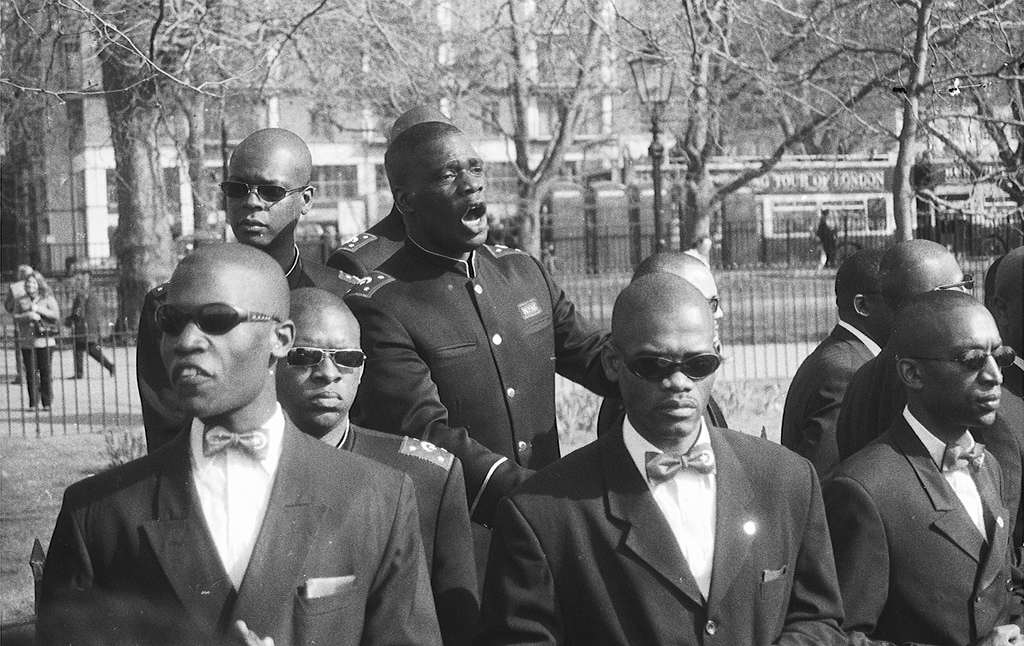
Members of the Nation of Islam

“They were talking about killing people,” Harris later testified.  Films were shown “of the Watts riots [in 1965]   and different riots taking place throughout the past, black people being beaten down by the police and shot.”

The meetings’ participants were asked, “Could we allow this to continue?  They said the only way to stop it was to act and be vicious…like the police department.

“That you had to…be able to go out and just deliberately take a baby and smash his head against the wall and kill him and, if you have to, even drink the blood to show how vicious you are.

“And they showed us a large number of pictures” on a bulletin board “of a lot of bald-headed men with little white wings on their necks, and identified each guy as being members of the Death Angels.”

Harris was told that “if I wanted to be a member of the Death Angels, that I’d have to go out and kill people to get some wings.”

Not only was the wearing of a pair of white wings a symbol of belonging to the Death Angels, so was a shaved head, stated Harris.

Only certified members of the Death Angels could enter Muslim temples with shaved heads.  Anyone else who entered such a temple with a shaved head “can be killed or put out of the temple for coming in like that.”

ALLAH’S DEATH ANGELS: PART TWO (OF FIVE)

In Bureaucracy, Law Enforcement, Politics, Social commentary on June 12, 2014 at 12:15 am

While an inmate at San Quentin prison, Anthony C. Harris became a devout member of the Nation of Islam.

At that time, the spiritual leader of the Nation was Elijah Muhammad, who preached a gospel of black separatism and superiority.  Muhammad taught that whites were literally the incarnation of evil, a race of “blue-eyed devils.”

Elijah Muhammad NYWTS-2.jpg

Elijah Muhammed

To test the worthiness of His Chosen Black People, proclaimed Muhammad, Allah had allowed their 400-year persecution by these “bleached-out, grafted snakes.”

But that great testing period would soon come to its end.  Then would follow the literal, heaven-sent destruction of all whites.  At the conclusion of this divine slaughter, Allah would create a paradise earth for His Chosen Black People.

It was also in San Quentin that Harris met two other inmates who would radically change his life: Manuel Moore and Jessie Lee Cooks.

Both men asked Harris–a fifth-dan kung-fu expert–to teach them the martial art–so they could kill whites.

Harris agreed to supply the lessons.

The three men had a conversation in the temporary Muslim temple in the prison–about “killing people and cutting their heads off–just white people,” Harris later testified in court.

After Harris was paroled on October 15, 1973, he drifted into San Francisco.  There he made a new friend–Larry Craig Green, who helped him into a job at the Black Self-Help, a Muslim-owned, furniture-moving company in the city.

Yet another new friend he made there was J.C. Simon.

Soon he was reunited with Jessie Cooks, who had been paroled in July.  The release of Manuel Moore followed in November–as did his own arrival in San Francisco.

In September or October, 1973, Harris and 12 to 13 other Muslims–including Simon, Cooks and Green–met at J.C. Simon’s San Francisco apartment.

“They asked me,” Harris later testified, “was I able to kill anyone?  Did I have my mind together?  They wanted me to work in the [Muslim] temple” as a kung-fu instructor.

At a second meeting at Simon’s apartment, a large, velvet-lined case was prominently displayed.  In it were two machetes, three pistols–a snubnose .38 revolver, a .357 Magnum and an automatic–and a shotgun.

“They asked me, how did I feel about white people?  Did I feel they were my enemy?  Was my mind together enough to destroy my enemy?

“And I just told them, ‘I don’t know what you mean by destroying my enemy.'”  Harris told the other Muslims that he had no enemies.

“They wanted me to go out and kill some people, to show them I could be trusted among them.  They told me I would have to make some kind of move sooner or later.”

Once again, Harris found himself under cross-examination: was he ready to take his first step towards joining the elite of Allah, the Death Angels?  Was he willing to assist his brethren in destroying the blue-eyed white devils?

To drive the point home, the Muslims showed Harris photographs of his brother, stepbrother, mother, sister and fiancee.

“They told me I knew too much about the organization, and something could happen” to Harris himself and his family unless he joined the group of future killers.

Still, Harris refused to commit himself to the coming plot to slaughter whites.

So his companions decided to enlist him in their cause in one dramatic–and lethal–move.

On the night of October 20, 1973, Americans were glued to their TV sets.  President Richard Nixon had just fired Special Watergate Prosecutor Archibald Cox and disbanded the Watergate Special Prosecutor’s office.

On that same evening, Harris stood at a bus stop, waiting to be taken home from his job at the Black Self-Help, when a panel truck driven by Larry Green pulled up in the bus zone.

Next to Green, in the passenger’s seat, sat Jessie Lee Cooks.  Both men offered Harris a ride home, and he accepted.

The truck drove around for awhile, then parked in the shadows near Powell and Chestnut Streets, in a residential neighborhood.

A few minutes later, the three Muslims spotted a young–and white–married couple, Richard and Quite Hague, strolling nearby.

Hague, 30, worked as a mining engineer for the San Francisco office of Utah International.  Quita, 28, was a reporter for the Industrial City Press, in South San Francisco.  The previous month they had celebrated their seventh wedding anniversary.

Cooks stopped the Hagues, asking for directions.  Then he shoved a pistol into the back of Richard Hague and  forced the couple into the rear of the panel truck.

The Hagues were bound, beaten and driven to a remote spot in the San Francisco industrial district.  There they were yanked from the van.  Larry Green seized a machete and, with one stroke, nearly decapitated Quita Hague.

“He got blood all over him,” Harris would later testify.

“Larry came over with the knife and said something about, ‘You ought to have seen all the blood gush out of her neck.'”

Green handed the machete to Cooks, who slashed Richard Hague about the face and back of the head.  Left for dead, Hague would eventually recover–and testify against his wife’s killers.

ALLAH’S DEATH ANGELS: PART ONE (OF FIVE)

In Bureaucracy, History, Law Enforcement, Politics on June 11, 2014 at 12:30 pm

From October 20, 1973 to April 20, 1974, San Francisco was rocked by a series of random, brutal attacks against whites.  The assailant was at first thought to be a lone black gunman.

The toll finally reached 16 murders, five woundings, one rape, and the attempted kidnapping of three children.

The rampage, however, was not limited to San Francisco.  Throughout California–from Bakersfield to San Diego–at least 93 other whites were murdered, according to later police investigations.

To end the San Francisco slaughter, teams of police decoys roamed the streets, posing as hitchhikers, a favorite target of the supposed lone gunman.

To prevent ham radio operators from honing in on their operation, the San Francisco Police Department (SFPD)used a special high-frequency “zebra” radio band.

When the use of this became known, the slaughters were dubbed “the Zebra case” by the media.  Most people assumed the term referred to black-on-white crime.

But the killer failed to blunder into any of these ambushes.

On April 20, 1974, then-Mayor Joseph Alioto–desperate to end the slaughter–authorized a massive, city-wide dragnet.

Over 600 young black males were stopped and questioned by police who were armed with only a vague description of the killer, as given by surviving victims.  Some blacks were stopped so many times they were given special ID cards to prevent future stops.

Civil libertarians and the National Association for the Advancement of Colored People (NAACP) protested vigorously.  The NAACP filed a complaint with U.S. District Judge Alfonso J. Zirpoli in San Francisco.

Just six days after the dragnets began, Zirpoli declared the stops illegal.

In San Francisco, the tourist trade fell off.  Many whites stopped going outside after dark.  Some whites began talking about forming vigilante committees and spreading similar terror among blacks.

Then, on April 22, 1974, a break finally came in the case.

Anthony Cornelius Harris, a tall, thin, handsome member of the Nation of Islam–otherwise known as the Black Muslims–came forward as a police witness.

At 28, he was a fifth-dan kung-fu expert who always dressed well and spoke softly.  He also had firsthand knowledge of the “Zebra murders.”

Anthony Harris

Tne killings, said Harris, weren’t the work of a crazed loner.  They were being carried out by a group of militant Black Muslims who made use of elaborate security precautions.

Harris’ intimate knowledge of the killers stemmed from their having been among his closest friends for over six months.

According to Harris, the killers had repeatedly tried to enlist him as an accomplice.  But Harris–so he later claimed–could not bring himself to commit cold-blooded murder.  This led his friends to suspect that Harris might be a police informer or agent.

Harris began fearing for his life.  He also wanted the $30,000 reward being offered for the capture of the still-supposed lone gunman.

On May 1, 1974, police–acting on Harris’ information–arrested seven suspects.

Chief Assistant District Attorney W.H. Guibbini asked for high bail for three of the suspects after their indictment.  Presiding Superior Court Judge Clayton V. Horn raised it to $300,000 each.

The accused killers remained in jail before and during their trial.

Four of these were tried and convicted.  On March 29, 1976, they were sentenced to prison for life.

They were Larry Craig Green, 22; Manuel Moore, 29; Jessie Lee Cooks, 29; and J.C. Simon, 29.  They appealed their convictions to the California Supreme Court–which affirmed them.

Jessie Cooks, Manuel Moore, J.C. Simon and Larry Craig Green

During his testimony as a prosecution witness, Harris was guarded constantly by San Francisco police.

When the SFPD’s resources began to be strained, Harris was placed on the Witness Security Program, operated by the U.S. Marshals Service for the Justice Department.

Also known as WITSEC, it offers protection, relocation and new identities to those who testify against organized crime groups.

Harris was eventually given a new name and relocated to a series of different states.  He received a portion of the $30,000 reward he was seeking.  Then he vanished altogether.

What follows is an inside account of the “Zebra” death cult, as depicted through the grand jury testimony of the star witness against the killers: Anthony C. Harris.

* * * * *

Born in Long Beach, California, in 1946, Anthony Cornelius Harris got as far as the sixth grade.  He clashed often with police and, on January 3, 1969, he was convicted for assaulting a policeman.

He was released from prison in May, 1970, when he won a reversal of his sentence at the California Supreme Court.

But he was once again arrested and convicted, in 1971, of second-degree burglary in Los Angeles.  For this, he drew a sentence at San Quentin prison.

And he also met two of the future “Zebra” killers: Manuel Moore and Jessie Lee Cooks.

Cooks had been convicted of robbery; Moore had been sent to prison for burglary.  Both wanted Harris, a fifth-dan kung-fu expert, to teach them the martial arts.

According to Harris, Cooks wanted to learn kung-fu so he could kill whites “because they had castrated and killed our ancestors and stomped our babies’ heads in.”

STRIPPING DOWN FOR THE FBI

In Bureaucracy, Law Enforcement on September 27, 2013 at 12:00 am

The Federal Bureau of Investigation has always encouraged Americans to report anything they consider a threat to national security or a violation of Federal law.

But recently the FBI has adopted a practice that is almost certain to sharply decrease the number of people willing to report knowledge of a crime.

Earlier this year, a friend of mine named Jim visited the San Francisco field office of the FBI.  He wanted to report a violation of Federal computer fraud and harassment laws.

This meant visiting the San Francisco Federal Building (technically named the Phillip Burton Federal Building, in honor of the late San Francisco Congressman).

At 450 Golden Gate Avenue, located close to the Civic Center and City Hall, it serves as a courthouse of the United States District Court for the Northern District of California.

It also lhouses offices for such Federal law enforcement agencies as the FBI, Bureau of Alcohol, Tobacco and Firearms, Drug Enforcement Administration and U.S. Marshal’s Service.

To enter, you must first show a driver’s license or State ID card.  Then you must remove

  • Your belt
  • Your shoes
  • Your watch
  • Your wallet
  • All other objects from your pants pockets
  • Any jacket you’re wearing
  • Any cell phone you’re carrying

All of these must be placed in one or more large plastic containers, which are run through an x-ray scanner.

Then, assuming you avoid setting off any alarm system, you’re set for your next big screen test.

This comes when you enter the 13th floor office of the FBI.

According to Jim: You walk into a large room filled with several comfortable chairs that sit close to the floor.  Ahead is a window such as you find in a bank–made of thick, presumably bulletproof glass.

A secretary on the opposite side greets you, and asks why you’ve come.

You say that you want to speak with an agent about what you believe is a violation of Federal law.

If you’ve done your homework, you should know at least the general legal area this violation falls under.  And you’re even better-off if you know what division of the FBI is assigned to handle it.

For example: Jim knew the acts he wanted to report were a violation of Federal anti-computer hacking and harassment laws.  He also knew that these violations are handled by the FBI’s Cybercrime Division.

So he asked to speak with an agent from that division.

The secretary said she would see what she could do.  But before he could speak with an agent, he would have to show her his driver’s license or State ID card.

The secretary made a xerox of this, and then handed the card back.

Then, as if that wasn’t enough, he had to fill out a single-page form, where he was required to provide his:

  • Name
  • Address
  • Phone number
  • Social Security Number
  • The reason he wanted to speak to an agent

Of course, he could refuse to fill out the form.  But then the secretary would refuse to let him meet with an FBI agent to gain help in resolving his problem.

In Jim’s case, his request to speak with an agent specializing in Cybercrime was denied.   He would up speaking instead with the “duty agent”–whichever luckless person has been assigned to deal with the public that day.

Unofficially, the “duty agent” is the one who takes the “nut calls” from, among others, the mentally disabled who claim they’re picking up KGB transmissions in the fillings of their teeth.

In Jim’s case, the “duty agent” he drew specialized in Gang Violence.  While this is definitely a worthy subject for investigation, it had nothing to do with the matter Jim wanted to talk about.

The agent candidly said he knew nothing about cybercrime.  Which meant he couldn’t give Jim even the barest information about what he might expect to happen after submitting his report.

Fortunately, Jim had thought ahead enough to write up a detailed, three-page report of the cyber attacks he had recently experienced.  He now gave this to the agent.

The agent promised to forward it to the Cybercrime Division.

Jim asked when he might hear from someone there.  The agent said this was highly unlikely.

Jim was surprised.  The agent was in turn surprised that Jim would expect anyone to get back to him.

“I would think,” said Jim, “they would want to ask me a few questions.  And give me some idea as to what was going on in my case.”

The agent said that if the FBI wanted more information, they would contact him.  And, no, they wouldn’t give him any hints about what–if anything–was happening in his case.

That was assuming they chose to investigate it.

No one at the FBI ever contacted Jim.

So if you want to report a crime to the FBI, be prepared to give up a lot of your own privacy beforehand.

And don’t expect to receive even the courtesy of a call-back in exchange for all of it.

WITNESS-SECURITY: A BLOODSTAINED HISTORY: PART SIX (OF TEN)

In Bureaucracy, History, Law, Law Enforcement on June 17, 2013 at 12:16 am

Mafia Hitman Joseph Barboza had become known throughout the New England underworld as “The Animal.”

He relished his new alias and his reputation as a temperamental killer.

Everyone who dealt with Barboza—including Mafia Boss Raymond Patriarca—feared his explosive temper.

Granted an audience with Patriarca, Barboza was transfixed by the capo’s diamond ring.  Later, he bragged that he had thought of biting off Patriarca’s finger to get the ring.

“He’s crazy,” Patriarca often told his closest associates.  “Someday we’ll have to whack him out.”

Only one other mob gunman could match Barboza’s reputation for deadliness: Steve Hughes, the top triggerman for the McLaughlins.

Barboza spent more than a year trying to eliminate Hughes, until his chance finally came on September 23, 1966.

On that day, Hughes and a loanshark friend, Sammy Lindenbaum, went for a drive along Route 114 in Middleton, Massachusetts.

They paid no attention as another car—carrying Barboza and a crony, Joseph Amico—rapidly closed on them.

With Amico behind the wheel, Barboza aimed a high-powered rifle out the window and dropped Hughes and Lindenbaum in their seats.

Barboza’s moment of supreme triumph was short-lived.  His rising notoriety disturbed Patriarca, who believed in taking a low profile and avoiding the antagonism of the press and police.

Patriarca began searching for an excuse to part with his top muscleman.   He found it on October 6, 1966, when Boston police arrested Barboza and three companions.

Inside Barboza’s car, police found a loaded .45 automatic and an M-1 carbine.  Barboza, then out on bail on a stabbing charge, was shipped off to Walpole State Prison for parole violation.

There he waited vainly for the Patriarca Family to post the $50,000 bond demanded for his release.

Tired of waiting, two of his fellow enforcers decided to lend a hand: Thomas DePrisco and Arthur Bratsos began raiding Patriarca gambling dens to collect the money.

Their fund-raising efforts ended violently one night when their intended victims drew pistols and shot Bratsos and DePrisco to death.

When he learned of the deaths of his friends, Barboza exploded.  He damned Patriarca as a “fag” and swore to kill several of the capo’s top associates, whom he blamed for the slayings.

Word of this outburst reached Patriarca, who sent back a threat of his own: Barboza was a dead man, in or out of prison.

Fearing for his own life, Barboza yielded to the proddings of two FBI agents seeking evidence against Patriarca.  He agreed to act as a federal witness against his former mob cronies.

In exchange, he demanded protection for himself, his wife and young daughter, and the dropping of his parole and all charges now facing him.

Although Barboza’s terms were stiff, Boston District Attorney Gary Byrne and the prosecutors of the Justice Department felt they were getting the best of the bargain.

They saw in Barboza a dramatic, unprecedented opportunity to strike down a powerful crime cartel.

This, in turn, would enable federal lawmen to recruit new informants and witnesses for additional—and successful—prosecutions..

To achieve these goals, however, the Justice Department had to prove it could protect Barboza against mob reprisals.

As a first step in this process, Byrne released the ex-hitman to the protective custody of the FBI.  But the FBI found its budget and manpower strained by the assignment.

Realizing that a combined effort was necessary, the Bureau called in a handpicked security detail of sixteen deputy U.S. marshals.

Heading the detail was Deputy Marshal John Partington, a former agent with the IRS Intelligence Division and a specialist in organized crime.

John Partington (on right)

Equally important, Partington understood the criminal mentality: Not only did Barboza need to be protected, he needed to be kept in a proper state of mind to testify in court.

The marshals transferred Barboza to Thatcher’s Island, an isolated lighthouse station off the coast of Gloucester.  Occupied by two houses and approachable only by sea, the island seemed a perfect security spot.

Every two weeks, a new detail of marshals arrived to relieve the sixteen men on duty.  Food and supplies were regularly shipped in aboard Coast Guard vessels.

Eventually, the press learned of the security detail on ”Baron’s Island”—so  nicknamed because “Baron” had once been a Barboza alias.

The disclosure led to a series of attempts by mob hitmen to eliminate Barboza.

Thatcher’s Island

The first attempt came in September, 1967.  Patriarca ordered a 325-pound stock swindler named Vincent Teresa to take a crew of hitman, infiltrate the island and dispose of Barboza.

But the FBI learned of the plot and tipped off the security detail.

When Teresa’s $112,000, forty-three foot yacht, The Living End, cruised around the island, the hitman couldn’t find an unprotected spot to land.

Everywhere they looked they saw deputy U.S. marshals, armed with pistols and carbines, patrolling the beach.  Barboza never appeared in sight.

Then a Patriarca assassin, Maurice “Pro” Lerner, thought of making a one-man, commando-style assault on the island.  An experienced skindiver, he brought along his own scuba gear for just such an attack.

But he quickly dropped the idea: he estimated the odds of getting a successful shot at Barboza were a million to one.

Copyright@1984 Taking Cover: Inside the Witness Security Program, by Steffen White and Richard St. Germain

WITNESS-SECURITY: A BLOODSTAINED HISTORY: PART FIVE (OF TEN)

In Bureaucracy, History, Law, Law Enforcement on June 14, 2013 at 12:05 am

The Witness Security Program owes its creation to one of the most-feared assassins the Mafia has ever produced: Joseph Barboza, who took pride in his underworld alias, “The Animal.”

It was a nickname he had lived up to.  “I was an enforcer,” he boasted to the House Select Committee on Crime in 1972, “who kept the other enforcers in line.”

Barboza had done so as a top hitman earning $900 a week from the most powerful Mafia family in New England.  Ruling that family was Raymond Patriarca, based in Providence, Rhode Island.

Joseph “The Animal” Barboza

But even before entering the Mafia, Joseph Barboza had spent most of his life as a career criminal.  He was born in 1932, in New Bedford, Massachusetts, to Portuguese immigrant parents.

By the time he was thirty, he had served two prison sentences—one for burglary, the other for assault with a deadly weapon.

Even his jailers couldn’t restrain him.  At Norfolk Prison Colony, he got drunk on illicit “hooch” and led an inmates’ riot, culminating in a short-lived escape-attempt.

When Barboza wasn’t serving time in prison, he made his living as a boxer (winning three professional matches and earning a rating in Ring magazine).  He supplemented his income through a career as a freelance loanshark and extortionist.

By 1963, his growing notoriety had brought him to the attention of Enrico Henry Tameleo, the underboss, or second-in-command, to Raymond Patriarca.

Since 1948, Patriarca had been “the policymaker, judge and overlord of organized crime” throughout New England, according to a 1966 FBI report.

Raymond Patriarca

Tameleo offered a Barboza a job and fulltime income as an enforcer for the Patriarca Family.  Barboza instantly agreed.  He had always dreamed of becoming a “made man” of the Mafia.

(Tameleo didn’t warn him that this was impossible.  Barboza was of Portuguese descent, and only full-blooded Sicilians and Italians could hold Mafia membership.)

Tameleo sent Barboza to shake down 20 nightclubs whose owners had refused to pay “protection insurance” to the mob.

The owners changed their minds after one or two visits from Barboza and his wrecking crew.  Furniture would be smashed and customers terrorized until the owners began paying $1,000 a month to Patriarca’s collectors.

Meanwhile, the always fragile peace of the New England underworld was being shattered by an escalating wave of gangland violence.

In 1961, the two most powerful factions of the region’s “Irish Mafia” had gone to war.  On one side was the Charleston mob of Bernard McLaughlin.  On the other was the Winter Hill gang of James “Buddy” McLean.

The “Irish Gang War” triggered a police crackdown on all the New England organized crime groups—including Patriarca’s.  That was when Patriarca demanded that the fighting stop.

To ensure that it did, he sent his underboss, Tameleo, to arrange a peace conference between the McLeans and McLaughlins.  Both sides agreed to a truce because Tameleo was widely respected for his skills as a negotiator.

But when the conference opened in January, 1965, Tameleo was outraged to find the McLaughlins had come armed–a direct violation of the “rules of order.”  Patriarca also grew furious at this spurning of his efforts as underworld peacemaker.

As a result, the Patriarca Family threw its full weight behind the McLeans.

During 1965, Joseph Barboza moved from being a “mere” legbreaker for the Patriarca Family to becoming its top assassin.  His first important victim was Edward Deegan, a McLaughlin member who had raided several Patriarca gambling dens.

Barboza invited Deegan to join him in a burglary of the Lincoln National Bank in Boston.  Unaware that he had been marked for death, Deegan agreed.

On the night of March 12, 1965, the burglars struck.  As the four men emerged from the bank, Barboza and two cronies emptied their pistols into Deegan.

This killing proved a turning point for Barboza.  He became the top hitman for the Patriarca Family and the McLean mob.  He carried out more  hits than any other assassin during the war.  Later, in a hastily-written autobiography, he would boast of his string of killings.

(But he was always careful to describe his actions in the third-person, as though someone else had actually been responsible.  In this way he protected himself against prosecution for murder, where no immunity existed.)

In June, Jimmy “The Bear” Flemmi, a close friend of Barboza’s, was gravely wounded by a shotgun blast.  Barboza soon learned that the attackers had been Steve Hughes and Edward “Punchy” McLaughlin.

Swearing vengeance, Barboza quickly set out to claim his next victim.  He was especially intent on disposing of Hughes, who had become the top triggerman of the McLaughlins.

On October 20, 1963, Edward McLaughlin was waiting at a bus stop when Barboza casually walked up behind him.  Disguised in a wig and glasses, Barboza drew his pistol and pumped five bullets into McLaughlin.

Less than a month later, on November 11, the hitman visited the Mickey Mouse Club, a tavern in Revere Reach.  This time his intended target was a bartender and McLaughlin member named Ray DiStassio.

Talking with DiStassio at that moment was an innocent bystander, John R. O’Neill.  Barboza simply drew and shot both men dead.

Copyright@1984 Taking Cover: Inside the Witness Security Program, by Steffen White and Richard St. Germain