New York State prisons are about to get a lot fuller.
New York State Senator Tony Avella is sponsoring a bill to create a felony charge– “aggravated resisting arrest”–for people who have been convicted of resisting arrest twice in a 10-year period.
Under current law, resisting arrest is a misdemeanor, carrying a maximum penalty of one year in prison.
If the charge became a felony, those convicted could be sentenced from four years of probation to life in prison.
The bill has its origins in a letter the Lieutenants Benevolent Association–a police union–sent to New York Police Department (NYPD) Commissioner Bill Bratton in January requesting a change in the current law.
State Senator Avella’s proposed legislation reads as follows:
“A person is guilty of aggravated resisting arrest when he or she commits the crime of resisting arrest pursuant to Section 205.30 and has previously been convicted of such crimetwo prior times within a ten-year period.
“Aggravated resisting arrest is a class E felony.”
And Bratton, in testimony before the New York State Senate in February, supported harsher penalties for those who resist arrest.
“We need to get around this idea that you can resist arrest,” Bratton said to reporters after his appearance. “One of the ways to do that is to give penalties for that.”
This legislation–if enacted–will have both local and national implications.
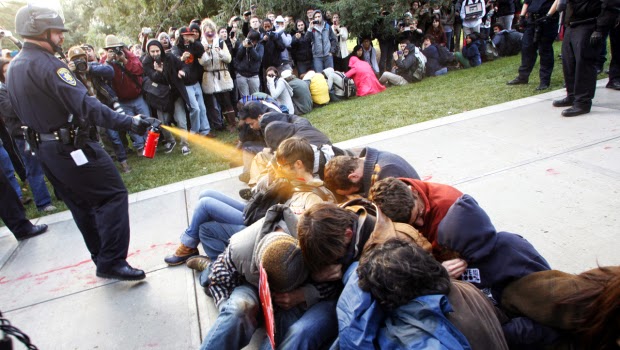
Police pepper-spraying non-violent protesters
Local–because the NYPD is the largest police department in the country. Its website states that it now has “approximately 34,500” uniformed officers.
(To put that number into historical perspective: When Alexander the Great set out in 334 B.C. to conquer the Persian empire, his army numbered 30,000.)
National–because the NYPD is one of the most respected police departments in the country. And other police departments will almost certainly follow suit in urging their state legislatures to pass similar legislation.
So what’s wrong with that?
“Resisting arrest” is one of those terms that can mean whatever a police officer wants it to mean.
If a prosecutor accuses someone of bank robbery, he must present valid evidence–such as witnesses, camera footage and (probably) portions of stolen money in the arrested person’s possession.
But if a cop says someone “resisted arrest,” the “evidence” often consists of only his claim.
“Resisting arrest” can mean anything–including that the person merely asked, “Why am I being arrested?”
WNYC–New York’s highly respected public radio station–reported in 2014 that 40% of resisting arrest cases are brought by five percent of police officers.
If an officer routinely claims that people are resisting arrest, this might signal his being overly aggressive toward civilians.
He might even use the criminal charge to cover up his use of excessive force.
This is especially relevant in light of a series of recent cases–some caught on camera–of police savagely beating arrestees, or using forbidden chokeholds on them.
Consider how such increased penalties could have affected the life of Tyeesha Mobley.
Mobley, 29, caught her nine-year-old son stealing $10 from her purse. She called the called the NYPD.
Can you please send over an officer to explain to my kids that stealing is wrong? she asked.
The police department obliged, sending over four officers to meet Mobley and her two boys at a nearby gas station.
%23!031915-national-Tyeesha-Mobley&docid=JHk4KstsAEHWfM&tbnid=O-hToga7ZXEKgM%3A&w=1200&h=675&ei=undefined&ved=undefined&iact=c "https://www.google.com/imgres?imgurl=http://www.bet.com/content/dam/betcom/images/2015/03/National/031915-national-Tyeesha-Mobley.jpg.custom1200x675x20.dimg&imgrefurl=http://www.bet.com/news/national/photos/bring-that-week-back/2015/03/bring-that-week-back-parents-says-daughter-not-allowed-at-black-friend-s-sleepover.html?utm_source=feedburner&utm_medium=feed&utm_campaign=Feed%3A+Betcom-LatestPhotos+(BET.com+-+Latest+Photos)#!031915-national-Tyeesha-Mobley&docid=JHk4KstsAEHWfM&tbnid=O-hToga7ZXEKgM:&w=1200&h=675&ei=undefined&ved=undefined&iact=c")
Tyeesha Mobley
The meeting started off well. “Three officers was joking around with [the nine-year-old who had stolen the $10], telling him, ‘You can’t be stealing; you’ll wind up going in the police car,’” Mobley testified at a court hearing in October, 2014.
But the fourth officer apparently resented the assignment. According to a lawsuit subsequently filed by Mobley, the following happened:
“You black bitches don’t know how to take care of your kids,” said the fourth officer. “Why are you wasting our time? Why don’t you take your fucking kid and leave?”
Mobley decided that was a good time to do just that
But before she could do so, the cop told her she was under arrest.
“What for?” she asked. “If you’re going to say another fucking word,” the lawsuit alleges the cop warned her, “I’m going to knock your teeth down your throat.”
He then shoved her up against a car, kicked her legs, and handcuffed her.
Mobley spent a night in jail. Her two boys were taken away and placed in foster care for four months–with a family that spoke no English.
Finally, a judge threw out the case against her.
Mobley has since filed a lawsuit against New York City, the NYPD and the Administration for Children’s Services.
It doesn’t take a genius to see how Mobley’s life could have been turned into an even greater hell under the proposed change in “resisting arrest” laws.


ABC NEWS, ADOLF HITLER, BOOKS, BUSINESS LEADERSHIP, CBS NEWS, CNN, ENGLAND, ERICH VON MANSTEIN, ERWIN ROMMEL, FACEBOOK, FRANCE, HEINZ GUDERIAN, HOW HITLER COULD HAVE WON WORLD WAR II, JOSEPH STALIN, NAZI GERMANY, NBC NEWS, SOVIET UNION, THE CHICAGO SUN-TIMES, THE CHICAGO TRIBUNE, THE LOS ANGELES TIMES, THE NEW YORK TIMES, THE WALL STREET JOURNAL, THE WASHINGTON POST, TWITTER, USA TODAY, WORLD WAR ii
IS THERE A HITLER IN YOUR CEO?
In Bureaucracy, Business, History, Military, Politics, Social commentary on March 27, 2015 at 4:19 pmWould-be CEOs and Fuehrers, listen up: Character is destiny.
Case in point: The ultimate Fuehrer and CEO, Adolf Hitler.
Ever since he shot himself in his underground Berlin bunker on April 30, 1945, historians have fiercely debated: Was der Fuehrer a military genius or an imbecile?
With literally thousands of titles to choose, the average reader may feel overwhelmed. But if you’re looking for an understandable, overall view of Hitler’s generalship, an excellent choice would be How Hitler Could Have Won World War II by Bevin Alexander.
Among “the fatal errors that led to Nazi defeat” (as proclaimed on the book jacket) were:
As the war turned increasingly against him, Hitler became ever more rigid in his thinking.
He demanded absolute control over the smallest details of his forces. This, in turn, led to astounding and needless losses in German soldiers.
One such incident was immortalized in the 1962 movie, The Longest Day, about the Allied invasion of France known as D-Day.
On June 6, 1944, Rommel ordered the panzer tanks to drive the Allies from the Normandy beaches. But these could not be released except on direct order of theFuehrer. As Hitler’s chief of staff, General Alfred Jodl, informed Rommel: The Fuehrer was asleep–and, no, he, Jodl, would not wake him. By the time Hitler awoke and issued the order, it was too late.
Nor could he accept responsibility for the policies that were clearly leading Germany to certain defeat. Hitler blamed his generals, accused them of cowardice, and relieved many of the best ones from command.
Among those sacked was Heinz Guderian, creator of the German panzer corps–and thus responsible for its highly effective “blitzkrieg” campaign against France in 1940.
Heinz Guderian
Another was Erich von Manstein, designer of the strategy that defeated France in six weeks–something Germany couldn’t do during the four years of World War 1.
Erich von Manstein
Finally, on April 29, 1945–with the Russians only blocks from his underground bunker in Berlin–Hitler dictated his “Last Political Testament.”
Once again, he refused to accept responsibility for unleashing a war that would ultimately consume 50 million lives:
“It is untrue that I or anyone else in Germany wanted war in 1939. It was desired and instigated exclusively by those international statesmen who either were of Jewish origin or worked for Jewish interests.”
Hitler had launched the war with a lie–that Poland had attacked Germany, rather than vice versa. And he closed the war–and his life–with a final lie.
All of which brings us to Niccolo Machiavelli, the father of political science.
In his classic book, The Discourses, he wrote at length on the best ways to maintain liberty within a republic.
In Book Three, Chapter 31, Machiavelli declares: “Great Men and Powerful Republics Preserve an Equal Dignity and Courage in Prosperity and Adversity.”
It is a chapter that Adolf Hitler would have done well to read.
“…A truly great man is ever the same under all circumstances. And if his fortune varies, exalting him at one moment and oppressing him at another, he himself never varies, but always preserves a firm courage, which is so closely interwoven with his character that everyone can readily see that the fickleness of fortune has no power over him.
“The conduct of weak men is very different. Made vain and intoxicated by good fortune, they attribute their success to merits which they do not possess, and this makes them odious and insupportable to all around them.
“And when they have afterwards to meet a reverse of fortune, they quickly fall into the other extreme, and become abject and vile.
“Thence it comes that princes of this character think more of flying in adversity than of defending themselves, like men who, having made a bad use of prosperity, are wholly unprepared for any defense against reverses.”
Stay alert to signs of such character flaws among your own business colleagues–and especially your superiors. They are the warning signs of a future catastrophe.
Share this: