Niccolo Machiavelli, the father of modern political science, wrote that there are three periods of danger in a conspiracy:
- Dangers in organizing the plot
- Dangers in executing the conspiracy
- Dangers following the execution of the plot.
The first two dangers were covered in Part One of this series. Now, as to the third danger.
Dangers following the Execution of the Conspiracy: There is really but one—someone is left who will avenge the murdered prince. These can be brothers, sons or other relatives, who have been spared by negligence or for other reasons.
But of all the perils that follow the execution of a conspiracy, the most certain and fearful is the attachment of the people to the murdered prince. There is no remedy against this, for the conspirators can never secure themselves against a whole people.
An example of this occurred in the case of Julius Caesar, who, being beloved by the people, was avenged by them.
.jpg&imgrefurl=https%3A%2F%2Fen.wikipedia.org%2Fwiki%2FJulius_Caesar&docid=i5zp8D4W-fCkiM&tbnid=pa1aoGEpET-OGM%3A&vet=1&w=1117&h=1769&bih=414&biw=745&ved=0ahUKEwjsvNnh8-rSAhULe7wKHWZBDxoQMwhQKBUwFQ&iact=c&ictx=1)
Julius Caesar
Machiavelli closes his chapter “Of Conspiracies” with advice to rulers on how they should act when they find a conspiracy has been formed against them.
If they discover that a conspiracy exists against them, they must, before punishing its authors, strive to learn its nature and extent. And they must measure the danger posed by the conspirators against their own strength.
And if they find it powerful and alarming, they must not expose it until they have amassed sufficient force to crush it. Otherwise, they will only speed their own destruction. They should try to pretend ignorance of it. If the conspirators find themselves discovered, they will be forced by necessity to act without consideration.
The foregoing was taken from Book Three, Chapter Six, of Machiavelli’s masterwork, The Discourses on Livy, which was published posthumously in 1531. But elsewhere in this volume, he notes how important it is for rulers to make themselves loved—or at least respected—by their fellow citizens:
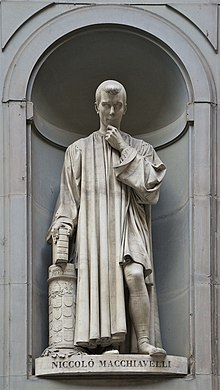
Niccolo Machiavelli
Note how much more praise those Emperors merited who, after Rome became an empire, conformed to her laws like good princes, than those who took the opposite course.
Titus, Nerva, Trajan, Hadrian, Antoninus and Marcus Auelius did not require the Praetorians nor the multitudinous legions to defend them, because they were protected by their own good conduct, the good will of the people, and by the love of the Senate.
On the other hand, neither the Eastern nor the Western armies saved Caligula, Nero, Vitellius and so many other wicked Emperors from the enemies which their bad conduct and evil lives had raised up against them.
In his better-known work, The Prince, he warns rulers who—like Donald Trump—are inclined to rule by fear:
A prince should make himself feared in such a way that if he does not gain love, he at any rate avoids hatred: for fear and the absence of hatred may well go together.

Donald Trump
If Trump is aware of Machiavelli’s warnings, he has shown no signs of it.
Presidents have universally tried to seem friendly and caring toward their fellow Americans.
This held true even for Richard M. Nixon, when he made an impromptu visit to the Lincoln Memorial and engaged in a rambling dialogue with Vietnam war protesters.
The encounter happened around 4 a.m. on May 9, 1970, shortly after the invasion of Cambodia. Nationwide outrage had exploded on college campuses, climaxing in the killing of four students at Kent State University on May 4.
So young Vietnam antiwar protesters who had descended on Washington, D.C. were startled when Nixon suddenly appeared in their midst.
Nixon, in his awkward way of trying to establish rapport, asked some of the students where they were from. When they said they attended Syracuse University, Nixon replied that it had a great football team.
But Nixon and the protesters were separated by too many differences—in their views on sexuality, civil rights, dissent and war—to find common cause.
Still, Nixon at least made an effort to understand and reach an accommodation with his critics.
Since taking office on January 20, 2017, Donald Trump has made none.
Instead, he has:
- Defended white supremacists who sparked violence in Charlottesville, Virginia.
- Fired James Comey, the director of the FBI, for investigating ties between his 2016 Presidential campaign and Russian Intelligence agents.
- Attacked the integrity of Federal judges who struck down his travel ban on Muslims.
- Called the nation’s most prestigious news media “the enemy of the American people.”
- Rammed through Congress a massive tax cut for the wealthy, at the expense of ordinary Americans.
- Attacked the integrity of American Intelligence agencies, such as the FBI and CIA.
- Falsely accused his predecessor, President Barack Obama, of wiretapping him.
These and other infamous actions have led to only 36% of Americans approving of his performance—while 58% disapprove.
Trump’s approval rating is now lower than that of any other President at this point in modern polling at this point.
By Machiavelli’s standards, Trump has made himself the perfect target for a conspiracy: “When a prince becomes universally hated, it is likely that he’s harmed some individuals—who thus seek revenge. This desire is increased by seeing that the prince is widely loathed.”


 Bureaucracybuster's Blog
ABC NEWS, ADOLF HITLER, ALTERNET, AMERICABLOG, AP, ASSASSINATION, BABY BOOMER RESISTANCE, BBC, BLOOMBERG, BUZZFEED, CBS NEWS, CNN, CONSPIRACIES, CROOKS AND LIARS, DAILY KOS, DAY OF THE JACKAL, DONALD TRUMP, FACEBOOK, FIVETHIRTYEIGHT, FREDERICK FORSYTHE, GAIUS CASSIUS, HARPER’S MAGAZINE, HUFFINGTON POST, JULIUS CAESAR, LINCOLN MEMORIAL, MAR-A-LAGO, MARCUS BRUTUS, MARK ANTHONY, MEDIA MATTERS, MOTHER JONES, MOVEON, MSNBC, NBC NEWS, NEW REPUBLIC, NEWSDAY, NEWSWEEK, NICCOLO MACHIAVELLI, NPR, PBS NEWSHOUR, PLOTS, POLITICO, POLITICUSUSA, RAW STORY, REUTERS, RICHARD M. NIXON, SALON, SEATTLE TIMES, Secret Service, SLATE, TALKING POINTS MEMO, THE ATLANTIC, THE CHICAGO SUN-TIMES, THE CHICAGO TRIBUNE, THE DAILY BEAST, THE DAILY BLOG, THE DISCOURSES, THE GUARDIAN, THE HILL, THE HUFFINGTON POST, THE INTERCEPT, THE LOS ANGELES TIMES, THE NATION, THE NEW REPUBLIC, THE NEW YORK TIMES, THE NEW YORKER, THE VILLAGE VOICE, THE WALL STREET JOURNAL, THE WASHINGTON POST, THINKPROGRESS, TIME, TRUTHDIG, TRUTHOUT, TWO POLITICAL JUNKIES, U.S. NEWS & WORLD REPORT, UPI, USA TODAY, VIETNAM WAR, WHITE HOUSE STAFFER, X
SECRETS OF CONSPIRACIES: PART ONE (OF THREE)
In Bureaucracy, History, Law Enforcement, Military, Politics, Social commentary on October 10, 2018 at 12:01 amIn the 1973 movie, The Day of the Jackal, a methodical assassin devises an ingenious plan to kill French President Charles de Gaulle.
Despite the best efforts of French security forces to entrap him, he eludes them time and again—and comes within an ace of assassinating de Gaulle.
The Day of the Jackal is fiction, based on a 1971 novel by Frederick Forsythe. In real life, most would-be political assassins lack the skills and sophistication of Forsythe’s anti-hero.
Take the case of the man who, on March 18, 2017, jumped over a bicycle rack outside the security perimeter of the White House. Within two minutes, agents of the U.S. Secret Service had tackled and arrested him.
Then, hours later, a motorist drove up to a White House checkpoint and claimed to have a bomb. Secret Service agents immediately arrested him and seized the stolen 2017 Chevrolet Impala. After a careful search, no explosives were found.
Both men will face criminal prosecution—and probably years in prison.
Even if they had been armed, President Donald J. Trump would not have faced any danger.
For the fifth time since taking office on January 20, he was in Florida, vacationing at his Mar-a-Lago resort.
That does not mean, of course, that future assassins will prove so inept.
More than 500 years ago, Niccolo Machiavelli, the father of modern political science, offered sound advice for would-be conspirators—and for rulers seeking to thwart conspiracies.
Niccolo Machiavellil
Niccolo Machiavelli: When a prince becomes universally hated, it is likely that he’s harmed some individuals—who thus seek revenge. This desire is increased by seeing the prince is widely loathed.
A prince, then, should avoid incurring such universal hatred….
By doing this, he protects himself from such vengeance-seekers. There are two reasons for this:
(1) Men rarely risk danger to avenge a wrong; and
(2) Even if they want to avenge a wrong, they know they will face almost universal condemnation because the prince is held in such high esteem.
So much for Machiavelli.
Now consider some of the tweets of “White House Staffer,” a self-proclaimed member of the Trump administration who claims 160,000 Twitter followers.
Since January 27, 2017, he has blasted a series of short, information-crammed tweets about daily life in the Executive Mansion.
[NOTE: Although I can’t confirm the legitimacy of his status or his tweets, I believe they are real. They contain too many small, intimate secrets of life in a paranoia-laced White House to not be genuine.]
March 1, 2017: Well the good times didn’t last long here. POTUS is back to flipping out on us.
March 13: POTUS [President of the United States] is thinking about suspending daily press briefings until the media “learn to be nice.” [Steve] Bannon [a top Trump adviser] is pushing for it.
March 16: Sean Hannity was asked to be Press Secretary last week. He turned it down because he didn’t want to take the pay cut. [Sean] Spicer survives.
Donald Trump
Niccolo Machiavelli: He who is threatened, and decides to avenge himself on the prince, becomes a truly dangerous man.
Anger is most likely aroused by injury to a a man’s property or honor. A prince should carefully avoid injuring either, for such a victim will always desire vengeance.
White House Staffer – February 25, 2017: The President keeps saying we’re a finely tuned machine. If that’s true why has he been fricking screaming at us all week? He’s losing it.
February 27: [Steve] Bannon is the scariest person here. He’s broken so much White House stuff by throwing it in anger. Plates, phones, chairs, etc.
February 27: It’s one thing to swear but [Steve] Bannon does it in front of the women here. C**t this, c**t that. He can’t finish a sentence without it.
Machiavelli draws a distinction between plots and conspiracies. A plot may be formed by a single individual or by many. The first isn’t a conspiracy, since that would involve at least two participants.
A single plotter avoids the danger faced by two or more conspirators: Since no one knows his intention, he can’t be betrayed by an accomplice.
Anyone may form a plot, whether he is prominent or insignificant, because everyone is at some time allowed to speak to the prince. And he can use this opportunity to satisfy his desire for revenge.
On the other hand, says Machiavelli, the dangers of assassination by a trusted intimate are slight: Few people dare to assault a prince. Of those who do, few or none escapes being killed in the attempt, or immediately afterward. As a result, only a small number of people are willing to incur such certain death.
Those who take part in a conspiracy against a ruler are “the great men of the state, or those on terms of familiar intercourse with the prince.”
These are men who have access to him. Julius Caesar, for example, was stabbed to death by members of the Roman Senate, who feared his assuming dictatorial powers.
And Adolf Hitler was conspired against by colonels and generals of the German Army. He was in fact holding a war conference when a briefcase bomb exploded, killing three officers and a stenographer, but leaving Hitler only slightly injured.
Share this: