The Witness Security Program owes its creation to one of the most-feared assassins the Mafia has ever produced: Joseph Barboza, who took pride in his underworld alias, “The Animal.”
It was a nickname he had lived up to. “I was an enforcer,” he boasted to the House Select Committee on Crime in 1972, “who kept the other enforcers in line.”
Barboza had done so as a top hitman earning $900 a week from the most powerful Mafia family in New England. Ruling that family was Raymond Patriarca, based in Providence, Rhode Island.

Joseph “The Animal” Barboza
But even before entering the Mafia, Joseph Barboza had spent most of his life as a career criminal. He was born in 1932, in New Bedford, Massachusetts, to Portuguese immigrant parents.
By the time he was thirty, he had served two prison sentences—one for burglary, the other for assault with a deadly weapon.
Even his jailers couldn’t restrain him. At Norfolk Prison Colony, he got drunk on illicit “hooch” and led an inmates’ riot, culminating in a short-lived escape-attempt.
When Barboza wasn’t serving time in prison, he made his living as a boxer (winning three professional matches and earning a rating in Ring magazine). He supplemented his income through a career as a freelance loanshark and extortionist.
By 1963, his growing notoriety had brought him to the attention of Enrico Henry Tameleo, the underboss, or second-in-command, to Raymond Patriarca.
Since 1948, Patriarca had been “the policymaker, judge and overlord of organized crime” throughout New England, according to a 1966 FBI report.
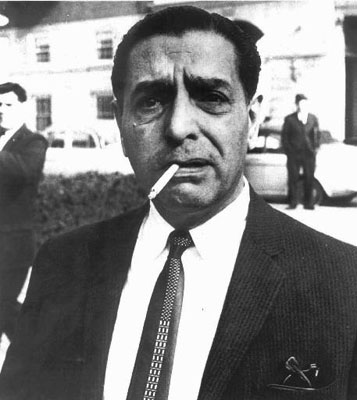
Raymond Patriarca
Tameleo offered a Barboza a job and fulltime income as an enforcer for the Patriarca Family. Barboza instantly agreed. He had always dreamed of becoming a “made man” of the Mafia.
(Tameleo didn’t warn him that this was impossible. Barboza was of Portuguese descent, and only full-blooded Sicilians and Italians could hold Mafia membership.)
Tameleo sent Barboza to shake down 20 nightclubs whose owners had refused to pay “protection insurance” to the mob.
The owners changed their minds after one or two visits from Barboza and his wrecking crew. Furniture would be smashed and customers terrorized until the owners began paying $1,000 a month to Patriarca’s collectors.
Meanwhile, the always fragile peace of the New England underworld was being shattered by an escalating wave of gangland violence.
In 1961, the two most powerful factions of the region’s “Irish Mafia” had gone to war. On one side was the Charleston mob of Bernard McLaughlin. On the other was the Winter Hill gang of James “Buddy” McLean.
The “Irish Gang War” triggered a police crackdown on all the New England organized crime groups—including Patriarca’s. That was when Patriarca demanded that the fighting stop.
To ensure that it did, he sent his underboss, Tameleo, to arrange a peace conference between the McLeans and McLaughlins. Both sides agreed to a truce because Tameleo was widely respected for his skills as a negotiator.
But when the conference opened in January, 1965, Tameleo was outraged to find the McLaughlins had come armed–a direct violation of the “rules of order.” Patriarca also grew furious at this spurning of his efforts as underworld peacemaker.
As a result, the Patriarca Family threw its full weight behind the McLeans.
During 1965, Joseph Barboza moved from being a “mere” legbreaker for the Patriarca Family to becoming its top assassin. His first important victim was Edward Deegan, a McLaughlin member who had raided several Patriarca gambling dens.
Barboza invited Deegan to join him in a burglary of the Lincoln National Bank in Boston. Unaware that he had been marked for death, Deegan agreed.
On the night of March 12, 1965, the burglars struck. As the four men emerged from the bank, Barboza and two cronies emptied their pistols into Deegan.
This killing proved a turning point for Barboza. He became the top hitman for the Patriarca Family and the McLean mob. He carried out more hits than any other assassin during the war. Later, in a hastily-written autobiography, he would boast of his string of killings.
(But he was always careful to describe his actions in the third-person, as though someone else had actually been responsible. In this way he protected himself against prosecution for murder, where no immunity existed.)
In June, Jimmy “The Bear” Flemmi, a close friend of Barboza’s, was gravely wounded by a shotgun blast. Barboza soon learned that the attackers had been Steve Hughes and Edward “Punchy” McLaughlin.
Swearing vengeance, Barboza quickly set out to claim his next victim. He was especially intent on disposing of Hughes, who had become the top triggerman of the McLaughlins.
On October 20, 1963, Edward McLaughlin was waiting at a bus stop when Barboza casually walked up behind him. Disguised in a wig and glasses, Barboza drew his pistol and pumped five bullets into McLaughlin.
Less than a month later, on November 11, the hitman visited the Mickey Mouse Club, a tavern in Revere Reach. This time his intended target was a bartender and McLaughlin member named Ray DiStassio.
Talking with DiStassio at that moment was an innocent bystander, John R. O’Neill. Barboza simply drew and shot both men dead.
Copyright@1984 Taking Cover: Inside the Witness Security Program, by Steffen White and Richard St. Germain


ABC NEWS, ARYAN BROTHERHOOD, CBS NEWS, CNN, FACEBOOK, FBI, GANGS, J. EDGAR HOOVER, MAFIA, NAPOLEON BONAPARTE, NBC NEWS, TAXES, THE LOS ANGELES TIMES, THE NEW YORK TIMES, THE WALL STREET JOURNAL, THE WASHINGTON POST, TWITTER
A NEW APPROACH TO GANGBUSTING: PART TWO (END)
In Bureaucracy, Law, Law Enforcement, Politics, Social commentary on April 4, 2013 at 12:01 amThere is a phrase that’s well-known south of the border: “Pan, o palo.” Or, in English: “Bread or stick.”
And this, in turn, comes down to: Behave well and you’ll get this nice reward. Behave badly and you’ll get your head beaten in.
In my last column I discussed the need for brandishing the stick when dealing with powerful street gangs such as the Aryan Brotherhood.
It’s the Brotherhood that’s suspected of being responsible for murdering two Texas prosecutors since February.
In this column I want to discuss creatively using the carrot to at least partially control gang violence.
It’s essential to remember the following:
These gangs aren’t going to disappear, no matter how many of their members die or wind up in prison.
For decades, the rhetoric of the Cold War has carried over into the debate over policing.
“Hawks” on the Right have demanded a “hard” approach to law enforcement, emphasizing punishment. “Doves” on the Left have pursued a “soft” line, stressing social programs and rehabilitation.
But it isn’t enough to be “hard” or “soft” in pursuing the goal of a safe, law-abiding society. It’s necessary to be “smart” above all.
If you can’t eradicate evil, then you should try to direct at least some of its elements into a safer path. Thus:
vs.
A modern-day Coliseum
But would hard-core gangs even consider participating in such a series of contests?
Yes–most gangs would want to do so. Here’s why:
On the last point: Napoleon Bonaparte created the Order of the Legion of Honor, distributed 15,000 crosses to his soldiers and called his troops the “Grand Army.” When someone criticized him for giving “toys” to his war-hardened veterans, Napoleon replied: “Men are ruled by toys.”
And for the State there would be gains as well:
Admittedly, many law-abiding citizens would be repulsed by the carnage that would result from implemting this proposal. But these are generally the people who disdain boxing or wrestling contests anyway.
But given our increasingly jaded and violence-prone society, most of them would eventually tolerate it as an effective way to simultaneously raise badly-needed tax revenues and reduce the size of criminal gangs.
Republican politicians would find this an especially attractive proposal, since it adheres to the two concepts dear to the hearts of all Right-wingers: Killing people and making money.
In short: With sufficient creativity and ruthlessness, it should be possible to reclaim control of our streets from the evils of gang violence.
Share this: