bureaucracybusters

Posts Tagged ‘JOSEPH R. MCCARTHY’

THE “TWO MINUTES HATE”–A GOP GIFT: PART ONE (OF THREE)

In Bureaucracy, History, Politics, Social commentary on May 19, 2016 at 12:01 am

The Right’s fixation on transgender “dangers” is only the latest in a long string of “enemies” painted by the Republican party.

During the 1960s and 1970s, the “enemy” was blacks.  The key to winning votes of racist whites without appearing racist lay in what Republicans called “the Southern Strategy.”

It was this that won Richard Nixon the Presidency in 1968 and 1972 and the White House for George H.W. Bush in 1988.

In a now-infamous 1981 interview, Right-wing political consultant Lee Atwater explained how this worked:

You start out in 1954 by saying, ‘Nigger, nigger, nigger.’ By 1968 you can’t say ‘nigger’—that hurts you, backfires.

“So you say stuff like, uh, forced busing, states’ rights, and all that stuff, and you’re getting so abstract.

“Now, you’re talking about cutting taxes, and all these things you’re talking about are totally economic things and a byproduct of them is, blacks get hurt worse than whites.…

“’We want to cut this,’ is much more abstract than even the busing thing, uh, and a hell of a lot more abstract than ‘Nigger, nigger.’

“So anyway you look at it, race is coming on the back burner.” 

Lee Atwater 1989.jpg

Lee Atwater 

At the end of his life, Atwater recognized the monster he had helped unleash.

Like Reinhard Heydrich–the designer of the “Final Solution” who, on his deathbed, begged forgiveness for his crimes–Atwater, in a 1991 article for Life, apologized to former Democratic Presidential nominee Michael Dukakis for the “naked cruelty” of the 1988 campaign.

But blacks have by no means been the only targets–and victims–of Republican hate campaigns. A partial list of these would include:

  • Liberals
  • Women
  • Socialists
  • Secularists
  • Disabled
  • Environmentalists
  • Hispanics
  • Gays
  • Lesbians

And now transgenders.

George Orwell’s classic 1949 novel, 1984, serves as a better guide to Republican electioneering than any official statement of the GOP.

1984 is set in a futuristic dictatorship called Oceania, whose constantly alternating mortal enemies are Eurasia and Eastasia.

A daily fixture of life in Oceania is the “Two Minutes Hate.”  During this, Party members must watch a film depicting the Party’s enemies and express their hatred for them in exactly two minutes.

Chief among these is Emmanuel Goldstein, who is obviously based on Leon Trotsky, the longtime antagonist of Joseph Stalin, dictator of the Soviet Union for almost 30 years.

The “Two Minutes Hate” serves as a form of brainwashing, whose purpose is to whip ordinary citizens into a frenzy of hatred and loathing for whoever the Party designates as its–and their–mortal enemies.

Since the end of World War II, Republicans have regularly hurled the charge of “treason” against anyone who dared to run against them for office or think other than Republican-approved thoughts.

Republicans had been locked out of the White House from 1933 to 1952, during the administrations of Franklin D. Roosevelt and Harry S. Truman.

Determined to regain the Presidency by any means, they found that attacking the integrity of their fellow Americans a highly effective tactic.

During the 1950s, Wisconsin Senator Joseph R. McCarthy rode a wave of paranoia to national prominence–by attacking the patriotism of anyone who disagreed with him.

Joseph McCarthy

Elected to the Senate in 1946, he rose to national prominence on February 9, 1950, after giving a fiery speech in Wheeling, West Virginia:

“The State Department is infested with communists. I have here in my hand a list of 205—a list of names that were made known to the Secretary of State as being members of the Communist Party and who nevertheless are still working and shaping policy in the State Department.”

Americans were already growing increasingly fearful of Communism:

  • Soviet dictator Joseph Stalin had not withdrawn the Red Army from the countries it had occupied in Eastern Europe during World War II.
  • In 1948, the Soviet Union developed–and demonstrated–its own atomic bomb, an achievement U.S. scientists had claimed would not happen for at least a decade.
  • In 1949, China fell to the triumphant armies of Mao Tse Tung.

But anti-communism as a lever to political advancement sharply accelerated following McCarthy’s speech. Republicans–resentful at being denied the White House since 1932–seized upon anti-communism as their passport to power.

No American–no matter how prominent–was safe from the accusation of being a Communist or a Communist sympathizer–”a Comsymp” or “fellow traveler” in the style of the era.

Among those accused:

  • Secretary of State George C. Marshall, who had overseen America’s strategy for defeating Nazi Germany and Imperial Japan
  • President Harry S. Truman
  • Playwrights Lillian Hellman and Arthur Miller
  • Actors Charlie Chaplin, Zero Mostel, Lloyd Bridges, Howard Da Silva, Edward G. Robinson and John Garfield
  • Composers Arron Copland and Elmer Bernstein
  • Physicist J. Robert Oppenheimer, who presided over the creation of America’s atomic bomb
  • Actresses Lee Grant, Delores del Rio, Ruth Gordon and Lucille Ball
  • Journalists Edward R. Murrow and William L. Shirer, who had chronicled the rise of Nazi Germany
  • Folksinger Pete Seeger
  • Writers Irwin Shaw, Howard Fast, John Steinbeck and Dashiell Hammett

Even “untouchable” Republicans became targets for such slander.

The most prominent of these was President Dwight D. Eisenhower–labeled ”a conscious, dedicated agent of the Communist Conspiracy” by Robert Welch, who founded the John Birch Society in 1958.

HOW AMERICA BECAME “DEATH, THE SHATTERER OF WORLDS”

In Bureaucracy, History, Military, Politics, Social commentary on February 19, 2016 at 12:01 am

The 1989 movie, Fat Man and Little Boy, provides useful insights into the real-life workings of bureaucracies. 

In it, the brilliant and ambitious physicist, J. Robert Oppenheimer (played by Dwight Schultz) comes–too late–to realize he’s made a deal with the devil. 

The same proved true for the J. Robert Oppenhemer of history. 

Paul Newman as General Leslie Groves and Dwight Schultz as J. Robert Oppenheimer 

Hired by Army General Leslie Groves (played by Paul Newman) to ramrod construction of an atomic bomb, Oppenheimer has no qualms about using it against Nazi Germany. 

It’s believed, after all, that German scientists are furiously pursuing work on such a weapon. The full horror of the extermination camps has not yet been revealed. 

But “Oppie” and many other Jewish scientists working on the Manhattan Project can easily imagine the fate of Jews trapped within the borders of the Third Reich. 

Then something unforeseen happens.

On May 8, 1945, the Third Reich collapses and signs unconditional surrender terms. Almost at the same time, the U.S. military learns that although German physicists had tried to make an atomic bomb, they never even got close to producing one. 

So Oppenheimer finds himself still working to build the most devastating weapon in history–but now lacking the enemy he had originally signed on to destroy. 

Meanwhile, the U.S. Government has invested nearly $2 billion in the Manhattan Project–at a time when $2 billion truly meant the equivalent of $1 trillion today. Is all that money to go for nothing?  

What to do?

Oppenheimer doesn’t have to make that decision. It’s made for him—by Groves, by Groves’ superiors in the Army, and ultimately by the new President, Harry S. Truman. The bomb will be used, after all.

It will just be turned against the Japanese, who are even more hated by most Americans than the Germans. It doesn’t matter that: 

  • The Japanese lack the technological skill of the Germans to produce an atomic bomb. 
  • They are rapidly being pushed across the Pacific to their home islands. 
  • American bombers are incinerating Japanese cities at will. 
  • The Japanese are desperately trying to find a way to surrender without losing face. 

What matters is that Pearl Harbor is still fresh in the minds of Americans generally and of the American military in particular. And that now that the Japanese are being pushed back into their home islands, they are fighting ever more fanatically to hold off certain defeat. 

General Douglas MacArthur, who is scheduled to command the invasion of Japan, has estimated a million American casualties if this goes forward. 

Oppenheimer, who has taught physics at the University of California at Berkeley, now finds himself being taught a lesson: That, once set in motion, bureaucracies–like objects–continue to move forward unless something intervenes to stop them. 

And, in this case, there is no one willing to say: Stop. 

So, on July 16, 1945, the first atomic bomb in history is detonated at Los Alamos, New Mexico. 

Atomic bomb test at Los Alamos: July 16, 1945

Then, on August 6, 1945, an American B-29 bomber drops “Little Boy” on Hiroshima. An estimated 80,000 people die instantly. 

By the end of the year, injury and radiation bring total casualties to 90,000-140,000. 

On August 9, it’s the turn of Nagasaki. Casualty estimates for the dropping of “Fat Man” range from 40,000 to 73,884, with another 74,909 injured, and another several hundred thousand diseased and dying due to fallout and other illness caused by radiation. 

For Oppenheimer, the three years he has devoted to creating an atomic bomb will prove the pivotal event of his life.

He will be praised and damned as an “American Prometheus,” who brought atomic fire to man. Countless Americans–especially those who would have been ordered to invade Japan–will revere him as the man who brought the war to a quick end.  

And countless Americans–and non-Americans–will condemn him as a man whose arrogance and ambition led him to arm mankind with the means of its own destruction. 

Witnessing the first successful atomic explosion, Oppenheimer had been stunned by the sheer magnitude of destructiveness he had helped unleash. Quoting the Hindu holy book, the Bhagavad Gita, he murmured: “Now I am become Death, the shatterer of worlds.” 

Faced with the massive toll of lives taken by the device he had created, Oppenheimer became convinced that the only hope for humanity lay in abolishing nuclear weapons. 

He vigorously opposed the creation of a “super” hydrogen bomb. His advice was overruled, however, and construction of this went forward at the same pace that Oppenheimer had once driven others to create the atomic bomb. 

The first test of this even more terrifying weapon occurred on November 1, 1952. By 1953, just as Oppenheimer had predicted, the Soviet Union had launched its own H-bomb test. 

In a famous meeting with President Truman, Oppenheimer reportedly said, “Mr. President, I have blood on my hands.” Truman later claimed that he had offered Oppenheimer a handkerchief, saying, “Here, this will wash it off.” 

It didn’t. 

During the hysteria of the Joseph McCarthy witch-hunts, Oppenheimer found himself accused of being a Communist traitor. In 1954, he was stripped of his government security clearance. 

Unable to prevent the military bureaucracy from moving relentlessly to use the atomic bomb, he could not halt the political bureaucracy from its own rush into cowardice and the wrecking of others’ lives. 
“BRIDGE OF SPIES” TELLS UNPLEASANT TRUTHS ABOUT GOVERNMENT: PART TWO (END)

In Bureaucracy, History, Law, Military, Politics, Social commentary on October 27, 2015 at 12:01 am

“Bridge of Spies” vividly recaptures a now-forgotten time in American history.

It was the time of “the Cold War.”  A time when:

  • America was almost universally seen as “The Good Guy,” in contrast to “The Bad Guy” of the Soviet Union;
  • The United States and the Soviet Union held each other at bay with arsenals of nuclear weapons;
  • Wisconsin Senator Joseph R. McCarthy terrorized the nation, accusing anyone who disagreed with him of being a Communist–and leaving ruined lives in his wake;
  • American TVs blared commercials warning that Soviet Premier Nikita Khrushchev had boasted: “We will bury you”; and
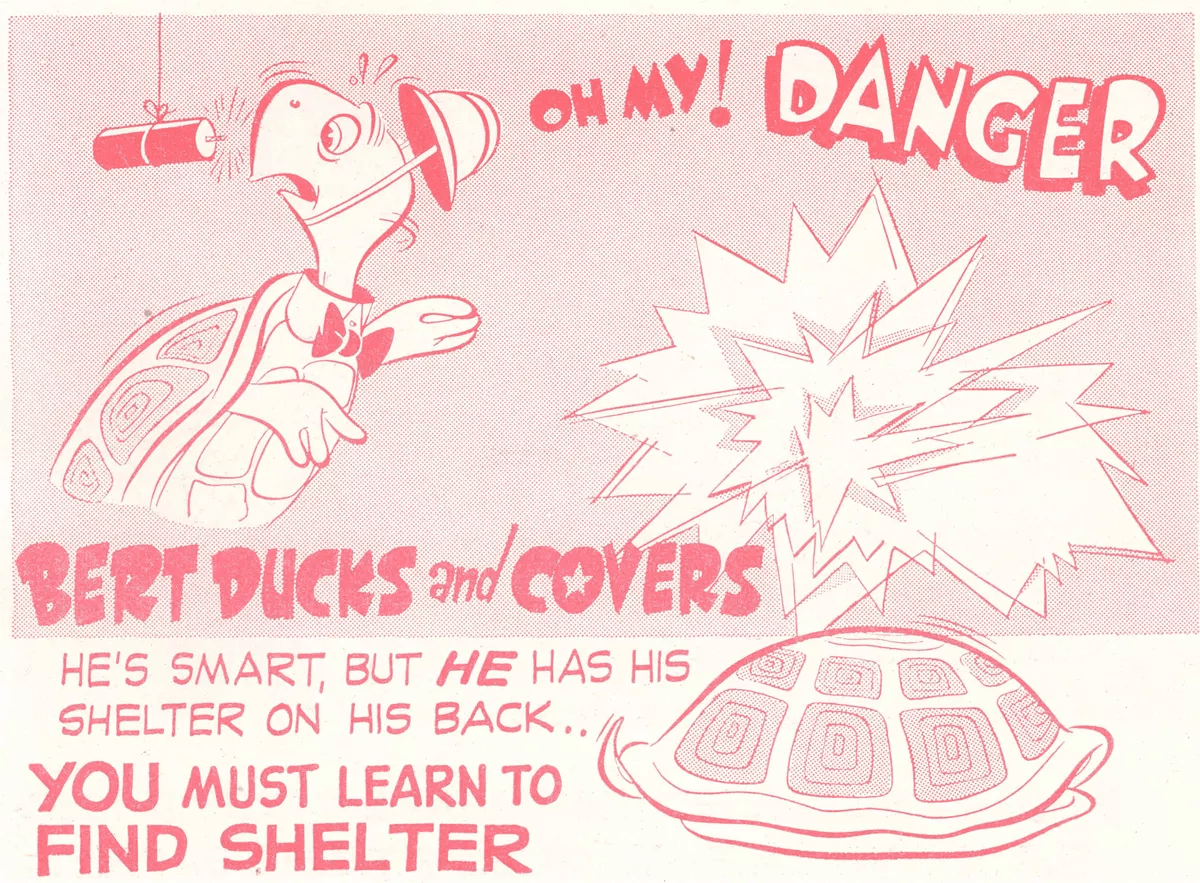
  • Children and teenagers were taught in school that they could survive a nuclear attack through “duck and cover” drills. They were instructed to keep their bathtubs filled with water for safe drinking, in the event of a Soviet nuclear strike.

Bert2.png (300×232)

Bert the Turtle teaches schoolchildren to “Duck and Cover”

Yet even in this poisonous atmosphere of fear and denunciation, some men stood out as heroes–simply by holding fast to their consciences.

One of these was a New York insurance attorney named James B. Donovan (played by Tom Hanks). Asked by the Justice Department to defend arrested Soviet spy Rudolph Abel (Mark Rylance) Donovan did what no one expected.

He gave Abel a truly vigorous defense, arguing that the evidence used to convict him was the legally-tainted product of an invalid search warrant.

Upon Abel’s conviction and sentencing to 45 years’ imprisonment, Donovan again shocked the political and legal communities by appealing the case to the Supreme Court.

Donovan argued that Constitutional protections should apply to everyone–including non-Americans–tried in American courts.  To do less made a mockery of the very freedoms we claimed to champion.

He lost by a vote of 5-4.  But the arguments he made would resurface 50 years later when al-Qaeda suspects were hauled into American courts.

James B. Donovan

In 1961, Donovan was again called upon to render service by a Federal agency–this time the CIA.  It wanted his help in negotiating the release of its spy, Francis Gary Powers, shot down over the Soviet Union in 1960 while flying a high-altitude U-2 spy plane.

Throughout “Bridge of Spies,” audiences learn some unsettling truths about how the American government–and governments generally–actually operate.

The first three of these were outlined in Part one of this series:

Truth #1: Appearance counts for more than reality.

Truth #2: Individual conscience can wreck the best-laid plans of government.

Truth #3: High-ranking government officials will ask citizens to take risks they themselves refuse to take.

Now for the remaining truths revealed in this movie.

Truth #4: Appeals to fear often prevail when appeals to humanity are ignored.

After crossing into East Germany, Donovan enters into negotiations with Wolfgang Vogel, a lawyer representing the East German government.

Vogel offers to exchange Frederic Pryor, an American economics graduate student seized by the East German secret police, for Abel. Donovan replies this is a deal-breaker; the United States (which is never mentioned during the negotiations) wants Powers, not Pryor.

Nevertheless, Donovan is equally concerned for Pryor, and adds him to the list of hostages to be released in return for Abel.

Then a new complication arises: The East German government that holds Pryor threatens to pull out. claiming to be insulted because Donovan did not inform them that the USSR was a party to the negotiation.

His reasoned, legal arguments having failed, Donovan resorts to a threat. He conveys a warning to the president of East Germany:

Abel has not yet revealed any Soviet secrets. But if this deal fails, he may well do so to earn favors from the United States government. And, in that case, the Soviets will blame you–Erich Honecker, the  president of East Germany–for the resulting damage.

Where arguments based on humanity have failed, this one–based on fear–works.  A prisoner-exchange is arranged.

Truth #5: Personal loyalty can supersede bureaucratic inventions.

On February 10, 1962, Donovan, Abel and several CIA agents arrive at the Glienicke Bridge, which connects East and West Germany. The Soviets have Powers, but not Pryor–who is to be released at Checkpoint Charlie, a crossing point between East and West Berlin.

    Glienicke Bridge, the “Bridge of Spies” 

The CIA agent in charge of the American delegation tells Abel he can cross into East Germany, even though Pryor has not been released.

But Abel has learned that Donovan has negotiated the release of not only Powers but Pryor. Out of loyalty to the man who has vigorously defended him, he waits on his side of the bridge until word arrives that Pryor has been released.

Then Abel crosses into East Germany while Powers crosses into the Western sector.

Donovan returns home. Before flying off to West Germany, he had told his wife he was going on a fishing trip in Scotland.

His wife and children learn the truth about the risks he ran and the success he attained only when a television newscast breaks the news:

Francis Gary Powers has been returned to the United States. And the man responsible is James Donovan, once the most reviled man in America for having defended a notorious Soviet spy.

“BRIDGE OF SPIES” TELLS UNPLEASANT TRUTHS ABOUT GOVERNMENT: PART ONE (OF TWO)

In Bureaucracy, History, Law, Military, Politics, Social commentary on October 26, 2015 at 12:27 am

Steven Spielberg’s new movie, “Bridge of Spies,” is that rarity among films: An intelligent mixture of history and drama, stripped of gratuitous sex and violence.

It’s also a film that accurately reveals unsettling truths about how government agencies really operate.

Truth #1: Appearance counts for more than reality.

The movie opens with the FBI’s arrest of KGB spy Rudolph Abel (Mark Rylance). The evidence against him is overwhelming. This–plus the “Red Scare” climate of 1957–will guarantee his conviction.

But the Eisenhower administration doesn’t want the upcoming trial to be seen as a hangman’s court.  It must have at least the appearance of a fair proceeding.

So the Justice Department (through the Brooklyn Bar Association) asks a New York insurance attorney named James B. Donovan (Tom Hanks) to take on Abel’s defense. He’s expected to make a reasonably competent effort but not go all out on behalf of his client.

Truth #2: Individual conscience can wreck the best-laid plans of government.

Donovan has never handled a spy case before. And he has no delusions that Abel isn’t the spy he’s charged with being. But he’s determined to give Abel the same committed defense he would give to any other client.

Rudolph Abel (Mark Rylance) and James Donovan (Tom Hanks) in court

This comes as a shock to the prosecutors, the judge, his law firm and even his family.

A CIA agent approaches Donovan in a nearly deserted restaurant and asks him to reveal any secrets that might help win Abel’s conviction.

Donovan replies: “This conversation isn’t happening.”

“No, of course not,” replies the CIA agent, assuming Donovan is agreeing to keep the overture secret.

“No, I mean this conversation isn’t happening,” angrily says Donovan, who leaves the agent fuming.

Donovan becomes a pariah; his mailbox is stuffed with hate mail and one night a would-be drive-by killer riddles his house with bullets.

Abel is convicted and sentenced to 45 years’ imprisonment. But Donovan–again shocking everyone he knows–pursues an appeal up to the Supreme Court.

He argues that the evidence against Abel is tainted by an invalid search warrant. No American citizen could be convicted under such circumstances; and the Constitutional protections that hold true for Americans should hold equally true for non-Americans charged with crimes in American courts.

Donovan’s arguments will be heard a half-century later, when al-Qaeda suspects are hauled before American courts.

He puts on an impressive case on Abel’s behalf, but loses 5-4 at the Supreme Court.

That seems to be the end of Donovan’s relationship with Abel.  But events soon dictate otherwise.

Before the judge could pronounce a death sentence on Abel, Donovan had argued that this might be a mistake. The day might come, he told the judge, when an American spy might fall into Soviet hands.

And then the United States would need to swap Abel to secure the release of its own agent.

The judge, moved by that argument, had given Abel a lengthy prison term instead.

On May 1, 1960, Francis Gary Powers, a former Air Force pilot, is flying a high-altitude U-2 plane above the Soviet Union for the CIA. The plane is equipped with state-of-the-art cameras, and Powers intends to photograph military sites and other important complexes.

Suddenly, a surface-to-air missile slams into the plane. Powers ejects before it crashes, but fails to commit suicide with a poison pin concealed in a phony silver dollar.  He’s captured by the KGB and brutally interrogated, but maintains his silence.

At about the same time, Frederic Pryor, an American economics graduate student living in West Germany, visits his German girlfriend living in Soviet-dominated East Germany.

The Soviets are starting to build their infamous Berlin Wall, which will stop the flow of refugees from East to West.  Pryor tries to bring his girlfriend and her father into West Berlin, but he’s stopped and arrested by agents of Stasi, the East German police, who accuse him of being a spy.

Meanwhile, the Soviet Union wants its spy, Abel, returned, before he can spell its secrets. In turn, the new Kennedy administration wants Powers returned, before he can be made to spill American secrets.

Truth #3: High-ranking government officials will ask citizens to take risks they themselves refuse to take.

In 1961, Donovan is once again sought out by the American government–this time by no less than CIA Director Allen Dulles.

And he’s asked to go where no official American representative can go–East Germany. His new assignment: Negotiate the exchange of Powers for Abel.

The CIA wants its spy back. And it’s willing to send Donovan into East Germany to negotiate his release. But it’s not willing to back him up if he’s arrested by Stasi, the notorious East German secret police.

In such a case, Donovan could spend the rest of his life in a Communist prison cell.