For countless citizens, the adage proves unfortunately true: If you become a victim of crime, you’re victimized twice—once by the criminal, and again by the criminal justice system.
And this truth proves especially apt in San Francisco.
A friend of mine named Dave [not his real name] who lives in San Francisco, offers the following case:
“On August 7, 2017, I witnessed a brutal assault on a friend of mine named Hal [not his real name]. I was a passenger in his car as he waited for a parking space to open in front of the apartment building where we both live.
“A man—clearly in an agitated state—approached the driver’s side and accused Hal of using the wrong signal. After hearing him out, Hal asked him to back away. Instead, the man quickly began striking Hal in the face at least a half dozen times.”

Dave got out on the passenger’s side and threatened to call police. The assailant returned to his Jeep Cherokee truck, which was parked right behind Hal’s car. Dave re-entered Hal’s car and thought that the worst was over.
Suddenly the Jeep Cherokee slammed into the rear of Hal ‘s car. Then the driver pulled out.
“Hal started his car and followed the Jeep Cherokee to get a photo of its license plate. Using his iPhone, he did. The truck continued a short distance forward, then suddenly reversed and slammed into the front of Hal’s car. The driver then roared off.
“Hal and I then drove to the SFPD’s Central Station, where we both filled out statements and spoke individually with an officer. In addition, Hal provided a photo of the license plate of the vehicle that had rammed him.
“After that, Hal and I waited for a response from the SFPD. We never received one.
In early November, 2017—after waiting three months for a police response—Dave called the SFPD and arranged an appointment with a sergeant at Central Station.
“She showed me a series of photos that seemed to resemble the man who had assaulted Hal. Frankly, I had caught only a brief glimpse of the man when I exited Hal’s car and saw him heading for his Jeep. It certainly didn’t help that, three months later, I was now being asked to give an accurate description of him.
Later, Dave learned that the SFPD had chosen to not pursue criminal charges against the assailant. No reason was given for this decision.
In January, 2018, Dave filed a complaint with the SFPD’s Department of Police Accountability (DPA), formerly known as its Internal Affairs Division.
The investigator he met with was friendly and concerned. Even so, his complaint didn’t lead the SFPD to pursue criminal charges against the assailant. Again, no reason was offered by the agency.
“In November, 2018, I received a Complainant Satisfaction Survey from the SFPD’s Department of Police Accountability. But its Q&A format didn’t let me address the issues I thought important.”
To do so, on November 26, he sent back a memo, offering the following summation:
- A man commits assault and battery on another without the slightest provocation.
- He then uses his Jeep Cherokee to ram the rear of his victim’s car.
- He then uses his Jeep Cherokee to ram the front of his victim’s car.
- These violations of criminal law are reported to the SFPD within an hour of their occurrence.They are reported by not one but two eyewitnesses/victims.
- One of those eyewitnesses provides the SFPD with a photo of the license plate of the car used in the vehicular assaults.
- The SFPD makes no effort to contact either witness/victim in this incident.
- Despite being provided with all this evidence, the SFPD does NOTHING.
And he concluded his indictment:
“I have nothing but contempt for [the SFPD’s] refusal to take even a cursory interest in this case.
“If a friend of mine became the victim of a crime, I would advise him: ‘Don’t waste your time contacting the SFPD. There is simply no reason to set yourself up for a double injury—the first one inflicted by the criminal, and the second one inflicted by the criminally negligent SFPD.'”

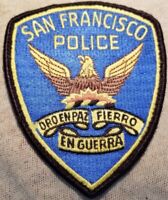
Dllu [CC BY-SA 4.0 (https://creativecommons.org/licenses/by-sa/4.0)%5D, from Wikimedia Commons
To his surprise, Dave received a letter from the DPA, dated December 13, 2018:
“Your Request for an Investigative Hearing in the above-captioned case has been received. We have reviewed the investigative file and have determined that the facts and circumstances supported the DPA’s findings.
“More specifically, we reviewed your letter dated December 5, 2018. The DPA strongly recommends that you call and make an appointment with your investigator in your case at (415) ###-#### to discuss our finding(s).
“We understand that you may not agree with our finding(s), but it may be of some use to contact the investigator for better clarity and understanding in this matter.
“Your Request for Investigative Hearing is therefore denied. Thank you for the time you took to ensure that the DPA understood your concerns. We view this as a positive step in keeping with the goals of the DPA.”
And it was signed by Paul David Henderson, the agency’s executive director.
 Bureaucracybuster's Blog
ABC NEWS, ALTERNET, AMERICABLOG, AP, ASSAULT, BABY BOOMER RESISTANCE, BUZZFEED, CBS NEWS, CNN, CRIME, CROOKS AND LIARS, DAILY KOZ, DEPARTMENT OF POLICE ACCOUNTABILITY, FACEBOOK, FIVETHIRTYEIGHT, LAW ENFORCEMENT, MOTHER JONES, MOVEON, MSNBC, NBC NEWS, NEWSWEEK, NPR, PBS NEWSHOUR, POLITICO, POLITICUSUSA, RAW STORY, REUTERS, SALON, SAN FRANCISCO, SAN FRANCISCO CHRONICLE, SAN FRANCISCO POLICE DEPARTMENT, SEATTLE TIMES, SLATE, TALKING POINTS MEMO, THE ATLANTIC, THE CHICAGO SUN-TIMES, THE CHICAGO TRIBUNE, THE DAILY BEAST, THE DAILY BLOG, THE GUARDIAN, THE HILL, THE HUFFINGTON POST, THE LOS ANGELES TIMES, THE NATION, THE NEW YORK TIMES, THE WASHINGTON POST, THINKPROGRESS, TIME, TRUTHDIG, TWITTER, U.S. NEWS & WORLD REPORT, UPI, USA TODAY
TWICE-RAPED CRIME VICTIMS: PART TWO (END)
In Bureaucracy, History, Law, Law Enforcement, Politics, Social commentary on November 7, 2019 at 12:16 am“On August 7, 2017, I witnessed a brutal assault on a friend of mine named Hal [not his real name]. I was a passenger in his car as he waited for a parking space to open in front of the apartment building where we both live.”
So opened a letter from a man named Dave [not his real name] to the San Francisco Police Department (SFPD).
Summarizing his experience as a witness and assault victim, Dave wrote:
Dave subsequently received a Complainant Satisfaction Survey from the SFPD’s Department of Police Accountability (DPA). After bluntly stating his disgust at the complete indifference of the SFPD to the assault, he got a letter from DPA on December 13, 2018, which stated:
“Your Request for an Investigative Hearing in the above-captioned case has been received. We have reviewed the investigative file and have determined that the facts and circumstances supported the DPA’s findings.”
And: “We understand that you may not agree with our finding(s), but it may be of some use to contact the investigator for better clarity and understanding in this matter.”
In short: We aren’t going to arrest the man who assaulted you, but we’ll try to convince you that it’s all for the best.
Determined to not let the SFPD have the last word, Dave sent back a letter to David Henderson, executive director of DPA.
He noted that he had never requested an investigative hearing. Nor had he written a December 5, 2018 letter to the SFPD, as the letter claimed.
He also noted that, 16 years earlier, on May 19, 2002, the San Francisco Chronicle had published a series of devastating reports on the SFPD. Among the newspaper’s findings:
“Judging from the results of my own experience with your agency, little—if anything—has changed within the SFPD during the last 16 years,” Dave wrote.
Referring to the DPA’s false claim that he had requested an investigative hearing, he ended his letter in cold fury:
“It’s a misdemeanor to file a false report with the police. It should be a felony for a police agency to write and send a letter filled with demonstrably false information.
“It is also the height of arrogance and stupidity to believe you can convince the victim of an assault that the criminal negligence he experienced at the hands of the police department didn’t happen.
“Undoubtedly this letter was written for placement in the official files of your department, as a way to cover itself against any possible legal action. No doubt this is common practice within your agency.
“It is precisely such conduct—as well as the refusal of your agency to aggressively investigate crimes of violence against San Francisco residents—that is guaranteed to produce widespread contempt for and refusal to cooperate with your police department.”
Dave didn’t receive another letter from the SFPD.
* * * * *
Unfortunately, real-life police departments do not operate like the ones depicted in movies and on TV. Among the realities of those departments:
Unless you’re wealthy, a politician or—best of all—a cop, don’t expect the police to protect you if your life is threatened. You’ll simply be told: “We don’t have the resources to protect everybody.”
Above everyone else, police look out for each other. If a citizen murders his lover, he’ll be tracked by two detectives. But whoever kills a cop is sought by the entire department.
Police departments are plagued by the same problems that haunt all major bureaucracies, such as:
The result of all this can only be increased disrespect for law enforcement from a deservedly—and increasingly—cynical public.
When citizens believe police lack the ability-–or even the will-–to protect them or avenge their victimization, that is a deadly blow to law enforcement.
When public support vanishes, so does much of that public funding for hiring more cops and buying necessary equipment.
The result can only be a return to the days of the lawless West, where citizens—as individuals or members of vigilante committees—look only to themselves for protection.
Share this: