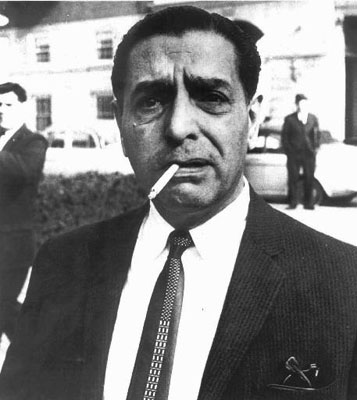
Mafia Hitman Joseph Barboza had become known throughout the New England underworld as “The Animal.”
He relished his new alias and his reputation as a temperamental killer.
Everyone who dealt with Barboza—including Mafia Boss Raymond Patriarca—feared his explosive temper.
Granted an audience with Patriarca, Barboza was transfixed by the capo’s diamond ring. Later, he bragged that he had thought of biting off Patriarca’s finger to get the ring.
“He’s crazy,” Patriarca often told his closest associates. “Someday we’ll have to whack him out.”
Only one other mob gunman could match Barboza’s reputation for deadliness: Steve Hughes, the top triggerman for the McLaughlins.
Barboza spent more than a year trying to eliminate Hughes, until his chance finally came on September 23, 1966.
On that day, Hughes and a loanshark friend, Sammy Lindenbaum, went for a drive along Route 114 in Middleton, Massachusetts.
They paid no attention as another car—carrying Barboza and a crony, Joseph Amico—rapidly closed on them.
With Amico behind the wheel, Barboza aimed a high-powered rifle out the window and dropped Hughes and Lindenbaum in their seats.
Barboza’s moment of supreme triumph was short-lived. His rising notoriety disturbed Patriarca, who believed in taking a low profile and avoiding the antagonism of the press and police.
Patriarca began searching for an excuse to part with his top muscleman. He found it on October 6, 1966, when Boston police arrested Barboza and three companions.
Inside Barboza’s car, police found a loaded .45 automatic and an M-1 carbine. Barboza, then out on bail on a stabbing charge, was shipped off to Walpole State Prison for parole violation.
There he waited vainly for the Patriarca Family to post the $50,000 bond demanded for his release.
Tired of waiting, two of his fellow enforcers decided to lend a hand: Thomas DePrisco and Arthur Bratsos began raiding Patriarca gambling dens to collect the money.
Their fund-raising efforts ended violently one night when their intended victims drew pistols and shot Bratsos and DePrisco to death.
When he learned of the deaths of his friends, Barboza exploded. He damned Patriarca as a “fag” and swore to kill several of the capo’s top associates, whom he blamed for the slayings.
Word of this outburst reached Patriarca, who sent back a threat of his own: Barboza was a dead man, in or out of prison.
Fearing for his own life, Barboza yielded to the proddings of two FBI agents seeking evidence against Patriarca. He agreed to act as a federal witness against his former mob cronies.
In exchange, he demanded protection for himself, his wife and young daughter, and the dropping of his parole and all charges now facing him.
Although Barboza’s terms were stiff, Boston District Attorney Gary Byrne and the prosecutors of the Justice Department felt they were getting the best of the bargain.
They saw in Barboza a dramatic, unprecedented opportunity to strike down a powerful crime cartel.
This, in turn, would enable federal lawmen to recruit new informants and witnesses for additional—and successful—prosecutions..
To achieve these goals, however, the Justice Department had to prove it could protect Barboza against mob reprisals.
As a first step in this process, Byrne released the ex-hitman to the protective custody of the FBI. But the FBI found its budget and manpower strained by the assignment.
Realizing that a combined effort was necessary, the Bureau called in a handpicked security detail of sixteen deputy U.S. marshals.
Heading the detail was Deputy Marshal John Partington, a former agent with the IRS Intelligence Division and a specialist in organized crime.
John Partington (on right)
Equally important, Partington understood the criminal mentality: Not only did Barboza need to be protected, he needed to be kept in a proper state of mind to testify in court.
The marshals transferred Barboza to Thatcher’s Island, an isolated lighthouse station off the coast of Gloucester. Occupied by two houses and approachable only by sea, the island seemed a perfect security spot.
Every two weeks, a new detail of marshals arrived to relieve the sixteen men on duty. Food and supplies were regularly shipped in aboard Coast Guard vessels.
Eventually, the press learned of the security detail on ”Baron’s Island”—so nicknamed because “Baron” had once been a Barboza alias.
The disclosure led to a series of attempts by mob hitmen to eliminate Barboza.
Thatcher’s Island
The first attempt came in September, 1967. Patriarca ordered a 325-pound stock swindler named Vincent Teresa to take a crew of hitman, infiltrate the island and dispose of Barboza.
But the FBI learned of the plot and tipped off the security detail.
When Teresa’s $112,000, forty-three foot yacht, The Living End, cruised around the island, the hitman couldn’t find an unprotected spot to land.
Everywhere they looked they saw deputy U.S. marshals, armed with pistols and carbines, patrolling the beach. Barboza never appeared in sight.
Then a Patriarca assassin, Maurice “Pro” Lerner, thought of making a one-man, commando-style assault on the island. An experienced skindiver, he brought along his own scuba gear for just such an attack.
But he quickly dropped the idea: he estimated the odds of getting a successful shot at Barboza were a million to one.
Copyright@1984 Taking Cover: Inside the Witness Security Program, by Steffen White and Richard St. Germain


.jpg)
 Bureaucracybuster's Blog
9/11, ADOLF HITLER, BOSTON MARATHON BOMBING, CHRISTIANITY, COLUMBIA UNIVERSITY, FACEBOOK, HARVARD UNIVERSITY, IRAN, ISLAM, LEBANON, MUNICH OLYMPICS MASSACRE, POLITICAL CORRECTNESS, RACIAL PROFILING, RELIGION, SAMUEL P. HUNTINGTON, TERRORISM, THE CLASH OF CIVILIZATIONS, THE LOS ANGELES TIMES, THE NEW YORK TIMES, THE SPECTATOR, THE WASHINGTON POST, TWITTER, WINSTON CHURCHILL, WORLD TRADE CENTER
A CHURCHILL FOR OUR TIME: PART TWO (END)
In History, Politics, Social commentary on May 27, 2013 at 6:02 pmDuring the 1930s, Winston Churchill, a seemingly failed politican, repeatedly warned his British countrymen against the growing menace of Nazi Germany.
The leaders of Britain, France and the United States–the three great victors of World War 1–hoped that if they simply ignored the increasingly aggressive behavior of Adolf Hitler, they could somehow escape catastrophe.
Winston Churchill
When, in the early 1930s, Hitler began re-building a powerful German army (Whermacht) in open defiance of the Versallies Treaty that had ended World War 1, Churchill gave warning–and was ignored.
When Hitler ordered his army to occupy his native Austria in 1938, Churchill warned that the Nazis would not be content with the conquest of one nation. And was ignored.
In 1938, Hitler demanded that Czechoslavakia cede the Sudetenland, its northern, southwest and western regions, which were inhabited mostly by ethnic Germans.
Adolf Hitler
When British Prime Minister Nveille Chamberlain surrendered to Hitler’s demands at the infamous “Munich conference,” his fellow Britons were ecstatic. He returned to England as a hero.
Churchill knew better: “Britain and France had to choose between war and dishonor. They chose dishonor. They will have war.”
In March, 1939, the German army occupied the rest of Czechoslovakia.
Hitler next turned his attention to Poland–which he invaded on September 1, unintentionally triggering World War II.
In time, historians and statesmen would regard Munich as an object lesson in the futility—and danger—in appeasing evil and aggression.
It is a lesson that current world leaders have forgotten as Islamic fundamentalists increasingly flex their military and economic muscles–and demand that Western nations bow to their demands.
Winston Churchill’s warnings fell on deaf ears until other world leaders–most notably Franklin Roosevelt and Joseph Stalin–were forced by events to take action.
So did the warnings of Harvard political science professor Samuel P. Huntington.
In 1993, he published an essay in Foreign Affairs called “The Clash of Civilizations?” In this, he argued that the post-Cold War would be marked by civilizational conflict. Among his assertions:
Huntington’s critique of Islamic civilizations ignited a firestorm of controversey–especially his statement: “Islam has bloody borders.”
In 1996, Huntington expanded his thesis into a book–also called The Clash of Civilizations. Once again, he minced no words:
“Some Westerners, including President Bill Clinton, have argued that the West does not have problems with Islam but only with violent Islamist extremists. Fourteen hundred years of history demonstrate otherwise.”
Huntington cited British scholar Barry Buzan as giving several reasons for an inevitable war between the West and Islam:
Much of the fury Muslims were directing toward the West, wrote Huntington, was aimed at its embrace of secularism. Westerners were attacked not for being Christian but “for not adhering to any religion at all.”
Following the 1979 Iranian Revolution, a quasi-war developed between some Islamic nations and some Western ones. On the Islamic side: Iran, Sudan, Iraq, Libya and Syria. On the Western side: The United States and Britain.
“In this quasi war,” wrote Huntington, “each side has capitalized on its own strengths and the other side’s weaknesses.” For example:
Writing at a time before the United States directed its full military power at conquering Afghanistan and Iraq, Huntington ominously noted:
“During the 15 years between 1980 and 1995…the United States engaged in 17 military operations in the Middle East, all of them directed against Muslims. No comparable pattern of U.S. military operations occurred against the people of any other civilization.”
The war that Huntington warned was coming and was, in fact, already in progress, has since erupted into full-scale conflict, with no end in sight.
Share this: