Posts Tagged ‘ANCIENT ROME’
2016 PRESIDENTIAL CAMPAIGN, 2020 PRESIDENTIAL CAMPAIGN, ABC NEWS, ADOLF HITLER, ALTERNET, ANCIENT GREECE, ANCIENT ROME, AP, BERNIE SANDERS, BUZZFEED, CATASTROPHE, CBS NEWS, CHINA, CNN, CONSUMER PROTECTION, CORPORATE TAXES, CORRUPTION, CROOKS AND LIARS, DAILY KOZ, DEMOCRATIC PARTY, DONALD TRUMP, EXECUTIVE PAYWATCH, FACEBOOK, FORBES, FUNDRAISING, HILLARY CLINTON, INCOME INEQUALITY, IVAN THE TERRIBLE, JOE BIDEN, JOSEPH STALIN, LEON TROTSKY, MOTHER JONES, MOVEON, MSNBC, NAZI GERMANY, NBC NEWS, NEWSWEEK, NICCOLO MACHIAVELLI, NPR, PBS NEWSHOUR, POLITICO, RAW STORY, REUTERS, ROBERT PAYNE, SALON, SEATTLE TIMES, SLATE, SPARTACUS, THE ATLANTIC, THE CHICAGO SUN-TIMES, THE CHICAGO TRIBUNE, THE CORRUPT SOCIETY (BOOK), THE DAILY BEAST, THE DISCOURSES, THE FRENCH REVOLUTION, THE GREAT LEVELER (BOOK), THE GUARDIAN, THE HILL, THE HUFFINGTON POST, THE LOS ANGELES TIMES, THE NATION, THE NEW YORK TIMES, THE RUSSIAN REVOLUTION, THE WASHINGTON POST, TIME, TWITTER, U.S. NEWS & WORLD REPORT, UPI, USA TODAY, VIOLENCE, Vladimir Lenin, WALL STREET, WALTER SCHEIDEL, WATERGATE, WEALTH GAP, WILLIAM SHAKESPEARE, WINSTON CHURCHILL
In Bureaucracy, Business, History, Law, Politics, Social commentary on June 25, 2019 at 12:15 am
The gap between rich and poor in the United States has never been greater.
A May 1, 2018 article in Forbes—which bills itself as “The Capitalist Tool”—vividly documents this truth.
“In the 1950s, a typical CEO made 20 times the salary of his or her average worker. Last year, [2017] CEO pay at an S&P 500 Index firm soared to an average of 361 times more than the average rank-and-file worker, or pay of $13,940,000 a year, according to an AFL-CIO’s Executive Paywatch news release today.”
The average CEO pay climbed six percent in 2017—while the average production worker earned just $38,613, according to Executive Paywatch.
The average wage—adjusted for inflation—has stagnated for more than 50 years. Meanwhile, CEOs’ average pay since the 1950s has risen by 1000%.
This would not have been news to Niccolo Machiavelli, the father of modern political science. In his masterwork, The Discourses, he observed the human condition as that of constant struggle:
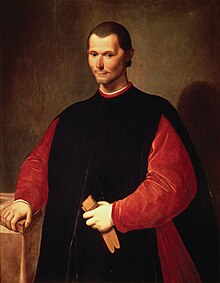
Niccolo Machiavelli
It was a saying of ancient writers, that men afflict themselves in evil, and become weary of the good, and that both these dispositions produce the same effects.
For when men are no longer obliged to fight from necessity, they fight from ambition, which passion is so powerful in the hearts of men that it never leaves them, no matter to what height they may rise.
The reason for this is that nature has created men so that they desire everything, but are unable to attain it. Desire being thus always greater than the faculty of acquiring, discontent with what they have and dissatisfaction with themselves result from it.
This causes the changes in their fortunes—for as some men desire to have more, while others fear to lose what they have, enmities and war are the consequences. And this brings about the ruin of one province and the elevation of another.
Author Walter Scheidel, Dickason Professor in the Humanities, Professor of Classics and History at Stanford University, has also given this subject a great deal of thought. And, like Machiavelli, he has reached some highly disturbing conclusions.

Walter Scheidel
World Economic Forum [CC BY-SA 2.0 (https://creativecommons.org/licenses/by-sa/2.0)%5D
He gave voice to these in his 2017 book, The Great Leveler: Violence and the History of Inequality from the Stone Age to the Twenty-First Century. His thesis: Only violence and catastrophes have consistently reduced inequality throughout history.
According to the book’s jacket blurb: “Are mass violence and catastrophes the only forces that can seriously decrease economic inequality? To judge by thousands of years of history, the answer is yes.
“Tracing the global history of inequality from the Stone Age to today, Walter Scheidel shows that inequality never dies peacefully. Inequality declines when carnage and disaster strike and increases when peace and stability return.
“The Great Leveler is the first book to chart the crucial role of violent shocks in reducing inequality over the full sweep of human history around the world.
“Ever since humans began to farm, herd livestock, and pass on their assets to future generations, economic inequality has been a defining feature of civilization. Over thousands of years, only violent events have significantly lessened inequality.
“The ‘Four Horsemen’ of leveling–mass-mobilization warfare, transformative revolutions, state collapse, and catastrophic plagues—have repeatedly destroyed the fortunes of the rich.
“Scheidel identifies and examines these processes, from the crises of the earliest civilizations to the cataclysmic world wars and communist revolutions of the twentieth century.
“Today, the violence that reduced inequality in the past seems to have diminished, and that is a good thing. But it casts serious doubt on the prospects for a more equal future.”
Revolutionaries have known the truth of Scheidel’s findings from the gladiators’ revolt of Spartacus (73-71 B.C.) to the French Revolution (1789 – 1799) to the overthrow of the Czarist Romanov dynasty (1917).
But American politicians serenely ignore that truth. They depend on the mega-rich for millions of dollars in “campaign contributions”—which pay for self-glorifying ads on TV.
Thus, in 2016, American voters had a “choice” between two “love-the-rich” Presidential candidates: Donald Trump and Hillary Clinton. The result was that millions stayed home or voted in protest for third-party candidates who had no chance of winning.
In his 1975 book, The Corrupt Society: From Ancient Greece to Modern-day America, British historian Robert Payne warned that the predatory rich would not change their behavior: “Nor is there any likelihood that the rich will plow back their money into services to ensure the general good.
“They have rarely demonstrated social responsibility, and they are much more likely to hold on to their wealth at all costs than to renounce any part of it.
“Like the tyrant who lives in a world wholly remote from the world of the people, shielded and protected from all possible influences, the rich are usually the last to observe the social pressures rising from below, and when these social pressures reach flashpoint, it is too late to call in the police or the army.
“The tyrant dies; the police and the army go over to the revolutionaries; and the new government dispossesses the rich by decree. A single authoritative sentence suffices to expunge all private wealth and restore it to the service of the nation.”
2020 PRESIDENTIAL CAMPAIGN, ABC NEWS, ADOLF HITLER, ALTERNET, ANCIENT GREECE, ANCIENT ROME, AP, BERNIE SANDERS, BUZZFEED, CBS NEWS, CHINA, CNN, CONSUMER PROTECTION, CORPORATE TAXES, CORRUPTION, CROOKS AND LIARS, DAILY KOZ, DEMOCRATIC PARTY, FACEBOOK, FUNDRAISING, INCOME INEQUALITY, IVAN THE TERRIBLE, JOE BIDEN, JOSEPH STALIN, LEON TROTSKY, MOTHER JONES, MOVEON, MSNBC, NAZI GERMANY, NBC NEWS, NEWSWEEK, NICCOLO MACHIAVELLI, NPR, PBS NEWSHOUR, POLITICO, RAW STORY, REUTERS, ROBERT PAYNE, SALON, SEATTLE TIMES, SLATE, THE ATLANTIC, THE CHICAGO SUN-TIMES, THE CHICAGO TRIBUNE, THE DAILY BEAST, THE DISCOURSES, THE GREAT LEVELER, THE GUARDIAN, THE HILL, THE HUFFINGTON POST, THE LOS ANGELES TIMES, THE NATION, THE NEW YORK TIMES, THE WASHINGTON POST, TIME, TWITTER, U.S. NEWS & WORLD REPORT, UPI, USA TODAY, Vladimir Lenin, WALL STREET, WALTER SCHEIDEL, WATERGATE, WEALTH GAP, WILLIAM SHAKESPEARE, WINSTON CHURCHILL
In Bureaucracy, Business, History, Law, Politics, Social commentary on June 24, 2019 at 1:21 am
Americans are used to Presidential candidates telling lies (euphemistically known as “campaign promises”) to get elected.
But when a candidate actually (and usually accidentally) tells the truth, the results can be electrifying. A pointed example:
On June 18, Democratic Presidential candidate (and momentary front-runner) Joe Biden addressed a roomful of donors in New York. Money is, after all, the lifeblood of all political campaigns, and Biden wanted to guarantee he got more of it than any of his 23 Democratic rivals.
So the former vice president had a message he felt sure would appeal to his well-heeled audience of billionaires: Don’t worry, if I’m elected, your standard of living won’t change.
Addressing the 100 or so guests at a fundraiser at the Carlyle Hotel in New York City, Biden said that he had taken heat from “some of the people on my team, on the Democratic side” because he had said that rich people were “just as patriotic as poor people.

Joe Biden
“The truth of the matter is, you all, you all know, you all know in your gut what has to be done. We can disagree in the margins but the truth of the matter is it’s all within our wheelhouse and nobody has to be punished. No one’s standard of living will change, nothing would fundamentally change,” he said.
And he added: “I mean, we may not want to demonize anybody who has made money.
“When we have income inequality as large as we have in the United States today, it brews and ferments political discord and basic revolution. Not a joke. Not a joke … It allows demagogues to step in and say the reason where we are is because of the ‘other’….
“You’re not the other. I need you very badly. I hope if I win this nomination, I won’t let you down. I promise you. I have a bad reputation, I always say what I mean. The problem is I sometimes say all that I mean.”
Biden has talked about decreasing income inequality and promoting workers’ rights. But he’s taken a moderate stance when it comes to taxation.
Vermont United States Senator Bernie Sanders, on the other hand, has attacked the ultra-rich as responsible for the ever-widening gap between themselves and the poor.
“I love Bernie, but I’m not Bernie Sanders. I don’t think 500 billionaires are the reason why we’re in trouble,” Biden said in March.
Instead, he proposes expanding tax credits for the poor and middle class, and making the tax code less friendly to rich investors.
Robert Payne, the distinguished British historian, had a different—and darker—view of the rich.
Payne authored more than 110 books. Among his subjects were Adolf Hitler, Ivan the Terrible, Winston Churchill, Joseph Stalin, Vladimir Lenin, William Shakespeare and Leon Trotsky.
In 1975, he published The Corrupt Society: From Ancient Greece to Present-Day America. It proved a summary of many of his previous works.
Among the epochs it covered were the civilizations of ancient Greece, Rome and China; Nazi Germany; the Soviet Union; and Watergate-era America. And the massive corruption each of those epochs had spawned.
In his chapter, “A View of the Uncorrupted Society,” Payne warned: Power and wealth are the main sources of corruption.
“The rich, simply by being rich, are infected with corruption. Their overwhelming desire is to grow richer, but they can do this only at the expense of those who are poorer than themselves.
”Their interests conflict with those of the overall society. They live sheltered from the constant anxieties of the poor, and thus cannot understand them. Nor do they try to.
They see the poor as alien from themselves, and thus come to fear and despise them. And their wealth and influence enables them to buy politicians—who, in turn, write legislation that protects the rich from the poor.
But Payne foresaw an even greater danger from the rich and powerful than their mere isolation from the rest of society: “The mere presence of the rich is corrupting. Their habits, their moral codes, their delight in conspicuous consumption are permanent affronts to the rest of humanity. Vast inequalities of wealth are intolerable in any decent society.”
Writing in 1975, Payne noted that a third of the private wealth was possessed by less than five percent of the population—while about a fifth of the populace lived at the poverty level. By 2000, he predicted, about five percent of the population would possess two-thirds of America’s wealth. And more than half the population would be near or below the starvation level.
The result could only be catastrophe. The only way to halt this this increasing concentration of wealth by fewer people would be through law or violent revolution.
Payne has proven to be an uncanny prophet.
On December 8, 2017, the Seattle Times noted that the wealthiest one percent of Americans owned 40% of the country’s wealth. They owned more wealth than the bottom 90% combined.
From 2013, the share of wealth owned by the one percent increased by nearly three percentage points. Wealth owned by the bottom 90%, meanwhile, fell over the same period.
But this situation need not remain permanent.
2016 PRESIDENTIAL CAMPAIGN, ABC NEWS, ADOLF HITLER, ALTERNET, ANCIENT ROME, ANTONIN SCALIA, AP, BUZZFEED, CAMPAIGN CONTRIBUTIONS, CBS NEWS, CITIZENS UNITED, CLEOPATRA, CNN, CROOKS AND LIARS, DAILY KOZ, DONALD TRUMP, FACEBOOK, FORECLOSURES, GLADIATORS, JULIUS CAESAR, KIRK DOUGLAS, LAURENCE OLIVER, MARCUS CRASSUS, MEIN KAMPF, MITT ROMNEY, MOTHER JONES, MOVEON, NBC NEWS, NEWSWEEK, NEWT GINGRICH, NPR, POLITICO, RAW STORY, REUTERS, SALON, SEATTLE TIMES, SHELDON ADELSON, SLATE, SPARTACUS, SUPREME COURT, THE ATLANTIC, THE CHICAGO SUN-TIMES, THE CHICAGO TRIBUNE, THE DAILY BEAST, THE GUARDIAN, THE HILL, THE HUFFINGTON POST, THE LOS ANGELES TIMES, THE NATION, THE NEW YORK TIMES, THE WASHINGTON POST, TIME, TWITTER, U.S. NEWS & WORLD REPORT, UPI, USA TODAY
In Bureaucracy, History, Law, Military, Politics, Social commentary on November 17, 2017 at 12:07 am
The 1960 Kirk Douglas epic, Spartacus, may soon prove to be more than great entertainment. It may also turn out to be a prophecy of the end of the American Republic.
In the movie, Spartacus (Douglas), a Roman slave, entertains Marcus Crassus (Laurence Oliver) the richest man in Rome. He does so by fighting to the death as a gladiator.

Poster for Spartacus
While Spartacus and his fellow gladiator/friend, Draba, slash and stab at each other in the arena, Crassus idly chats with his crony, Marcus Glabrus.
Crassus has just secured Glabrus’ appointment as commander of the garrison of Rome. Glabrus is grateful, but curious as to how he did it.
After all, Gaius Gracchus, the leader of the Roman Senate, hates Crassus, and stands ever ready to oppose his every move.
“I fought fire with oil,” says Crassus. “I purchased the Senate behind his back.”
Draba defeats Spartacus in their gladiatorial bout, but refuses to kill him. Instead, he throws his spear at Crassus—and is immediately slaughtered by Roman guards.
Soon afterward, Spartacus leads 70 other gladiators against their Roman masters, forms an army of freed slaves, and marches against Rome.
Just as Crassus bought the Roman Senate in Spartacus, billionaires similarly bought the 2016 Presidential election.
In 2016, Newt Gingrich, former Speaker of the House of Representatives, ran as the pet candidate of casino billionaire Sheldon G. Adelson. Since 2007, Adelson had spent millions in support of Gingrich and his causes.
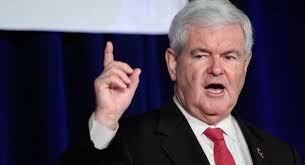
Newt Gingrich
Adelson put up seed money and, ultimately, $7.7 million between 2006 and 2010 for a nonprofit group that served as a precursor to Gingrich’s presidential campaign.
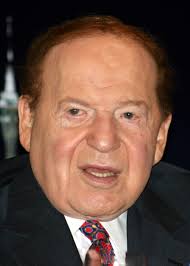
Sheldon Adelson
Such a contribution is no small amount to the average American. But Adelson is listed by Forbes as the eighth-wealthiest American, with a net worth of $21.5 billion.
Naturally, Adelson denied he had any selfish motives for shelling out so much money to a candidate for the most powerful office in the world:
“My motivation for helping Newt is simple and should not be mistaken for anything other than the fact that my wife Miriam and I hold our friendship with him very dear and are doing what we can as private citizens to support his candidacy.”
Unfortunately, Gingrich was not the only candidate of the rich, by the rich and for the rich seeking the Presidency.
Former Massachusetts Governor Mitt Romney relied heavily on a small group of millionaires and billionaires for support.
By February, 2012, a quarter of the money amassed by Romney’s campaign came from just 41 people. Each contributor gave more than $100,000, according to a Washington Post analysis of disclosure data. Nearly a dozen of the donors had contributed $1 million or more.
Some of Romney’s biggest supporters included executives at Bain Capital, his former firm; bankers at Goldman Sachs; and a hedge fund mogul who made billions betting on the housing crash.
Like Adelson, Bain has directly profited from the losses of others.
Fast forward to 2016:
In early May, Adelson met privately with Republican Presidential nominee-in-waiting Donald Trump. Nevertheless, at least this much has leaked:
Adelson promised to contribute more to secure Trump’s election than he had contributed to any previous campaign—up to and exceeding $100 million.
Meanwhile, Trump bragged that he was “not beholden” to any “special interests” because “I’m really rich.” This myth proved a main reason for his popularity as a candidate.

Donald Trump
All of this can be directly traced to the 2010 “Citizens United” decision by the U.S. Supreme Court that ended limits in corporate contributions to political campaigns. The decision is so named for the group that successfully sued over federal campaign finance laws.
The 5-4 decision led to the rise of Super PACs—outside groups affiliated with candidates that can take in unlimited contributions as long as they don’t directly coordinate with the candidate. The overwhelming majority of this money goes for negative ads—that slander opponents without saying anything about what a candidate proposes to do.
Former U.S. Supreme Court Justice Antonin Scalia brushed aside criticism of the corrupting role money played in politics: Change the channel or turn off the TV.
“I don’t care who is doing the speech—the more the merrier,” Scalia said. “People are not stupid. If they don’t like it, they’ll shut it off.”
On the contrary: A fundamental principle of propaganda holds that most people are stupid—or can be made to behave stupidly. If they are ceaselessly bombarded with mind-numbing lies, they will eventually substitute these for reality.
In Mein Kampf, Adolf Hitler laid out his formula for successful propaganda: “All effective propaganda must be confined to a few bare essentials.
“These must be expressed as far as possible in stereotypical formulas. These slogans should be persistently repeated until the very last individual has come to grasp the idea that has been put forward.”
During the early 1960s a series of movies about the Roman Empire—like Spartacus and Cleopatra—hit the big screen. In these, rich criminals like Marcus Crassus openly bought the favors of ambitious politicians like Julius Caesar.
No doubt millions of moviegoers thought, “Boy, I’m glad that couldn’t happen here.”
But it has happened here—and it’s happening right now.
2016 PRESIDENTIAL CAMPAIGN, ABC NEWS, ADOLF HITLER, ANCIENT ROME, ANTONIN SCALIA, CAMPAIGN CONTRIBUTIONS, CBS NEWS, CITIZENS UNITED, CLEOPATRA, CNN, DONALD TRUMP, FACEBOOK, FORECLOSURES, GLADIATORS, JULIUS CAESAR, KIRK DOUGLAS, LAURENCE OLIVER, MARCUS CRASSUS, MEIN KAMPF, MITT ROMNEY, NBC NEWS, NEWT GINGRICH, SHELDON ADELSON, SPARTACUS, SUPREME COURT, THE CHICAGO SUN-TIMES, THE CHICAGO TRIBUNE, THE LOS ANGELES TIMES, THE NEW YORK TIMES, THE WASHINGTON POST, TWITTER
In Bureaucracy, Business, History, Law, Politics, Social commentary on May 24, 2016 at 12:56 am
The 1960 Kirk Douglas epic, Spartacus, may soon prove to be more than great entertainment. It may also turn out to be a prophecy of the end of the American Republic.
In the movie, Spartacus (Douglas), a Roman slave, entertains Marcus Crassus (Laurence Oliver) the richest man in Rome. He does so by fighting to the death as a gladiator.
Poster for Spartacus
While Spartacus and his fellow gladiator/friend, Draba, slash and stab at each other in the arena, Crassus idly chats with his crony, Marcus Glabrus.
Crassus has just secured Glabrus’ appointment as commander of the garrison of Rome. Glabrus is grateful, but curious as to how he did it.
After all, Gaius Gracchus, the leader of the Roman Senate, hates Crassus, and stands ever ready to oppose his every move.
“I fought fire with oil,” says Crassus. “I purchased the Senate behind his back.”
Draba defeats Spartacus in their gladiatorial bout, but refuses to kill him. Instead, he throws his spear at Crassus and is immediately slaughtered by Roman guards.
Soon afterward, Spartacus leads 70 other gladiators against their Roman masters, forms an army of freed slaves, and marches against Rome.
Just as Crassus bought the Roman Senate in Spartacus, so, too, are billionaires now buying the 2016 Presidential election.
In 2016, Newt Gingrich, former Speaker of the House of Representatives, ran as the pet candidate of casino billionaire Sheldon G. Adelson. Since 2007, Adelson had spent millions in support of Gingrich and his causes.
Newt Gingrich
Adelson put up seed money and, ultimately, $7.7 million between 2006 and 2010 for a nonprofit group that served as a precursor to Gingrich’s presidential campaign.
Sheldon Adelson
Such a contribution is no small amount to the average American. But Adelson is listed by Forbes as the eighth-wealthiest American, with a net worth of $21.5 billion.
Naturally, Adelson denied he had any selfish motives for shelling out so much money to a candidate for the most powerful office in the world:
“My motivation for helping Newt is simple and should not be mistaken for anything other than the fact that my wife Miriam and I hold our friendship with him very dear and are doing what we can as private citizens to support his candidacy.”
Unfortunately, Gingrich was not the only candidate of the rich, by the rich and for the rich seeking the Presidency.
Former Massachusetts Governor Mitt Romney relied heavily on a small group of millionaires and billionaires for support.
By February, 2012, a quarter of the money amassed by Romney’s campaign came from just 41 people. Each contributor gave more than $100,000, according to a Washington Post analysis of disclosure data. Nearly a dozen of the donors had contributed $1 million or more.
Some of Romney’s biggest supporters included executives at Bain Capital, his former firm; bankers at Goldman Sachs; and a hedge fund mogul who made billions betting on the housing crash.
Like Adelson, Bain has directly profited from the losses of others.
Fast forward to 2016:
In early May, Adelson met privately with Republican Presidential nominee-in-waiting Donald Trump. Nevertheless, at least this much has leaked:
Adelson promised to contribute more to secure Trump’s election than he had contributed to any previous campaign. This could exceed $100 million.
Meanwhile, Trump is bragging that he’s “not beholden” to any “special interests” because “I’m really rich.” This myth has been a main reason for his popularity as a candidate.

Donald Trump
All of this can be directly traced to the 2010 “Citizens United” decision by the U.S. Supreme Court that ended limits in corporate contributions to political campaigns. The decision is so named for the group that successfully sued over federal campaign finance laws.
The 5-4 decision led to the rise of Super PACs–outside groups affiliated with candidates that can take in unlimited contributions as long as they don’t directly coordinate with the candidate. The overwhelming majority of this money goes for negative ads–that slander opponents without saying anything about what a candidate proposes to do.
Former U.S. Supreme Court Justice Antonin Scalia brushed aside criticism of the corrupting role money played in politics: Change the channel or turn off the TV.
“I don’t care who is doing the speech–the more the merrier,” Scalia said. “People are not stupid. If they don’t like it, they’ll shut it off.”
On the contrary: A fundamental principle of propaganda holds that most people are stupid–or can be made to behave stupidly. If they are ceaselessly bombarded with mind-numbing lies, they will eventually substitute these for reality.
In Mein Kampf, Adolf Hitler laid out his formula for successful propaganda: “All effective propaganda must be confined to a few bare essentials.
“These must be expressed as far as possible in stereotypical formulas. These slogans should be persistently repeated until the very last individual has come to grasp the idea that has been put forward.”
During the early 1960s a series of movies about the Roman Empire–like Spartacus and Cleopatra–hit the big screen. In these, rich criminals like Marcus Crassus openly bought the favors of ambitious politicians like Julius Caesar.
No doubt millions of moviegoers thought, “Boy, I’m glad that couldn’t happen here.” But it has happened here–and it’s happening right now.
ABC NEWS, ADOLF HITLER, ANCIENT ROME, CBS NEWS, CNN, ISLAMIC STATE OF IRAQ AND SYRIA, JORDAN, JOSEPH STALIN, KATYN FOREST MASSACRE, KGB, N.K.V.D., NAZI GERMANY, NBC NEWS, NICCOLO MACHIAVELLI, SOVIET UNION, THE CHICAGO SUN-TIMES, THE CHICAGO TRIBUNE, THE DISCOURSES, THE LOS ANGELES TIMES, THE NEW YORK TIMES, THE WASHINGTON POST, USA TODAY, WAR CRIMES, WORLD WAR ii
In History, Military, Politics on February 17, 2015 at 6:30 pm
The Islamic State of Iraq and Syria (ISIS) has been in the news a great deal lately–and for reasons most organizations try to avoid. Or at least cover up. It has been designated as a terrorist organization by
- Russia
- the United States
- Canada
- the European Union
- Australia
- Turkey
- the United Nations
- Indonesia
- the United Kingdom
- Saudi Arabia
- the United Arab Emerites
- Egypt
- India and
- Malaysia
It been condemned by such well-known human rights organizations as Amnesty International. And a major reason for this is the evidence of its brutalities that ISIS has proudly supplied. Among this evidence are its own Internet videos of
- the beheadings of soldiers, civilians, journalists, and aid workers;
- the burning of a captured Jordanian fighter pilot;
- demands for extortionate ransoms for kidnapped Japanese and American captives;
- the wholesale shooting of captured Iraqi soldiers; and
- the selling of captured children.
The release on February 3 of a video showing the barbaric “execution” of a captured Jordanian fighter pilot, Lt. Muath al-Kasaesbeh, underscored ISIS reputation for cruelty
Al Kasaesbeh, locked in a steel cage like an animal, could only watch stoically as an ISIS member ignited a trail of flammable liquid leading directly to him. The pilot stood upright throughout the ordeal until the flames at last consumed him.
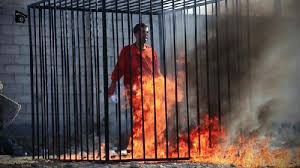
ISIS burning of captured Jordanian fighter pilot Muath al-Kasaesbeh
Terrorism experts believe that the elaborately-staged video was meant to weaken the morale of Jordan and other Sunni Arab members of the U.S.-led coalition against ISIS.
But it violated a fundamental rule of public relations: If you commit atrocities, do it secretly so you can deny it if the truth ever comes out.
That’s how the members of Soviet dictator Joseph Stalin’s dreaded secret police–the N.K.V.D.–the predecsssors to the later-named KGB–operated throughout their brutal history.
In 1939, when the Soviet Union seized the eastern half of Poland, the N.K.V.D. executed 22,000 Polish army officers in the dense Katyn forest.
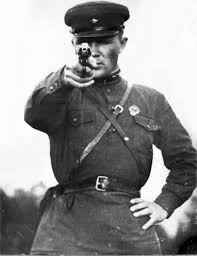
N.K.V.D. executioner
The government of Nazi Germany announced the discovery of mass graves in the forest in 1943. The Soviet Union furiously denied responsibility, claiming the victims had been executed by the Germans.
The Soviets continued to deny responsibility for the massacres until 1990, when the government finally admitted its guilt.
ISIS has turned out videos of its brutalities which film experts have declared are almost up to the quality of Hollywood spectaculars. But ISIS leaders have apparently forgotten–if they ever knew–the truth of the saying: “You can make a throne of bayonets, but you can’t sit on it.”
Niccolo Machiavelli, in his classic work, The Discourses, offered a telling example of how magnanimity can triumph over brutality.
Camillus was besieging the city of the Faliscians, and had surrounded it….A teacher charged with the education of the children of some of the noblest families of that city [to ingratiate himself] with Camillus and the Romans, led these children…into the Roman camp.
And presenting them to Camillus [the teacher] said to him, “By means of these children as hostages, you will be able to compel the city to surrender.”
Camillus not only declined the offer but had the teacher stripped and his hands tied behind his back….[Then Camillus] had a rod put into the hands of each of the children…[and] directed them to whip [the teacher] all the way back to the city.
Upon learning this fact, the citizens of Faliscia were so much touched by the humanity and integrity of Camillus, that they surrendered the place to him without any further defense.
This example shows that an act of humanity and benevolence will at all times have more influence over the minds of men than violence and ferocity. It also proves that provinces and cities which no armies…could conquer, have yielded to an act of humanity, benevolence, chastity or generosity.
What Machiavelli doesn’t say–but what history offers plenty of examples to substantiate–is this: The brutality of aggressors will be met–and sometimes overcome–with brutality by their past or intended victims.
Nowhere was this better proved than during the German invasion of the Soviet Union.
Without warning, three million German soldiers–backed up by overwhelming air and tank support–attacked their “ally” on June 22, 1941.
The Wehrmacht blitzed its way across Russia–to the gates of Moscow and as far south as Stalingrad on the Volga River. In its path it left devastated cities and at least 20 million dead Russians.
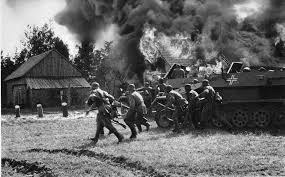
German soldiers moving into a burning Russian village
Russian women were gang-raped, then shot, or blown up with hand grenades. Tens of thousands of captured Russian soldiers were allowed to die of hunger, sickness and freezing cold behind barbed wire. Other captured POWs were brutally beaten, tortured and/or shot.
But then the tide of war turned and the Russians launched their own offensives in 1943. And they kept going–all the way to Berlin.
Russians raped tens of thousands of German women–and nailed others to barn doors. Cossacks cut off the raised hands of Germans trying to surrender. Tanks crushed retreating German soldiers and civilians unlucky enough to be in their path.
Thus do those who practice barbarism often find themselves being repaid with it–usually ten-fold.
ABC NEWS, ANCIENT ROME, BILL O'REILLY, CARLOS THE JACKAL, CBS NEWS, CIA, CNN, DEFENSE INTELLIGENCE AGENCY, DIPLOMATIC ASYLUM, EDWARD SNOWDEN, FACEBOOK, FOX NEWS CHANNEL, MERCENARIES, NATIONAL SECURITY AGENCY, NBC NEWS, NICCOLO MACHIAVELLI, OUTSOURCING CONTRACTORS, SPYING, THE LOS ANGELES TIMES, THE NEW YORK TIMES, THE O'REILLY FACTOR, THE WASHINGTON POST, THE WAY OF THE KNIFE, TWITTER
In Bureaucracy, Business, History, Military, Politics, Social commentary on October 2, 2014 at 12:19 pm
Bill O’Reilly, host of the Fox News Channel program The O’Reilly Factor, has offered his own solution to fighting terrorism: A multi-national mercenary army, based on a NATO coalition and trained by the United States.
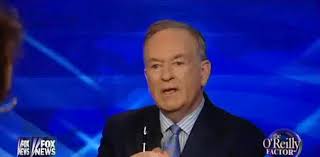
Bill O’Reilly
“We would select them, special forces would train them–25,000-man force to be deployed to fight on the ground against worldwide terrorism. Not just ISIS,” O’Reilly said on “CBS This Morning” on September 24.
Searching for allies to back his proposal, O’Reilly invited Tom Nichols, a professor at the US Naval War College, onto his show.
Nichols’ response: “This is a terrible idea…not just as a practical matter but a moral matter. It’s a morally corrosive idea to try to outsource our national security. This is something Americans are going to have to deal for themselves.”
Actually, O’Reilly’s idea is in fact being tried out, albeit unofficially.
Sixty to 70% of America’s Intelligence budget doesn’t go to the CIA or the National Security Agency (NSA) or the Defense Intelligence Agency (DIA).
Instead, it goes to private contractors who supply secrets or “soldiers of fortune.”
The outsourcing of government intelligence work to private contractors took off after 9/11.
This was especially true after the United States invaded Iraq in 2003–and found its Intelligence and armed services stretched to their furtherest limits.
The DIA estimates that, from the mid-1990s to 2005, the number of private contracts awarded by Intelligence agencies rose by 38%.
During that same period, government spending on “spies/guns for hire” doubled, from about $18 billion in 1995 to about $42 billion in 2005.
Many tasks and services once performed only by government employees are being “outsourced” to civilian contractors:
- Analyzing Intelligence collected by drones and satellites;
- Writing reports;
- Creating and maintaining software programs to manipulate data for tracking terrorist suspects;
- Staffing overseas CIA stations;
- Serving as bodyguards to government officials stationed overseas;
- Providing disguises used by agents working undercover.
More than 500 years ago, Niccolo Machiavelli warned of the dangers of relying on mercenaries:
“Mercenaries…are useless and dangerous. And if a prince holds on to his state by means of mercenary armies, he will never be stable or secure; for they are disunited, ambitious, without discipline, disloyal; they are brave among friends; among enemies they are cowards.
“They have neither the fear of God nor fidelity to men, and destruction is deferred only so long as the attack is. For in peace one is robbed by them, and in war by the enemy.”
Americans–generally disdainful of history–have blatantly ignored both the examples of history and the counsel of Machiavelli. To their own peril.
Mark Mazzetti, author of the bestselling The Way of the Knife, chronicles how the CIA has been transformed from a primarily fact-finding agency into a terrorist-killing one.

Along with this transformation has come a dangerous dependency on private contractors to supply information that government agents used to dig up for themselves.
The U.S. Navy SEALS raid that killed Osama bin Laden has been the subject of books, documentaries and even an Oscar-nominated movie: “Zero Dark Thirty.”
Almost unknown by comparison is a program the CIA developed with Blackwater, a private security company, to locate and assassinate Islamic terrorists.
“We were building a unilateral, unattributable capability,” Erik Prince, CEO of Blackwater, said in an interview. “If it went bad, we weren’t expecting the [CIA] chief of station, the ambassador or anyone to bail us out.”
But the program never got past the planning stage. Senior CIA officials feared the agency would not be able to permanently hide its own role in the effort.
“The more you outsource an operation,” said a CIA official, “the more deniable it becomes. But you’re also giving up control of the operation. And if that guy screws up, it’s still your fault.”
Increased reliance on “outsourcing” has created a “brain-drain” within the Intelligence community. Jobs with private security companies usually pay 50% more than government jobs.
Many employees at the CIA, NSA and other Intelligence agencies leave government service–and then return to it as private contractors earning far higher salaries.
Many within the Intelligence community fear that too much Intelligence work has been outsourced and the government has effectively lost control of its own information channels.
And, as always with the hiring of mercenaries, there is an even more basic fear: How fully can they be trusted?
“There’s an inevitable tension as to where the contractor’s loyalties lie,” said Jeffrey Smith, a former general counsel for the CIA. “Do they lie with the flag? Or do they lie with the bottom line?”
Yet another concern: How much can Intelligence agencies count on private contractors to effectively screen the people they hire?
Edward Snowden was an employee of Booz Allen Hamilton, a consulting/security firm. It was through this company that Snowden gained access to a treasury of NSA secrets.
From September 11, 2001 to 2013, the government has spent more than $500 billion on intelligence.
A 2010 investigative series by the Washington Post found that “1,931 private companies work on programs related to counterterrorism, homeland security and intelligence in about 10,000 locations across the country.”
Jesus never served as a spy or soldier. But he clearly understood a truth too many officials within the American Intelligence community have forgotten:
“For where your treasure is, there will your heart be also.”
ABC NEWS, ANCIENT ROME, CARLOS THE JACKAL, CBS NEWS, CIA, CNN, DEFENSE INTELLIGENCE AGENCY, DIPLOMATIC ASYLUM, EDWARD SNOWDEN, FACEBOOK, JOHN WAYNE, LAURENCE OLIVER, MERCENARIES, NATIONAL SECURITY AGENCY, NBC NEWS, NICCOLO MACHIAVELLI, OUTSOURCING CONTRACTORS, PAULA DEEN, SPARTACUS, SPYING, STAR TREK, SUDAN, THE GREEN BERETS, THE LOS ANGELES TIMES, THE NEW YORK TIMES, THE WASHINGTON POST, THE WAY OF THE KNIFE, TWITTER
In Bureaucracy, Business, History, Military, Politics, Social commentary on May 15, 2014 at 12:33 am
The 1960 Kirk Douglas epic, Spartacus, may soon prove to be more than great entertainment. It may also turn out to be a prophecy of the end of the American Republic.
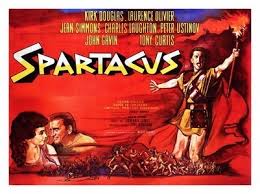
Throughout the movie, wealthy Romans assume they can buy anything–or anyone. When seeking a favor, Marcus Licinius Crassus (Laurence Oliver) says bluntly: “Name your price.”
Today, “Name your price” has become the password for entry into America’s Intelligence community.
Althugh not portrayed in Spartacus, one of the reasons for the fall of the Roman empire lay in its reliance on foreign mercenaries.
Roman citizens, who had for centuries manned their city’s legions, decided to outsource these hardships and dangers to hired soldiers from Germany and Gaul (now France).
Although Germans and Gauls had proven capable fighters when defending their own countries, they proved highly unrelible as paid mercenaries.
Niccolo Machiavelli, the father of political science, drew heavily on ancient history for his examples of how liberty could best be preserved within a republic.
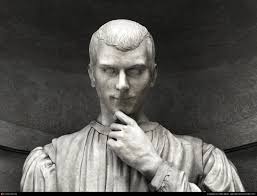
Niccolo Machiavelli
Fully aware of the Romans’ disastrous experience with mercenaries, Machiavelli believed that a nation’s army should be driven by patriotism, not greed. Speaking of mercenaries, he warned:
“Mercenaries…are useless and dangerous. And if a prince holds on to his state by means of mercenary armies, he will never be stable or secure; for they are disunited, ambitious, without discipline, disloyal; they are brave among friends, among enemies they are cowards.”
Americans–generally disdainful of history–have blatantly ignored both the examples of history and the counsel of Machiavelli. To their own peril.
Mark Mazzetti, author of the bestselling The Way of the Knife, chronicles how the CIA has been transformed from a primarily fact-finding agency into a terrorist-killing one.
Along with this transformation has come a dangerous dependency on private contractors to supply information that government agents used to dig up for themselves.
America’s defense and Intelligence industries, writes Mazzetti, once spread across the country, have relocated to the Washington area.
They want to be close to “the customer”: The National Security Agency, the Pentagon, the CIA and an array of other Intelligence agencies.
The U.S. Navy SEALS raid that killed Osama bin Laden has been the subject of books, documentaries and even an Oscar-nominated movie: “Zero Dark Thirty.”
Almost unknown by comparison is a program the CIA developed with Blackwater, a private security company, to locate and assassinate Islamic terrorists.
“We were building a unilateral, unattributable capability,” Erik Prince, CEO of Blackwater, said in an interview. “If it went bad, we weren’t expecting the [CIA] chief of station, the ambassador or anyone to bail us out.”
But the program never got past the planning stage. Senior CIA officials feared the agency would not be able to permanently hide its own role in the effort.
“The more you outsource an operation,” said a CIA official, “the more deniable it becomes. But you’re also giving up control of the operation. And if that guy screws up, it’s still your fault.”
Increased reliance on “outsourcing” has created a “brain-drain” within the Intelligence community. Jobs with private security companies usually pay 50% more than government jobs.
Many employees at the CIA, NSA and other Intelligence agencies leave government service–and then return to it as private contractors earning far higher salaries.
Many within the Intelligence community fear that too much Intelligence work has been outsourced and the government has effectively lost control of its own information channels.
And, as always with the hiring of mercenaries, there is an even more basic fear: How fully can they be trusted?
“There’s an inevitable tension as to where the contractor’s loyalties lie,” said Jeffrey Smith, a former general counsel for the CIA. “Do they lie with the flag? Or do they lie with the bottom line?”
Yet another concern: How much can Intelligence agencies count on private contractors to effectively screen the people they hire?
Edward Snowden, it should be remembered, was an employee of Booz Allen Hamilton, a consulting/security firm. It was through this company that Snowden gained access to a treasury of NSA secrets.
In March 2007, the Bush administration revealed that it paid 70% of its intelligence budget to private security contractors. That remains the case today–and the Intelligence budget for 2012 was $75.4 billion.
A 2010 investigative series by the Washington Post found that “1,931 private companies work on programs related to counterterrorism, homeland security and intelligence in about 10,000 locations across the country.”
Jesus never served as a spy or soldier. But he clearly understood a truth too many officials within the American Intelligence community have forgotten:
“For where your treasure is, there will your heart be also.”
ABC NEWS, ANCIENT ROME, BANKS, BARACK OBAMA, BUSINESS, CBS NEWS, CEOS, CNN, DODD-FRANK ACT, FACEBOOK, JONATHAN ALTER, JULIUS CAESAR, MITT ROMNEY, NBC NEWS, TEA PARTY, THE CENTER HOLDS: OBAMA AND HIS ENEMIES, THE LOS ANGELES TIMES, THE NEW YORK TIMES, THE WASHINGTON POST, TWITTER
In Bureaucracy, Business, History, Politics, Social commentary on October 29, 2013 at 12:58 pm
Why do so many CEOs hate President Barack Obama?
It isn’t because they’re being over-taxed and -regulated,d as so many on the Right would have you believe.
According to a January 16, 2013 story published in Bloomberg:
- U.S. corporations’ after-tax profits have grown by 171% under Obama.
- This is more than has existed under any President since World War II.
- Corporate profits are now at their highest level, relative to the economy, since the government began keeping records in 1947.
- Profits are more than twice as high than during Ronald Reagan’s Presidency.
- They are more than 50% greater than during the late-1990s Internet boom.
Click here: Corporate Profits Soar as Executives Attack Obama Policy – Bloomberg
So if money isn’t the issue, what is?
In a word: Ego.
Jonathan Alter, author of The Center Holds: Obama and His Enemies, provides some eye-opening insights into relations between the President and business leaders.

He notes, for example, that even before taking office as President in 2009, Obama pushed through Congress the second $350 billion portion of the $700 billion Troubled Asset Relief Program (TARP)
And he stablilized the almost-wrecked American financial system with stress tests and regulatory reforms.
So Obama believed that business CEOs would be grateful for his efforts on their behalf.
And what did the President get in return?
- The rise of the Tea Party, angered by government bailouts to mega-corporations–and the subsequent loss of a Democratic House of Representatives; and
- Ingratitude and resentment from the very CEOs whose corporations he had saved.
CEOs visiting the White House often believed the President didn’t take them seriously.
For example, many of them wanted a tax amnesty on their overseas earnings. And Obama would ask: How will the government make up for the lost Treasury revenues that would come from such a huge tax break?
Many CEOs thought he was not taking them seriously.
Obama was in fact being serious, and was hoping that his greed-obsessed visitors would help him find an answer that would satisfy both parties.
What the President apparently didn’t understand was this: Most CEOs weren’t used to being dealt with on an equal basis.
They were used to people cowering before them, or instantly agreeing with anything they said.
For Obama, who had taught Constitutional law at the University of Chicago from 1992 to 2004, such intellectual querys were routine. He had enjoyed the cut-and-thrust of such exchanges with his law students.
But his law students had not been billionaires with billionaire-sized egos.
One Wall Street CEO charged that Obama regarded intellectuals as a cut above political operatives–and two cuts above businessmen.
As Alter writes: “Being worth a billion dollars wasn’t going to get the President…to believe that your insights were better than anyone else’s.”
Obama was angered that many CEOs felt that nothing should change–even after the excesses of greed-fueled banks almost destroyed the nation’s economy in 2008.
Thus, bank CEOs had furiously opposed the Dodd-Frank bank re-regulations that had been imposed to prevent a recurrence of such abuses.
Obama felt that bankers were ungrateful for his pushing through the second part of the TARP program that had saved their corporations from the CEOs’ own self-destructive greed.
As Alter sums up: “The complex psychology of business confidence was only partly about their tax rates and the threat of regulation; the real problem was personal.
“They [businessmen] had an intuitive sense that Obama didn’t particularly like them, and they responded in kind.”
These are not the kinds of insights you’ll get by reading the highly sanitized bios of corporate chieftains.
As a result, during the 2012 Presidential race, Mitt Romney received nearly $150 million, or more than 15% of his total money raised, from New York. Which meant mostly from Wall Street.
“We got a lot of Barack Obama’s Wall Street money,” said Spencer Zwick, Romney’s finance director, after the campaign.
A passage from Finley Hooper’s classic Roman Realities puts an ancient-world spin on Obama’s relations with wealthy businessmen.
Assessing the reasons for why so many patricians hated Julius Caesar, Hooper writes:
“Caesar…like a teacher, seemed always to be directing affairs in a world of children–chiding one, patting another–yet too far above them all to care about hurting any.
“To less gifted men, however, his aloofness, even if mixed with kindness, was thought to be patronizing. They could not believe that in his heart he really cared about them.
“Caesar never bothered to ask for another man’s opinion. He lacked the tact by which a talented person might reasure others that they have worth, too.
“Pardons, jobs or favors did not completely satisfy the recipients’ craving for attention….
“Caesar…was a supreme egotist wrapped up in his own sense of well-being and good service to the state.
“…For all his experience and sophistication, he had never learned how ungrateful men can be–especially those who feel ignored.”
It has been President Obama’s bad luck–like that of Julius Caesar– to find himself at odds with powerful men whose profits he has greatly expanded.
ABC NEWS, ANCIENT ROME, CARLOS THE JACKAL, CBS NEWS, CIA, CNN, DEFENSE INTELLIGENCE AGENCY, DIPLOMATIC ASYLUM, EDWARD SNOWDEN, FACEBOOK, JOHN WAYNE, LAURENCE OLIVER, MERCENARIES, NATIONAL SECURITY AGENCY, NBC NEWS, NICCOLO MACHIAVELLI, OUTSOURCING CONTRACTORS, PAULA DEEN, SPARTACUS, SPYING, STAR TREK, SUDAN, THE GREEN BERETS, THE LOS ANGELES TIMES, THE NEW YORK TIMES, THE WASHINGTON POST, THE WAY OF THE KNIFE, TWITTER
In Bureaucracy, History, Military, Politics, Social commentary on July 12, 2013 at 9:00 pm
The 1960 Kirk Douglas epic, Spartacus, may soon prove to be more than great entertainment. It may also turn out to be a prophecy of the end of the American Republic.
Throughout the movie, wealthy Romans assume they can buy anything–or anyone. When seeking a favor, Marcus Licinius Crassus (Laurence Oliver) says bluntly: “Name your price.”
Today, “Name your price” has become the password for entry into America’s Intelligence community.
Althugh not portrayed in Spartacus, one of the reasons for the fall of the Roman empire lay in its reliance on foreign mercenaries.
Roman citizens, who had for centuries manned their city’s legions, decided to outsource these hardships and dangers to hired soldiers from Germany and Gaul (now France).
Although Germans and Gauls had proven capable fighters when defending their own countries, they proved highly unrelible as paid mercenaries.
Niccolo Machiavelli, the father of political science, drew heavily on ancient history for his examples of how liberty could best be preserved within a republic.
Fully aware of the Romans’ disastrous experience with mercenaries, Machiavelli believed that a nation’s army should be driven by patriotism, not greed. Speaking of mercenaries, he warned:
“Mercenaries…are useless and dangerous. And if a prince holds on to his state by means of mercenary armies, he will never be stable or secure; for they are disunited, ambitious, without discipline, disloyal; they are brave among friends, among enemies they are cowards.
“They have neither the fear of God nor fidelity to men, and destruction is deferred only so long as the attack is. For in peace one is robbed by them, and in war by the enemy.”
Americans–generally disdainful of history–have blatantly ignored both the examples of history and the counsel of Machiavelli. To their own peril.
Mark Mazzetti, author of the bestselling The Way of the Knife, chronicles how the CIA has been transformed from a primarily fact-finding agency into a terrorist-killing one.
Along with this transformation has come a dangerous dependency on private contractors to supply information that government agents used to dig up for themselves.
America’s defense and intelligence industries, writes Mazzetti, once spread across the country, have relocated to the Washington area.
They want to be close to “the customer”: The National Security Agency, the Pentagon, the CIA and an array of other Intelligence agencies.
The U.S. Navy SEALS raid that killed Osama bin Laden has been the subject of books, documentaries and even an Oscar-nominated movie: “Zero Dark Thirty.”
Almost unknown by comparison is a program the CIA developed with Blackwater, a private security company, to locate and assassinate Islamic terrorists.
“We were building a unilateral, unattributable capability,” Erik Prince, CEO of Blackwater, said in an interview. “If it went bad, we weren’t expecting the [CIA] chief of station, the ambassador or anyone to bail us out.”
But the program never got past the planning stage. Senior CIA officials feared the agency would not be able to permanently hide its own role in the effort.
“The more you outsource an operation,” said a CIA official, “the more deniable it becomes. But you’re also giving up control of the operation. And if that guy screws up, it’s still your fault.”
Increased reliance on “outsourcing” has created a “brain-drain” within the Intelligence community. Jobs with private security companies usually pay 50% more than government jobs.
Many employees at the CIA, NSA and other Intelligence agencies leave government service–and then return to it as private contractors earning far higher salaries.
Many within the Intelligence community fear that too much Intelligence work has been outsourced and the government has effectively lost control of its own information channels.
And, as always with the hiring of mercenaries, there is an even more basic fear: How fully can they be trusted?
“There’s an inevitable tension as to where the contractor’s loyalties lie,” said Jeffrey Smith, a former general counsel for the CIA. “Do they lie with the flag? Or do they lie with the bottom line?”
Yet another concern: How much can Intelligence agencies count on private contractors to effectively screen the people they hire?
Edward Snowden, it should be remembered, was an employee of Booz Allen Hamilton, a consulting/security firm. It was through this company that Snowden gained access to a treasury of NSA secrets.
In March 2007, the Bush administration revealed that it paid 70% of its intelligence budget to private security contractors. That remains the case today–and the Intelligence budget for 2012 was $75.4 billion.
A 2010 investigative series by the Washington Post found that “1,931 private companies work on programs related to counterterrorism, homeland security and intelligence in about 10,000 locations across the country.”
Jesus never served as a spy or soldier. But he clearly understood a truth too many officials within the American Intelligence community have forgotten:
“For where your treasure is, there will your heart be also.”


 Bureaucracybuster's Blog
2016 PRESIDENTIAL CAMPAIGN, 2020 PRESIDENTIAL CAMPAIGN, ABC NEWS, ADOLF HITLER, ALTERNET, ANCIENT GREECE, ANCIENT ROME, AP, BERNIE SANDERS, BUZZFEED, CATASTROPHE, CBS NEWS, CHINA, CNN, CONSUMER PROTECTION, CORPORATE TAXES, CORRUPTION, CROOKS AND LIARS, DAILY KOZ, DEMOCRATIC PARTY, DONALD TRUMP, EXECUTIVE PAYWATCH, FACEBOOK, FORBES, FUNDRAISING, HILLARY CLINTON, INCOME INEQUALITY, IVAN THE TERRIBLE, JOE BIDEN, JOSEPH STALIN, LEON TROTSKY, MOTHER JONES, MOVEON, MSNBC, NAZI GERMANY, NBC NEWS, NEWSWEEK, NICCOLO MACHIAVELLI, NPR, PBS NEWSHOUR, POLITICO, RAW STORY, REUTERS, ROBERT PAYNE, SALON, SEATTLE TIMES, SLATE, SPARTACUS, THE ATLANTIC, THE CHICAGO SUN-TIMES, THE CHICAGO TRIBUNE, THE CORRUPT SOCIETY (BOOK), THE DAILY BEAST, THE DISCOURSES, THE FRENCH REVOLUTION, THE GREAT LEVELER (BOOK), THE GUARDIAN, THE HILL, THE HUFFINGTON POST, THE LOS ANGELES TIMES, THE NATION, THE NEW YORK TIMES, THE RUSSIAN REVOLUTION, THE WASHINGTON POST, TIME, TWITTER, U.S. NEWS & WORLD REPORT, UPI, USA TODAY, VIOLENCE, Vladimir Lenin, WALL STREET, WALTER SCHEIDEL, WATERGATE, WEALTH GAP, WILLIAM SHAKESPEARE, WINSTON CHURCHILL
LOVE THE RICH, IGNORE THE REST: PART TWO (END)
In Bureaucracy, Business, History, Law, Politics, Social commentary on June 25, 2019 at 12:15 amThe gap between rich and poor in the United States has never been greater.
A May 1, 2018 article in Forbes—which bills itself as “The Capitalist Tool”—vividly documents this truth.
“In the 1950s, a typical CEO made 20 times the salary of his or her average worker. Last year, [2017] CEO pay at an S&P 500 Index firm soared to an average of 361 times more than the average rank-and-file worker, or pay of $13,940,000 a year, according to an AFL-CIO’s Executive Paywatch news release today.”
The average CEO pay climbed six percent in 2017—while the average production worker earned just $38,613, according to Executive Paywatch.
The average wage—adjusted for inflation—has stagnated for more than 50 years. Meanwhile, CEOs’ average pay since the 1950s has risen by 1000%.
This would not have been news to Niccolo Machiavelli, the father of modern political science. In his masterwork, The Discourses, he observed the human condition as that of constant struggle:
Niccolo Machiavelli
It was a saying of ancient writers, that men afflict themselves in evil, and become weary of the good, and that both these dispositions produce the same effects.
For when men are no longer obliged to fight from necessity, they fight from ambition, which passion is so powerful in the hearts of men that it never leaves them, no matter to what height they may rise.
The reason for this is that nature has created men so that they desire everything, but are unable to attain it. Desire being thus always greater than the faculty of acquiring, discontent with what they have and dissatisfaction with themselves result from it.
This causes the changes in their fortunes—for as some men desire to have more, while others fear to lose what they have, enmities and war are the consequences. And this brings about the ruin of one province and the elevation of another.
Author Walter Scheidel, Dickason Professor in the Humanities, Professor of Classics and History at Stanford University, has also given this subject a great deal of thought. And, like Machiavelli, he has reached some highly disturbing conclusions.
Walter Scheidel
World Economic Forum [CC BY-SA 2.0 (https://creativecommons.org/licenses/by-sa/2.0)%5D
He gave voice to these in his 2017 book, The Great Leveler: Violence and the History of Inequality from the Stone Age to the Twenty-First Century. His thesis: Only violence and catastrophes have consistently reduced inequality throughout history.
According to the book’s jacket blurb: “Are mass violence and catastrophes the only forces that can seriously decrease economic inequality? To judge by thousands of years of history, the answer is yes.
“Tracing the global history of inequality from the Stone Age to today, Walter Scheidel shows that inequality never dies peacefully. Inequality declines when carnage and disaster strike and increases when peace and stability return.
“The Great Leveler is the first book to chart the crucial role of violent shocks in reducing inequality over the full sweep of human history around the world.
“Ever since humans began to farm, herd livestock, and pass on their assets to future generations, economic inequality has been a defining feature of civilization. Over thousands of years, only violent events have significantly lessened inequality.
“The ‘Four Horsemen’ of leveling–mass-mobilization warfare, transformative revolutions, state collapse, and catastrophic plagues—have repeatedly destroyed the fortunes of the rich.
“Scheidel identifies and examines these processes, from the crises of the earliest civilizations to the cataclysmic world wars and communist revolutions of the twentieth century.
“Today, the violence that reduced inequality in the past seems to have diminished, and that is a good thing. But it casts serious doubt on the prospects for a more equal future.”
Revolutionaries have known the truth of Scheidel’s findings from the gladiators’ revolt of Spartacus (73-71 B.C.) to the French Revolution (1789 – 1799) to the overthrow of the Czarist Romanov dynasty (1917).
But American politicians serenely ignore that truth. They depend on the mega-rich for millions of dollars in “campaign contributions”—which pay for self-glorifying ads on TV.
Thus, in 2016, American voters had a “choice” between two “love-the-rich” Presidential candidates: Donald Trump and Hillary Clinton. The result was that millions stayed home or voted in protest for third-party candidates who had no chance of winning.
In his 1975 book, The Corrupt Society: From Ancient Greece to Modern-day America, British historian Robert Payne warned that the predatory rich would not change their behavior: “Nor is there any likelihood that the rich will plow back their money into services to ensure the general good.
“They have rarely demonstrated social responsibility, and they are much more likely to hold on to their wealth at all costs than to renounce any part of it.
“Like the tyrant who lives in a world wholly remote from the world of the people, shielded and protected from all possible influences, the rich are usually the last to observe the social pressures rising from below, and when these social pressures reach flashpoint, it is too late to call in the police or the army.
“The tyrant dies; the police and the army go over to the revolutionaries; and the new government dispossesses the rich by decree. A single authoritative sentence suffices to expunge all private wealth and restore it to the service of the nation.”
Share this: