In the 1981 epic medieval fantasy “Excalibur,” director John Boorman warns us through King Arthur’s court magician, Merlin: “For it is the doom of men that they forget.”
But that isn’t true for fiction and nonfiction writer Steven Pressfield, who repeatedly holds up the past as a mirror to our present.
In his 1998 novel, Gates of Fire, he depicted the heroic last stand of “The Three Hundred Spartans” at Thermopylae.
In Tides of War (2000), he recreated the later conflict between ancient Athens and Sparta through the life of Alcibiades, the infamous Athenian statesman and general.
And in The Virtues of War (2004), he showcased the brilliant and luminous (if increasingly dark and explosive) personality of Alexander the Great, whose soaring rhetoric inspired men to hurl themselves into countless battles on his behalf.
But it is his 2006 novel, The Afghan Campaign, that today holds special relevance for Americans obsessed with the end of their 20-year war in Afghanistan.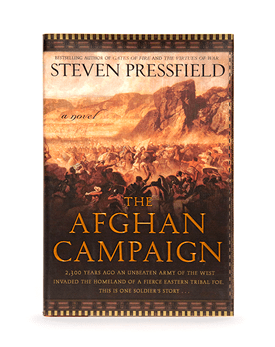
The novel opens with Matthias, a young Greek seeking glory and opportunity, signing up with the army of Alexander the Great. But Alexander has conquered the Persian Empire, and with it have passed those conventional, set-piece battles where everyone can instantly tell friend from foe.
Alexander next plans to conquer India. But first he must pacify its gateway—Afghanistan. It is here, for the first time, that the Macedonians meet an enemy unlike any other.
“Here the foe does not meet us in pitched battle,” warns Alexander. “Even when we defeat him, he will no accept our dominion. He comes back again and again. He hates us with a passion whose depth is exceeded only by his patience and his capacity for suffering.”
Matthias learns this early. In his first raid on an Afghan village, he’s ordered to execute a helpless prisoner. When he refuses, he’s brutalized until he strikes out with his sword—and then botches the job.
But, soon, exposed to an unending series of atrocities—committed by himself and his comrades, as well as the enemy—he finds himself transformed.
It is not a transformation he expected—or relishes. He agonizes over the gap between the ideals he meant to embrace when he became a soldier—and the brutalities that have drained him of everything but a grim determination to survive at any cost.
Pressfield, a former Marine himself, repeatedly contrasts how noncombatants see war as a kind of “glorious” child’s-play with how those who must fight it actually experience it.
Steven Pressfield
He creates an extraordinary exchange between Costas, an ancient-world version of a CNN war correspondent, and Lucas, a soldier whose morality is outraged at how Costas and his ilk routinely prettify the indescribable.
The phrase Lucas hates most: “Put to death.”
“Language matters, Costas. Look at my feet. That black isn’t dirt. I can scour my flesh with lye and caustic. That man-blood never comes out.
“I hate the Afghan. He is a beast and a coward. But what I hate most is that he has dragged us down to his level.”
And we know the truth of this exchange immediately. For there are brutalities inflicted by our troops on the enemy—and atrocities inflicted by the enemy upon our soldiers—that never make the headlines, let alone the TV cameras.
We know, though we don’t wish to admit, that, decades from now, thousands of these men will carry horrific memories to their graves. These memories will remain sealed from public view, allowing their fellow but unblooded Americans to sleep peacefully, unaware of the price that others have paid on their behalf.
Like the Macedonians (who call themselves “Macks”), our own soldiers found themselves serving in an all-but-forgotten land among a populace whose values could not be more alien from our own if they came from Mars.
Instinctively, they turned to one another–not only for physical security but to preserve their last vestiges of humanity. Pressfield is never more eloquent than when he puts into the words of his war-weary veteran, Lucas, the following:
“Never tell anyone except your mates. Only you don’t need to tell them. They know. They know you. Better than a man knows his wife, better than he knows himself. They’re bound to you and you to them, like wolves in a pack. It’s not you and them. You are them. The unit is indivisible. One dies, we all die.”
Put conversely: One lives, we all live.
Pressfield has reached into the past to reveal fundamental truths about the present that most of us could probably not accept if contained in a modern-day memoir. These truths take on an immediate poignancy owing to our recent wars in Afghanistan and Iraq. But they will remain just as relevant decades from now, when our young soldiers of today are old and retired.
The Afghan Campaign thrusts us directly into the flesh-and-blood horrors created by political rhetoric: The horrors of men traumatized by an often unseen and always menacing enemy, and the horrors they must inflict in return if they are to survive in a hostile and alien world.


 Bureaucracybuster's Blog
ABC NEWS, AFGHANISTAN, ALCIBIADES, ALEXANDER THE GREAT, ALTERNET, AMERICABLOG, AP, BABY BOOMER RESISTANCE, BBC, BILL O'REILLY, BLOOMBERG, BUZZFEED, CBS NEWS, CNN, CROOKS AND LIARS, DAILY KOS, FIVETHIRTYEIGHT, FOX NEWS CHANNEL, GATES OF FIRE (BOOK), HARPER’S MAGAZINE, HUFFINGTON POST, MEDIA MATTERS, MERCENARIES, MOTHER JONES, MOVEON, MSNBC, NBC NEWS, NEW REPUBLIC, NEWSDAY, NEWSWEEK, NICCOLO MACHIAVELLI, NPR, PBS NEWSHOUR, POLITICO, POLITICUSUSA, RAW STORY, REUTERS, SALON, SEATTLE TIMES, SLATE, SPARTA, STEVEN PRESSFIELD, TALKING POINTS MEMO, THE AFGHAN CAMPAIGN (BOOK), THE ATLANTIC, THE CHICAGO SUN-TIMES, THE CHICAGO TRIBUNE, THE DAILY BEAST, THE DAILY BLOG, THE GUARDIAN, THE HILL, THE HUFFINGTON POST, THE INTERCEPT, THE LOS ANGELES TIMES, THE NATION, THE NEW REPUBLIC, THE NEW YORK TIMES, THE NEW YORKER, THE O'REILLY FACTOR, THE PROFESSION (BOOK), THE VILLAGE VOICE, THE VIRTUES OF WAR, THE VIRTUES OF WAR (BOOK), THE WASHINGTON POST, THERMOPYLAE, THINKPROGRESS, TIDES OF WAR (BOOK), TIME, TRUTHDIG, TRUTHOUT, TWO POLITICAL JUNKIES, U.S. NEWS & WORLD REPORT, UPI, USA TODAY, X
WHEN PATRIOTS BECOME PREDATORS
In Business, History, Military, Politics, Social commentary on May 6, 2024 at 12:12 amBill O’Reilly, the former host of the Fox News Channel program The O’Reilly Factor, has offered his own solution to fighting terrorism: A multinational mercenary army, based on a NATO coalition and trained by the United States.
“We would select them, special forces would train them—a 25,000-man force to be deployed to fight on the ground against worldwide terrorism. Not just ISIS,” O’Reilly said on “CBS This Morning” on September 24, 2014.
Bill O’Reilly
Actually, O’Reilly’s idea is the subject of The Profession, a 2011 novel by bestselling author Steven Pressfield.
Pressfield made his literary reputation with four classic novels about classical Greece.
In Gates of Fire (1998) he explored the rigors and heroism of Spartan society—and the famous last stand of its 300 picked warriors at Thermopylae.
In Tides of War (2000) Pressfield depicted the rise and fall of Alcibiades, Athens’ greatest general, as he shifted his loyalties from that city to its arch-enemy, Sparta, and then to Persia, the enemy of both.
In The Virtues of War (2004) he took on the identity of Alexander the Great, explaining to his readers what it was like to command armies that swept across the known world, destroying all who dared oppose them.
Finally, in The Afghan Campaign (2006) Pressfield—this time from the viewpoint of a lowly Greek soldier—refought Alexander’s brutal, three-year anti-guerrilla campaign in Afghanistan.
Steven Pressfield
But in The Profession, Pressfield created a seemingly plausible world set into the future of 2032. The book’s own dust jacket offers the best summary of its plot-line:
“The year is 2032. The third Iran-Iraq war is over. The 11/11 dirty bomb attack on the port of Long Beach, California is receding into memory. Saudi Arabia has recently quelled a coup. Russians and Turks are clashing in the Caspian Basin.
“Iranian armored units, supported by the satellite and drone power of their Chinese allies, have emerged from their enclaves in Tehran and are sweeping south attempting to recapture the resource rich territory that had been stolen from them, in their view, by Lukoil, BP, and ExxonMobil and their privately-funded armies.
“Everywhere military force is for hire. Oil companies, multi-national corporations and banks employ powerful, cutting-edge mercenary armies to control global chaos and protect their riches.
“Even nation states enlist mercenary forces to suppress internal insurrections, hunt terrorists, and do the black bag jobs necessary to maintain the new New World Order.
“Force Insertion is the world’s merc monopoly. Its leader is the disgraced former United States Marine General James Salter, stripped of his command by the president for nuclear saber-rattling with the Chinese and banished to the Far East.”
Salter appears as a hybrid of World War II General Douglas MacArthur and Iraqi War General Stanley McCrystal. Like MacArthur, Salter has butted heads with his President—and paid dearly for it. Now his ambition is no less than to become President himself—by popular acclaim.
And like McCrystal, he is a pure warrior who leads from the front and is revered by his men. Salter seizes Saudi oil fields, then offers them as a gift to America. By doing so, he makes himself the most popular man in the country—and a guaranteed occupant of the White House.
And in 2032 the United States is a far different nation from the one its Founding Fathers created in 1776.
“Any time that you have the rise of mercenaries…society has entered a twilight era, a time past the zenith of its arc,” says Salter.”The United States is an empire…but the American people lack the imperial temperament. We’re not legionaries, we’re mechanics. In the end the American Dream boils down to what? ‘I’m getting mine and the hell with you.'”
Americans, asserts Salter, have come to like mercenaries: “They’ve had enough of sacrificing their sons and daughters in the name of some illusory world order. They want someone else’s sons and daughters to bear the burden….
“They want their problems to go away. They want me to to make them go away.”
And so Salter will “accept whatever crown, of paper or gold, that my country wants to press upon me.”
More than 500 years ago, Niccolo Machiavelli warned of the dangers of relying on mercenaries:
“Mercenaries…are useless and dangerous. And if a prince holds on to his state by means of mercenary armies, he will never be stable or secure; for they are disunited, ambitious, without discipline, disloyal; they are brave among friends; among enemies they are cowards.
Niccolo Machiavelli
“They have neither the fear of God nor fidelity to men, and destruction is deferred only so long as the attack is. For in peace one is robbed by them, and in war by the enemy.”
Centuries ago, Niccolo Machiavelli issued a warning against relying on men whose first love is their own enrichment.
Steven Pressfield, in a work of fiction, has given us a nightmarish vision of a not-so-distant America where “Name your price” has become the byword for an age.
Both warnings are well worth heeding.
Share this: