bureaucracybusters

Posts Tagged ‘ABC’

WELCOME TO THE TWITTER SMEAR-A-THON: PART TWO (END)

In Bureaucracy, Business, Entertainment, History, Politics, Social commentary on November 1, 2022 at 12:13 am

From June 15, 2015, when he launched his Presidential campaign, until October 24, 2016, Donald Trump fired nearly 4,000 angry, insulting tweets at 281 people and institutions. The New York Times needed two full pages of its print edition to showcase them.

Among these targets were:

  • His Democratic rival, Hillary Clinton
  • His fellow Republican Presidential candidates
  • Actress Meryl Streep
  • News organizations
  • President Barack Obama
  • Comedian John Oliver
  • Obamacare
  • Singer Neil Young
  • The state of New Jersey
  • Actor Arnold Schwarzenegger.

Donald Trump

During his first two weeks as President, Trump attacked 22 people, places and institutions on his @realDonaldTrump account.

Then, on March 4, 2017, Trump falsely accused former President Barack Obama of tapping his Trump Tower phones prior to the election:

“How low has President Obama gone to tapp my phones during the very sacred election process. This is Nixon/Watergate. Bad (or sick) guy!”

Thus, without offering a shred of evidence to back it up, Trump accused his predecessor—on Twitter—of committing an impeachable offense.

President Barack Obama

On May 9, 2017, Trump abruptly fired FBI Director James Comey—for pursuing an investigation into Russian subversion of the 2016 election.

Just 72 hours after firing Comey, Trump threatened him via Twitter: “James Comey better hope that there are no ‘tapes’ of our conversations before he starts leaking to the press!”

Trump had no such tapes.

And Twitter’s reaction to such a blatant threat?  Silence.

James Comey official portrait.jpg

James B. Comey

On February 17, 2017, Trump used Twitter to attack the Constitutionally-protected free press:

“The FAKE NEWS media (failing @nytimes, @NBCNews, @ABC, @CBS, @CNNis not my enemy, it is the enemy of the American People!”

“Enemy of the people” was a popular charge during the 30-year reign of Soviet dictator Joseph Stalin.

On July 2, 2017, Trump tweeted a video showing him punching a man with the CNN logo superimposed on his head during a WWE wrestling match.

Yet Twitter’s Terms of Service stated:

Hateful imagery and display names: You may not use hateful images or symbols in your profile image or profile header. You also may not use your username, display name, or profile bio to engage in abusive behavior, such as targeted harassment or expressing hate towards a person, group, or protected category. We will begin enforcing this rule on December 18, 2017. [Italics added.]

Even foreign leaders were unnerved by Trump’s obsession with Twitter. As CNN Political Analyst Julian Zelizer outlined in a July 3, 2017 article:

“To have one of the most powerful people in the room being someone who is willing to send out explosive and controversial statements through social media, including nasty personal attacks or an edited video of him physically assaulting the media, does not make others….feel very confident about how he will handle deliberations with them.”

On September 25, 2017, Twitter’s top executives justified allowing these repeated violations of “Twitter Rules,” tweeting:

“We hold all accounts to the same Rules, and consider a number of factors when assessing whether Tweets violate our Rules.

“Among the considerations is ‘newsworthiness’ and whether a Tweet is of public interest. This has long been internal policy and we’ll soon update our public-facing rules to reflect it. We need to do better on this, and will.”

Only after Trump incited a mob of his Right-wing followers to attack the U.S. Capitol on January 6, 2021, did Twitter ban him from its website. 

But Twitter has never acknowledged publicly that Trump violated any of its guidelines. It rarely even acknowledged Trump’s tweets.

Trump’s apologists fiercely defended his tweetstorms, claiming they allowed him to bypass the media and “communicate directly with the American people.”

One of those apologists was former Twitter CEO Jack Dorsey: “I believe it’s really important to have these conversations out in the open, rather than have them behind closed doors.”

Image result for Images of Jack Dorsey

Jack Dorsey

In April, 2017, Twitter announced that it had added 9,000,000 new users, its largest quarter-over-quarter jump in two years.

“We believe Twitter is the best at showing you what’s happening in the world and what’s being talked about,” said Anthony Noto, Twitter’s chief financial officer.

“Having political leaders of the world as well as news agencies participating and driving that is an important element to reinforcing what we’re the best at.”

In short: Trump is good at attracting more Twitter users. and if the company needs to overlook his blatant and repeated violations of its “Twitter Rules,” so be it.

Twitter has been so plagued by trolling that potential investors like the Walt Disney Company have refused to taint their own reputations by partnering with it.

Cyber-bullying, racist comments, violent threats and reputation-smashing phony celebrity accounts have repeatedly brought Twitter harsh criticism. 

And now its new owner, Tessla CEO Elon Musk, clearly intends to restore Donald Trump’s Twitter account.

Not content with that, Musk has engaged in a Twitter-smear of his own.

On October 28, David DePape, a Right-wing QAnon fanatic, assaulted Paul Pelosi, husband of House Speaker Nancy Pelosi, in his San Francisco house.

Hours later, Musk tweeted a Right-wing slander: That DePape is a male sex worker who was hired by Paul Pelosi. 

Musk later deleted the tweet. 

Anyone who wanted to know what the “new” Twitter will be like just found out. 

WELCOME TO THE TWITTER SMEAR-A-THON: PART ONE (OF TWO)

In Bureaucracy, Business, Entertainment, History, Politics, Social commentary on October 31, 2022 at 12:22 am

Behind the racism
And the tweet
Behind the venom
And the act
Lies the Hatred.

In less than 12 hours, Roseanne Barr demolished her hit show, Roseanne, and threw the lives of dozens of men and women into unemployed chaos.

A short timeline is instructive:

May 28, 2018  – 1:45 a.m.

Roseanne Barr takes to Twitter and tweets: “muslim brotherhood and planet of the apes had a baby = vj”

[“vj” stands for “Valerie Jarrett,” a former senior adviser and assistant for public engagement and intergovernmental affairs for then-President Barack Obama. The reference to “planet of the apes” is Barr’s way of comparing Jarrett—who is black—to an ape.]
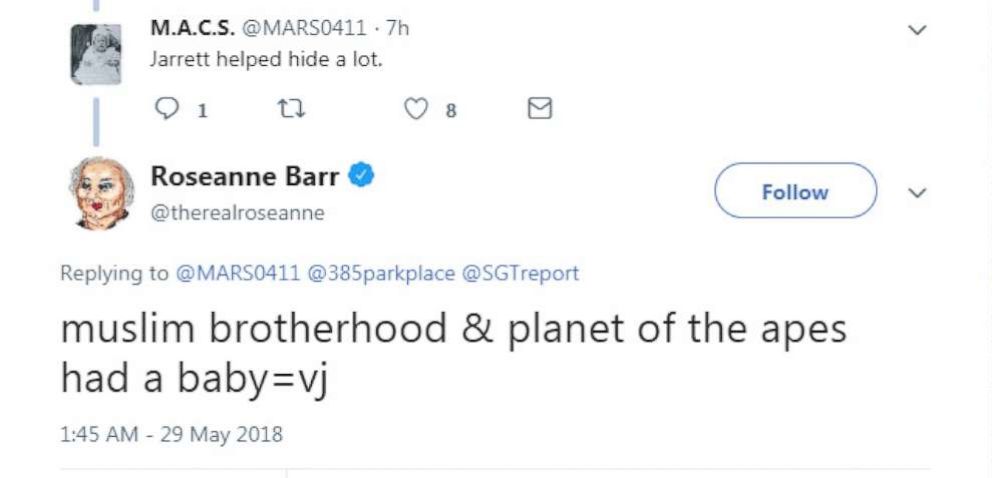
PHOTO: Roseanne Barr posted a tweet on May 29, 2018 that read, muslim brotherhood & planet of the apes had a baby=vj.

May 29 – 6:29 a.m.

“It’s a joke.”

[Apparently, Barr has suddenly realized that posting such a racist, poisonous tweet just might not be a good career move. So she’s trying to defuse the bomb before it can explode on her.]

May 29 – 9:28 a.m.

“I apologize. I am now leaving Twitter.”

[Obviously, she’s really worried now.]

May 29 – 7:33 a.m.

“I apologize to Valerie Jarrett and to all Americans.  I am truly sorry for making a bad joke about her politics and her looks. I should have known better.  Forgive me–my joke was in bad taste.”

[This looks like standard boiletplate, perhaps crafted by someone familiar with corporate-speak. It’s clear that Barr or someone close to her not only recognizes the public relations dangers of her tweet but made an “I was only joking” effort to deflect those dangers. Barr’s idol, President Donald Trump, has often hurled despicable insults at people—and then claimed: “I was only joking.”  Perhaps Barr believes—or at least hopes—the same tactic will work for her.]

Related image

Roseanne Barr (Pinterest)

May 29 – 9:15 a.m.

Channing Dungey, entertainment president of the American Broadcasting Company (ABC), issues the following announcement: “Roseanne’s Twitter statement is abhorrent, repugnant and inconsistent with our values, and we have decided to cancel her show.”

Robert Iger, CEO of Disney (which owns ABC) tweets:  “There was only one thing to do here, and that was the right thing.”

This was, of course, not the first time that Roseanne Barr had starred in her own series.  From 1988 to 1997, she had portrayed Roseanne Conner, wife and mother of an Illinois working-class American family.  John Goodman had played her husband.

Their three children (Becky, Darlene, and DJ) were played by, respectively, Lecy Goranson (and, later, Sarah Chalke); Sarah Gilbert; and Michael Fishman.

The series reached No. 1 in the Nielsen ratings, and became the most-watched television show in the United States from 1989 to 1990.

The show remained in the top four for six of its nine seasons, and in the top 20 for eight seasons.  In 2002, Roseanne was ranked No. 35 on TV Guide’s 50 Greatest TV Shows of All Time

So when Roseanne pitched an updated version of her show to ABC in 2017, the network was naturally excited.

On May 16, 2017, ABC announced that it would revive Roseanne as a mid-season replacement in 2018, with the original cast returning. Eight episodes were ordered. In November, ABC ordered a ninth episode.

The rebooted version premiered on March 27, 2018, to an initial audience of 27.26 million viewers. On March 30, thrilled by the success of its premiere, ABC renewed Roseanne for another 13 episodes.

Thirteen new episodes of Roseanne represented steady work for dozens of men and women:

  • Actors portraying the Conner family.
  • Actors in minor roles.
  • Costume designers.
  • Writers
  • Editors
  • Makeup artists.
  • Caterers.
  • Sound techs.
  • Lighting techs.
  • Production assistants.

Then came Roseanne Barr’s tweet.

And, suddenly, all of these people found themselves unemployed—and uncertain about their futures in the fickle and often unforgiving entertainment industry.

Of course, the person most immediately—and rightly—blamed was Roseanne Barr herself. But she was by no means the only one worthy of condemnation.

A major portion of blame is owed the men who run Twitter.

According to “The Twitter Rules,” posted on the Twitter website:

We believe in freedom of expression and open dialogue, but that means little as an underlying philosophy if voices are silenced because people are afraid to speak up.

In order to ensure that people feel safe expressing diverse opinions and beliefs, we prohibit behavior that crosses the line into abuse, including behavior that harasses, intimidates, or uses fear to silence another user’s voice.

Context matters when evaluating for abusive behavior and determining appropriate enforcement actions. Factors we may take into consideration include, but are not limited to whether:

  • the behavior is targeted at an individual or group of people;
  • the report has been filed by the target of the abuse or a bystander;
  • the behavior is newsworthy and in the legitimate public interest.

Abuse: You may not engage in the targeted harassment of someone, or incite other people to do so. We consider abusive behavior an attempt to harass, intimidate, or silence someone else’s voice….

Hateful conduct: You may not promote violence against, threaten, or harass other people on the basis of race, ethnicity, national origin, sexual orientation, gender, gender identity, religious affiliation, age, disability, or serious disease. Read more about our hateful conduct policy.

All of which leads to the question: Why didn’t Twitter police—and purge—the single greatest abuser of its “Twitter Rules”: Donald Trump?

IMMUNITY FOR ONE TWITTER TROLL, NO IMMUNITY FOR OTHERS: PART TWO (END)

In Bureaucracy, Business, Entertainment, History, Politics, Social commentary on June 1, 2018 at 12:29 am

With one tweet, Roseanne Barr blew her newly-revised TV sitcom to bits—and made herself an outcast from the American Broadcasting Company.

Her mistake: Thinking that she could get away with the same racist, hate-filled insults that her idol, President Donald Trump, has long gotten away with on Twitter.

From June 15, 2015, when he launched his Presidential campaign, until October 24, 2016, he fired nearly 4,000 angry, insulting tweets at 281 people and institutions. The New York Times needed two full pages of its print edition to showcase them.

Donald Trump

Among these targets were:

  • His Democratic rival, Hillary Clinton
  • His fellow Republican Presidential candidates
  • Actress Meryl Streep
  • News organizations
  • President Barack Obama
  • Comedian John Oliver
  • Obamacare
  • Singer Neil Young
  • The state of New Jersey
  • Actor Arnold Schwarzenegger.

During his first two weeks as President, Trump attacked 22 people, places and institutions on his @realDonaldTrump account.

Then, on March 4, 2017, Trump accused former President Barack Obama of tapping his Trump Tower phones prior to the election:

“Terrible! Just found out that Obama had my ‘wires tapped’ in Trump Tower just before the victory. Nothing found. This is McCarthyism!”

“How low has President Obama gone to tapp my phones during the very sacred election process. This is Nixon/Watergate. Bad (or sick) guy!”

Thus, without offering a shred of evidence to back it up, Trump accused his predecessor—on Twitter—of committing an impeachable offense.

President Barack Obama

On May 9, 2017, Trump abruptly fired FBI Director James Comey—for pursuing an investigation into Russian subversion of the 2016 election.

Just 72 hours after firing Comey, Trump threatened him via Twitter: “James Comey better hope that there are no ‘tapes’ of our conversations before he starts leaking to the press!”

And Twitter’s reaction to such a blatant threat?  Silence.

Trump had no such tapes.

James Comey official portrait.jpg

James B. Comey

On February 17, 2017, Trump used Twitter to attack the Constitutionally-protected free press:

“The FAKE NEWS media (failing @nytimes, @NBCNews, @ABC, @CBS, @CNNis not my enemy, it is the enemy of the American People!”

On July 2, 2017, Trump tweeted a video showing him punching a man with the CNN logo superimposed on his head during a WWE wrestling match.

And on August 15, the President retweeted a cartoon photo of a “Trump Train” running over a CNN reporter.

Yet Twitter’s Terms of Service state:

Hateful imagery and display names: You may not use hateful images or symbols in your profile image or profile header. You also may not use your username, display name, or profile bio to engage in abusive behavior, such as targeted harassment or expressing hate towards a person, group, or protected category. We will begin enforcing this rule on December 18, 2017. [Italics added.]

Even foreign leaders have been unnerved by Trump’s obsession with Twitter. As CNN Political Analyst Julian Zelizer outlined in a July 3 article:

“Putting aside the specific content of the recent blasts from the Oval smart phone, the President’s ongoing Twitter storms make all leaders uneasy. The heads of government in most nations prefer a certain amount of predictability and decorum from other heads of state.

“To have one of the most powerful people in the room being someone who is willing to send out explosive and controversial statements through social media, including nasty personal attacks or an edited video of him physically assaulting the media, does not make others….feel very confident about how he will handle deliberations with them.”

On September 25, 2017, Twitter, Twitter’s top executives justified allowing these repeated violations of “Twitter Rules,” tweeting:

“We hold all accounts to the same Rules, and consider a number of factors when assessing whether Tweets violate our Rules.

“Among the considerations is ‘newsworthiness’ and whether a Tweet is of public interest. This has long been internal policy and we’ll soon update our public-facing rules to reflect it. We need to do better on this, and will.”

Twitter has never acknowledged publicly that Trump has violated any of its guidelines. It rarely even acknowledges Trump’s tweets.

Trump’s apologists have fiercely defended his tweetstorms, claiming they allow him to bypass the media and “communicate directly with the American people.”

One of those apologists is Twitter CEO Jack Dorsey, who said: “I believe it’s really important to have these conversations out in the open, rather than have them behind closed doors.”

Image result for Images of Jack Dorsey

Jack Dorsey

In April, 2017, Twitter announced that it had added 9,000,000 new users, its largest quarter-over-quarter jump in two years.

“We believe Twitter is the best at showing you what’s happening in the world and what’s being talked about,” said Anthony Noto, Twitter’s chief financial officer.

“Having political leaders of the world as well as news agencies participating and driving that is an important element to reinforcing what we’re the best at.”

In short: Trump is good at attracting more Twitter users. and if the company needs to overlook his blatant and repeated violations of its “Twitter Rules,” so be it.

Twitter has been so plagued by trolling that potential investors like the Walt Disney Company have refused to taint their own reputations by partnering with it.

But Twiter executives refuse to end their Faustian pact with the biggest Twitter troll of all.

IMMUNITY FOR ONE TWITTER TROLL, NO IMMUNITY FOR OTHERS: PART ONE (OF TWO)

In Bureaucracy, Business, Entertainment, History, Politics, Social commentary on May 31, 2018 at 12:09 am

Behind the racism
And the tweet
Behind the venom
And the act
Lies the Hatred.

In less than 12 hours, Roseanne Barr demolished her hit show, Roseanne, and threw the lives of dozens of men and women into unemployed chaos.

A short timeline is instructive:

May 28, 2018  – 1:45 a.m.

Roseanne Barr takes to Twitter and tweets: “muslim brotherhood and planet of the apes had a baby = vj”

[“vj” stands for “Valerie Jarrett,” a former senior adviser and assistant for public engagement and intergovernmental affairs for President Barack Obama. The reference to “planet of the apes” is Barr’s way of comparing Jarrett—who is black—to an ape.]

PHOTO: Roseanne Barr posted a tweet on May 29, 2018 that read, muslim brotherhood & planet of the apes had a baby=vj.

May 29 – 6:29 a.m.

“It’s a joke.”

[Apparently, Barr has suddenly realized that posting such a racist, poisonous tweet just might not be a good career move. So she’s trying to defuse the bomb before it can explode on her.]

May 29 – 9:28 a.m.

“I apologize. I am now leaving Twitter.”

[Obviously, she’s really worried now.]

May 29 – 7:33 a.m.

“I apologize to Valerie Jarrett and to all Americans.  I am truly sorry for making a bad joke about her politics and her looks. I should have known better.  Forgive me–my joke was in bad taste.”

[This looks like standard boiletplate, perhaps crafted by someone familiar with corporate-speak.  It’s clear that Barr or someone close to her not only recognizes the public relations dangers of her tweet but made an “I was only joking” effort to deflect those dangers. Barr’s idol, President Donald Trump, has often hurled despicable insults at people—and then claimed: “I was only joking.”  Perhaps Barr believes—or at least hopes—the same tactic will work for her.]

Related image

Roseanne Barr (Pinterest)

May 29 – 9:15 a.m.

Channing Dungey, entertainment president of the American Broadcasting Company (ABC), issues the following announcement: “Roseanne’s Twitter statement is abhorrent, repugnant and inconsistent with our values, and we have decided to cancel her show.”

Robert Iger, CEO of Disney (which owns ABC) tweets:  “There was only one thing to do here, and that was the right thing.”

This was, of course, not the first time that Roseanne Barr had starred in her own series.  From 1988 to 1997, she had portrayed Roseanne Conner, wife and mother of an Illinois working-class American family.  John Goodman had played her husband.

Their three children (Becky, Darlene, and DJ) were played by, respectively, Lecy Goranson (and, later, Sarah Chalke); Sarah Gilbert; and Michael Fishman.

The series reached No. 1 in the Nielsen ratings, and became the most watched television show in the United States from 1989 to 1990.

The show remained in the top four for six of its nine seasons, and in the top 20 for eight seasons.  In 2002, Roseanne was ranked No. 35 on TV Guide’s 50 Greatest TV Shows of All Time

So when Roseanne pitched an updated version of her show to ABC in 2017, the network was naturally excited.

On May 16, 2017, ABC announced that it would revive Roseanne as a mid-season replacement in 2018, with the original cast returning. Eight episodes were ordered. In November, ABC ordered a ninth episode.

The rebooted version premiered on March 27, 2018, to an initial audience of 27.26 million viewers. On March 30, thrilled by the success of its premiere, ABC renewed Roseanne for another 13 episodes.

Thirteen new episodes of Roseanne represented steady work for dozens of men and women:

  • Actors portraying the Conner family.
  • Actors in minor roles.
  • Costume designers.
  • Writers
  • Editors
  • Makeup artists.
  • Caterers.
  • Sound techs.
  • Lighting techs.
  • Production assistants.

Then came Roseanne Barr’s tweet.

And, suddenly, all of these people found themselves unemployed—and uncertain about their futures in the fickle and often unforgiving entertainment industry.

Of course, the person most immediately—and rightly—blamed was Roseanne Barr herself. But she was by no means the only one worthy of condemnation.

A major portion of blame is owed the men who run Twitter.

According to “The Twitter Rules,” posted on the Twitter website:

We believe in freedom of expression and open dialogue, but that means little as an underlying philosophy if voices are silenced because people are afraid to speak up.

In order to ensure that people feel safe expressing diverse opinions and beliefs, we prohibit behavior that crosses the line into abuse, including behavior that harasses, intimidates, or uses fear to silence another user’s voice.

Context matters when evaluating for abusive behavior and determining appropriate enforcement actions. Factors we may take into consideration include, but are not limited to whether:

  • the behavior is targeted at an individual or group of people;
  • the report has been filed by the target of the abuse or a bystander;
  • the behavior is newsworthy and in the legitimate public interest.

Abuse: You may not engage in the targeted harassment of someone, or incite other people to do so. We consider abusive behavior an attempt to harass, intimidate, or silence someone else’s voice….

Hateful conduct: You may not promote violence against, threaten, or harass other people on the basis of race, ethnicity, national origin, sexual orientation, gender, gender identity, religious affiliation, age, disability, or serious disease. Read more about our hateful conduct policy.

All of which leads to the question: Why hasn’t Twitter policed—and purged—the single greatest abuser of its “Twitter Rules”: Donald Trump?

TV CENSORS: SLEAZE IS IN, PATRIOTISM IS OUT

In Bureaucracy, Entertainment, History, Politics, Social commentary on September 24, 2015 at 12:04 am

On November 7, 2013, American television culture took yet another step deeper into Toiletville.

It was the Two and Half Men episode, “Justice in Star-Spangled Hot Pants.”  And it starred Lynda Carter as the target of a crush that was both infantile and obscene.

Carter, of course, is the singer/actress best-known for her role as Wonder Woman (1975-1979).

And watching this episode of Men, it was hard to tell where the real-life Carter left off and the fictional character she was playing took over.

Lynda Carter as Wonder Woman

Here, in brief, was the plotline:

Alan Harper (Jon Cryer) learns that his roommate, Walden Schmidt (Ashton Kutcher) knows Lynda Carter.

Having an enormous crush on Carter from his years of watching her as Wonder Woman, Alan asks Walden to set him up on a date with her.

Against his better judgment, Walden agrees to invite her to the house for dinner.

Now, if Carter had been playing a fictional character, there wouldn’t have been anything wrong with this premise. Nobody, after all, would have mistaken Laurence Olivier for Richard III.

But she wasn’t.  She was playing herself.

And, in her real-life self, she was then 62.  An admittedly good-looking 62, but, even so, a woman about 40 years older than the character (Alan) who wants to meet her.

And not simply meet her.  Bone her.

Bone her?  Yes–that’s exactly what he says when Walden initially turns down his request to introduce him to her: “Now I’ll never get to bone Lynda Carter.”

And since Carter was playing herself, it’s useful to recall that she is, in real-life, a married woman (since 1984 to attorney Robert Altman).

And the show achieved an even lower level of crassness when Walden says Alan is so desperate to meet Carter that he’d skulk around in the bushes in front of her house.

“Wow, Lynda Carter’s bush,” says Alan, practically salivating over the contemplation of a 62-year-old woman’s vagina.

But males weren’t the only gender who got to descend to new depths of bad taste in this episode. There was the character of Jenny (Amber Tamblyn), the lesbian sister of the departed character Charlie (Charlie Sheen).

Again, the show’s writers simply couldn’t resist the temptation to mix real-life with fantasy.

Jenny is, at first, not even aware who Lynda Carter is until Alan, shocked, clues her in on the juvenile series she’s best-known for.

And, after meeting Carter, Jenny remains unimpressed.  There’s an edginess in her voice as she comes face-to-face with the actress who’s well-known for supporting gay and lesbian rights.

“I understand you’re into cuffs,” she tells Carter–a reference to the “magic bracelets” worn by her character, Wonder Woman.

But it’s also a double entendre, conjuring up the image of Carter (perhaps in her Wonder Woman outfit) staked out on a bed in a bondage fantasy.

For all of Alan’s over-the-top infatuation with Carter, it’s not him that she’s interested in.  It’s his buddy, Walden (Ashton Kutcher).

Lynda Carter and Ashton Kutcher

And to prove it, she gives him a real smackeroo of a kiss.

Which may well have conjured up, for him, real-life memories of his May-December marriage to the actress Demi Moore.

Kutcher was 27 when he tied the knot with Moore in 2005.  Moore, by contrast, was 42.

The marriage ended in 2013, amid tabloid reports that Kutcher had cheated on her with Sara Leal, a 22-year-old San Diego-based administrative assistant.  Moore by then was 51.

Kutcher, born in 1978, was still rolling around in his cradle while Carter–born in 1951–was wrapping up her third and final season as Wonder Woman.

So, for Kutcher, maybe it was a case of deja vu all over again.

So much for network TV censors’ attitude toward sleaze.  Now for their attitude toward patriotism.

On Veterans Day from 2001 to 2004, the American Broadcasting Company (ABC) aired the 1998 Steven Spielberg World War II classic, Saving Private Ryan, uncut and with limited commercial interruptions.

Both the grity, realistic battle scenes and profanity were left intact.

Storming the beach at Normandy in Saving Private Ryan

But in 2004, its airing was marked by pre-emptions by 65 ABC affiliates.

The reason: The backlash over Super Bowl XXXVIII’s halftime show controversy (starring the infamous bared breast of Janet Jackson).

The affiliates—28% of the network—did not clear the available timeslot for the film.

And this was even after the Walt Disney Company–which owns ABC–offered to pay all fines for language to the FCC.

No complaints, however, were lodged with the FCC.

It speaks volumes to the priorities–and values–of American television when a film honoring the wartime sacrifices of American soldiers is banned from network TV.

And it speaks volumes as well to the priorities–and values–of American television when a casually juvenile and crudity-laced series like Two and a Half Men becomes CBS’ biggest cash cow.

WONDER WOMAN: COARSENING THE CULTURE

In Business, Entertainment, Military, Social commentary on February 7, 2014 at 1:32 am

On November 7, 2013, American television culture took yet another step deeper into Toiletville.

It was the Two and Half Men episode, “Justice in Star-Spangled Hot Pants.”  And it starred Lynda Carter as the target of a crush that was both infantile and obscene.

Carter, of course, is the singer/actress best-known for her role as Wonder Woman (1975-1979).

And watching this episode of Men, it was hard to tell where the real-life Carter left off and the fictional character she was playing took over.

Lynda Carter as Wonder Woman

Here, in brief, was the plotline:

Alan Harper (Jon Cryer) learns that his roommate, Walden Schmidt (Ashton Kutcher) knows Lynda Carter.

Having an enormous crush on Carter from his years of watching her as Wonder Woman, Alan asks Walden to set him up on a date with her.

Against his better judgment, Walden agrees to invite her to the house for dinner.

Now, if Carter had been playing a fictional character, there wouldn’t have been anything wrong with this premise.

Nobody, for example, would have mistaken Laurence Olivier for Richard III.

But she wasn’t.  She was playing herself.

And, in her real-life self, she’s 62.  An admittedly good-looking 62, but, even so, a woman about 40 years older than the character (Alan) who wants to meet her.

And not simply meet her.  Bone her.

Bone her?  Yes–that’s exactly what he says when Walden initially turns down his request to introduce him to her: “Now I’ll never get to bone Lynda Carter.”

And since Carter was playing herself, it’s useful to recall that she is, in real-life, a married woman (since 1984 to attorney Robert Altman).

And the show achieves an even lower level of crassness when Walden says Alan is so desperate to meet Carter that he’d skulk around in the bushes in front of her house.

“Wow, Lynda Carter’s bush,” says Alan, practically salivating over the contemplation of a 62-year-old woman’s vagina.

But males aren’t the only gender who get to descend to new depths of bad taste in this episode.  There’s the character of Jenny (Amber Tamblyn), the lesbian sister of the departed character Charlie (Charlie Sheen).

Again, the show’s writers simply couldn’t resist the temptation to mix real-life with fantasy.

Jenny is, at first, not even aware who Lynda Carter is until Alan, shocked, clues her in on the infantile series she’s best-known for.

And, after meeting Carter, Jenny remain unimpressed.  There’s an edginess in her voice as she comes face-to-face with the actress who’s well-known for supporting gay and lesbian rights.

“I understand you’re into cuffs,” she tells Carter–a reference to the “magic bracelets” worn by her character, Wonder Woman.

But it’s also a double entendre, conjuring up the image of Carter (perhaps in her Wonder Woman outfit) staked out on a bed in a bondage fantasy.

For all of Alan’s over-the-top infatuation with Carter, it’s not him that she’s interested in.  It’s his buddy, Walden (Ashton Kutcher).

Lynda Carter and Ashton Kutcher

And to prove it, she gives him a real smackeroo of a kiss.

Which may well have conjured up, for him, real-life memories of his May-December marriage to the actress Demi Moore.

Kutcher was 27 when he tied the knot with Moore in 2005.  Moore, by contrast, was 42.

The marriage ended in 2013, amid tabloid reports that Kutcher had cheated on her with Sara Leal, a 22-year-old San Diego-based administrative assistant.

Kutcher, born in 1978, was still rolling around in his cradle while Carter–born in 1951–was wrapping up her third and final season as Wonder Woman.

So, for Kutcher, maybe it was a case of deja vu all over again.

On Veterans Day from 2001 to 2004, the American Broadcasting Company (ABC) aired the 1998 Steven Spielberg World War II classic, Saving Private Ryan, uncut and with limited commercial interruptions.

Both the grity, realistic battle scenes and profanity were left intact.

Storming the beach at Normandy in Saving Private Ryan

But in 2004, its airing was marked by pre-emptions by 65 ABC affiliates.

The reason: The backlash over Super Bowl XXXVIII’s halftime show controversy (starring the infamous bared breast of Janet Jackson).

The affiliates—28% of the network—did not clear the available timeslot for the film.

And this was even after the Walt Disney Company–which owns ABC–offered to pay all fines for language to the FCC.

No complaints, however, were lodged with the FCC.

It speaks volumes to the priorities–and values–of American television when a film honoring the wartime sacrifices of American soldiers is banned from network TV.

And it speaks volumes as well to the priorities–and values–of American television when a casually juvenile and crudity-laced series like Two and a Half Men becomes CBS’ biggest cash cow.