bureaucracybusters

Posts Tagged ‘STANLEY KUBRICK’

FROM “CREDIBILITY GAP” TO “ORWELL LAND”: PART ONE (OF THREE)

In Bureaucracy, History, Law, Law Enforcement, Military, Politics, Social commentary on September 28, 2016 at 12:09 am

“Credibility gap” is a term that came into use during the mid-1960s to describe public and journalistic distrust of President Lyndon B. Johnson. In particular, the term was applied to his administration’s conduct of the Vietnam war.

It was, in short, a euphemism for accusing government officials of outright lying.

An example of the credibility gap in full swing appeared in Stanley Kubrick’s classic 1987 Vietnam war movie, Full Metal Jacket

Related image

Vietnam was a war where military and political officials spewed a gung-ho version of constant American progress against a tough enemy.

And where civilian reporters like David Halberstam and Walter Cronkite saw–and labeled–the war as a brutal, wasteful and ultimately doomed effort. 

Midway through the film, there’s an editorial meeting of The Sea Tiger, the official Marine newspaper.

Lieutenant Lockhart is presiding–and he is determined to give his superiors an endless stream of “all-systems-go” propaganda reports. He reads a series of stories that have been published:

Story #1: DIPLOMATS IN DUNGAREES–MARINE ENGINEERS LEND A HELPING HAND REBUILDING DONG PHUC VILLAGES.

LOCKHART: “Chili, “if we move Vietnamese, they are evacuees. If they come to us to be evacuated, they are refugees.”

Story #2: N.V.A. SOLDIER DESERTS AFTER READING PAMPHLETS.

LOCKHART: “A young North Vietnamese Army regular, who realized his side could not win the war, deserted from his unit after reading Open Arms program pamphlets.”

Story #3: NOT WHILE WE’RE EATING: N.V.A. LEARN MARINES ON A SEARCH AND DESTROY MISSION DON’T LIKE TO BE INTERRUPTED WHILE EATING CHOW.

LOCKHART: “‘Search and destroy.’  Uh, we have a new directive on this. In the future, in place of ‘search and destroy,’ substitute the phrase ‘sweep and clear.’ Got it?” 

Related image

Lt. Lockhart, editor of The Sea Tiger 

LOCKHART:  “And, Joker–where’s the weenie?”

JOKER:  “Sir?”

LOCKHART  “The Kill, Joker. I mean, all that fire, the grunts must’ve hit something.”

JOKER:  “Didn’t see ’em.”

LOCKHART:  “Joker, I’ve told you, we run two basic stories here: Grunts who give half their pay to buy gooks toothbrushes and deodorants–winning of hearts and Minds–okay? And combat action that results in a kill–Winning the War. Now you must have seen blood trails … drag marks?”

JOKER:  “It was raining, sir.”

LOCKHART:  “Well, that’s why God passed the law of probability. Now rewrite it and give it a happy ending–say, uh, one kill. Make it a sapper or an officer. Grunts like reading about dead officers.”

JOKER:  “Okay, an officer. How about a general?”

LOCKHART:  “Joker, maybe you’d like our guys to read the paper and feel bad. I mean, in case you didn’t know it, this is not a particularly popular war. Now, it is our job to report the news that these why-are-we-here civilian newsmen ignore.”

So great became the divide between truth and lies during military “press briefings” that reporters started calling them “The Five O’clock Follies.” And even some soldiers took to wearing buttons that said: “Ambushed at Credibility Gap.”

Reporters who dared to write truthfully about the military’s crimes and failures–like David Halberstam of the New York Times and Peter Arnett of the Associated Press–were regarded as traitors by military and political officials.

In 1963, President John F. Kennedy became enraged by Halberstam’s reporting on the corruption of the South Vietnamese government. He pressured New York Times publisher Arthur Ochs Sulzberger to transfer Halberstam to another locale. Sulzberger politely refused–and then extended Halberstam’s stay in Vietnam another six months.

Related image

David Halberstam

In 1965, when CBS Correspondent Morley Safer filmed Marines setting fire to the village of Cam Ne with Zippo lighters, President Lyndon B. Johnson was similarly outraged.

He placed an early-morning call to CBS News President Frank Stanton and shouted: “Your boys shat on the American flag!”

The trail of deceit and attempted censorship continued right up to the end of the war–in April, 1975. That was when North Vietnamese forces invaded the South and quickly overwhelmed the incompetent defenses arrayed against them.

And while America was still bogged down in Vietnam, the Watergate scandal erupted on June 17, 1972.

Related image

Watergate Hotel

Members of the Nixon administration’s secret “Plumbers Unit” burglarized the offices of the Democratic National Committee at the Watergate Hotel.

Obsessed with re-electing Richard Nixon, they sought incriminating information to discredit U.S. Senator George McGovern, the Democrats’ nominee for President.

When the burglars were caught, President Richard M. Nixon and his topmost officials lied and stonewalled both reporters and investigators seeking the truth.

Nixon’s press secretary, Ronald Ziegler, repeatedly slandered the integrity of The Washington Post for its coverage of the mushrooming Watergate scandal. He called the Watergate break-in “a third-rate burglary” and attacked the Post for “shabby journalism.”

Finally, on April 17, 1973, Ziegler, announced at a press conference: “This is the operative statement. The others are inoperative.”

In short: We’ve been lying to you for the last 10 months.  But now we’re telling the truth.

Like Vietnam, the Watergate scandal destroyed the reputations of many of its chief architects. Forty government officials were indicted or jailed.

Vietnam and Watergate were seminal events for Americans coming of age in the late 1960s and early 1970s. They taught an entire generation: Don’t trust the government.  Its officials routinely lie, and their lies can be deadly.

FROM “CREDIBILITY GAP” TO “ORWELL LAND”: PART THREE (END)

In Bureaucracy, History, Law, Law Enforcement, Military, Politics, Social commentary on September 26, 2016 at 3:03 pm

For five years, Donald Trump, more than anyone else, popularized the slander that President Barack Obama was born in Kenya–and was therefore not an American citizen.

In April, 2011, Obama released the long-form version of his Hawaiian birth certificate. Still, Trump questioned its–and Obama’s–legitimacy.

For more than a year during his 2016 Presidential campaign, Trump continued doing so. 

Meanwhile, Trump’s popularity steadily fell among blacks. In June, 2016, a Quinnipiac poll revealed that Trump had 1% of support from black voters–while 91% of black voters backed Hillary Clinton.

Even the managers of Trump’s campaign urged him to put the “birther” issue behind him.

And so, on September 16, 2016–10 days before his scheduled first debate with Democratic Presidential nominee Hillary Clinton–Trump made his version of a reversal.  
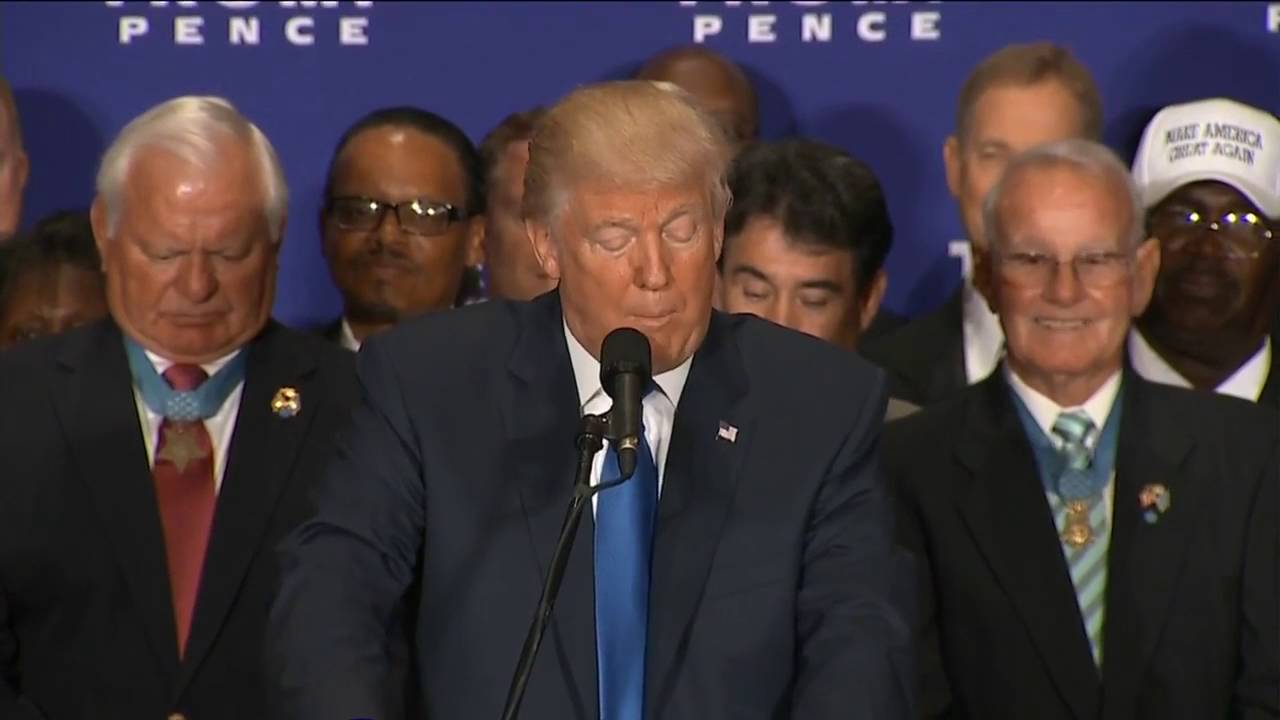
Image result for Images of Donald Trump's birther press conference

Donald Trump: “President Barack Obama was born in the United States.”

He did so in about seven seconds and 40 words–after spending a half hour paying tribute to the military and promoting his new upscale hotel in Washington, D.C.:

“Now, not to mention her in the same breath, but Hillary Clinton and her campaign of 2008 started the birther controversy.

“I finished it.  I finished it.  You know what I mean.

“President Barack Obama was born in the United States, period. Now we all want to get back to making America strong and great again.”  

His tone made it clear that he felt uneasy making that statement–and wanted to get it over with as fast as possible.

He refused to take questions from reporters covering the event. Nor did he apologize for his five-year campaign of slander.  

On the evening of September 16, Hillary Clinton strongly responded to Trump’s comments: 

“For five years, he has led the birther movement to delegitimize our first black president. His campaign was founded on this outrageous lie. There is no erasing it in history.”  

And First Lady Michelle Obama slammed Trump for his “birther” claims: 

“Then, of course, there were those who questioned, and who continue to question for the past eight years, and up to this very day, whether my husband was even born in this country.

“Well, during his time in office, I think Barack has answered those questions with the examples he set, by going high when they go low. And he’s answered these questions with the progress we’ve achieved together.” 

Related image

Michelle Obama

But perhaps the best perspective on this event was provided by syndicated columnist Mark Shields and New York Times columnist David Brooks. Each Friday they appear on the PBS Newshour to review the week’s major political events.
Image result for Images of Mark Shields and David Brooks on PBS Newshour

David Brooks and Mark Shields

On September 16, Shields (a liberal) and Brooks (a conservative) addressed Trump’s about-face on birtherism.    

MARK SHIELDS: “I think it’s important to establish right at the outset that [Trump] wasn’t only the loudest and the highest-profile and the most persistent and the most well-publicized birther, he, Donald Trump. He lied. He lied consistently and persistently.

“And, today, without explanation or excuse, he just changed his position and tried to absolutely falsely shift the blame onto Hillary Clinton.

“And this was an appeal to–he debased democracy. He debased the national debate. He appealed to that which is most ignoble or least noble in all of us.”

DAVID BROOKS: “Usually, there’s some tangential relationship to the truth, but a corroding relationship to the truth, frankly, as politics has gone on over the years.

“But now we’re in a reverse, Orwellian inversion of the truth with this. And so we have a team of staffers and then the candidate himself who have taken the normal spin and smashed all the rules.

“And so we are really in Orwell land. We are in 1984. And it’s interesting that an authoritarian personality type comes in at the same time with a complete disrespect for even tangential relationship to the truth that words are unmoored.

“And so I do think this statement sort of shocked me with the purification of a lot of terrible trends that have been happening. And so what’s white is black, and what is up is down, what is down is up. And that really is something new in politics.

“And the fact that there is no penalty for it, apparently–he’s doing fantastic in the last two weeks in the polls–is just somehow where we have gotten.”  

* * * * *  

Americans were slow to recognize the dangers of their government’s committing armed forces to South Vietnam. But when the record of government lies reached critical mass, Americans demanded an end to the war.  

Similarly, Americans were reluctant to brand Richard Nixon, their newly-re-elected President, a criminal worthy of impeachment. But when the evidence of his criminality steadily mounted, they demanded his ouster.  

Today, Americans are flooded with overwhelming evidence of Donald Trump’s unfitness to become President. His narcissism, vindictiveness, ignorance and hair-trigger temper have been on public display for more than a year.  

Yet millions of ignorant, hate-filled, Right-wing Americans plan to catapult this man–who “debased democracy, debased the national debate, appealed to that which is most ignoble or least noble in all of us”–to the Presidency.

If that happens, future historians–if there are any–may similarly condemn those Americans who stood by like “good Germans” and allowed their country to fall into the hands of a ruthless tyrant.

NEVER FIRED, ONLY DROPPED ONCE: PART TWO (END)

In Bureaucracy, History, Military, Politics on May 26, 2015 at 12:11 am

The relationship between the United States and Iraq has become dangerously similar to the one that existed between America and South Vietnam from 1955 to 1973.

From 1955 to 1963, the United States backed Ngo Dinh Diem as the “president” of South Vietnam.  During those eight years:

  • Diem was a Catholic mandarin who was alienated from an overwhelmingly poor, 95% Buddhist country.
  • The Shiite-dominated government of Iraq refuses to grant political concessions to alienated Sunnis.
  • Diem’s authority didn’t extend far beyond Saigon.
  • The Iraqi government controls little outside of Baghdad.
  • Diem didn’t believe in democracy–despite American claims to support his efforts to bring it to Vietnam.
  • Neither does the government in Baghdad.

Ngo Dinh Diem

  • Diem was widely regarded in Vietnam as an illegitimate leader, imposed by the Americans.
  • Ditto for the leaders of the Iraqi government.
  • American soldiers were sent to Vietnam because America feared Communism.
  • American soldiers have were sent to Iraq because America fears Islamic terrorism.
  • American troops were ordered to train the South Vietnamese army to defend themselves against Communism.
  • American troops were ordered to train the Iraqi army to defend themselves against terrorism.
  • Americans quickly determined that the South Vietnamese army was worthless–and decided to fight the Vietcong in its place.
  • Americans–such as Secretary of Defense Ash Carter–have determined that the Iraqi army is worthless. Yet many Americans on the Right believe the United States should commit American ground troops to fight ISIS in its  place.

American soldiers in Vietnam 

  • The Vietcong and North Vietnamese Army (NVA) fought to unify their country–and posed no threat to the United States.
  • ISIS is warring on Shiite Muslims–and poses no direct threat to the United States.
  • The far Right embraced the Vietnam war to assert American power in Asia.
  • The far Right embraces the Iraqi war to assert American power in the Middle East.
  • Americans entered Vietnam without an exit strategy.
  • Americans entered Iraq without an exit strategy.

American soldiers in Iraq

The United States’ relationship with Diem ended on November 1, 1963.  A coup led by generals of the South Vietnamese army ousted–and murdered–Diem.

But America continued to support successive and incompetent South Vietnamese dictatorships up to the end of the war in 1973.

Americans have been at war with Islamic expansionists since 2001.  But Republicans and their Rightist supporters want more of the same.

Rick Perry, former governor of Texas, has stated: “We face a global struggle against radical Islamic terrorists, and we are in the early stages of this struggle.”

And New Jersey Governor Chris Christie has declared: “No wonder we’re not intimidating our adversaries and they’re running around wild in the world, because they know we’re not investing in our defense anymore.”

As political commentator Mark Shields said on the May 22 edition of The PBS Newshour:

“Rick Perry has said–wants boots on the ground. Other Republicans have said they want boots on the ground, but they don’t necessarily have to be American boots. They should be Arab boots.

“Now, there are 60 nations in this coalition. I haven’t seen people lining up to join this fight. I mean, in a proxy war, you are dependent upon your proxies. And the Iraqis turn out to be not particularly engaged, divided, not unified, not committed the same way….

“[Republicans are saying] Get tough, get tough, swagger; 10,000 troops….

“George Pataki said, put in as many as you need, and kill everybody you can and get out. Now, getting out, I think, was the question and it remains the dilemma to this moment.”

* * * * *

Almost 50 years ago, American “grunts” felt about their South Vietnamese “allies” as American troops now feel about their Iraqi “allies.”

Dr. Dennis Greenbaum, a former army medic, summed it up as follows:

American surgical team in Vietnam

“The highest [priority for medical treatment] was any U.S. person.

“The second highest was a U.S. dog from the canine corps.

“The third was NVA [North Vietnamese Army].

“The fourth was VC [Viet Cong].

“And the fifth was ARVIN [Army of the Republic of South Vietnam], because they had no particular value,” said Greenbaum.

When you despise the “ally” you’re spending lives and treasure to defend, it’s time to pack up.

President Obama should recognize this–and start shipping those troops home.  And he should explain to Americans that a war among Islamics is actually in America’s best interests:

  • While Islamic nations like Syria and Iraq wage war within their own borders, they will lack the resources–and incentive–to attack the United States.
  • Every dead Hezbollah, ISIS and Al-Qaeda member makes the United States that much safer.
  • The peoples of the Middle East have long memories for those who commit brutalities against them.  In their veins, the cult of the blood feud runs deep.
  • This conflict could easily become the Islamic equivalent of “the Hundred Years’ War” that raged from 1337 to 1453 between England and France.

When Adolf Hitler invaded the Soviet Union in 1941, then-Senator Harry Truman said: “I hope the Russians kill lots of Nazis and vice versa.”

That should be America’s view whenever its sworn enemies start killing off each other.  Americans should welcome such self-slaughters, not become entrapped in them.

NEVER FIRED, ONLY DROPPED ONCE: PART ONE (OF TWO)

In Bureaucracy, History, Military, Politics on May 25, 2015 at 12:54 am

From 1965 until 1973, the United States lent its full military power to aiding the dictatorship of South Vietnam against the dictatorship of North Vietnam.

Despite this, veterans of combat with the North Vietnamese Army showed far more respect for their hard-core enemies than their supposedly staunch South Vietnamese allies.

Consider the following examples, taken from the screenplay of Stanley Kubrick’s classic 1987 film, Full Metal Jacket.

The movie is largely based on Dispatches, the Vietnam memoirs of Michael Herr, a war correspondent for Esquire magazine (1967-1969).

Example 1:

A group of Marines are resting on the plaza of a pagoda.  One of them calls to a photographer for the Marine newspaper, The Sea Tiger: “Hey photographer! You want to take a good picture? Here, man, take this. This is my bro….”

He lifts a hat, which is covering the face of a dead man–and reveals the face, not of an American, but of a North Vietnamese soldier.

“This is my bro…” 

“This is his party. He’s the guest of honor. Today is his birthday.  I will never forget this day. The day I came to Hue City and fought one million N.V.A. [North Vietnamese Army] gooks.

“I love the little Commie bastards, man, I really do. These enemy grunts are as hard as slant-eyed drill instructors. These people we wasted here today are the finest human beings we will ever know.

“After we rotate back to the world [the United States] we’re gonna miss not having anyone around that’s worth shooting.”

Example 2:

A reporter for a TV news crew is interviewing Marines during a lull in the fighting for the city of Hue.

EIGHTBALL: “Personally, I think they don’t really want to be involved in this war. I mean, they sort of took away our freedom and gave it to the gookers, you know. But they don’t want it. They’d rather be alive than free, I guess. Poor dumb bastards.”

COWBOY: “Well, the ones I’m fighting at are some pretty bad boys. I’m not real keen on some of these fellows that are supposed to be on our side. I keep meeting ’em coming the other way.”

DONLON: “I mean, we’re getting killed for these people and they don’t even appreciate it. They think it’s a big joke.”

ANIMAL MOTHER: “Well, if you ask me, uh, we’re shooting the wrong gooks.”

Example 3:

Haggling with a South Vietnamese pimp over the cost of a prostitute’s wares, a Marine recites a joke popular among American forces: “Be glad to trade you some ARVN rifles. Never been fired and only dropped once” [by retreating South Vietnamese forces].

* * * * *

Now, fast-forward from Vietnam in 1968 to Iraq in 2015.

Once again, the United States seems poised to embrace another worthless “ally.”

On May 25, Secretary of Defense Ash Carter bluntly accused the army of Iraq of lacking the will to stand up to its enemies in the Islamic State of Iraq and Syria (ISIS).

Secretary of Defense Ash Carter

On May 17, the Iraqi city of Ramadi fell to ISIS after the Iraqi army deserted the citizens counting on its protection.

Appearing on CNN’s Sunday news show, State of the Union, Carter said:

“What apparently happened is that the Iraqi forces showed no will to fight.  They were not outnumbered.  In fact, they vastly outnumbered the opposing force.

“That says to me, and I think to most of us, that we have an issue with the will of the Iraqis to fight [ISIS] and defend themselves.”

On the May 22, edition of the PBS Newshour, political commentator Mark Shields–a former Marine–sized up the situation:

“And the chairman of the Joint Chiefs of Staff, General Martin Dempsey, said they were not driven, the Iraqi army was not driven out of Ramadi. They drove out of Ramadi.

“They aren’t a paper tiger. They’re a paper tabby cat….

“But I will say that there are 250,000 Iraqi troops.  There are, by CIA estimates, up to 31,000 ISIS troops.

“And you have full flight.  I mean, they won’t be engaged. They haven’t been engaged.”

In 2010, President Barack Obama announced the withdrawal of American combat troops from Iraq.

Since then, Obama’s strategy for turning Iraq into a bulwark against islamic extemism has rested on two goals:

  1. Rebuilding and retraining the Iraqi army; and
  2. Prodding the Shiite-dominated government in Baghdad to reconcile with the nation’s Sunnis.

The second goal is especially important. The Sunnis, a religious minority in Iraq, ruled the country for centuries until the United States drove Saddam Hussein from power in 2003.

Now the Shiites are in control of Iraq, and they have been unwilling to grant political concessions to the alienated Sunnis. Baghdad has continued to work closely with Shiite militias backed by Iran.

In turn, the Sunnis have become a source of manpower and money for ISIS.

America’s relationship with Iraq has become eerily similar to the one it had with South Vietnam from 1955 to 1973.

And that relationship led the United States into the most divisive war in its history since the Civil War (1861-1865).

CENSORSHIP: THE AMERICAN WAY

In Bureaucracy, History, Military, Politics, Social commentary on May 14, 2015 at 3:29 pm

Midway through Stanley Kubrick’s 1987 Vietnam epic, Full Metal Jacket, there’s an editorial meeting of The Sea Tiger, the official Marine newspaper.

The correspondents are discussing how best to portray America’s faltering efforts to win a war that most of the “grunts” have come to see as unwinnable.

Lieutenant Lockhart, who’s presiding, wants his reporters to make some changes in the way they report the war.

LOCKHART: Chili, if we move Vietnamese, they are “evacuees.” If they come to us to be evacuated, they are “refugees.”

CHILI: I’ll make a note of it, sir.

LOCKHART (reading): “A young North Vietnamese Army regular, who realized his side could not win the war, deserted from his unit after reading Open Arms program pamphlets.”

That’s good, Dave. But why say “North Vietnamese Army regular”? Is there an irregular?  How about “North Vietnamese Army soldier”?

DAVE:  I’ll fix it up, sir.

LOCKHART: “Search and destroy.” Uh, we have a new directive on this. In the future, in place of “search and destroy,” substitute the phrase “sweep and clear.” Got it?

Lt. Lockhart (right) briefs his Marine reporters 

JOKER:  Got it. Very catchy.

LOCKHART: And, Joker–where’s the weenie?

JOKER:  Sir?

LOCKHART The Kill, Joker. The kill. I mean, all that fire, the grunts must’ve hit something.

JOKER:  Didn’t see ’em.

LOCKHART Joker, I’ve told you, we run two basic stories here. Grunts who give half their pay to buy gooks toothbrushes and deodorants–Winning of Hearts and Minds–okay?

And combat action that results in a kill–Winning the War. Now you must have seen blood trails … drag marks?

JOKER:  It was raining, sir.

LOCKHART:  Well, that’s why God passed the law of probability. Now rewrite it and give it a happy ending–say, uh, one kill. Make it a sapper or an officer. Which?

JOKER:  Whichever you say.

LOCKHART Grunts like reading about dead officers.

JOKER Okay, an officer. How about a general?

LOCKHART Joker, maybe you’d like our guys to read the paper and feel bad. I mean, in case you didn’t know it, this is not a particularly popular war. Now, it is our job to report the news that these why-are-we-here civilian newsmen ignore.

* * * * *

Kubrick’s film is set in the South Vietnam of 1968.

This was a war where military newspapers like Stars and Stripes offered a gung-ho, all-systems-go version of constant American progress against a tough enemy.

And where civilian reporters like David Halberstam and Walter Cronkite saw the war for what it was and labeled it a brutal, wasteful and ultimately doomed effort.

Now, 47 years after the events depicted in Full Metal Jacket, the Obama administration wants to censor the American news media as the military censored its own.

The President wants the media to stop using footage from the Islamic State of Iraq and the Levant (ISIL) during newscasts.

“We are urging broadcasters to avoid using the familiar B-roll that we’ve all seen before, file footage of ISIL convoys operating in broad daylight, moving in large formations with guns out, looking to wreak havoc,” Emily Horne, a spokeswoman for  the State Department, told Politico.

Stop using ISIL footage, Obama administration asks networks – Michael Crowley and Hadas Gold – POLITICO

The “B-roll” is stock footage that appears onscreen while reporters/commentators talk. It’s the stuff that keeps an audience watching the newscast, even if they ignore what’s being said.

“It’s inaccurate–that’s no longer how ISIL moves,” she added.

Since August, 2014, the United States and its allies have dropped thousands of bombs on ISIL–especially on its convoys–in Iraq and Syria.

As a result, claim U.S. officials, ISIL can no longer mass its forces in daylight–or move in large convoys.  Such large concentrations can be easily spotted–and attacked–from the air.

ISIL convoy

So how would the Pentagon like ISIL to be portrayed in file footage?

“One Toyota speeding down the road by itself at night with its headlights off,” said Pentagon spokesman Colonel Steve Warren.

Warren added that some of the B-roll the networks are using comes from propaganda videos made by ISIL.

Senior State Department and Pentagon officials have begun contacting television network reporters to suggest news sources switch to using more U.S.-friendly videos, such as Iraqi army soldiers being trained, or footage from coalition airstrikes.

When contacted by Politico for comment, ABC, CNN, Fox and NBC refused to comment.

Covering how Americans behave in war has proven a challenge for American news media since the Vietnam conflict.

In 1966, New York Times reporter Harrison E. Salisbury was allowed to enter North Vietnam to cover the war from their perspective.

His reports of heavy American bombing raids and their resulting civilian casualties and infrastructure damage provoked national controversy.

Officials of the Johnson administration charged Salisbury with “aiding and abetting the enemy” by reporting North Vietnamese claims of loss.

Salisbury–and the Times–replied that of course they were reporting what North Vietnamese officials were saying.  That was why he was there–to get the other side’s point-of-view.

So long as freedom of the press exists in reality as well as theory, there will always be tension between those who want to report the news–and those who want to censor it.

“DR. STRANGELOVE” LIVES: PART THREE (END)

In Bureaucracy, History, Military, Politics, Social commentary on March 19, 2014 at 12:21 am

He’s General Jack D. Ripper–the man who sends a nuclear bomber wing off to attack the Soviet Union.  And this triggers all-out thermonuclear war between the U.S.S.R and America.

Sterling Hayden as General Jack D. Ripper

While others feel he has clearly gone insane, Ripper is certain he’s done the right thing–and for the right reason: To stop “the most monstrously conceived and dangerous Communist plot” of all: Fluoridation.

And Ripper has assigned himself the task of saving “our precious bodily fluids”–although the result can only be universal destruction.

Fortunately, Ripper is only a fictitious character–played by Sterling Hayden in Stanley Kubrick’s classic 1964 dark comedy, “Dr. Strangelove.”

But America has had its share of irrational behavior among its Presidents.

RICHARD NIXON: In 1970, while deciding whether to widen the Vietnam war by invading Cambodia, he repeatedly watched the movie “Patton.”

Richard Nixon

In 1974, as journalistic and Justice Department investigations of Watergate increasingly threatened his Presidency, his behavior grew increasingly erratic.

He drank heavily, took pills by the handful, and, on at least one occasion, was seen talking to pictures of Presidents that adorned the walls of the White House.

In the final weeks of his administration, as impeachment for Watergate abuses seemed inevitable, Nixon inspired fears of a military coup in his Secretary of Defense.

James Schlesinger warned all military commands to ignore any direct orders from the White House–or any other source–without the counter-signature of the SecDef himself.

* * * * *

GEORGE W. BUSH:  In June, 2001, he met with Russian President Vladimir Putin in Slovenia.  Bush judged others–even world leaders–through the lens of his own fundamentalist Christian theology.

And Putin was quick to take advantage of it.

Vladimir Putin and George W. Bush

BUSH:  Let me say something about what caught my attention, Mr. President, was that your mother gave you a cross which you had blessed in Israel, the Holy Land.

PUTIN:  It’s true.

BUSH:  That amazes me, that here you were a Communist, KGB operative, and yet you were willing to wear a cross.  That speaks volumes to me, Mr. President.  May I call you Vladimir?

Falling back on his KGB training, Putin seized on this apparent point of commonality to build a bond.  He told Bush that his dacha had once burned to the ground, and the only item that had been saved was that cross.

BUSH:  Well, that’s the story of the cross as far as I’m concerned.  Things are meant to be.

Afterward, Bush and Putin gave an outdoor news conference.

“Is this a man that Americans can trust?” Associated Press correspondent Ron Fournier asked Bush.

“Yes,” said Bush. “I looked the man in the eye. I found him to be very straightforward and trustworthy. We had a very good dialogue.

“I was able to get a sense of his soul, a man deeply committed to his country and the best interests of his country.  I wouldn’t have invited him to my ranch if I didn’t trust him.”

In early 2003, Bush telephoned French President Jaques Chirac, hoping to enlist his support–and troops–for his long-planned invasion of Iraq.

Failing to convince Chirac that overthrowing Saddam Hussein was politically advantageous, Bush took a different tack.

BUSH: Jaques, you and I share a common faith.  You’re Roman Catholic, I’m Methodist, but we’re both Christians committed to the teachings of the Bible.  We share one common Lord.

Gog and Magog are at work in the Middle East.  Biblical prophecies are being fulfilled.

This confrontation is willed by God, who wants to use this conflict to erase His people’s enemies before a new age begins.

When the call ended, Chirac asked his advisors: “Gog and Magog–do any of you know what he’s talking about?”

When no one did, Chirac ordered: Find out.

The answer came from Thomas Roemer, a professor of theology at the University of Lausanne.

Romer explained that the Old Testament book of Ezekiel contains two chapters (38 and 39) in which God rages against Gog and Magog, sinister and mysterious forces menacing Israel.

Jehovah vows to slaughter them ruthlessly. In the New Testament book of Revelation (20:8) Gog and Magog are depicted as gathering nations for battle: “And fire came down from God out of Heaven, and devoured them.”

Chirac decided to oppose joining the upcoming invasion of Iraq.  France, he said, would not fight a war based on an American Presient’s interpretation of the Bible.

The incident is chronicled in 500 Days: Secrets and Lies in the Terror Wars, by investigative journalist Kurt Eichenwald.

Click here: 500 Days: Secrets and Lies in the Terror Wars: Kurt Eichenwald

Bush’s war cost the lives of 4,486 Americans–and an estimated 655,000 Iraqis.

Bush, however, was not the first President to invoke Gog and Magog.

Ronald Reagan predicted that this Biblical confrontation would pit the United States against the Soviet Union–which had abandoned God at the time of the Russian Revolution.

Evangelical Christians twice elected Ronald Reagan and George W. Bush to the Presidency.

In light of this, voters should think carefully before choosing candidates who accept superstitious beliefs over rational inquiry.

“DR. STRANGELOVE” LIVES: PART TWO (OF THREE)

In Bureaucracy, History, Military, Politics, Social commentary on March 18, 2014 at 12:15 am

In December, 1916, a group of outraged aristocrats, led by Prince Felix Yusspov, one of the wealthiest men in Russia, decided to take action.

They would murder Grigori Rasputin and–they believed–save the Czar from his corrupting influence.

On the night of December 29, 1916, Yusspov lured Rasputin to his estate on the pretext of meeting his lovely wife, Irina.

While Rasputin waited eagerly to meet the princess, Yusspov plied him with cakes and glasses of wine–all poisoned with potassium cyanide.  When these had no effect, Yusspov drew a revolver and shot him in the back.

Shortly afterward, Rasputin, with superhuman strength, tried to escape from the palace.  The rest of the assassins shot him several more times, wrapped his body in chains, and dumped it into an icy river.

The conspirators were hailed as heroes by the outraged aristocracy.  They believed that Rasputin’s death would ensure the salvation of the monarchy.

But it didn’t.  The notoriety of Rasputin’s life had by now fully attached itself to Nicholas and Alexandra.

In February, 1917, food riots broke out in St. Petersburg, and the Czar was forced to abdicate.   On July 17, 1916, he and his family–including Alexandra, their four daughters and Alexei–were executed by the Bolsheviks.

Click here: Nicholas and Alexandra: Robert K. Massie: 9780345438317: Amazon.com: Books

But Nicholas II was not the only world leader who placed his faith in the supernatural.

A modern-day example of this was Ronald Reagan, the 40th President of the United States from 1981 to 1989.

Ronald Reagan

Nancy Reagan met an astrologer named Joan Quigley on “The Merv Griffin Show” in 1973.

Quigley supposedly gave Nancy–and through her, Reagan himself–astrological advice during the latter’s campaign for the Republican Presidential nomination in 1976.

That effort failed to unseat President Gerald Ford–who was defeated that November by Jimmy Carter.

Four years later, in 1980, Reagan defeated Carter to become the 40th President of the United States.

On March 30, 1981, a mentally-disturbed loner named John W. Hinckley shot and critically wounded Reagan.  Hinckley’s motive: Fixiated on actress Jodie Foster, he believed that by shooting the President he could gain her affection.

For Nancy, the assassination attempt proved a watershed.

Shortly after the shooting, Merv Griffin told her that Quigley had told him: If Nancy had called her on that fateful day, she–Quigley–could have warned that the President’s astrological charts had foretold a bad day.

From that moment on, Nancy made sure to regularly consult Quigley on virtually everything that she and the President intended to do.

Click here: The President’s Astrologers – Joan Quigley, Nancy Reagan, Politicians and Their Families, Ronald Reagan : People.c

Many–if not most–of these calls from the White House to Quigley’s office in San Francisco were made on non-secure phone lines.

Joan Quigley

This meant that foreign powers–most notably the Soviet Union and Communist China–could have been privy to Reagan’s intentions.

Nancy passed on Quigley’s suggestions in the form of commands to Donald Regan, chief of the White House staff.

As a result, Regan kept a color-coded calendar on his desk to remember when the astrological signs were good for the President to speak, travel, or negotiate with foreign leaders.

Green ink was used to highlight “good” days, red for “bad” days, and yellow for “iffy” days.

A list provided by Quigley to Nancy made the following recommendations–which Nancy, in turn, made into commands:

Late Dec thru March    bad
Jan 16 – 23    very bad
Jan 20    nothing outside WH–possible attempt
Feb 20 – 26    be careful
March 7 – 14    bad period
March 10 – 14    no outside activity!
March 16    very bad
March 21    no
March 27    no
March 12 – 19    no trips exposure
March 19 – 25    no public exposure
April 3    careful
April 11    careful
April 17    careful
April 21 – 28    stay home

Donald Regan, no fan of Nancy’s, chafed under such restrictions: “Obviously, this list of dangerous or forbidden dates left very little lattitude for scheduling,” he later wrote.

Forced out of the White House in 1987 by Nancy, Regan struck back in a 1988 tell-all memoir: For the Record: From Wall Street to Washington.

The book revealed, for the first time, how Ronald Reagan actually made his Presidential decisions.

All–including decisions to risk nuclear war with the Soviet Union–were based on a court astrologer’s horoscopes.  Rationality and the best military intelligence available played a lesser, secondary role.

In 1990, Quigley confirmed the allegations an autobiography, What Does Joan Say?: My Seven Years As White House Astrologer to Nancy and Ronald Reagan.

Click here: What Does Joan Say?: My Seven Years As White House Astrologer to Nancy and Ronald Reagan: Joan Quigley

The title came from the question that Ronald Reagan asked Nancy before making important decisions–including those that could risk the destruction of the United States.

Among the success Quigley took credit for:

  • Strategies for winning the Presidential elections of 1980 and 1984;
  • Visiting a graveyard for SS soldiers in Bitburg, Germany;
  • Pursuing “Star Wars” as a major part of his strategy against the Soviet Union;
  • The Intermediate-Range Nuclear Forces Treaty; and
  • Moving from seeing the Soviet Union as the “Evil Empire” to accepting Mikhail Gorbachev as a peace-seeking leader.

Thirty-three years after he became President, Ronald Reagan remains the most popular figure among Republicans.

His name is constantly invoked by Right-wing candidates, while his deliberately-crafted myth is held up as the example of Presidential greatness.

“DR. STRANGELOVE” LIVES: PART ONE (OF THREE)

In Bureaucracy, History, Military, Politics, Social commentary on March 17, 2014 at 12:58 am

Most people–especially Americans–like to believe they choose rational men and women for their political leaders.

This is especially true when it comes to deciding who will govern the country for the next four years as President of the United States.

And those voters like to believe that, once elected, the new President will base his or her decisions on a firm foundation of rationality and careful consideration.

Unfortunately, this isn’t always true.

And in an age when a Presidential decision can, in a matter of minutes, hurl nuclear bombers and missiles to lay waste entire nations, it’s essential for Americans to realize this.

Of course, Americans have no monopoly on leaders who rule by irrationality.

The classic foreign-affairs version of this is that of Nicholas 11, Czar of All the Russias, his wife, the Czarina Alexandra, and the “mad monk” from Siberia, Grigori Rasputin.

Rasputin arrived in St. Petersburg, Russia, in 1905.  Founded by Czar Peter the Great in 1703, it was then the capitol of Russia–and the center of Russian cultural life.

(When Russia entered World War 1 against Germany in 1914, the Imperial government renamed the city Petrograd, meaning “Peter’s City”, to remove the German words “saint” and “burg.”

(After the Bolsheviks came to power in 1917, they renamed it Leningrad in honor of Vladimir Lenin, the first Communist dictator.  After the Soviet Union collapsed in 1991, the city reclaimed its original name: St. Petersburg.)

Rasputin carried with him the auroa of a holy man and a healer.  A woman friend of the Empress made his fateful introduction to the royal family in late 1095. 

It was Rasputin’s claim to be a healer that cemented his relationship with the Czar and Czarina–and especially the latter.

For Nicholas and Alexandra lived with a frightening secret–one known to only a handful of trusted doctors: Their only son, Alexei–next in line to the throne when his father died–was a hemophiliac.

Nicholas 11 and Alexandra

A disease inherited on the mother’s side, hemophilia prevents the blood from clotting normally.  A slight cut can result in massive–and fatal–bleeding.  Even a slight bruise cause internal bleeding.

Doctors had told the Czar there was nothing they could do to cure his young son.  If an accident happened, all that could be done was to await the outcome.

Alexei

So when Nicholas and Alexandra learned of Rasputin’s supposed reputation as a healer, they dared to hope that a miracle might be possible for their son.

And on several occasions, Rasputin seemed to deliver on his reputation–and claims–of being able to work miracles in God’s name.

One such instance occurred in October, 1912.  Alexei, riding in a train carriage, received an unexpected jolt, and began bleeding internally.

His condition became steadily worse.  He was given the last rites, and Russians were informed that the Czarevich was ill and needed their prayers to recover.  No mention of hemophilia was made.

Finally, Alexandra sent word–via telegram–of the situation to Rasputin, who was then in Siberia.  He promptly sent back a telegram: “The Little One will not die.  Do not allow the doctors to bother him too much.”

From that moment, Alexei underwent a steady recovery.

For Rasputin–and the royal family–it was a fateful moment.

Rasputin had been exiled to Siberia because the Czar was outraged by his notorious womanizing.  Drunk on his newfound celebrity at court, Rasputin had found himself sought out by scores of women.

Grigori Rasputin

They came in all ages and comprised both rich and poor.  For jaded aristocratic women, going to bed with a semi-literate peasant was a novel and deliciously carnal experience.

And Rasputin, who claimed to be a holy man, had a ready formula for relieving the guilt so many women felt after such encounters.

Rasputin preached a gospel that one could not truly repent until one had committed sin.  So first came the sinning, and then the repenting–and this, in turn, brought the sinner closer to God.

But Rasputin’s outrageous reputation made the Czar a target for scandal.  Gossips even whispered that Rasputin and the Czarina were lovers.

So, in 1912, Nicholas had sent Rasputin packing back to Siberia.

But with his apparent healing of Alexei, Czarina Alexandra demanded that he be returned to the nation’s capitol.

For her, Rasputin offered the only promise of hope for her constantly endangered son.

With Rasputin’s return, the rumors–increasingly uttered in public–started up again.

In 1914, Russia was drawn into World War 1 against Imperial Germany.  The Russian army–poorly equipped and trained–suffered a series of disastrous reverses early on.

The Czar decided to take personal command of the war effort–which meant spending most of his time at the front.

This, in turn, left the Czarina, Alexandra, behind in St. Petersburg, to essentially run the country.  And at her side, “guiding” her decisions, was the semi-literate peasant, Grigori Rasputin.

Rasputin, in turn, was the subject of countless and scandalous affairs–with wives, daughters, aristocrats and chambermaids.

Enemies of Nicholas II–including the Communistic Bolsheviks–relished the scandals as a way to attack the Czar through one of his intimates.

Finally, a group of outraged aristocrats, led by Prince Felix Yusspov, one of the wealthiest men in Russia, decided to “save” the Czar–by murdering Rasputin.