“Thirty years after her death, Ayn Rand’s ideas have never been more important.
“Unfettered capitalism, unregulated business, bare-bones government providing no social services, glorification of selfishness, disdain for Judeo-Christian morality—these are the tenets of Rand’s harsh philosophy.”
So reads the jacket blurb for Ayn Rand Nation: The Struggle for America’s Soul, by Gary Weiss.

“The timing of this book couldn’t be better for Americans who are trying to understand where in the hell the far-out right’s anti-worker, anti-egalitarian extremism is coming from,” asserts Jim Hightower, New York Times bestselling author of Thieves in High Places.
“Ayn Rand Nation introduces us to the godmother of such Tea Party craziness as destroying Social Security and eliminating Wall Street regulation. Weiss writes with perception and wit.”
For those who believe that Rand’s philosophy is the remedy for America’s economic and social ills, a 60 Minutes news story sounds a warning.
New England Compounding Center (NECC) pharmacy, based in Framington, Massachusetts, is under criminal investigation. The reason: Shipping, in the fall of 2012, 17,000 vials of a steroid to be injected into the joints or spines of patients suffering chronic pain.
But instead of relieving pain, this steroid–contaminated with fungal meningitis–brought only agony and death.

The vials went out to thousands of pharmacies scattered across 23 states.
Forty-eight people have died, and 720 are still fighting horrific infections caused by the drug.
Just as Ayn Rand would have wanted, the pharmacy managed to avoid supervision by the Food and Drug Administration (FDA).
NECC was one of thousands of pharmacies that Congress exempted from FDA oversight. The reason: By law, they are allowed to make custom drugs for just one patient at a time.
But within a few years, NECC went national–and vastly expanded the quantities of drugs produced.
“The underlying factor is that the company got greedy and overextended and we got sloppy, and something happened,” John Connolly, a lab technician for the company, told 60 Minutes, the CBS news magazine.
And, also as Rand would have wanted, the four family members who founded the pharmacy were enriched by it–receiving over $16 million in wages and profits, from December 2011 through November 2012.

Bankruptcy records show the family members racked up $90,000 on corporate American Express credit cards, including charges made after the company shut down in early October.
A month before the first steroid death, Connolly says he warned his supervisor: “Something’s gonna happen, something’s gonna get missed and we’re gonna get shut down.”
His supervisor just shrugged.
NECC was shut down by the authorities. Barry Cadden, the president and lead pharmacist of the company, was subpoenaed by Congress to testify. In true gangster fashion, he pleaded the Fifth.
He claims he doesn’t know how the contamination started.
Which brings us back to Ayn Rand–and, more specifically, Ayn Rand Nation.
Among the themes explored in Weiss’ book:
- Atlas Shrugged–Rand’s 1957 novel–depicts a United States where many of society’s most productive citizens refuse to be exploited by increasing taxation and government regulations and go on strike. The refusal evokes the imagery of what would happen if the mythological Atlas refused to continue to hold up the world. The novel continues to influence those who aren’t hard-core Rand followers, who are known as Objectivists.
- Ayn Rand’s novels dramatically affirm such bedrock American values as independence, creativity, self-reliance, and above all, a permanent distrust of government.
- In Rand’s 1936 novel, We the Living–set in Soviet Russia–her heroine, Kira Argounova, tells a Communist: “I loathe your ideals; I admire your methods.” Objectivists believe in defending capitalism with the same ruthless methods of Communists.
- In Rand’s ideal world, government would control only police, armies and law courts. To her, a government which performs more than these three functions is not simply impractical or expensive: it is evil.
Many of those who embrace Rand substitute rage for logic: Tea Partiers are furious about the 2008 Wall Street crash, yet they blame the government for it.
(Ironically, in a way, they are right: The government can be blamed–but not for too much regulation of greed-fueled capitalists but too little.)
Weiss asserts that Tea Party members resent the social and economic realities facing the nation, but lack a coherent intellectual framework to help them focus and justify their rage. But Objectivists have–and offer–such a framework.
Thus, Tea Partiers form the ideological part of the right wing, and the clarity–and fanaticism–of their views gives them a power far out of proportion to their numbers.
Weiss believes that Rand is presenting a moral argument for laissez-faire capitalism, which means eliminating Social Security, Medicare, public road system, fire departments, parks, building codes–and, above all, any type of financial regulation.
Weiss maintains that Rand’s moral argument must be directly confronted–and defeated–with moral arguments calling for charity and rationality.
Given the fanaticism of Tea Partiers and the right-wing Republicans they support, success in countering Rand’s “I’ve-got-mine-and-the-hell-with-everybody-else” morality is by no means assured.


ABC NEWS, AMERICA INSIDE OUT: AT HOME AND ABROAD, BARACK OBAMA, CBS NEWS, CHRIS MATHEWS, CIVIL WAR, CNN, DAVID SHOEMBRUN, DEMOCRATIC PARTY, FACEBOOK, FOOD STAMPS, MEDICARE, MSNBC, NBC NEWS, PROPAGANDA, REPUBLICAN PARTY, REPUBLICANS, Ronald Reagan, SOCIAL SECURITY, THE HUFFINGTON POST, THE LOS ANGELES TIMES, THE NEW YORK TIMES, THE SOUL OF BATTLE, THE WALL STREET JOURNAL, THE WASHINGTON POST, TIME MAGAZINE, TWITTER, VICTOR DAVIS HANSON, WILLIAM TECUMSEH SHERMAN
WHY THE POOR SUPPORT THE RICH: PART ONE (OF TWO)
In Bureaucracy, History, Law, Politics, Social commentary on July 31, 2014 at 3:44 pmOn July 22, 2011, the Pew Foundation, analyzing voter identification, found that the GOP had gained strength among white voters, most specifically “the young and poor.”
A seven-point Democratic advantage among whites under age 30 three years earlier had turned into an 11-point GOP advantage.
And a 15-point Democratic advantage among whites earning less than $30,000 annually had swung to a slim four-point Republican edge.
In addition:
What is fascinating about these findings is this: The Republicans have, since 1980, pursued a policy of gutting programs aimed at helping the poor–while repeatedly creating tax-breaks for the wealthiest 1% of the population.
For Republicans, the patron saint of this “love-the-rich-screw-the-poor” ideology remains Ronald Reagan. Reagan served as governor of California (1967-1974) and President of the United States (1981-1989).
Ronald Reagan
Among those charting Reagan’s legacy as President was former CBS Correspondent David Schoenbrun In his bestselling autobiography, America Inside Out: At Home and Abroad from Roosevelt to Reagan, he noted:
“In short,” wrote Schoenbrun,”welfare for the rich is good for America. But welfare for the poor is bad for America, even for the poor themselves, for it encourages them to be shiftless and lazy.
“Somehow, loans to the inefficient management of American corporations would not similarly encourage them in their inefficient methods.”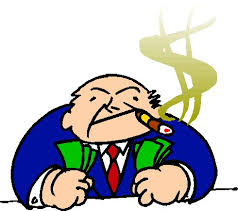
Republicans have sought to dismantle Social Security ever since that program began in 1935. And Republicans have furiously opposed other programs aiding the poor and middle-class–such as Medicare, food stamps and WIC (Women, Infants, Children).
In short, this is not a political party with a history of rushing to the defense of those most in need.
So the question remains: Why are so many poor Americans now flocking to its banner?
Two reasons: Racism and greed. There are historical parallels for both.
Racism:
In 1999, historian Victor Davis Hanson noted the huge gap in wealth between the aristocratic, slave-owning minority of the pre-Civil War South and the vast majority of poor white Southerners.
“Before the war in the counties Sherman would later ruin, the top 10% of the landowners controlled 40% of the assessed wealth.”
In contrast, “more than half of those who were lucky enough to own any property at all still possessed less than 15% of the area’s valuation.”
So Hanson asked: “Why did the millions of poor whites of the Confederacy fight at all?”
He supplied the answer in his brilliant work on military history, The Soul of Battle: From Ancient Times to the Present Day, How Three Great Liberators Vanquished Tyranny.
One of those liberators was General William Tecumseh Sherman, who led 62,000 Union troops in a victorious “March to the Sea” through the Confederacy in 1864.
So why did so many poor Southern whites literally lay down their lives for the wealthy planter class, which despised them?
Share this: