bureaucracybusters

Posts Tagged ‘FULL METAL JACKET’

FROM “CREDIBILITY GAP” TO “ORWELL LAND”: PART ONE (OF THREE)

In Bureaucracy, History, Law, Law Enforcement, Military, Politics, Social commentary on September 28, 2016 at 12:09 am

“Credibility gap” is a term that came into use during the mid-1960s to describe public and journalistic distrust of President Lyndon B. Johnson. In particular, the term was applied to his administration’s conduct of the Vietnam war.

It was, in short, a euphemism for accusing government officials of outright lying.

An example of the credibility gap in full swing appeared in Stanley Kubrick’s classic 1987 Vietnam war movie, Full Metal Jacket

Related image

Vietnam was a war where military and political officials spewed a gung-ho version of constant American progress against a tough enemy.

And where civilian reporters like David Halberstam and Walter Cronkite saw–and labeled–the war as a brutal, wasteful and ultimately doomed effort. 

Midway through the film, there’s an editorial meeting of The Sea Tiger, the official Marine newspaper.

Lieutenant Lockhart is presiding–and he is determined to give his superiors an endless stream of “all-systems-go” propaganda reports. He reads a series of stories that have been published:

Story #1: DIPLOMATS IN DUNGAREES–MARINE ENGINEERS LEND A HELPING HAND REBUILDING DONG PHUC VILLAGES.

LOCKHART: “Chili, “if we move Vietnamese, they are evacuees. If they come to us to be evacuated, they are refugees.”

Story #2: N.V.A. SOLDIER DESERTS AFTER READING PAMPHLETS.

LOCKHART: “A young North Vietnamese Army regular, who realized his side could not win the war, deserted from his unit after reading Open Arms program pamphlets.”

Story #3: NOT WHILE WE’RE EATING: N.V.A. LEARN MARINES ON A SEARCH AND DESTROY MISSION DON’T LIKE TO BE INTERRUPTED WHILE EATING CHOW.

LOCKHART: “‘Search and destroy.’  Uh, we have a new directive on this. In the future, in place of ‘search and destroy,’ substitute the phrase ‘sweep and clear.’ Got it?” 

Related image

Lt. Lockhart, editor of The Sea Tiger 

LOCKHART:  “And, Joker–where’s the weenie?”

JOKER:  “Sir?”

LOCKHART  “The Kill, Joker. I mean, all that fire, the grunts must’ve hit something.”

JOKER:  “Didn’t see ’em.”

LOCKHART:  “Joker, I’ve told you, we run two basic stories here: Grunts who give half their pay to buy gooks toothbrushes and deodorants–winning of hearts and Minds–okay? And combat action that results in a kill–Winning the War. Now you must have seen blood trails … drag marks?”

JOKER:  “It was raining, sir.”

LOCKHART:  “Well, that’s why God passed the law of probability. Now rewrite it and give it a happy ending–say, uh, one kill. Make it a sapper or an officer. Grunts like reading about dead officers.”

JOKER:  “Okay, an officer. How about a general?”

LOCKHART:  “Joker, maybe you’d like our guys to read the paper and feel bad. I mean, in case you didn’t know it, this is not a particularly popular war. Now, it is our job to report the news that these why-are-we-here civilian newsmen ignore.”

So great became the divide between truth and lies during military “press briefings” that reporters started calling them “The Five O’clock Follies.” And even some soldiers took to wearing buttons that said: “Ambushed at Credibility Gap.”

Reporters who dared to write truthfully about the military’s crimes and failures–like David Halberstam of the New York Times and Peter Arnett of the Associated Press–were regarded as traitors by military and political officials.

In 1963, President John F. Kennedy became enraged by Halberstam’s reporting on the corruption of the South Vietnamese government. He pressured New York Times publisher Arthur Ochs Sulzberger to transfer Halberstam to another locale. Sulzberger politely refused–and then extended Halberstam’s stay in Vietnam another six months.

Related image

David Halberstam

In 1965, when CBS Correspondent Morley Safer filmed Marines setting fire to the village of Cam Ne with Zippo lighters, President Lyndon B. Johnson was similarly outraged.

He placed an early-morning call to CBS News President Frank Stanton and shouted: “Your boys shat on the American flag!”

The trail of deceit and attempted censorship continued right up to the end of the war–in April, 1975. That was when North Vietnamese forces invaded the South and quickly overwhelmed the incompetent defenses arrayed against them.

And while America was still bogged down in Vietnam, the Watergate scandal erupted on June 17, 1972.

Related image

Watergate Hotel

Members of the Nixon administration’s secret “Plumbers Unit” burglarized the offices of the Democratic National Committee at the Watergate Hotel.

Obsessed with re-electing Richard Nixon, they sought incriminating information to discredit U.S. Senator George McGovern, the Democrats’ nominee for President.

When the burglars were caught, President Richard M. Nixon and his topmost officials lied and stonewalled both reporters and investigators seeking the truth.

Nixon’s press secretary, Ronald Ziegler, repeatedly slandered the integrity of The Washington Post for its coverage of the mushrooming Watergate scandal. He called the Watergate break-in “a third-rate burglary” and attacked the Post for “shabby journalism.”

Finally, on April 17, 1973, Ziegler, announced at a press conference: “This is the operative statement. The others are inoperative.”

In short: We’ve been lying to you for the last 10 months.  But now we’re telling the truth.

Like Vietnam, the Watergate scandal destroyed the reputations of many of its chief architects. Forty government officials were indicted or jailed.

Vietnam and Watergate were seminal events for Americans coming of age in the late 1960s and early 1970s. They taught an entire generation: Don’t trust the government.  Its officials routinely lie, and their lies can be deadly.

FROM “CREDIBILITY GAP” TO “ORWELL LAND”: PART THREE (END)

In Bureaucracy, History, Law, Law Enforcement, Military, Politics, Social commentary on September 26, 2016 at 3:03 pm

For five years, Donald Trump, more than anyone else, popularized the slander that President Barack Obama was born in Kenya–and was therefore not an American citizen.

In April, 2011, Obama released the long-form version of his Hawaiian birth certificate. Still, Trump questioned its–and Obama’s–legitimacy.

For more than a year during his 2016 Presidential campaign, Trump continued doing so. 

Meanwhile, Trump’s popularity steadily fell among blacks. In June, 2016, a Quinnipiac poll revealed that Trump had 1% of support from black voters–while 91% of black voters backed Hillary Clinton.

Even the managers of Trump’s campaign urged him to put the “birther” issue behind him.

And so, on September 16, 2016–10 days before his scheduled first debate with Democratic Presidential nominee Hillary Clinton–Trump made his version of a reversal.  
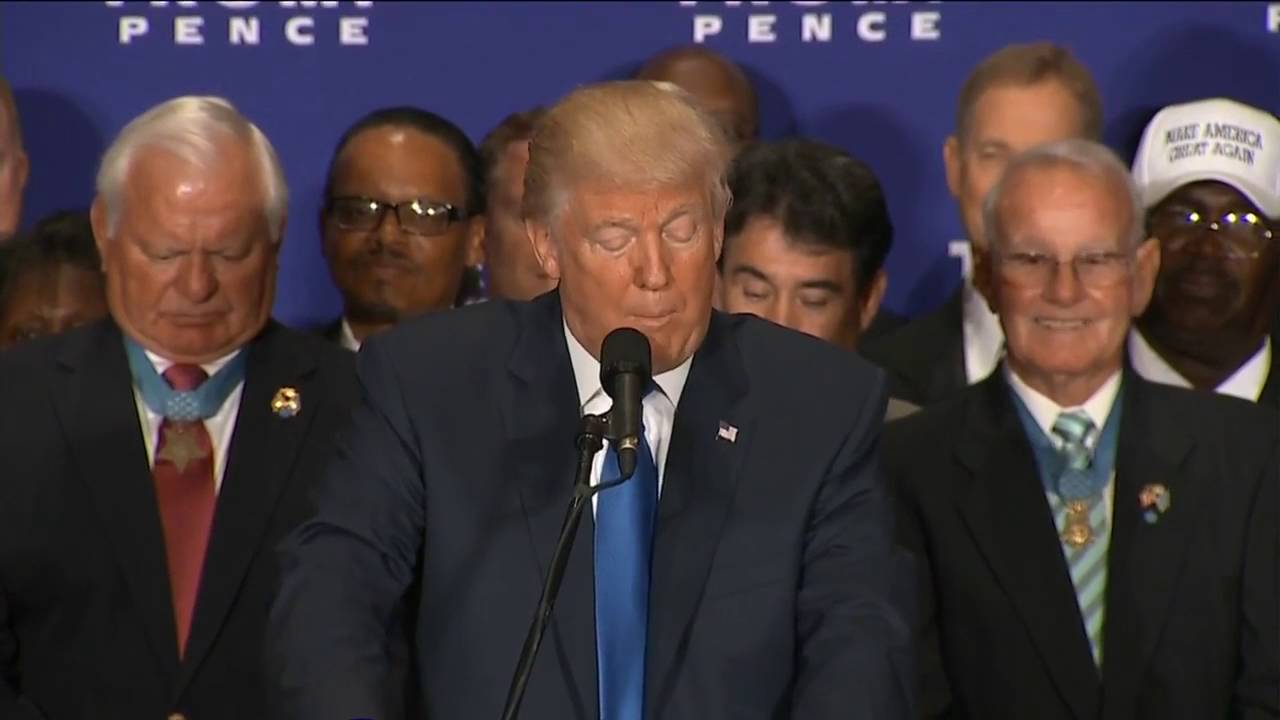
Image result for Images of Donald Trump's birther press conference

Donald Trump: “President Barack Obama was born in the United States.”

He did so in about seven seconds and 40 words–after spending a half hour paying tribute to the military and promoting his new upscale hotel in Washington, D.C.:

“Now, not to mention her in the same breath, but Hillary Clinton and her campaign of 2008 started the birther controversy.

“I finished it.  I finished it.  You know what I mean.

“President Barack Obama was born in the United States, period. Now we all want to get back to making America strong and great again.”  

His tone made it clear that he felt uneasy making that statement–and wanted to get it over with as fast as possible.

He refused to take questions from reporters covering the event. Nor did he apologize for his five-year campaign of slander.  

On the evening of September 16, Hillary Clinton strongly responded to Trump’s comments: 

“For five years, he has led the birther movement to delegitimize our first black president. His campaign was founded on this outrageous lie. There is no erasing it in history.”  

And First Lady Michelle Obama slammed Trump for his “birther” claims: 

“Then, of course, there were those who questioned, and who continue to question for the past eight years, and up to this very day, whether my husband was even born in this country.

“Well, during his time in office, I think Barack has answered those questions with the examples he set, by going high when they go low. And he’s answered these questions with the progress we’ve achieved together.” 

Related image

Michelle Obama

But perhaps the best perspective on this event was provided by syndicated columnist Mark Shields and New York Times columnist David Brooks. Each Friday they appear on the PBS Newshour to review the week’s major political events.
Image result for Images of Mark Shields and David Brooks on PBS Newshour

David Brooks and Mark Shields

On September 16, Shields (a liberal) and Brooks (a conservative) addressed Trump’s about-face on birtherism.    

MARK SHIELDS: “I think it’s important to establish right at the outset that [Trump] wasn’t only the loudest and the highest-profile and the most persistent and the most well-publicized birther, he, Donald Trump. He lied. He lied consistently and persistently.

“And, today, without explanation or excuse, he just changed his position and tried to absolutely falsely shift the blame onto Hillary Clinton.

“And this was an appeal to–he debased democracy. He debased the national debate. He appealed to that which is most ignoble or least noble in all of us.”

DAVID BROOKS: “Usually, there’s some tangential relationship to the truth, but a corroding relationship to the truth, frankly, as politics has gone on over the years.

“But now we’re in a reverse, Orwellian inversion of the truth with this. And so we have a team of staffers and then the candidate himself who have taken the normal spin and smashed all the rules.

“And so we are really in Orwell land. We are in 1984. And it’s interesting that an authoritarian personality type comes in at the same time with a complete disrespect for even tangential relationship to the truth that words are unmoored.

“And so I do think this statement sort of shocked me with the purification of a lot of terrible trends that have been happening. And so what’s white is black, and what is up is down, what is down is up. And that really is something new in politics.

“And the fact that there is no penalty for it, apparently–he’s doing fantastic in the last two weeks in the polls–is just somehow where we have gotten.”  

* * * * *  

Americans were slow to recognize the dangers of their government’s committing armed forces to South Vietnam. But when the record of government lies reached critical mass, Americans demanded an end to the war.  

Similarly, Americans were reluctant to brand Richard Nixon, their newly-re-elected President, a criminal worthy of impeachment. But when the evidence of his criminality steadily mounted, they demanded his ouster.  

Today, Americans are flooded with overwhelming evidence of Donald Trump’s unfitness to become President. His narcissism, vindictiveness, ignorance and hair-trigger temper have been on public display for more than a year.  

Yet millions of ignorant, hate-filled, Right-wing Americans plan to catapult this man–who “debased democracy, debased the national debate, appealed to that which is most ignoble or least noble in all of us”–to the Presidency.

If that happens, future historians–if there are any–may similarly condemn those Americans who stood by like “good Germans” and allowed their country to fall into the hands of a ruthless tyrant.

NEVER FIRED, ONLY DROPPED ONCE: PART TWO (END)

In Bureaucracy, History, Military, Politics on May 26, 2015 at 12:11 am

The relationship between the United States and Iraq has become dangerously similar to the one that existed between America and South Vietnam from 1955 to 1973.

From 1955 to 1963, the United States backed Ngo Dinh Diem as the “president” of South Vietnam.  During those eight years:

  • Diem was a Catholic mandarin who was alienated from an overwhelmingly poor, 95% Buddhist country.
  • The Shiite-dominated government of Iraq refuses to grant political concessions to alienated Sunnis.
  • Diem’s authority didn’t extend far beyond Saigon.
  • The Iraqi government controls little outside of Baghdad.
  • Diem didn’t believe in democracy–despite American claims to support his efforts to bring it to Vietnam.
  • Neither does the government in Baghdad.

Ngo Dinh Diem

  • Diem was widely regarded in Vietnam as an illegitimate leader, imposed by the Americans.
  • Ditto for the leaders of the Iraqi government.
  • American soldiers were sent to Vietnam because America feared Communism.
  • American soldiers have were sent to Iraq because America fears Islamic terrorism.
  • American troops were ordered to train the South Vietnamese army to defend themselves against Communism.
  • American troops were ordered to train the Iraqi army to defend themselves against terrorism.
  • Americans quickly determined that the South Vietnamese army was worthless–and decided to fight the Vietcong in its place.
  • Americans–such as Secretary of Defense Ash Carter–have determined that the Iraqi army is worthless. Yet many Americans on the Right believe the United States should commit American ground troops to fight ISIS in its  place.

American soldiers in Vietnam 

  • The Vietcong and North Vietnamese Army (NVA) fought to unify their country–and posed no threat to the United States.
  • ISIS is warring on Shiite Muslims–and poses no direct threat to the United States.
  • The far Right embraced the Vietnam war to assert American power in Asia.
  • The far Right embraces the Iraqi war to assert American power in the Middle East.
  • Americans entered Vietnam without an exit strategy.
  • Americans entered Iraq without an exit strategy.

American soldiers in Iraq

The United States’ relationship with Diem ended on November 1, 1963.  A coup led by generals of the South Vietnamese army ousted–and murdered–Diem.

But America continued to support successive and incompetent South Vietnamese dictatorships up to the end of the war in 1973.

Americans have been at war with Islamic expansionists since 2001.  But Republicans and their Rightist supporters want more of the same.

Rick Perry, former governor of Texas, has stated: “We face a global struggle against radical Islamic terrorists, and we are in the early stages of this struggle.”

And New Jersey Governor Chris Christie has declared: “No wonder we’re not intimidating our adversaries and they’re running around wild in the world, because they know we’re not investing in our defense anymore.”

As political commentator Mark Shields said on the May 22 edition of The PBS Newshour:

“Rick Perry has said–wants boots on the ground. Other Republicans have said they want boots on the ground, but they don’t necessarily have to be American boots. They should be Arab boots.

“Now, there are 60 nations in this coalition. I haven’t seen people lining up to join this fight. I mean, in a proxy war, you are dependent upon your proxies. And the Iraqis turn out to be not particularly engaged, divided, not unified, not committed the same way….

“[Republicans are saying] Get tough, get tough, swagger; 10,000 troops….

“George Pataki said, put in as many as you need, and kill everybody you can and get out. Now, getting out, I think, was the question and it remains the dilemma to this moment.”

* * * * *

Almost 50 years ago, American “grunts” felt about their South Vietnamese “allies” as American troops now feel about their Iraqi “allies.”

Dr. Dennis Greenbaum, a former army medic, summed it up as follows:

American surgical team in Vietnam

“The highest [priority for medical treatment] was any U.S. person.

“The second highest was a U.S. dog from the canine corps.

“The third was NVA [North Vietnamese Army].

“The fourth was VC [Viet Cong].

“And the fifth was ARVIN [Army of the Republic of South Vietnam], because they had no particular value,” said Greenbaum.

When you despise the “ally” you’re spending lives and treasure to defend, it’s time to pack up.

President Obama should recognize this–and start shipping those troops home.  And he should explain to Americans that a war among Islamics is actually in America’s best interests:

  • While Islamic nations like Syria and Iraq wage war within their own borders, they will lack the resources–and incentive–to attack the United States.
  • Every dead Hezbollah, ISIS and Al-Qaeda member makes the United States that much safer.
  • The peoples of the Middle East have long memories for those who commit brutalities against them.  In their veins, the cult of the blood feud runs deep.
  • This conflict could easily become the Islamic equivalent of “the Hundred Years’ War” that raged from 1337 to 1453 between England and France.

When Adolf Hitler invaded the Soviet Union in 1941, then-Senator Harry Truman said: “I hope the Russians kill lots of Nazis and vice versa.”

That should be America’s view whenever its sworn enemies start killing off each other.  Americans should welcome such self-slaughters, not become entrapped in them.

NEVER FIRED, ONLY DROPPED ONCE: PART ONE (OF TWO)

In Bureaucracy, History, Military, Politics on May 25, 2015 at 12:54 am

From 1965 until 1973, the United States lent its full military power to aiding the dictatorship of South Vietnam against the dictatorship of North Vietnam.

Despite this, veterans of combat with the North Vietnamese Army showed far more respect for their hard-core enemies than their supposedly staunch South Vietnamese allies.

Consider the following examples, taken from the screenplay of Stanley Kubrick’s classic 1987 film, Full Metal Jacket.

The movie is largely based on Dispatches, the Vietnam memoirs of Michael Herr, a war correspondent for Esquire magazine (1967-1969).

Example 1:

A group of Marines are resting on the plaza of a pagoda.  One of them calls to a photographer for the Marine newspaper, The Sea Tiger: “Hey photographer! You want to take a good picture? Here, man, take this. This is my bro….”

He lifts a hat, which is covering the face of a dead man–and reveals the face, not of an American, but of a North Vietnamese soldier.

“This is my bro…” 

“This is his party. He’s the guest of honor. Today is his birthday.  I will never forget this day. The day I came to Hue City and fought one million N.V.A. [North Vietnamese Army] gooks.

“I love the little Commie bastards, man, I really do. These enemy grunts are as hard as slant-eyed drill instructors. These people we wasted here today are the finest human beings we will ever know.

“After we rotate back to the world [the United States] we’re gonna miss not having anyone around that’s worth shooting.”

Example 2:

A reporter for a TV news crew is interviewing Marines during a lull in the fighting for the city of Hue.

EIGHTBALL: “Personally, I think they don’t really want to be involved in this war. I mean, they sort of took away our freedom and gave it to the gookers, you know. But they don’t want it. They’d rather be alive than free, I guess. Poor dumb bastards.”

COWBOY: “Well, the ones I’m fighting at are some pretty bad boys. I’m not real keen on some of these fellows that are supposed to be on our side. I keep meeting ’em coming the other way.”

DONLON: “I mean, we’re getting killed for these people and they don’t even appreciate it. They think it’s a big joke.”

ANIMAL MOTHER: “Well, if you ask me, uh, we’re shooting the wrong gooks.”

Example 3:

Haggling with a South Vietnamese pimp over the cost of a prostitute’s wares, a Marine recites a joke popular among American forces: “Be glad to trade you some ARVN rifles. Never been fired and only dropped once” [by retreating South Vietnamese forces].

* * * * *

Now, fast-forward from Vietnam in 1968 to Iraq in 2015.

Once again, the United States seems poised to embrace another worthless “ally.”

On May 25, Secretary of Defense Ash Carter bluntly accused the army of Iraq of lacking the will to stand up to its enemies in the Islamic State of Iraq and Syria (ISIS).

Secretary of Defense Ash Carter

On May 17, the Iraqi city of Ramadi fell to ISIS after the Iraqi army deserted the citizens counting on its protection.

Appearing on CNN’s Sunday news show, State of the Union, Carter said:

“What apparently happened is that the Iraqi forces showed no will to fight.  They were not outnumbered.  In fact, they vastly outnumbered the opposing force.

“That says to me, and I think to most of us, that we have an issue with the will of the Iraqis to fight [ISIS] and defend themselves.”

On the May 22, edition of the PBS Newshour, political commentator Mark Shields–a former Marine–sized up the situation:

“And the chairman of the Joint Chiefs of Staff, General Martin Dempsey, said they were not driven, the Iraqi army was not driven out of Ramadi. They drove out of Ramadi.

“They aren’t a paper tiger. They’re a paper tabby cat….

“But I will say that there are 250,000 Iraqi troops.  There are, by CIA estimates, up to 31,000 ISIS troops.

“And you have full flight.  I mean, they won’t be engaged. They haven’t been engaged.”

In 2010, President Barack Obama announced the withdrawal of American combat troops from Iraq.

Since then, Obama’s strategy for turning Iraq into a bulwark against islamic extemism has rested on two goals:

  1. Rebuilding and retraining the Iraqi army; and
  2. Prodding the Shiite-dominated government in Baghdad to reconcile with the nation’s Sunnis.

The second goal is especially important. The Sunnis, a religious minority in Iraq, ruled the country for centuries until the United States drove Saddam Hussein from power in 2003.

Now the Shiites are in control of Iraq, and they have been unwilling to grant political concessions to the alienated Sunnis. Baghdad has continued to work closely with Shiite militias backed by Iran.

In turn, the Sunnis have become a source of manpower and money for ISIS.

America’s relationship with Iraq has become eerily similar to the one it had with South Vietnam from 1955 to 1973.

And that relationship led the United States into the most divisive war in its history since the Civil War (1861-1865).

CENSORSHIP: THE AMERICAN WAY

In Bureaucracy, History, Military, Politics, Social commentary on May 14, 2015 at 3:29 pm

Midway through Stanley Kubrick’s 1987 Vietnam epic, Full Metal Jacket, there’s an editorial meeting of The Sea Tiger, the official Marine newspaper.

The correspondents are discussing how best to portray America’s faltering efforts to win a war that most of the “grunts” have come to see as unwinnable.

Lieutenant Lockhart, who’s presiding, wants his reporters to make some changes in the way they report the war.

LOCKHART: Chili, if we move Vietnamese, they are “evacuees.” If they come to us to be evacuated, they are “refugees.”

CHILI: I’ll make a note of it, sir.

LOCKHART (reading): “A young North Vietnamese Army regular, who realized his side could not win the war, deserted from his unit after reading Open Arms program pamphlets.”

That’s good, Dave. But why say “North Vietnamese Army regular”? Is there an irregular?  How about “North Vietnamese Army soldier”?

DAVE:  I’ll fix it up, sir.

LOCKHART: “Search and destroy.” Uh, we have a new directive on this. In the future, in place of “search and destroy,” substitute the phrase “sweep and clear.” Got it?

Lt. Lockhart (right) briefs his Marine reporters 

JOKER:  Got it. Very catchy.

LOCKHART: And, Joker–where’s the weenie?

JOKER:  Sir?

LOCKHART The Kill, Joker. The kill. I mean, all that fire, the grunts must’ve hit something.

JOKER:  Didn’t see ’em.

LOCKHART Joker, I’ve told you, we run two basic stories here. Grunts who give half their pay to buy gooks toothbrushes and deodorants–Winning of Hearts and Minds–okay?

And combat action that results in a kill–Winning the War. Now you must have seen blood trails … drag marks?

JOKER:  It was raining, sir.

LOCKHART:  Well, that’s why God passed the law of probability. Now rewrite it and give it a happy ending–say, uh, one kill. Make it a sapper or an officer. Which?

JOKER:  Whichever you say.

LOCKHART Grunts like reading about dead officers.

JOKER Okay, an officer. How about a general?

LOCKHART Joker, maybe you’d like our guys to read the paper and feel bad. I mean, in case you didn’t know it, this is not a particularly popular war. Now, it is our job to report the news that these why-are-we-here civilian newsmen ignore.

* * * * *

Kubrick’s film is set in the South Vietnam of 1968.

This was a war where military newspapers like Stars and Stripes offered a gung-ho, all-systems-go version of constant American progress against a tough enemy.

And where civilian reporters like David Halberstam and Walter Cronkite saw the war for what it was and labeled it a brutal, wasteful and ultimately doomed effort.

Now, 47 years after the events depicted in Full Metal Jacket, the Obama administration wants to censor the American news media as the military censored its own.

The President wants the media to stop using footage from the Islamic State of Iraq and the Levant (ISIL) during newscasts.

“We are urging broadcasters to avoid using the familiar B-roll that we’ve all seen before, file footage of ISIL convoys operating in broad daylight, moving in large formations with guns out, looking to wreak havoc,” Emily Horne, a spokeswoman for  the State Department, told Politico.

Stop using ISIL footage, Obama administration asks networks – Michael Crowley and Hadas Gold – POLITICO

The “B-roll” is stock footage that appears onscreen while reporters/commentators talk. It’s the stuff that keeps an audience watching the newscast, even if they ignore what’s being said.

“It’s inaccurate–that’s no longer how ISIL moves,” she added.

Since August, 2014, the United States and its allies have dropped thousands of bombs on ISIL–especially on its convoys–in Iraq and Syria.

As a result, claim U.S. officials, ISIL can no longer mass its forces in daylight–or move in large convoys.  Such large concentrations can be easily spotted–and attacked–from the air.

ISIL convoy

So how would the Pentagon like ISIL to be portrayed in file footage?

“One Toyota speeding down the road by itself at night with its headlights off,” said Pentagon spokesman Colonel Steve Warren.

Warren added that some of the B-roll the networks are using comes from propaganda videos made by ISIL.

Senior State Department and Pentagon officials have begun contacting television network reporters to suggest news sources switch to using more U.S.-friendly videos, such as Iraqi army soldiers being trained, or footage from coalition airstrikes.

When contacted by Politico for comment, ABC, CNN, Fox and NBC refused to comment.

Covering how Americans behave in war has proven a challenge for American news media since the Vietnam conflict.

In 1966, New York Times reporter Harrison E. Salisbury was allowed to enter North Vietnam to cover the war from their perspective.

His reports of heavy American bombing raids and their resulting civilian casualties and infrastructure damage provoked national controversy.

Officials of the Johnson administration charged Salisbury with “aiding and abetting the enemy” by reporting North Vietnamese claims of loss.

Salisbury–and the Times–replied that of course they were reporting what North Vietnamese officials were saying.  That was why he was there–to get the other side’s point-of-view.

So long as freedom of the press exists in reality as well as theory, there will always be tension between those who want to report the news–and those who want to censor it.