ABC NEWS, ALAN GREENSPAN, BUREAUCRACY, BUSINESS, CBS NEWS, CNN, CORPORATIONS, EXECUTIVES, FACEBOOK, LEADERSHIP, NBC NEWS, NICCOLO MACHIAVELLI, THE CHICAGO SUN-TIMES, THE CHICAGO TRIBUNE, THE NEW YORK TIMES, THE WALL STREET JOURNAL, THE WASHINGTON POST, TWITTER
In Bureaucracy, Business, History, Self-Help on March 13, 2015 at 12:08 am
“The man who builds a factory,” said President Calvin Coolidge, “builds a temple. And the man who works there worships there.”
Many American corporate executives still feel about themselves–nd their employees. But those heady days of knee-jerk worship of CEOs and their oversize salaries and egos are over–at least, temporarily.
Americans have reluctantly learned that the robber barons who rule Wall Street arenot God’s own elect.
Even Ayn Rand disciple Allen Greenspan, the former Federal Reserve chairman and a longtime champion of de-regulation, has admitted he totally underestimated the role greed plays in the making of financial decisions.
It’s thus time for Americans to demand wholesale reforms in the ways corporate executives are allowed to operate. And a good place to start is with the advice of Niccolo Machiavelli.
The Florentine statesman (1469-1527) wrote extensively about how bureaucracies truly work–as opposed to how people believe they do.
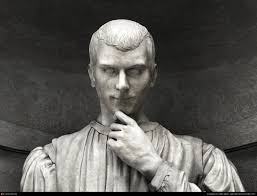
Niccolo Machiavelli
Consider the following from his book, The Prince, which offers instruction on how to attain and retain power:
- IMITATE THOSE WHO HAVE ATTAINED GREATNESS: Not always being able to follow others exactly, nor attain to the excellence of those he imitates, a prudent man should always follow in the paths trodden by great men and imitate those who are most excellent…. If he does not attain to their greatness, at any rate he will get some tinge of it.
- DON’T RELY ON LOVE: …I conclude, therefore, with regard to being loved and feared, that men love at their own free will, but fear at the will of the prince, and that a wise prince must rely on what is in his power and not on what is in the power of others, and he must only contrive to avoid incurring hatred….
- NEED TO BE PRACTICAL: A man who wishes to make a profession of goodness in everything must inevitably come to grief among so many who are not good. And therefore it is necessary for a prince, who wishes to maintain himself, to learn how not to be good, and to use this knowledge and not use it, according to the necessity of the case.
- CAUTION AND BOLDNESS: A [leader]…must imitate the fox and the lion, for the lion cannot protect himself from traps, and the fox cannot defend himself from wolves. One must therefore be a fox to avoid traps, and a lion to frighten wolves. Those who wish to be only lions do not realize this.
- SANCTIONS VS. FAVORS: [Leaders] should let the carrying out of unfavorable duties devolve to others, and bestow favors themselves.
- RISK AS A GIVEN: Let no [leader] believe that [he] can always follow a safe policy, rather let [he] think that all are doubtful. This is found in the nature of things, that one never tries to avoid one difficulty without running into another, but prudence consists in being able to know the nature of the difficulties, and taking the least harmful as good.
- A RULER’S SUBORDINATES: The first impression that one gets of a ruler and his brains is from seeing the men that he has about him. When they are competent and loyal one can always consider him wise, as he has been able to recognize their ability and keep them faithful.
- But when they are the reverse, one can always form an unfavorable opinion of him, because the first mistake that he makes is in making this choice.
- EVALUATING COMPETENCE: There are three different kinds of brains: the one understands things unassisted, the other understands things when shown by others, the third understands neither alone nor with the explanations of others. The first kind is most excellent; the second is also excellent; but the third is useless.
- OVERCOMING ONE’S OWN NATURE: No man can be found so prudent as to be able to adopt himself to [time and circumstances], either because he cannot deviate from that to which his nature disposes him.
- Or else because having always prospered by walking in one path, he cannot persuade himself that it is well to leave it; and therefore the cautious man, when it is time to act suddenly, does not know how to do so and is consequently ruined. For if one could change one’s nature with time and circumstances, fortune would never change.
- ENSURING LOYALTY: A wise prince will seek means by which his subjects will always have need of his government, and then they will always be faithful to him.
- CRUELTIES: Well-committed may be called those…cruelties which are perpetrated once for the need of securing one’s self, and which afterward are not persisted in, but are exchanged for measures as useful to the subjects as possible. Cruelties ill committed are those which, although at first few, increase rather than diminish with time.
- FORTUNE: I think it may be true that fortune is the ruler of half our actions, but that she allows the other half or thereabouts to be governed by us.
- I would compare her to an impetuous river that, when turbulent, inundates the plains, casts down trees and buildings, removes earth from this side and places it on the other; every one flees before it, and everything yields to its fury without being able to oppose it. Still, when it is quiet, men can make provisions against it by dykes and banks, so that when it follows it will either go into a canal or its rush will not be so wild and dangerous.
ABC NEWS, ALAN GREENSPAN, BUREAUCRACIES, BUSINESS, CBS NEWS, CNN, CORPORATIONS, ECONOMICS, EXECUTIVES, FACEBOOK, LEADERSHIP, NBC NEWS, NICCOLO MACHIAVELLI, SELF-HELP, THE FEDERAL RESERVE, THE HUFFINGTON POST, THE NEW YORK TIMES, THE WALL STREET JOURNAL, THE WASHINGTON POST, TWITTER
In Bureaucracy, Business, History, Self-Help on May 14, 2013 at 12:00 am
I returned, and saw under the sun, that the race is not to the swift, nor the battle to the strong, neither yet bread to the wise, nor yet riches to men of understanding, nor yet favour to men of skill; but time and chance happeneth to them all.
–Ecclesiastes 9:11
It is one thing to gain executive power, and another to hold onto it. It is altogether different to use it wisely and justly.
Many are the dictators who have ruled long, but not justly–such as Porfiro Diaz, whose 30-year regime was ended by the Mexican Revolution in 1911.
And many are those who wanted to rule justly but could not face up to the harsh realities of power. One of these was Francisco Madero, who democratically succeeded Diaz–but was soon betrayed and executed by Victoriana Huerta, one of his own generals.
In Part One, I outlined a number of timeless suggestions by Niccolo Machiavelli, the Florentine statesman and patriot (1469-1527) for attaining and wisely employing executive power.
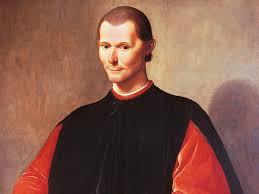
Niccolo Machiavelli
Many of this nation’s corporate executives and officials manning local, state and Federal agencies (including the Presidency) would do well to pay close attention to his advisories. Among these:
-
EVALUATING A SUBORDINATE: For a prince to be able to know a minister there is this method which never fails. When you see the minister think more of himself than of you, and in all his actions seek his own profit, such a man will never be a good minister, and you can never rely on him. For whoever has in hand the state of another man must never think of himself but of the prince, and not mind anything but what relates to him.
-
TREATMENT OF SUBORDINATES: And on the other hand, the prince, in order to retain his fidelity, ought to think of his minister, honoring and enriching him, doing him kindnesses and conferring on him favors and responsible tasks, so that the great favors and riches bestowed on him cause him not to desire other honors and riches, and the offices he holds make him fearful of changes. When princes and their ministers stand in this relation to each other, they can rely the one upon the other; when it is otherwise, the result is always injurious either for one or the other of them.
-
TAKING COUNSEL: There is no way of guarding oneself against flattery than by letting men understand that they will not offend you by speaking the truth. But when every one can tell you the truth, you lose their respect.
-
A prudent prince must therefore take a third course, by choosing for his counsel wise men, and giving them alone full liberty to speak the truth to him, but only of those things that he asks and of nothing else.
-
MAKING DECISIONS: But he must be a great asker about everything and hear their opinions, and afterwards deliberate by himself in his own way, and in these counsels and with each of these men comport himself so that every one may see that the more freely he speaks, the more he will be acceptable. Beyond these he should listen to no one, go about the matter deliberately, and be determined in his decisions.
- SEEK THE TRUTH: A prince, therefore, ought always to take counsel, but only when he wishes, not when others wish. On the contrary, he ought to discourage absolutely attempts to advise him unless he asks it. But he ought to be a great asker, and a patient hearer of the truth about those things of which he has inquired. Indeed, if he finds that anyone has scruples in telling him the truth he should be angry.
-
UNWISE PRINCES CANNOT BE WISELY ADVISED: And since some think that a prince who gains the reputation of being prudent is so considered, not by his nature but by the good counselors he has about him, they are undoubtedly deceived. It is an infallible rule that a prince who is not wise himself cannot be well advised, unless by chance he leaves himself entirely in the hands of one man who rules him in everything, and happens to be a very prudent man. In this case, he may doubtless be well governed, but it would not last long, for the governor would in a short time deprive him of the state.
-
FORTUNE: I think it may be true that fortune is the ruler of half our actions, but that she allows the other half or thereabouts to be governed by us.
-
I would compare her to an impetuous river that, when turbulent, inundates the plains, casts down trees and buildings, removes earth from this side and places it on the other; every one flees before it, and everything yields to its fury without being able to oppose it.
-
Still, when it is quiet, men can make provisions against it by dykes and banks, so that when it follows it will either go into a canal or its rush will not be so wild and dangerous.
 Bureaucracybuster's Blog