Posts Tagged ‘ERNESTO “CHE” GUEVARA’
9/11 ATTACKS, ABC NEWS, AFGHANISTAN, AL QAEDA, ALTERNET, AMERICABLOG, AP, BABY BOOMER RESISTANCE, BARACK OBAMA, BLOOMBERG, BOLIVIA, BUZZFEED, CBS NEWS, CIA, CNN, COMMUNISM, CROOKS AND LIARS, CUBA, CUBAN MISSILE CRISIS, DAILY KOZ, DRUDGE REPORT, ERNESTO "CHE" GUEVARA, FIDEL CASTRO, FIVETHIRTYEIGHT, GEORGE W. BUSH, GREEN BERETS, HARPER’S MAGAZINE, HUFFINGTON POST, IRAQ, ISLAM, JOHN F. KENNEDY, MEDIA MATTERS, MOTHER JONES, MOVEON, MSNBC, NAVY SEALS, NBC NEWS, NEWSWEEK, NIKITA KHRUSHCHEV, NPR, OSAMA BIN LADEN, PAKISTAN, PBS NEWSHOUR, POLITICO, POLITICUSUSA, RAW STORY, REUTERS, SALON, SEATTLE TIMES, SLATE, SOVIET UNION, TALIBAN, TALKING POINTS MEMO, THE ATLANTIC, THE CHICAGO SUN-TIMES, THE CHICAGO TRIBUNE, THE DAILY BEAST, THE DAILY BLOG, THE GUARDIAN, THE HILL, THE HUFFINGTON POST, THE LOS ANGELES TIMES, THE NATION, THE NEW REPUBLIC, THE NEW YORK TIMES, THE VILLAGE VOICE, THE WASHINGTON POST, THINKPROGRESS, TIME, TRUTHDIG, TRUTHOUT, TWITTER, TWO POLITICAL JUNKIES, U.S. NEWS & WORLD REPORT, UPI, USA TODAY, WONKETTE
In Bureaucracy, History, Military, Politics on May 5, 2023 at 12:20 am
When Osama bin Laden died, two weapons were within easy reach—an AK-47 assault rifle and a Russian-made nine-millimeter Makarov pistol.
But according to his wife, Amal, he was shot by Navy SEALS before he could reach either one.
A SEAL flashed coded news of bin Laden’s death to the Pentagon and the White House Situation Room, where President Barack Obama and the topmost officials of his administration anxiously followed events via a closed-circuit television.
“Geronimo [bin Laden] E-KIA [Enemy Killed in Action]” read the message.
The entire raid—including Intelligence sweeps of the compound—was over in less than 40 minutes. The SEALS moved quickly because they rightly feared that the Pakistani army would intervene to protect bin Laden.
Bin Laden had been living undisturbed at a large compound in Abbottabad for at least five years, just a short distance from Pakistan’s version of West Point.
Furthermore, the ISI—Pakistan’s Intelligence agency—had long been riddled with Al-Qaeda sympathizers, if not agents.
Within 24 hours of his death, Bin Laden’s body was transported to the aircraft carrier USS Carl Vinson for final rites and burial at sea.
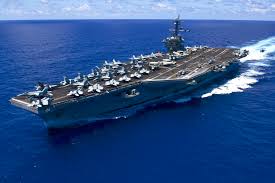
U.S.S. Carl Vinson
President Obama and other U.S. officials feared that his grave site would become a memorial for members of Al-Qaeda and other Islamic terrorist organizations.
In the late evening of May 1, 2011, the White House surprised major television networks by informing them that the President had a major announcement to make.
At 11:35 P.M. Eastern Standard Time, the President appeared at a podium in the East Room of the White House.
“Good evening. Tonight I can report to the American people and to the world that the United States had conducted an operation that killed Osama bin Laden, the leader of Al-Qaeda, and a terrorist who’s responsible for the murder of thousands of innocent men, women and children….
“For over two decades, bin Laden has been Al-Qaeda’s leader and symbol, and has continued to plot attacks against our country and our friends and allies. The death of bin Laden marks the most significant achievement to date in our nation’s efforts to defeat Al-Qaeda.”
He added that “no Americans were harmed” in the raid and that the SEALS had taken care to avoid civilian casualties.

President Barack Obama announcing Osama bin Laden’s death
Like Ernesto “Che” Guevara, bin Laden had become a pale, largely irrelevant figure by the time of his death.
Knowing he was the world’s most wanted man, he imprisoned himself within a fortified compound—which he never left.
Afraid to use a phone or the Internet, he relayed orders—which were often ignored—via the cumbersome use of couriers. All trash generated by the inhabitants of the compound was burned within its walls.
Ironically, the lack of Internet and phone lines to the compound—and the burning of its trash—led CIA officials to suspect that Osama bin Laden might be hiding there.
Pakistan was outraged. Officially an American ally, its territory had been secretly invaded by American military forces. Even more embarrassing: For years, Pakistani Intelligence had denied knowing bin Laden’s whereabouts.
Meanwhile, leaders of Islamic expansionist groups rallied to praise the dead bin Laden. Among these was his son, Omar, who denounced his father’s killing as a “criminal” act, and his burial at sea as demeaning to the Islamic faith.
In a letter published on the website of Islamic ideologue Abu Walid al-Masri, the younger bin Laden said the former Al-Qaeda leader’s children reserved the right to take legal action in the United States and internationally to “determine the true fate of our vanished father.”
Bin Laden’s death drew protests from hundreds of people in the city of Quetta, in southwestern Pakistan, who burned American flags and paid homage to the late terrorist leader.
On May 13, a pair of Taliban suicide bombers attacked Pakistani police recruits eagerly heading home for a break after months of training, killing 80 people. It was the first act of retaliation for the killing of bin Laden.
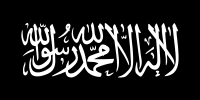
Flag of Al-Qaeda
Americans reacted differently.
Almost as Obama was addressing the nation, cheering crowds gathered outside the White House and in New York City’s Times Square. Many of them shouted “USA! USA! USA!” and waved American flags in celebration.
Celebration also broke out at the site of the former World Trade Center, the primary victim of the September 11 attacks.
For the next two weeks, Americans continued to rejoice. Much of their feelings were best expressed in grisly humor on websites and late night comedy shows such as “Tonight” and “Late Night With David Letterman.”
Killing Osama bin Laden removed Al-Qaeda’s most important member. But its treasury of secret materials—such as computer hard-drives, DVDs, notebooks, diaries—proved even more important to American military and Intelligence officials.
During the late 1960s and early 1970s, many Vietnam protesters marched carrying blown-up photos of Ernesto “Che” Guevara or tacked them to the walls of their dormitory rooms.
Most of these college students were members of the middle-class which Guevara had so despised.
Twelve years since the death of bin Laden, his poster has been noticeably absent from American college campuses—and everywhere else in the United States.
9/11 ATTACKS, ABC NEWS, AFGHANISTAN, AL QAEDA, ALTERNET, AMERICABLOG, AP, BABY BOOMER RESISTANCE, BARACK OBAMA, BLOOMBERG, BOLIVIA, BUZZFEED, CBS NEWS, CIA, CNN, COMMUNISM, CROOKS AND LIARS, CUBA, CUBAN MISSILE CRISIS, DAILY KOZ, DRUDGE REPORT, ERNESTO "CHE" GUEVARA, FIDEL CASTRO, FIVETHIRTYEIGHT, GEORGE W. BUSH, GREEN BERETS, HARPER’S MAGAZINE, HUFFINGTON POST, IRAQ, ISLAM, JOHN F. KENNEDY, MEDIA MATTERS, MOTHER JONES, MOVEON, MSNBC, NAVY SEALS, NBC NEWS, NEWSWEEK, NIKITA KHRUSHCHEV, NPR, OSAMA BIN LADEN, PAKISTAN, PBS NEWSHOUR, POLITICO, POLITICUSUSA, RAW STORY, REUTERS, SALON, SEATTLE TIMES, SLATE, SOVIET UNION, TALIBAN, TALKING POINTS MEMO, THE ATLANTIC, THE CHICAGO SUN-TIMES, THE CHICAGO TRIBUNE, THE DAILY BEAST, THE DAILY BLOG, THE GUARDIAN, THE HILL, THE HUFFINGTON POST, THE LOS ANGELES TIMES, THE NATION, THE NEW REPUBLIC, THE NEW YORK TIMES, THE VILLAGE VOICE, THE WASHINGTON POST, THINKPROGRESS, TIME, TRUTHDIG, TRUTHOUT, TWITTER, TWO POLITICAL JUNKIES, U.S. NEWS & WORLD REPORT, UPI, USA TODAY, WONKETTE
In Bureaucracy, History, Military, Politics on May 4, 2023 at 12:05 am
Ernesto “Che” Guevara was dead.
But that wasn’t enough for the Bolivian government that had authorized his execution. His corpse was disappear from the face of the earth.
On October 10, 1967, Guavara’s body was flown to nearby Vallegrande, where photographs were taken of him lying on a concrete slab in the laundry room of the Nuestra Senora de Malta.

Che Guevara in death
Several witnesses were called in to confirm that it was indeed Guevara. As hundreds of local residents filed past the corpse, many of them felt Guevara resembled images of a bearded, long-haired Jesus Christ. Some of them even surreptitiously clipped locks of his hair as divine relics.
After a military doctor amputated his hands, Bolivian army officers transferred Guevara’s body to an undisclosed location. The government refused to say whether his remains had been buried or cremated.
Che’s hands were preserved in formaldehyde and sent to Buenos Aires, Argentina, for fingerprint identification. (His prints were on file with the Argentine police.)
On October 15, Fidel Castro acknowledged that Guevara was dead and proclaimed three days of public mourning throughout Cuba.
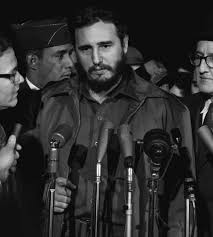
Fidel Castro
Che, in one sense, was lucky to die as he did—and when he did. He was only 39, but he was already running to fat and increasingly troubled by his lifelong asthma.
His Don Quixote-like venture into Bolivia had proven a failure from first to last. Peasants didn’t flock to his banner; in fact, some of them betrayed his movements to the Bolivian army.
And 24 years after Guevara’s execution, Communism, his secular religion, died a violent death in its birthplace—the Soviet Union. It wasn’t killed off by invading capitalist forces, but thrown off by the Russian people themselves.
Nor would Che be pleased with the course of “revolutionary” events in Cuba. Until the death of the Soviet Union, the island remained dependent on what amounted to Soviet welfare.
Since then, Cubans have supported themselves by turning their island into a privileged playground for the rich—especially rich Americans.
On October 17, 1997—30 years after their deaths—Guevara and six of his fellow combatants were buried with full military honors in a specially built mausoleum in Santa Clara, Cuba. It was there in 1958 that he had commanded the decisive military victory of the Cuban Revolution.
Having described, in Part One, how Ernesto “Che” Guevara met his end, it’s time to examine how Osama bin Laden earned his 72 willing virgins.
After the September 11, 2001 attacks on the Pentagon and the World Trade Center, the United States quickly established that bin laden had plotted them.
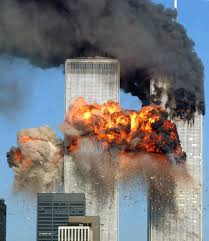
World Trade Center on 9/11/01
But bin Laden was then living in Afghanistan and protected by its Islamic rulers, the Taliban. President George W. Bush gave the Taliban an ultimatum: Surrender bin Laden—or else.
The Taliban refused.
On October 7, 2001, the United States’ new allies, the Northern Alliance, supported by American airstrikes, began a ground campaign against the Taliban.
Taliban resistance quickly vanished. Bin Laden retreated to Tora Bora, a series of bunkers in a mountainous region near the Pakistani border. With the mountains literally shaking under a rain of “bunker-busting” bombs, bin Laden decided to move on.
Suddenly, in December, 2001, he seemed to vanish from the earth.
Reports circulated that he was living in a cave in the no-man’s-land lying between Afghanistan and Pakistan.
Strangely, the Bush administration lost interest in locating him. Increasing numbers of American troops were quietly transferred from Afghanistan to staging areas near Iraq–for Bush’s long-planned overthrow of its dictator, Saddam Hussein.
Only when Barack Obama took office as President in 2009 was the CIA ordered to make finding bin Laden its top priority. Over the next two years, CIA agents sifted through a conflicting series of reports about bin Laden’s possible whereabouts.
Finally, the agency tracked a courier linked to bin Laden to a large, high-walled compound in Abbottabad, Pakistan.
On April 28, 2011, President Obama authorized a U.S. military raid on the compound, dubbed “Operation Neptune Spear.” On May 1, 2011, two teams of 12 U.S. Navy SEALS, working with the CIA, traveled in two helicopters to the compound.
The helicopters were specially outfitted to emit little noise. But an accident resulted when the tail rotor of one helicopter grazed the compound’s stone wall.
The damaged aircraft was “hard-landed” and then destroyed on-site to protect its technological secrets. Back-up forces were immediately available, and another helicopter was brought in to retrieve the commandos and relevant captured documents.
All combined, a total of 79 commandos and a dog (believed to have explosive-detection training) were involved in the raid.
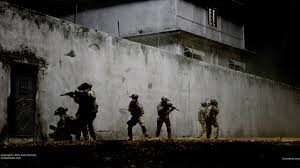
SEALS attacking bin Laden’s compound in the 2012 movie, “Zero Dark Thirty”
Abu Ahmed al-Kuwaiti, bin Laden’s courier, opened fire on the SEALS from the guesthouse with an AK-47 assault rifle. He and his wife were killed by return fire.
A male relative of the courier was shot and killed by the SEALS before he could reach a weapon lying nearby.
Bin Laden’s 22-year-old son rushed toward the SEALS on the staircase of the main house. SEAL gunfire instantly killed him.
Osama bin Laden, standing at the top of a staircase, retreated into his room—where SEALS followed and shot him in the head and chest.
9/11 ATTACKS, ABC NEWS, AFGHANISTAN, AL QAEDA, ALTERNET, AMERICABLOG, AP, BABY BOOMER RESISTANCE, BARACK OBAMA, BLOOMBERG, BOLIVIA, BUZZFEED, CBS NEWS, CIA, CNN, COMMUNISM, CROOKS AND LIARS, CUBA, CUBAN MISSILE CRISIS, DAILY KOZ, DRUDGE REPORT, ERNESTO "CHE" GUEVARA, FIDEL CASTRO, FIVETHIRTYEIGHT, GEORGE W. BUSH, GREEN BERETS, HARPER’S MAGAZINE, HUFFINGTON POST, IRAQ, ISLAM, JOHN F. KENNEDY, MEDIA MATTERS, MOTHER JONES, MOVEON, MSNBC, NAVY SEALS, NBC NEWS, NEWSWEEK, NIKITA KHRUSHCHEV, NPR, OSAMA BIN LADEN, PAKISTAN, PBS NEWSHOUR, POLITICO, POLITICUSUSA, RAW STORY, REUTERS, SALON, SEATTLE TIMES, SLATE, SOVIET UNION, TALIBAN, TALKING POINTS MEMO, THE ATLANTIC, THE CHICAGO SUN-TIMES, THE CHICAGO TRIBUNE, THE DAILY BEAST, THE DAILY BLOG, THE GUARDIAN, THE HILL, THE HUFFINGTON POST, THE LOS ANGELES TIMES, THE NATION, THE NEW REPUBLIC, THE NEW YORK TIMES, THE VILLAGE VOICE, THE WASHINGTON POST, THINKPROGRESS, TIME, TRUTHDIG, TRUTHOUT, TWITTER, TWO POLITICAL JUNKIES, U.S. NEWS & WORLD REPORT, UPI, USA TODAY, WONKETTE
In Bureaucracy, History, Military, Politics, Social commentary on May 3, 2023 at 12:11 am
They both had beards. They both saw military action. They both passionately hated the United States. And they both died in a hail of bullets.
And immediately after their deaths, both seemed to disappear from the face of the earth.
Ernesto “Che” Guevara and Osama bin Laden.
Two men who inspired widespread admiration among their supporters—and fear among their enemies.
Guevara, an Argentinian doctor-turned-Cuban revolutionary, sought to destroy the United States’ power to fight Communism. Bin Laden sought to destroy its power to intervene in the Middle East.
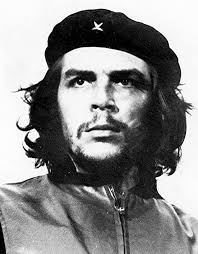
Ernesto “Che” Guevara
Guevara’s most optimistic hope was that Americans would eventually see the error of their capitalistic ways and convert to Communism. His last words were: “Tell Fidel [Castro] that he will soon see a triumphant revolution in America.”
But he was prepared to fight to the death–as indeed he did—to force revolutionary change upon the United States.
For Bin Laden, the cause was Islam, not Communism. His most optimistic hope was that Christian and Jewish Americans would eventually convert to Islam.
But if that didn’t happen, he, too, was prepared to attack Americans anywhere and in any way he could—as his private diary and documents have revealed.
Guevara died on October 9, 1967, at the hands of a CIA-directed operation run by the Bolivian army.
Bin Laden, creator of the Al-Qaeda (“The Base”) terrorist network, met his end on May 1, 2011, during a raid by U.S. Navy SEALS on his compound in Pakistan.
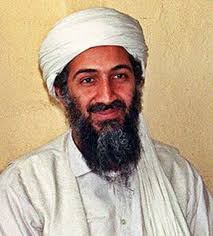
Osama bin Laden
One man—Guevara—has since attained secular sainthood in the eyes of millions of Communists and their sympathizers.
The other—bin Laden—has attained instant “martyr” status in the eyes of untold numbers of Islamic terrorists and their sympathizers.
In November, 1962, during an interview with the Communist newspaper, the London Daily Worker, Guevara raged against the Soviet Union’s recent withdrawal of nuclear missiles from Cuba.
Those “thirteen days” of the Cuban Missile Crisis that October had brought the world to the brink of nuclear destruction.
“If the missiles had remained, we would have used them against the very heart of the United States, including New York,” said Guevara.
“We must never establish peaceful coexistence. We must walk the path of victory even if it costs millions of atomic victims.”
Similarly, until the end of his life, bin Laden demanded more attacks like the one on September 11, 2001, that snuffed out the lives of 3,000 Americans.
This brought him into conflict with other Al-Qaeda members who wanted to launch assaults on more vulnerable targets outside the United States.
Guevara died as he had lived—violently.
In late October, 1966, he slipped out of Cuba. On November 3, he secretly arrived in La Paz, Bolivia, intent on re-staging the Cuban revolution among the Bolivian peasantry.

But the peasants showed no interest in his aims and in fact reported his movements to the Bolivian army.
The army, in turn, was being advised by United States Green Berets under the direction of the CIA.
On October 7, 1967, an informant tipped off the Bolivian Special Forces to the location of Guevara’s guerrilla camp in the Yuro ravine.
On October 8, they encircled the area with 1,800 soldiers. In the shootout that followed, Guevara was wounded and taken prisoner while leading a detachment.
His rifle broken by a lucky shot, a twice-wounded Guevara shouted: “Do not shoot! I am Che Guevara and worth more to you alive than dead.”
Quickly informed of Guevara’s capture, the Bolivian government debated his fate: Should he be immediately executed or placed on trial?
On the morning of October 9, Bolivian President Rene Barrientos ordered that Guevara be executed. Barrientos feared that placing him on trial would create an international media circus and/or render Bolivia vulnerable to efforts to free him.
The Bolivian government planned to declare that Guevara had been killed in action during a clash with the nation’s armed forces. Special instructions were thus issued.
These came from Felix Rodrieguez, a CIA agent acting as advisor to the Bolivians.
The executioner would be Mario Teran, a Bolivian army sergeant who had lost three of his friends in an earlier firefight with Guevara’s band of guerrillas.
Rodriguez ordered Teran to aim carefully to make it appear that Guevara had been killed in action.
To his surprise, Rodriguez found himself highly impressed with Guevara’s courage. When informed of his imminent execution, Guevara blanched, then quickly got control of himself.
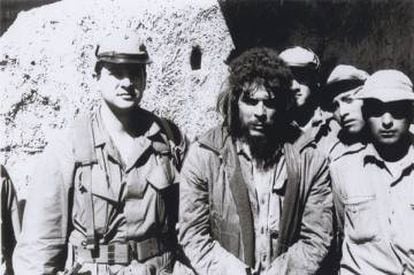
Felix Rodriguez, left, Che, center
“It is better like this,” he said. “I should never have been captured alive.”
Rodriguez asked if he had any messages for his family. Guevara replied: “Tell Fidel [Castro, the president/dictator of Cuba] that he will soon see a triumphant revolution in America.
“And tell my wife to remarry and try to be happy.”
When Sergeant Teran entered the hut, Guevara told his executioner: “I know you’ve come to kill me. Shoot, coward! You are only going to kill a man!”
Teran hesitated, then opened fire with his semiautomatic rifle, hitting Guevara in his arms and legs.
Guevara writhed on the ground, apparently biting one of his wrists to avoid crying out. Teran then fired several more times, finally killing him with a shot in the chest.
9/11 ATTACKS, ABC NEWS, AFGHANISTAN, AL QAEDA, ALTERNET, AMERICABLOG, AP, BABY BOOMER RESISTANCE, BARACK OBAMA, BLOOMBERG, BOLIVIA, BUZZFEED, CBS NEWS, CIA, CNN, COMMUNISM, CROOKS AND LIARS, CUBA, CUBAN MISSILE CRISIS, DAILY KOZ, DRUDGE REPORT, ERNESTO "CHE" GUEVARA, FACEBOOK, FIDEL CASTRO, FIVETHIRTYEIGHT, GEORGE W. BUSH, GREEN BERETS, HARPER’S MAGAZINE, HUFFINGTON POST, IRAQ, ISLAM, JOHN F. KENNEDY, MEDIA MATTERS, MOTHER JONES, MOVEON, MSNBC, NAVY SEALS, NBC NEWS, NEWSWEEK, NIKITA KHRUSHCHEV, NPR, OSAMA BIN LADEN, PAKISTAN, PBS NEWSHOUR, POLITICO, POLITICUSUSA, RAW STORY, REUTERS, SALON, SEATTLE TIMES, SLATE, SOVIET UNION, TALIBAN, TALKING POINTS MEMO, THE ATLANTIC, THE CHICAGO SUN-TIMES, THE CHICAGO TRIBUNE, THE DAILY BEAST, THE DAILY BLOG, THE GUARDIAN, THE HILL, THE HUFFINGTON POST, THE LOS ANGELES TIMES, THE NATION, THE NEW REPUBLIC, THE NEW YORK TIMES, THE VILLAGE VOICE, THE WASHINGTON POST, THINKPROGRESS, TIME, TRUTHDIG, TRUTHOUT, TWITTER, TWO POLITICAL JUNKIES, U.S. NEWS & WORLD REPORT, UPI, USA TODAY, WONKETTE
In Bureaucracy, History, Military, Politics on February 16, 2016 at 12:10 am
When Osama bin Laden died, two weapons were within easy reach–an AK-47 assault rifle and a Russian-made nine-millimeter Makarov pistol.
But according to his wife, Amal, he was shot by Navy SEALS before he could reach either one.
A SEAL flashed coded news of bin Laden’s death to the Pentagon and the White House Situation Room, where President Barack Obama and the topmost officials of his administration anxiously followed events via a closed-circuit television.
“Geronimo E-KIA” read the message: “Geronimo [bin Laden] E-KIA [Enemy Killed in Action].”
The entire raid–including Intelligence sweeps of the compound–was over in less than 40 minutes. The SEALS moved quickly because they rightly feared that the Pakistani army would intervene to protect bin Laden.
Bin Laden had been living undisturbed at a large compound in Abbottabad for at least five years, just a short distance from Pakistan’s version of West Point.
Furthermore, the ISI–Pakistan’s Intelligence agency–had long been riddled with Al-Qaeda sympathizers, if not agents.
Within 24 hours of his death, Bin Laden’s body was transported to the aircraft carrier USS Carl Vinson for final rites and burial at sea.
U.S.S. Carl Vinson
President Obama and other U.S. officials feared that his grave site would become a memorial for members of Al-Qaeda and other Islamic terrorist organizations.
In the late evening of May 1, 2011, the White House surprised major television networks by informing them that the President had a major announcement to make.
At 11:35 P.M. Eastern Standard Time, the President appeared at a podium in the East Room of the White House.
“Good evening. Tonight I can report to the American people and to the world that the United States had conducted an operation that killed Osama bin Laden, the leader of Al-Qaeda, and a terrorist who’s responsible for the murder of thousands of innocent men, women and children….
“For over two decades, bin Laden has been Al-Qaeda’s leader and symbol, and has continued to plot attacks against our country and our friends and allies. The death of bin Laden marks the most significant achievement to date in our nation’s efforts to defeat Al-Qaeda.”
He added that “no Americans were harmed” in the raid and that the SEALS had taken care to avoid civilian casualties.
President Barack Obama announcing Osama bin Laden’s death
Like Ernesto “Che” Guevara, bin Laden had become a pale, largely irrelevant figure by the time of his death.
Knowing he was the world’s most wanted man, he imprisoned himself within a fortified compound–which he never left.
Afraid to use a phone or the Internet, he relayed orders–which were often ignored–via the cumbersome use of couriers. All trash generated by the inhabitants of the compound was burned within its walls.
Ironically, the lack of Internet and phone lines to the compound–and the burning of its trash–had led CIA officials to suspect that Osama bin Laden might be hiding there.
Pakistan was outraged. Officially an American ally, its territory had been secretly invaded by American military forces. Even more embarrassing: For years, Pakistani Intelligence had denied knowing bin Laden’s whereabouts.
Meanwhile, leaders of Islamic expansionist groups rallied to praise the dead bin Laden. Among these was his son, Omar, who denounced his father’s killing as a “criminal” act, and his burial at sea as demeaning to the Islamic faith.
In a letter published on the website of Islamic ideologue Abu Walid al-Masri, the younger bin Laden said the former Al-Qaeda leader’s children reserved the right to take legal action in the United States and internationally to “determine the true fate of our vanished father.”
Bin Laden’s death drew protests from hundreds of people in the city of Quetta, in southwestern Pakistan, who burned American flags and paid homage to the late terrorist leader.
On May 13, a pair of Taliban suicide bombers attacked paramilitary police recruits eagerly heading home for a break after months of training, killing 80 people. It was the first act of retaliation for the killing of bin Laden.
Americans reacted differently.
Almost as Obama was addressing the nation, cheering crowds gathered outside the White House and in New York City’s Times Square. Many of them shouted “USA! USA! USA!” and waved American flags in celebration.
Celebration also broke out at the site of the former World Trade Center, the primary victim of the September 11 attacks.
For the next two weeks, Americans continued to rejoice. Much of their feelings were best expressed in grisly humor on websites and late night comedy shows such as “Tonight” and “Late Night With David Letterman.”
Killing Osama bin Laden removed Al-Qaeda’s most important member. But its treasury of secret materials–such as computer hard-drives, DVDs, notebooks, diaries–proved even more important to American military and Intelligence officials.
During the late 1960s and early 1970s, many Vietnam protesters marched carrying blown-up photos of Ernesto “Che” Guevara or tacked them to the walls of their dormitory rooms.
Most of these college students were members of the middle-class which Guevara had so despised.
Going on five years since the death of bin Laden, his poster has been noticeably absent from American college campuses–and everywhere else in the United States.
It remains to be seen whether, decades from now, Osama bin Laden will attain the iconic status of Ernesto “Che” Guevara.
9/11 ATTACKS, ABC NEWS, AFGHANISTAN, AL QAEDA, ALTERNET, AMERICABLOG, AP, BABY BOOMER RESISTANCE, BARACK OBAMA, BLOOMBERG, BOLIVIA, BUZZFEED, CBS NEWS, CIA, CNN, COMMUNISM, CROOKS AND LIARS, CUBA, CUBAN MISSILE CRISIS, DAILY KOZ, DRUDGE REPORT, ERNESTO "CHE" GUEVARA, FACEBOOK, FIDEL CASTRO, FIVETHIRTYEIGHT, GEORGE W. BUSH, GREEN BERETS, HARPER’S MAGAZINE, HUFFINGTON POST, IRAQ, ISLAM, JOHN F. KENNEDY, MEDIA MATTERS, MOTHER JONES, MOVEON, MSNBC, NAVY SEALS, NBC NEWS, NEWSWEEK, NIKITA KHRUSHCHEV, NPR, OSAMA BIN LADEN, PAKISTAN, PBS NEWSHOUR, POLITICO, POLITICUSUSA, RAW STORY, REUTERS, SALON, SEATTLE TIMES, SLATE, SOVIET UNION, TALIBAN, TALKING POINTS MEMO, THE ATLANTIC, THE CHICAGO SUN-TIMES, THE CHICAGO TRIBUNE, THE DAILY BEAST, THE DAILY BLOG, THE GUARDIAN, THE HILL, THE HUFFINGTON POST, THE LOS ANGELES TIMES, THE NATION, THE NEW REPUBLIC, THE NEW YORK TIMES, THE VILLAGE VOICE, THE WASHINGTON POST, THINKPROGRESS, TIME, TRUTHDIG, TRUTHOUT, TWITTER, TWO POLITICAL JUNKIES, U.S. NEWS & WORLD REPORT, UPI, USA TODAY, WONKETTE
In Bureaucracy, History, Military, Politics on February 15, 2016 at 12:00 am
Ernesto “Che” Guevara was dead. But that wasn’t enough for the Bolivian government that had authorized his execution. His corpse was disappear from the face of the earth.
On October 10, 1967, Guavara’s body was flown to nearby Vallegrande, where photographs were taken of him lying on a concrete slab in the laundry room of the Nuestra Senora de Malta.
Che Guevara in death
Several witnesses were called in to confirm that it was indeed Guevara. As hundreds of local residents filed past the corpse, men of them felt Guevara resembled images of a bearded, long-haired Jesus Christ. Some of them even surreptitiously clipped locks of his hair as divine relics.
After a military doctor amputated his hands, Bolivian army officers transferred Guevara’s body to an undisclosed location. The government refused to say whether his remains had been buried or cremated.
Che’s hands were preserved in formaldehyde and sent to Buenos Aires, Argentina, for fingerprint identification. (His prints were on file with the Argentine police)
On October 15, Fidel Castro acknowledged that Guevara was dead and proclaimed three days of public mourning throughout Cuba.
Fidel Castro
Che, in one sense, was lucky to die as he did–and when he did. He was only 39, but he was already running to fat and increasingly troubled by his lifelong asthma.
His Don Quixote-like venture into Bolivia proved a failure from first to last. Peasants didn’t flock to his banner; in fact, some of them betrayed his movements to the Bolivian army.
And 24 years after Guevara’s execution, Communism, his secular religion, died a violent death in its birthplace–the Soviet Union. It wasn’t killed off by invading capitalist forces, but thrown off by the Russian people themselves.
Nor would Che be pleased with the course of “revolutionary” events in Cuba. Until the death of the Soviet Union, the island remained dependent on what amounted to Soviet welfare.
Since then, Cubans have supported themselves by turning their island into a privileged playground for the rich–especially rich Americans.
On October 17, 1997–30 years after their deaths–Guevara and six of his fellow combatants were buried with full military honors in a specially built mausoleum in Santa Clara, Cuba. It was there in 1958 that he had commanded the decisive military victory of the Cuban Revolution.
Having described, in Part One, how Ernesto “Che” Guevara met his end, it’s time to examine how Osama bin Laden earned his 72 willing virgins.
After the September 11, 2001 attacks on the Pentagon and the World Trade Center, the United States quickly established that bin laden had plotted them.
World Trade Center on 9/11/01
But bin Laden was then living in Afghanistan and protected by its Islamic rulers, the Taliban. President George W. Bush gave the Taliban an ultimatum: Surrender bin Laden–or else.
The Taliban refused.
On October 7, 2001, the United States’ new allies, the Northern Alliance, supported by American airstrikes, began a ground campaign against the Taliban.
Taliban resistance quickly vanished. Bin Laden retreated to Tora Bora, a series of bunkers in a mountainous region near the Pakistani border. With the mountains literally shaking under a rain of “bunker-busting” bombs, bin Laden decided to move on.
Suddenly, in December, 2001, he seemed to vanish from the earth.
Reports circulated that he was living in a cave in the no-man’s-land lying between Afghanistan and Pakistan.
Strangely, the Bush administration lost interest in locating him. Increasing numbers of American troops were quietly transferred from Afghanistan to staging areas near Iraq–for Bush’s long-planned overthrow of its dictator, Saddam Hussein.
Only when Barack Obama took office as President in 2009 was the CIA ordered to make finding bin Laden its top priority. Over the next two years, CIA agents sifted through a conflicting series of reports about bin Laden’s possible whereabouts.
Finally, the agency tracked a courier linked to bin Laden to a large, high-walled compound in Abbottabad, Pakistan.
On April 28, 2011, President Obama authorized a U.S. military raid on the compound, dubbed “Operation Neptune Spear.” On May 1, 2011, two teams of 12 U.S. Navy SEALS, working with the CIA, traveled in two helicopters to the compound.
The helicopters were specially outfitted to emit little noise. But an accident resulted when the tail rotor of one helicopter grazed the compound’s stone wall.
The damaged aircraft was “hard-landed” and then destroyed on-site to protect its technological secrets. Back-up forces were immediately available, and another helicopter was brought in to retrieve the commandos and relevant contents.
All combined, a total of 79 commandos and a dog (believed to have explosive-detection training) were involved in the raid.
SEALS attacking bin Laden’s compound in the 2012 movie, “Zero Dark Thirty”
Abu Ahmed al-Kuwaiti, bin Laden’s courier, opened fire on the SEALS from the guesthouse with an AK-47 assault rifle. He and his wife were killed by return fire.
A male relative of the courier was shot and killed by the SEALS before he could reach a weapon lying nearby.
Bin Laden’s 22-year-old son rushed toward the SEALS on the staircase of the main house. SEAL gunfire instantly killed him.
Osama bin Laden, standing at the top of a staircase, retreated into his room–where SEALS followed and shot him in the head and chest.
9/11 ATTACKS, ABC NEWS, AFGHANISTAN, AL QAEDA, ALTERNET, AMERICABLOG, AP, BABY BOOMER RESISTANCE, BARACK OBAMA, BLOOMBERG, BOLIVIA, BUZZFEED, CBS NEWS, CIA, CNN, COMMUNISM, CROOKS AND LIARS, CUBA, CUBAN MISSILE CRISIS, DAILY KOZ, DRUDGE REPORT, ERNESTO "CHE" GUEVARA, FACEBOOK, FIDEL CASTRO, FIVETHIRTYEIGHT, GEORGE W. BUSH, GREEN BERETS, HARPER’S MAGAZINE, HUFFINGTON POST, IRAQ, ISLAM, JOHN F. KENNEDY, MEDIA MATTERS, MOTHER JONES, MOVEON, MSNBC, NAVY SEALS, NBC NEWS, NEWSWEEK, NIKITA KHRUSHCHEV, NPR, OSAMA BIN LADEN, PAKISTAN, PBS NEWSHOUR, POLITICO, POLITICUSUSA, RAW STORY, REUTERS, SALON, SEATTLE TIMES, SLATE, SOVIET UNION, TALIBAN, TALKING POINTS MEMO, THE ATLANTIC, THE CHICAGO SUN-TIMES, THE CHICAGO TRIBUNE, THE DAILY BEAST, THE DAILY BLOG, THE GUARDIAN, THE HILL, THE HUFFINGTON POST, THE LOS ANGELES TIMES, THE NATION, THE NEW REPUBLIC, THE NEW YORK TIMES, THE VILLAGE VOICE, THE WASHINGTON POST, THINKPROGRESS, TIME, TRUTHDIG, TRUTHOUT, TWITTER, TWO POLITICAL JUNKIES, U.S. NEWS & WORLD REPORT, UPI, USA TODAY, WONKETTE
In Bureaucracy, History, Military, Politics, Social commentary on February 12, 2016 at 12:12 am
They both had beards. They both saw military action. They both passionately hated the United States.
And they both died in a hail of bullets.
And immediately after their deaths, both seemed to disappear from the face of the earth.
Ernesto “Che” Guevara and Osama bin Laden.
Two men who inspired widespread admiration among their supporters–and fear among their enemies.
Guevara, an Argentinian doctor-turned-Cuban revolutionary, sought to destroy the United States’ power to fight Communism. Bin Laden sought to destroy its power to intervene in the Middle East.
Ernesto “Che” Guevara
Guevara’s most optimistic hope was that Americans would eventually see the error of their capitalistic ways and convert to Communism. His last words were: “Tell Fidel [Castro] that he will soon see a triumphant revolution in America.”
But he was prepared to fight to the death–as indeed he did–to force revolutionary change upon the United States.
For Bin Laden, the cause was Islam, not Communism. His most optimistic hope was that Christian and Jewish Americans would eventually convert to Islam.
But if that didn’t happen, he, too, was prepared to attack Americans anywhere and in any way he could–as his private diary and documents have revealed.
Guevara died on October 9, 1967, at the hands of a CIA-directed operation run by the Bolivian army.
Bin Laden, creator of the Al-Qaeda (“The Base” terrorist network, met his end on May 1, 2011, during a raid by U.S. Navy SEALS on his compound in Pakistan.
Osama bin Laden
One man–Guevara–has since attained secular sainthood in the eyes of millions of Communists and their sympathizers.
The other–bin Laden–has attained instant “martyr” status in the eyes of untold numbers of Islamic terrorists and their sympathizers.
Both men plotted constantly against the United States and eagerly sought its destruction.
In November, 1962, during an interview with the Communist newspaper, the London Daily Worker, Guevara raged against the Soviet Union’s recent withdrawal of nuclear missiles from Cuba.
Those “thirteen days” of the Cuban Missile Crisis that October had brought the world to the brink of nuclear destruction.
“If the missiles had remained, we would have used them against the very heart of the United States, including New York,” said Guevara.
“We must never establish peaceful coexistence. We must walk the path of victory even if it costs millions of atomic victims.”
Similarly, until the end of his life, bin Laden demanded more attacks like the one on September 11, 2001, that snuffed out the lives of 3,000 Americans.
This brought him into conflict with other Al-Qaeda members who wanted to launch assaults on more vulnerable targets outside the United States.
Guevara died as he had lived–violently.
In late October, 1966, he slipped out of Cuba. On November 3, he secretly arrived in La Paz, Bolivia, intent on re-staging the Cuban revolution among the Bolivian peasantry.
But the peasants showed no interest in his aims and in fact reported his movements to the Bolivian army.
The army, in turn, was being advised by United States Green Berets under the direction of the CIA.
On October 7, 1967, an informant tipped off the Bolivian Special Forces to the location of Guevara’s guerrilla camp in the Yuro ravine.
On October 8, they encircled the area with 1,800 soldiers. In the shootout that followed, Guevara was wounded and taken prisoner while leading a detachment.
His rifle broken by a lucky shot, a twice-wounded Guevara shouted: “Do not shoot! I am Che Guevara and worth more to you alive than dead.”
Quickly informed of Guevara’s capture, the Bolivian government debated his fate: Should he be immediately executed or placed on trial?
On the morning of October 9, Bolivian President Rene Barrientos ordered that Guevara be executed. Barrientos feared that placing him on trial would create an international media circus and/or render Bolivia vulnerable to efforts to free him.
The Bolivian government planned to declare that Guevara had been killed in action during a clash with the nation’s armed forces. Special instructions were thus issued.
These came from Felix Rodrieguez, a CIA agent acting as advisor to the Bolivians.
The executioner would be Mario Teran, a Bolivian army sergeant who had lost three of his friends in an earlier firefight with Guevara’s band of guerrillas.
Rodriguez ordered Teran to aim carefully to make it appear that Guevara had been killed in action.
To his surprise, Rodriguez found himself highly impressed with Guevara’s courage. When informed of his imminent execution, Guevara blanched, then quickly got control of himself.

Felix Rodriguez, left, Che, center
“It is better like this,” he said. “I should never have been captured alive.”
Rodriguez asked if he had any messages for his family. Guevara replied: “Tell Fidel [Castro, the president/dictator of Cuba] that he will soon see a triumphant revolution in America.
“And tell my wife to remarry and try to be happy.”
When Sergeant Teran entered the hut, Guevara told his executioner: “I know you’ve come to kill me. Shoot, coward! You are only going to kill a man!”
Teran hesitated, then opened fire with his semiautomatic rifle, hitting Guevara in his arms and legs.
Guevara writhed on the ground, apparently biting one of his wrists to avoid crying out. Teran then fired several more times, finally killing him with a shot in the chest.
_underway_in_the_Pacific_Ocean_on_31_May_2015.JPG&imgrefurl=https%3A%2F%2Fen.wikipedia.org%2Fwiki%2FUSS_Carl_Vinson&docid=_CVahKI_7obrGM&tbnid=5YNeIda1dVcZQM%3A&w=3451&h=2301&ved=0ahUKEwid67qv7PvKAhVL7WMKHUoVBEUQxiAIAg&iact=c&ictx=1)


 Bureaucracybuster's Blog
9/11 ATTACKS, ABC NEWS, AFGHANISTAN, AL QAEDA, ALTERNET, AMERICABLOG, AP, BABY BOOMER RESISTANCE, BARACK OBAMA, BLOOMBERG, BOLIVIA, BUZZFEED, CBS NEWS, CIA, CNN, COMMUNISM, CROOKS AND LIARS, CUBA, CUBAN MISSILE CRISIS, DAILY KOZ, DRUDGE REPORT, ERNESTO "CHE" GUEVARA, FIDEL CASTRO, FIVETHIRTYEIGHT, GEORGE W. BUSH, GREEN BERETS, HARPER’S MAGAZINE, HUFFINGTON POST, IRAQ, ISLAM, JOHN F. KENNEDY, MEDIA MATTERS, MOTHER JONES, MOVEON, MSNBC, NAVY SEALS, NBC NEWS, NEWSWEEK, NIKITA KHRUSHCHEV, NPR, OSAMA BIN LADEN, PAKISTAN, PBS NEWSHOUR, POLITICO, POLITICUSUSA, RAW STORY, REUTERS, SALON, SEATTLE TIMES, SLATE, SOVIET UNION, TALIBAN, TALKING POINTS MEMO, THE ATLANTIC, THE CHICAGO SUN-TIMES, THE CHICAGO TRIBUNE, THE DAILY BEAST, THE DAILY BLOG, THE GUARDIAN, THE HILL, THE HUFFINGTON POST, THE LOS ANGELES TIMES, THE NATION, THE NEW REPUBLIC, THE NEW YORK TIMES, THE VILLAGE VOICE, THE WASHINGTON POST, THINKPROGRESS, TIME, TRUTHDIG, TRUTHOUT, TWITTER, TWO POLITICAL JUNKIES, U.S. NEWS & WORLD REPORT, UPI, USA TODAY, WONKETTE
A TALE OF TWO KILLINGS: PART ONE (OF THREE)
In Bureaucracy, History, Military, Politics, Social commentary on May 3, 2023 at 12:11 amThey both had beards. They both saw military action. They both passionately hated the United States. And they both died in a hail of bullets.
And immediately after their deaths, both seemed to disappear from the face of the earth.
Ernesto “Che” Guevara and Osama bin Laden.
Two men who inspired widespread admiration among their supporters—and fear among their enemies.
Guevara, an Argentinian doctor-turned-Cuban revolutionary, sought to destroy the United States’ power to fight Communism. Bin Laden sought to destroy its power to intervene in the Middle East.
Ernesto “Che” Guevara
Guevara’s most optimistic hope was that Americans would eventually see the error of their capitalistic ways and convert to Communism. His last words were: “Tell Fidel [Castro] that he will soon see a triumphant revolution in America.”
But he was prepared to fight to the death–as indeed he did—to force revolutionary change upon the United States.
For Bin Laden, the cause was Islam, not Communism. His most optimistic hope was that Christian and Jewish Americans would eventually convert to Islam.
But if that didn’t happen, he, too, was prepared to attack Americans anywhere and in any way he could—as his private diary and documents have revealed.
Guevara died on October 9, 1967, at the hands of a CIA-directed operation run by the Bolivian army.
Bin Laden, creator of the Al-Qaeda (“The Base”) terrorist network, met his end on May 1, 2011, during a raid by U.S. Navy SEALS on his compound in Pakistan.
Osama bin Laden
One man—Guevara—has since attained secular sainthood in the eyes of millions of Communists and their sympathizers.
The other—bin Laden—has attained instant “martyr” status in the eyes of untold numbers of Islamic terrorists and their sympathizers.
In November, 1962, during an interview with the Communist newspaper, the London Daily Worker, Guevara raged against the Soviet Union’s recent withdrawal of nuclear missiles from Cuba.
Those “thirteen days” of the Cuban Missile Crisis that October had brought the world to the brink of nuclear destruction.
“If the missiles had remained, we would have used them against the very heart of the United States, including New York,” said Guevara.
“We must never establish peaceful coexistence. We must walk the path of victory even if it costs millions of atomic victims.”
Similarly, until the end of his life, bin Laden demanded more attacks like the one on September 11, 2001, that snuffed out the lives of 3,000 Americans.
This brought him into conflict with other Al-Qaeda members who wanted to launch assaults on more vulnerable targets outside the United States.
Guevara died as he had lived—violently.
In late October, 1966, he slipped out of Cuba. On November 3, he secretly arrived in La Paz, Bolivia, intent on re-staging the Cuban revolution among the Bolivian peasantry.
But the peasants showed no interest in his aims and in fact reported his movements to the Bolivian army.
The army, in turn, was being advised by United States Green Berets under the direction of the CIA.
On October 7, 1967, an informant tipped off the Bolivian Special Forces to the location of Guevara’s guerrilla camp in the Yuro ravine.
On October 8, they encircled the area with 1,800 soldiers. In the shootout that followed, Guevara was wounded and taken prisoner while leading a detachment.
His rifle broken by a lucky shot, a twice-wounded Guevara shouted: “Do not shoot! I am Che Guevara and worth more to you alive than dead.”
Quickly informed of Guevara’s capture, the Bolivian government debated his fate: Should he be immediately executed or placed on trial?
On the morning of October 9, Bolivian President Rene Barrientos ordered that Guevara be executed. Barrientos feared that placing him on trial would create an international media circus and/or render Bolivia vulnerable to efforts to free him.
The Bolivian government planned to declare that Guevara had been killed in action during a clash with the nation’s armed forces. Special instructions were thus issued.
These came from Felix Rodrieguez, a CIA agent acting as advisor to the Bolivians.
The executioner would be Mario Teran, a Bolivian army sergeant who had lost three of his friends in an earlier firefight with Guevara’s band of guerrillas.
Rodriguez ordered Teran to aim carefully to make it appear that Guevara had been killed in action.
To his surprise, Rodriguez found himself highly impressed with Guevara’s courage. When informed of his imminent execution, Guevara blanched, then quickly got control of himself.
Felix Rodriguez, left, Che, center
“It is better like this,” he said. “I should never have been captured alive.”
Rodriguez asked if he had any messages for his family. Guevara replied: “Tell Fidel [Castro, the president/dictator of Cuba] that he will soon see a triumphant revolution in America.
“And tell my wife to remarry and try to be happy.”
When Sergeant Teran entered the hut, Guevara told his executioner: “I know you’ve come to kill me. Shoot, coward! You are only going to kill a man!”
Teran hesitated, then opened fire with his semiautomatic rifle, hitting Guevara in his arms and legs.
Guevara writhed on the ground, apparently biting one of his wrists to avoid crying out. Teran then fired several more times, finally killing him with a shot in the chest.
Share this: