bureaucracybusters

Posts Tagged ‘BREITBART NEWS’

FINDING THE COURAGE TO SAY “NO”: PART ONE (OF TWO)

In Bureaucracy, History, Law, Law Enforcement, Military, Politics, Social commentary on January 17, 2017 at 12:01 am

“What did the President know and when did he know it?”

It was the famous question asked by Tennessee U.S. Senator Howard Baker during the 1973 Watergate hearings.

Image result for Images of Howard Baker

Howard Baker

The question cut to the core of President Richard Nixon’s litany of crimes.  And the fact that it was posed by a Republican gave it added power.

More than a year later, Americans learned its answers:

  • Nixon had learned that his own White House “Plumbers” had carried out the Watergate Hotel burglary; and
  • Only days afterward, he ordered a cover-up.

With those revelations, his Presidency was finished.

America now stands only days away from swearing in Donald J. Trump as the 45th President of the United States.

And, once again, Howard Baker’s slightly altered question resonates with force: “What did the American people know, and when did they know it?”

And the subject of that question is not Richard Nixon but President-elect Donald Trump.

Since January 10, Americans have been obsessed with the unproven allegation that, during a visit to Russia several years ago, Trump paid prostitutes to urinate on a bed once slept in by the Obamas at the Moscow Ritz-Carlton.

The charge was published by Buzzfeed, and given weight by reports that both Trump and President Barack Obama had been briefed by Intelligence officials about the alleged incident.

Perhaps even worse for Trump, it’s made him the butt of countless “golden shower” jokes. Saturday Night Live featured a skit with Vladimir Putin appearing at a press conference to blackmail Trump (Alec Baldwin) with a video tape labeled: “PEE PEE TAPE.”

Trump has denied the charge as “fake news.”

But long before this disturbing claim, Americans had more than enough knowledge about Donald Trump to judge him unfit for the Oval Office.

  • He unknowingly admitted to being a sexual predator of women: “You know I’m automatically attracted to beautiful–I just start kissing them. It’s like a magnet. Just kiss. I don’t even wait. And when you’re a star they let you do it. You can do anything. Grab them by the pussy. You can do anything.”

Donald Trump

  • He refused to release his tax returns–unlike every other Presidential candidate since Ronald Reagan in 1980.
  • He said he was prepared to withdraw from NATO, the American-European alliance that held the Soviet Union at bay for a half-century.
  • He often and publicly praised Russian President Vladimir Putin, the absolute dictator of a foreign power hostile to the United States.
  • He publicly invited “Russia”–i.e., Putin–to interfere directly in an American Presidential election: “I will tell you this, Russia: If you’re listening, I hope you’re able to find the 30,000 [Hillary Clinton] emails that are missing. I think you will probably be rewarded mightily by our press.”

Image result for images of vladimir putin

Vladimir Putin

  • He surrounded himself with men who have close ties to Putin. One of these is Paul Manafort, his former campaign manager. His longstanding ties to pro-Russian politicians in Ukraine lead directly to Putin.  
  • Another–his pick for Secretary of State, Rex Tillerson–is the CEO of ExxonMobil, which has worked on major oil projects with Russia. In 2013, Putin awarded Tillerson the Order of Friendship, one of the highest honors the nation bestows on foreign citizens.  
  • Yet another Trump advisor, Roger Ailes, is a known sexual predator.  Hired to prepare Trump for the fall debates with Clinton, he was fired in July as CEO of Fox News on multiple charges of sexual harassment.
  • During the 2016 campaign, Trump received the enthusiastic support of the Ku Klux Klan and the American Nazi Party. 

KKK.svg

Ku Klux Klan enblem

  • Florida Attorney General Pam Bondi personally solicited a political contribution from Donald Trump around the same time her office deliberated joining an investigation of alleged fraud at Trump University and its affiliates.
  • After Bondi dropped the Trump University case against Trump, he wrote her a check $25,000 for her re-election campaign. The money came from the Donald J. Trump Foundation.
  • On November 18, Trump–rather than face trial–settled the case out of court for $25 million. “Today’s $25 million settlement agreement is a stunning reversal by Donald Trump,” said New York Attorney General Eric Schneiderman, “and a major victory for the over 6,000 victims of his fraudulent university.
  • Throughout the 2016 Presidential campaign, Trump repeatedly used threats of violence to intimidate his Republican and Democratic opponents. On March 16, he warned Republicans that if he didn’t win the GOP nomination in July, his supporters would literally riot: “I think you’d have riots. I think you would see problems like you’ve never seen before. I think bad things would happen. I really do. I wouldn’t lead it, but I think bad things would happen.
  • On August 9,  Trump issued a veiled solicitation for the assassination of Democratic Presidential candidate Hillary Clinton: “Hillary wants to abolish, essentially abolish, the Second Amendment. If she gets to pick her [Supreme Court] judges, nothing you can do folks. Although the Second Amendment people, maybe there is, I don’t know.”  
  • After slandering President Barack Obama for five years as “the President from Kenya,” he blatantly lied: “Hillary Clinton and her campaign of 2008 started the birther controversy.  I finished it.”

WHY TRUMP WON: WHAT DIDN’T HAPPEN: PART THREE (END)

In Bureaucracy, History, Law, Law Enforcement, Politics, Social commentary on January 4, 2017 at 12:15 am

Future historians may one day write that it’s what didn’t happen that played at least as great a role in electing Donald Trump President as what actually did.

There were at least four instances where intervention by Federal law enforcement authorities could have utterly changed the outcome of the 2016 election.

Two of these dealt with purely domestic issues—the Trump University scandal and Trump’s repeated threats of violence against Republican and Democratic opponents.

The third and fourth ones dealt with events directly affecting the security of the United States.

It is unprecedented for an American Presidential candidate to repeatedly bestow fulsome praise on the leader of a foreign power hostile to the United States. And to receive equally fawning compliments in return from that leader.

Yet that is precisely what has happened between Donald Trump and Vladimir Putin.

Thus Putin on Trump: “He is a bright personality, a talented person, no doubt about it. It is not up to us to appraise his positive sides, it is up to the U.S. voters. but, as we can see, he is an absolute leader in the presidential race.”
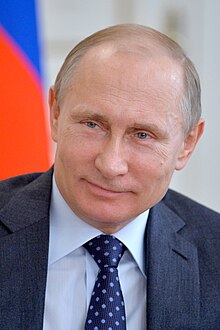
Image result for images of vladimir putin

Vladimir Putin

And Trump on Putin: “It is always a great honor to be so nicely complimented by a man so highly respected within his own country and beyond.  He’s running his country, and at least he’s a leader. Unlike what we have in this country”—a clear attack on President Barack Obama.

Related image

Donald Trump

Case #3: The Justice Department did not invalidate the results of the 2016 election, despite overwhelming evidence that Russia intervened to elect Trump as Vladimir Putin’s chosen candidate.

  • Admiral Michael Rogers, director of the National Security Agency (NSA) and US Cyber Command, said in mid-November that Russia made “a conscious effort” to sway the results of the Presidential election by the hacking of 20,000 emails from the Democratic National Committee.
  • “There shouldn’t be any doubt in anybody’s mind,” said Rogers. “This was not something that was done casually. This was not something that was done by chance. This was not a target that was selected purely arbitrarily. This was a conscious effort by a nation-state to attempt to achieve a specific effect.”
  • The Russians hacked the Democratic committee’s servers–but not those of the Republican National Committee.
  • On December 16, FBI Director James B. Comey and Director of National Intelligence James R. Clapper Jr. agreed with a CIA assessment that Russia intervened in the 2016 election in part to help Donald Trump win the White House. 

Related image

Trump, however, has steadfastly denied any such role by Russia: “I think it’s ridiculous,” he told “Fox News Sunday.” “I think it’s just another excuse. I don’t believe it….No, I don’t believe it at all.”   

Case #4: The Justice Department did not prosecute Trump for treason, even though he solicited aid from Russia, a nation hostile to the United States. And no major official of the government—including President Obama—publicly condemned him as a traitor.     

At a news conference in Doral, Florida on July 27, Trump publicly invited “Russia”—i.e., Vladimir Putin—to hack Hillary Clinton’s emails: “I will tell you this, Russia: If you’re listening, I hope you’re able to find the 30,000 emails that are missing. I think you will probably be rewarded mightily by our press.”

This was essentially treason—calling on a hostile foreign power to interfere directly in an American Presidential election. And it was seen as such by both Democrats and even Republicans.

  • “This has to be the first time that a major presidential candidate has actively encouraged a foreign power to conduct espionage against his political opponent,” Hillary for America policy adviser Jake Sullivan said in a statement. “That’s not hyperbole, those are just the facts. This has gone from being a matter of curiosity, and a matter of politics, to being a national security issue.”
  • “I find those kinds of statements to be totally outrageous because you’ve got now a presidential candidate who is, in fact, asking the Russians to engage in American politics,” said former CIA Director Leon Panetta, a Clinton surrogate. “I just think that’s beyond the pale.”
  • Brendan Buck, a spokesman for House Speaker Paul Ryan, said: “Russia is a global menace led by a devious thug. Putin should stay out of this election.”
  • Even Trump’s Vice Presidential running mate, Mike Pence, said: “If it is Russia and they are interfering in our elections, I can assure you both parties and the United States government will ensure there are serious consequences.”

FBI Director James Comey believed that Hillary Clinton’s emails on a private server were so dangerous to national security that he announced—11 days before the election—that he was re-opening an investigation he had closed.  

That announcement erased widespread outrage over Trump’s unintended admissions of predatory behavior toward women—“Grab them by the pussy”—and reversed Clinton’s growing lead in the polls.

Yet the Bureau has not issued any such statements about the continuing reports of close ties between Trump and Putin, and Trump’s possible investments in Russia.

To their shame, the federal agencies charged with safeguarding America failed to take action against these abuses. And, to their shame, the news media, to date, has failed to indict them for their negligence.
WHY TRUMP WON: WHAT DIDN’T HAPPEN: PART TWO (OF THREE)

In Bureaucracy, History, Law, Law Enforcement, Politics, Social commentary on January 3, 2017 at 12:01 am

Threatening his Republican and Democratic opponents with violence played a major role in Donald Trump’s campaign for President.

No other candidate—Republican or Democrat—had ever made such repeated and brutal use of threats of physical assault in pursuing the Presidency.

  • Philip Klein, the managing editor of the Washington Examiner,  wrote on the eve of the Republican National Convention in July: “Political commentators now routinely talk about the riots that would break out in Cleveland if Trump were denied the nomination, about how his supporters have guns and all hell could break loose, that they would burn everything to the ground. It works to Trump’s advantage to not try too hard to dispel these notions.”
  • On August 9,  Trump told a rally in Wilmington, North Carolina: “Hillary [Clinton] wants to abolish, essentially abolish, the Second Amendment. If she gets to pick her [Supreme Court] judges, nothing you can do folks. Although the Second Amendment people, maybe there is, I don’t know.”
  • “Don’t treat this as a political misstep,” Senator Christopher S. Murphy of Connecticut, who has called for stiffer gun laws, wrote on Twitter. “It’s an assassination threat, seriously upping the possibility of a national tragedy & crisis.”
  • “Well, let me say if someone else said that outside of the hall, he’d be in the back of a police wagon now, with the Secret Service questioning him,” said Michael Hayden, former head of the CIA and National Security Agency (NSA). 

Making threats against anyone under protection by the U.S. Secret Service is a felony. Yet Donald Trump was never held legally accountable by the Justice Department.

Threats of this type continued to be made by Trump supporters right up to the day of the election.

  • On July 29, Roger Stone, a notorious Right-wing political consultant acting as a Trump strategist, told Breitbart News: “The first thing Trump needs to do is begin talking about [voter fraud] constantly. If there’s voter fraud, this election will be illegitimate, the election of the winner will be illegitimate, we will have a constitutional crisis, widespread civil disobedience, and the government will no longer be the government.”
  • At a town hall meeting where Trump’s Vice Presidential nominee Mike Pence appeared, a woman named Rhonda said: “For me personally, if Hillary Clinton gets in, I myself am ready for a revolution.”
  • In Cincinnati, a Trump supporter threatened to forcibly remove Clinton from the White House if she won the race: “If she’s in office, I hope we can start a coup. She should be in prison or shot. That’s how I feel about it,” Dan Bowman, a 50-year-old contractor, said of Hillary Clinton, the Democratic nominee. “We’re going to have a revolution and take them out of office if that’s what it takes. There’s going to be a lot of bloodshed. But that’s what it’s going to take….I would do whatever I can for my country.”

Even Fergus Cullen, former chairman of the New Hampshire GOP, expressed fear of what might happen if Trump lost the election:

Fergus Cullen running for re-election to Dover City CouncilRelated image

Fergus Cullen

“That’s really scary,” Cullen said, recounting the violence at Trump rallies around the country leading up to the Republican National Convention. “In this country, we’ve always had recriminations after one side loses. But we haven’t had riots. We haven’t had mobs that act out with violence against supporters of the other side.

“There’s no telling what his supporters would be willing to do at the slightest encouragement from their candidate,” he said.

Trump even began encouraging his mostly white supporters to sign up online to be “election observers” to stop “Crooked Hillary from rigging this election.” He urged them to act as poll watchers in “other” [non-white] communities to ensure that things are “on the up and up.”

Many of his supporters promised to do so.

“Trump said to watch your precincts. I’m going to go, for sure,” said Steve Webb, a 61-year-old carpenter from Fairfield, Ohio.

“I’ll look for…well, it’s called racial profiling. Mexicans. Syrians. People who can’t speak American,” he said. “I’m going to go right up behind them. I’ll do everything legally. I want to see if they are accountable. I’m not going to do anything illegal. I’m going to make them a little bit nervous.”

Knowing that large numbers of angry—and possibly armed—Right-wingers planned to descend on polling places could only have had a chilling effect on untold numbers of Democratic voters. And this would have been especially true in heavily conservative states.

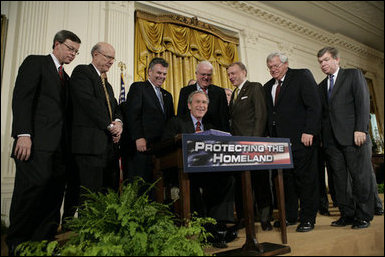
Both the USA Patriot Act and the Racketeer Influenced Corrupt Organizations (RICO) Act have statutes dealing with making terrorist threats against government institutions to influence their members.

Image result for Official White House photos of George W. Bush signing USA Patriot Act

President George W. Bush signing the USA Patriot Reauthorization Act of 2005

If Trump’s remarks did not violate one or both of those laws, certainly remarks made by his surrogates did.

Thus, the Justice Department could have cited the Patriot Act in indicting Trump and/or any number of his followers for “activities that…appear to be intended…to influence the policy of a government by intimidation or coercion [and]…occur primarily within the territorial jurisdiction of the United States.”

The Justice Department could have also demanded that the results of the election be invalidated on the basis that widespread voter and candidate intimidation played a massive role in it.

But of course this did not happen.

WHY TRUMP WON: WHAT DIDN’T HAPPEN: PART ONE (OF THREE)

In Bureaucracy, History, Law, Law Enforcement, Politics, Social commentary on January 2, 2017 at 12:12 am

On November 9, 1923, Nazi Party Fuhrer Adolf Hitler tried to overthrow the government in Munich, Bavaria.

About 2,000 Nazis marched to the center of Munich, where they confronted heavily-armed police. A shootout erupted, killing 16 Nazis and four policemen. 

Hitler was injured during the clash, but managed to escape. Two days later, he was arrested and charged with treason.

Put on trial, he found himself treated as a celebrity by a judge sympathetic to Right-wing groups. He was allowed to brutally cross-examine witnesses and even make inflammatory speeches.

At the end of the trial, he was convicted of treason and sentenced to five years’ imprisonment.

Serving time in Landsberg Prison, in Bavaria. he was given a huge cell, allowed to receive unlimited visitors and gifts, and treated with deference by guards and inmates.

Hitler used his time in prison to write his infamous book, Mein Kampf-–“My Struggle.” Part autobiography, part political treatise, it laid out his future plans—including the extermination of the Jews and the conquest of the Soviet Union.

Image result for Images of Adolf Hitler outside Landsberg prison

Adolf Hitler leaving Landsberg Prison, December, 20, 1924

Nine months later, he was released on parole—by authorities loyal to the authoritarian Right instead of the newly-created Weimar Republic.

Hitler immediately began rebuilding the shattered Nazi party—and deciding on a new strategy to gain power. Never again would he resort to armed force. He would win office by election—or intrigue.

Writes historian Volker Ullrich, in his monumental new biography, Hitler: Ascent 1889 – 1939: “Historians have perennially tried to answer the question of whether Hitler’s rise to power could have been halted….

“There were repeated opportunities to end Hitler’s run of triumphs. The most obvious one was after the failed Putsch of November 1923. Had the Munich rabble-rouser been forced to serve his full five-year term of imprisonment in Landsberg, it is extremely unlikely that he would have been able to restart his political career.”

Related imageAmazon.com: Hitler: Ascent, 1889-1939: 9780385354387: Ullrich, Volker: Books

Thus, it isn’t just what happens that can influence the course of history. Often, it’s what doesn’t happen that has at least as great a result.

Future historians—if there are any—may one day write that it’s what didn’t happen that played at least as great a role in electing Donald Trump President as what actually did.

There were at least four instances where intervention by Federal law enforcement authorities could have utterly changed the outcome of the 2016 election.

Related image

Donald Trump

Case #1:  The Justice Department did not indict Trump and/or the Attorney Generals of Texas and/or Florida for their roles in the Trump University scandal.

  • Florida Attorney General Pam Bondi personally solicited a political contribution from Donald Trump around the same time her office deliberated joining an investigation of alleged fraud at Trump University and its affiliates.
  • After Bondi dropped the Trump University case against Trump, he wrote her a check $25,000 for her re-election campaign. The money came from the Donald J. Trump Foundation.
  • Republican Texas Attorney General Ken Paxton moved to muzzle a former state regulator who says he was ordered in 2010 to drop a fraud investigation into Trump University for political reasons.
  • Paxton’s office issued a cease and desist letter to former Deputy Chief of Consumer Protection John Owens after he made public copies of a 14-page internal summary of the state’s case against Donald Trump for scamming millions from students of his now-defunct real estate seminar.
  • After the Texas case was dropped, Trump cut a $35,000 check to the gubernatorial campaign of then attorney general and now Texas Governor Greg Abbott.

One attorney general who refused to accept money from Trump was New York’s Eric Schneiderman. His decision to press fraud claims against Trump forced the real estate mogul to settle the case out of court for $25 million.

“Today’s $25 million settlement agreement is a stunning reversal by Donald Trump,” said Schneiderman on November 18, “and a major victory for the over 6,000 victims of his fraudulent university.”

There have been no press reports that the Justice Department investigated these cases to determine if Trump violated the Racketeer Influenced Corrupt Organizations (RICO) Act statutes.

If the Justice Department did not investigate these cases, it should have. And if he did violate the RICO statutes, he should have been indicted, even as a Presidential candidate or President-elect.

Even if an indictment had not produced a conviction, the mere bringing of one would have cast an unprecedented cloud over his candidacy–let alone his being sworn in as President.

Case #2:  The Justice Department did not indict Trump for his series of threats that he made—directly and indirectly—against Republicans and Democrats throughout the 2016 campaign.

  • On March 16, he warned Republicans that if he didn’t win the GOP nomination in July, his supporters would literally riot: “I think you’d have riots. I think you would see problems like you’ve never seen before. I think bad things would happen. I really do. I wouldn’t lead it, but I think bad things would happen.”
  • An NBC reporter summed it up as: “The message to Republicans was clear on [March 16]: ‘Nice convention you got there, shame if something happened to it.'”
  • That Republicans clearly saw this as a threat is undeniable. Paul Ryan, their Speaker of the House, said on March 17: “Nobody should say such things in my opinion because to even address or hint to violence is unacceptable.”
  • And Ohio governor and Republican presidential candidate John Kasich chinned in. “Leaders don’t imply violence,” Kasich told “Face the Nation” on March 20. “When he says that there could be riots, that’s inappropriate. I think you understand that, okay? Secondly, while we have our differences and disagreements, we’re Americans. Americans don’t say, ‘Let’s take to the streets and have violence.'”

BROWNSHIRTS WITHOUT UNIFORMS

In Bureaucracy, Business, History, Politics, Social commentary on November 23, 2016 at 12:09 am

Supporters of President-elect Donald Trump are furious at Starbucks.

For starters, the company’s CEO, Howard Schultz, endorsed Hillary Clinton for President.

Then, Starbucks “declared war on Christmas” by issuing a “less-festive” holiday paper drinking cup.

Starbucks releases its traditional red holiday cup each November. Past designs have included imagery such as snowflakes, snowmen and Christmas trees.

But in 2015, the company issued a plain red cup minus imagery, triggering a backlash among image-obsessed Christians, who saw it as an “attack” on Christmas.

[The Bible doesn’t give even a generalized date for Jesus’ birth. Nor did Jesus command his followers to celebrate his birth. At the Last Supper, he did command them to honor his death by taking the sacrament.

[Most of the traditions now associated with Christmas can be traced directly to the ancient Roman festival, Saturnalia, which celebrated the deity Saturn. These included feasting, drinking, gift-giving, hanging wreaths and decorating trees—which were not brought indoors.]

When Trump—then running for President—learned of the change in Starbucks cups, he was outraged.

“Did you read about Starbucks?” Trump asked supporters during a rally in Springfield, Ill. “No more ‘Merry Christmas’ at Starbucks. No more. Maybe we should boycott Starbucks.

“If I become president, we’re all going to be saying ‘Merry Christmas’ again,” Trump told the crowd—as if, by becoming President, he could issue such an order. “That I can tell you. That I can tell you! Unbelievable.”

Donald Trump

Now that Trump is about to become President, his legions of Trumpsters aren’t waiting for an official order.

On November 17, a Trumpster using the screen name Baked Alaska came up with a new idea to intimidate Starbucks.

Going on Twitter, he advised fellow Trumpsters to proceed with “Operation #TrumpCup.”  All they had to do was:

  1. “Go to Starbucks & tell them your name is Trump
  2. “If they refuse take video
  3. “Pls share & spread the word”

One Trumpster subsequently posted on Twitter the following: “I got my Starbucks with Trump name. he yelled Trump get your drink 

Another one proudly tweeted: “@bakedalaska did this today. They didn’t want to, said it was too political. I reminded her the campaign was over & he’s our president now. pic.twitter.com/LHgi7Vqexh

This may seem wonderful to Trumpsters, but there are five serious flaws with it:

  1. By taking on the name of the man they idolize, they are obliterating their own identities.
  2. They are trying to impose their idol’s name on others, whether they admire him or not.
  3. This is exactly what the fanatical followers of all tyrants do.
  4. If there’s more than one Trumpster in a Starbucks, how will each one know which “Trump” is being summoned to get his drink?
  5. This is actually the opposite of a boycott. They’re making a “statement”—but they’re also putting money into Starbucks’ pocket while doing so.

Baked Alaska, however, intends to stick to his campaign. “We have a culture war to win,” he said in a Periscope video. He claimed that Twitter was suspending accounts of “alt-Right” [i.e., Fascist] users and that liberals were making whites—especially men—feel guilty.

Related image

Baked Alaska with his Trump cup

Starbucks reacted by emailing the following statement: “Over the years, writing customer names on cups and calling out their names has been a fun ritual in our stores. Rarely has it been abused or taken advantage of. We hope and trust that our customers will continue to honor that tradition. We don’t require our partners to write or call out names.”

What’s past often turns out to be prologue.

Throughout the 2016 Presidential campaign, Donald Trump relied on threats and insults. He used them against Republicans in the primaries, and against Democrats in the general election.  

On March 16, he warned his fellow Republicans that if he didn’t win the GOP nomination at the convention in July, his supporters would literally riot: “I think you’d have riots. I think you would see problems like you’ve never seen before. I think bad things would happen.”

After Trump got the nomination, his surrogates continued to raise the specter of violence. Roger Stone, one of his advisers, told the Right-wing Breitbart News website:

“I think he’s [Trump] gotta put [Democrats] on notice that their inauguration will be a rhetorical and when I mean civil disobedience, not violence, but it will be a bloodbath….We will not stand for it.”

If Clinton had won, Trump’s followers would have remained—waiting for the next champion to voice their hatred and call on their votes. Meanwhile, they would have lost their energy as a social and political force.  

But Trump did win, and now they feel emboldened. And they will continue to draw encouragement from a steady stream of attacks by Trump and his surrogates.

During the general election, many Trump supporters openly threatened to wage armed rebellion against the government if Clinton won.  

What will they do after Trump becomes President—and starts blasting tweets at those who have offended his fragile ego?

Will they stand in front of Starbucks shops and refuse entry to customers–as Adolf Hitler’s brown-shirted Stormtroopers blocked customers from entering Jewish stores? 

And will intimidated local police stand by and allow it—as they did in Hitler’s Germany? 

“Operation TrumpCup” is only the beginning.

MARCHING THROUGH TREASON–AGAIN: PART TWO: PART TWO (END)

In Bureaucracy, History, Law, Law Enforcement, Military, Politics, Social commentary on October 27, 2016 at 12:09 am

When Andrew Jackson, seventh President of the United States from 1829 to 1837, was close to death, he asked his doctor: “What act of my administration will be most severely condemned by future Americans?”

“Perhaps the removal of the bank deposits,” said the doctor–referring to Jackson’s withdrawal of U.S. Government monies from the first Bank of the United States.

That act had destroyed the bank, which Jackson had believed was a source of political corruption.

“Oh, no!” said Jackson.

“Then maybe the specie circular,” said the doctor. He was referring to an 1836 executive order Jackson had issued, requiring payment for government land to be in gold and silver.

“Not at all!” said Jackson.

Then, his eyes blazing, Jackson raged: “I can tell you. Posterity will condemn me more because I was persuaded not to hang John C. Calhoun as a traitor than for any other act in my life!”

John C. Calhoun had once been Vice President under Jackson and later a United States Senator from South Carolina. His fiery rhetoric and radical theories of “nullification” played a major part in bringing on the Civil War (1861-1865).

John C. Calhoun

Calhoun was an outspoken proponent of slavery, which he declared to be a “positive good” rather than a “necessary evil.” He supported states’ rights and nullification–by which states could declare null and void federal laws they deemed unconstitutional.

Historians have not condemned Jackson for failing to hang the senator. But perhaps he was right–and perhaps he should have hanged Calhoun.

It might have prevented the Civil War–or at least delayed its coming.

Over time, Southern states’ threats of “nullification” turned to threats of “secession” from the Union.

Jackson died in 1845–16 years before the Civil War erupted.

The resulting carnage slaughtered as many as 620,000 lives. More Americans died in that war than have been killed in all the major wars fought by the United States since.

When it ended, America was reinvented as a new, unified nation–and one where slavery was now banned by the 13th Amendment to the United States Constitution.

Equally important, the Federal Government had now set a precedent for using overwhelming military power to force states to remain in the Union.

But in 2012, within days of Barack Obama’s decisive winning of another four years as President, residents across the country raised the call of treason.

They did done so by filing secession petitions to the Obama administration’s “We the People” program, which is featured on the White House website.

States whose residents filed secession petitions included:

Alabama, Alaska, Arizona, Arkansas, California, Colorado, Connecticut, Delaware, Florida, Georgia, Hawaii, Idaho, Illinois, Indiana, Iowa, Kansas, Kentucky, Louisiana, Maine, Maryland, Massachusetts, Michigan, Minnesota, Mississippi, Missouri, Montana, Nebraska, New Hampshire, New Jersey, New Mexico, New York, Nevada, North Carolina, North Dakota, Ohio, Oklahoma, Oregon, Pennsylvania, Rhode Island, South Carolina, South Dakota, Tennessee, Texas, Utah, Virginia, Washington (state), West Virginia, Wisconsin and Wyoming.

The reason: Thousands–if not millions–of Americans couldn’t abide a moderately-liberal black man winning a second term as President.

Abraham Lincoln dedicated his Presidency–and sacrificed his life–to ensure the preservation of a truly United States.

And Robert E. Lee–the defeated South’s greatest general–spent the last five years of his life trying to put the Civil War behind him and persuade his fellow Southerners to accept their place in the Union.

But today avowed racists, Fascists and other champions of treason are working hard to destroy that union–and unleash a second Civil War.  

Yet no official in Washington, D.C.–from President Obama on down–has so far dared to openly confront this menace. This failure to do so has only emboldened Trump’s Fascistic supporters and dismayed those who would oppose them.

President Obama should follow Andrew Jackson’s example–before treasonous talk becomes treasonous action.  

He should make clear that if treasonous violence erupts during his last two months in office, he will act decisively to crush it, using whatever level of force is necessary.

President Obama should warn these 21st-century would-be traitors that the FBI and U.S. Marshals Service are prepared to combat any threats to national security.

And if these agencies aren’t sufficient, the United States Army, Navy, Air Force and Marines stand ready to send modern-day counterparts of Union General William Tecumseh Sherman to wherever they are needed.  

In 1864, Sherman’s 62,000 soldiers marched more than 650 miles in less than 100 days, ravaged Georgia, burned Atlanta to the ground–and ended the Civil War.

President Obama’s attitude should be: “Let them hate me, so long as they fear me.”

Sherman’s March through Georgia

Similarly, Hillary Clinton–if she is elected–should issue a similar statement: That her coming administration will not tolerate the outbreak of widespread violence from any section of the population, whatever the excuse.

And she should bluntly warn that “Marching Through Georgia” is a song that can be played wherever treason dares to show its face:

So we made a thoroughfare for freedom and her train
Sixty miles of latitude, three hundred to the main.
Treason fled before us, for resistance was in vain
While we were marching through Georgia.

MARCHING THROUGH TREASON–AGAIN: PART ONE (OF TWO)

In Bureaucracy, History, Law, Law Enforcement, Military, Politics, Social commentary on October 26, 2016 at 12:19 am

They cannot be made to love us, but they may be made to fear us.
–William Tecumseh Sherman speaking of the Southern Confederacy

If Hillary Clinton is elected President, she may soon face the same crisis that confronted Abraham Lincoln more than a century ago: Mass treason.

Americans haven’t even voted yet. But, already, hard-core supporters of Republican Presidential nominee Donald Trump believe a sinister international cabal has “rigged” the 2016 election for Clinton.  

There is absolutely no evidence for this–other than what Trump himself has loudly and repeatedly told them: That there is a massive conspiracy to take him down.  

At one town hall meeting where his Vice Presidential running mate, Mike Pence, appeared, a woman named Rhonda stood up and announced: “One of the things that I can tell you that a lot of us are scared of is this voter fraud.

“There’s a lot of out here saying that when we vote, we’re going to wear red. Our lives depend on this election. Our kids’ futures depend on this election.

“For me personally, if Hillary Clinton gets in, I myself am ready for a revolution.”  

In Cincinnati, a Trump supporter threatened to forcibly remove Clinton from the White House if she won the Presidential race: “I feel like Hillary needs to be taken out if she gets in the government. I’ll do everything in my power to take her out of power–which, if I have to be a patriot, I will.”

When asked if he was physically threatening Clinton, Dan Bowman, 50, told CNN: “I don’t know, is it?”

Officially, the Trump campaign claimed: “We reject violence in any form and will not allow it to be a part of our campaign.”

But on August 9, Trump told a rally in Wilmington, North Carolina that Clinton intended to abolish the Second Amendment: “If she gets to pick her judges, there’s nothing you can do, folks. Although the Second Amendment people–maybe there is, I don’t know.”   

The Clinton camp instantly saw it as a “dog-whistle” solicitation for political assassination. The Trump campaign issued a statement denying that he had meant any such thing.  

On July 19, Trump clinched the Republican Presidential nomination. By early August, Roger Stone, a longtime Right-wing political consultant and now Trump strategist, was already predicting “widespread voter fraud” in the coming election.  

This despite the fact that a 2014 Washington Post analysis of 14 years of voter fraud found 31 possible incidents of in-person voter fraud, comprised of approximately 241 fraudulent ballots.  

In an interview with the Right-wing Breitbart News website, Stone said:

“The first thing that Trump needs to do is begin talking about [voter fraud] constantly. If there’s voter fraud, this election will be illegitimate, the election of the winner will be illegitimate, we will have a constitutional crisis, widespread civil disobedience, and the government will no longer be the government.” 

Image result for Images of Roger Stone

Roger Stone

Stone added that Trump should keep drumming up his supporters against the “rigged” system, and promise that the government would be shut down if Clinton was pronounced the victor in November.  

“I think he’s gotta put them on notice that their inauguration will be a rhetorical, and when I mean civil disobedience, not violence, but it will be a bloodbath… We will not stand for it.” 

Yet no official in Washington, D.C.–from President Barack Obama on down–has so far dared to openly acknowledge–let alone confront–this menace.

If Hillary Clinton is elected President, she would do well to review how Andrew Jackson, America’s seventh President from 1829 to 1837, reacted to threats of secession.

Andrew Jackson

In 1830, South Carolina was threatening to secede from the Union. A South Carolina Congressman who was returning home visited Jackson and asked: “Do you have a message you want me to give to your friends in the state?”

Jackson questioned him about the recent mass meetings in Charleston.

The friend warned him that South Carolina’s fire-eaters believed “the Army and Navy aren’t big enough to collect a penny” of Federal taxes.

“Do they realize what their words mean?” asked Jackson.

“I’m afraid they do, General.”

“Then tell them from me that they can talk and write resolutions and print threats to their hearts’ content.

“But if one drop of blood is shed there in opposition to the laws of the United States, I will hang the first man I can lay my hands on engaged in such treasonable conduct, from the first tree I can reach.”

News of Jackson’s threat quickly spread throughout Washington, D.C.

Senator Robert Hayne of South Carolina told his fellow Senator, Thomas Hart Benton, of Missouri, that he couldn’t believe that Jackson would send an army to invade a sovereign state.

Benton replied: “I tell you, Hayne, when Jackson starts talking about hanging, they can begin to look for the ropes.”

Jackson later issued a proclamation to the people of South Carolina and threatened to hang Hayne’s successor, Senator John C. Calhoun. He also warned that he would himself lead an army into the state to enforce Federal law.

The treasonous rumblings stopped–for the moment.