bureaucracybusters

Posts Tagged ‘WORLD WAR ii’

NEGOTIATING NAZI-REPUBLICAN STYLE: PART FIVE (OF SEVEN)

In Bureaucracy, History, Politics, Social commentary on August 12, 2013 at 12:15 am
“Those who are willing to risk everything, even death and destruction, to attain their ends will prevail over more responsible and prudent men who have more to lose and are rational, not suicidal.”
–Ernst Casier, Chairman of Philosophy, Hamburg University

U.S. House of Representatives

In April, 2011, the United States government almost shut down over Republican demands about subsidized pap smears.
During a late-night White House meeting with President Barack Obama and key Congressional leaders, Republican House Speaker John Boehner made this threat:

His conference would not approve funding for the government if any money were allowed to flow to Planned Parenthood through Title X legislation.

Facing an April 8 deadline, negotiators worked day and night to strike a compromise-–and finally reached one.

Three months later–on July 9–Republican extortionists again threatened the Nation with financial ruin and international disgrace unless their demands were met.

President Obama had offered to make historic cuts in the federal government and the social safety net–on which millions of Americans depend for their most basic needs.

But House Speaker John Boehner rejected that offer. He could not agree to the tax increases that Democrats wanted to impose on the wealthiest 1% as part of the bargain.

John Boehner

As the calendar moved ever closer to the fateful date of August 2, Republican leaders continued to insist: Any deal that includes taxes “can’t pass the House.”

One senior Republican said talks would go right up to–and maybe beyond–the brink of default.

“I think we’ll be here in August,” said Republican Representative Pete Sessions, of Texas. “We are not going to leave town until a proper deal gets done.”

President Obama had previously insisted on extending the debt ceiling through 2012. But in mid-July, he simply asked congressional leaders to review three options with their members:

  1. The “Grand Bargain” choice–favored by Obama–would cut deficits by about $4 trillion, including spending cuts and new tax revenues.
  2. A medium-range plan would aim to reduce the deficit by about $2 trillion.
  3. The smallest option would cut between $1 trillion and $1.5 trillion, without increased tax revenue or any Medicare and Medicaid cuts.

And the Republican response?

Said Rep. Darrell Issa, chairman of the Oversight and Government Reform Committee: “Quite frankly, [Republican] members of Congress are getting tired of what the president won’t do and what the president wants.”

Noted political analyst Chris Matthews summed up the sheer criminality of what happened within the House of Representatives.

Speaking on MSNBC’s “Hardball,” on July 28–five days before Congress reached its August 2 deadline to raise the debt-ceiling–Matthews noted:

“The first people to bow to the demands of those threatening to blow up the economy were the Republicans in the House, the leaders. The leaders did what the followers told them to do: meet the demands, hold up the country to get their way.

“Those followers didn’t win the Senate, or the Presidency, just the House.

“But by using the House they were able to hold up the entire United States government. They threatened to blow things up economically and it worked.

“They said they were willing to do that–just to get their way–not by persuasion, not by politics, not by democratic government, but by threatening the destruction of the country’s finances.

“Right. So what’s next? The power grid? Will they next time threaten to close down the country’s electricity and communications systems?”

With the United States teetering on the brink of national bankruptcy, President Obama faced three choices:

  1. Counter Republican extortion attempts via RICO–the Racketeer Influenced Corrupt Oganizations Act.
  2. Make a “Cuban Missile Crisis”-style address to the American people, seeking to rally them against a criminal threat to the financial security of the Nation.
  3. Cave in to Republican demands.

Unfortunately for Obama and the Nation, he chose Number Three.

Here is how he could have applied the other two options.

Racketeer Influenced Corrupt Organizations (RICO) Act

In 1970, Congress passed the Racketeer Influenced and Corrupt Organizations (RICO) Act, Title 18, United States Code, Sections 1961-1968.

Congress’ goal was to eliminate the ill-affects of organized crime on the nation’s economy. To put it bluntly, RICO was intended to destroy the Mafia.

In the 1980s, however, civil lawyers noticed section 1964(c) of the RICO Act.  This allows civil claims to be brought by anyone injured in their business or property by reason of a RICO violation.

Anyone who prevailed in a a civil RICO suit would automatically receive judgment of three times their actual damages and would be awarded their costs and attorneys’ fees.

Originally, the RICO Act was aimed at the Mafia and other organized crime syndicates.  But in United States v. Turkette, 452 U.S. 576 (1981), the Supreme Court held that RICO applied to both legitimate and illegitimate RICO enterprises.

Previously, many lower courts had tried to limit RICO to recognized “criminal” enterprises. After Turkette, RICO could also be used against corporations, political protest groups, labor unions and loosely knit-groups of people.

NEGOTIATING NAZI-REPUBLICAN STYLE: PART FOUR (OF SEVEN)

In Bureaucracy, History, Politics, Social commentary on August 9, 2013 at 1:07 am

Adolf Hitler is dead.  But his my-way-or-else “negotiating” style lives on in today’s Republican party.

During the summer of 2011, Republicans refused to raise the debt ceiling unless Democrats agreed to massively cut social programs for the elderly, poor and disabled.

If Congress failed to raise the borrowing limit of the federal government by August 2, the date when the U.S.  reached the limit of its borrowing abilities, it would have begun defaulting on its loans.

As Warren Buffett, CEO of Berkshire Hathaway, explained the looming economic catastrophe:

“If you don’t send out Social Security checks, I would hate to think about the credit meeting at S&P and Moody’s the next morning.

“If you’re not paying millions and millions and millions of people that range in age from 65 on up, money you promised them, you’re not a AAA,” said Buffett.

A triple-A credit rating is the highest possible rating that can be received.

And while Republicans demanded that the disadvantaged tighten their belts, they rejected any raising of taxes on their foremost constituency–the wealthiest 1%.

To raise taxes on the wealthy, they insisted, would be a “jobs-killer.” It would “discourage” corporate CEOs from creating tens of thousands of jobs they “want” to create.

Republicans knew this argument is a lie.  And so did the editors of Time.  The difference is, the editors of Time were willing to reveal the truth.

In its June 20, 2011  cover-story on “What U.S. Economic Recovery? Five Destructive Myths,” Rana Foroohar, the magazine’s assistant managing editor in charge of economics and business, delivered this warning:

Profit-seeking corporations can’t be relied on to ”make it all better.”

Wrote Foroohar:

“There is a fundamental disconnect between the fortunes of American companies, which are doing quite well, and American workers, most of whom are earning a lower hourly wage now than they did during the recession.

“The thing is, companies make plenty of money; they just don’t spend it on workers here.

“There may be $2 trillion sitting on the balance sheets of American corporations globally, but firms show no signs of wanting to spend it in order to hire workers at home.”

Yet there is also a disconnect between the truth of this situation and the willingness of Americans to face up to that truth.

The reason:

“The Republicans have pulled off a major (some would say cynical) miracle,” writes Foroohar.

They have convinced “the majority of Americans that the way to jump-start the economy is to slash taxes on the wealthy and on cash-hoarding corporations while cutting benefits for millions of Americans.

“It’s fun-house math that can’t work. We’ll need both tax increases and sensible entitlement cuts to get back on track.

“Yet surveys show 50% of Americans think that not raising the debt ceiling is a good idea — that you can somehow starve your way to economic growth.”

How have Republicans achieved this?  By adopting the principles of propaganda laid down by no less an authority on lying than Adolf Hitler.

According to Mein Kampf-–”My Struggle”–-Hitler’s autobiography and political treatise:

  1. The great majority of a nation is ruled by sentiment rather than by sober reasoning.
  2. This sentiment, however, is not complex, but simple and consistent. It is not highly differentiated, but has only the negative and positive notions of love and hatred, right and wrong, truth and falsehood.
  3. Propaganda must not investigate the truth objectively and must present only that aspect of the truth which is favorable to its own side.
  4. The receptive powers of the masses are very restricted, and their understanding is feeble. On the other hand, they quickly forget.
  5. All effective propaganda must be confined to a few bare essentials and those must be expressed as far as possible in stereotyped formulas.
  6. These slogans should be persistently repeated until the very last individual has come to grasp the idea that has been put forward.

Following these principles, Republicans have proved hugely successful at persuading millions that truth is whatever their party claims it to be at any given moment.

“Fascism,” said author Ernest Hemingway, “is a lie told by bullies.”  Thus, when Republicans couldn’t attain their goals by lying, they sought to do so by force–or at least the threat of it.

Republicans have repeatedly threatened to shut down the government unless their constantly escalating demands were met.

In November, 1995, Newt Gingrich, then Speaker of the House of Representatives, carried out his threat. Gingrich unwisely admitted that he did so because President Bill Clinton had put him in the back of Air Force One during a recent trip to Israel.

The shutdown proved a disaster for Republicans. Clinton was handily re-elected in 1996 and Gingrich suddenly resigned from Congress in 1998.

Still, the Republicans continued their policy of my-way-or-else. In April, 2011, the United States government almost shut down over Republican demands about subsidized pap smears.

NEGOTIATING NAZI-REPUBLICAN STYLE: PART THREE (OF SEVEN)

In Bureaucracy, History, Politics, Social commentary on August 8, 2013 at 1:00 pm

British Prime Minister Neville Chamberlain resolved to meet with Adolf Hitler, the German Fuehrer, to peacefully resolve the latest Nazi-created crisis.

Having conquered Austria, the German dictator now wanted Czechoslovakia.

And Chamberlain was determined to grant his every demand–so long as this meant avoiding a second world war.

The two European leaders met in Berchtesgaden on September 15, 1938.

Neville Chamberlain, Adolf Hitler at Munich

During their talks, Chamberlain said he had come to discuss German grievances. But, he added, it was necessary in all circumstances to exclude the use of force.

Hitler appeared to be shocked that he could be accused of such intentions: “Force? Who speaks of force?“

Then, without warning, he switched to an aggressive mode. He accused the Czechs of having mobilized their army in May. They had mobilized—in response to the mobilization of the German army.

“I shall not put up with this any longer,” shouted Hitler. “I shall settle this question in one way or another. I shall take matters in my own hands!”

Suddenly, Chamberlain seemed alarmed—and possibly angry: “If I understood you right, you are determined to proceed against Czechoslovakia in any case. If this is so, why did you let me come to Berchtesgaden?

“In the circumstances, it is best for me to return at once. Anything else now seems pointless.”

Hitler was taken aback by the unexpected show of defiance. He realized he was about to lose his chance to bully the British into accepting his latest demands.

So he softened his tone and said they should consider the Sudetenland according to the principle of self-determination.

Chamberlain said he must immediately return to England to consult with his colleagues. Hitler appeared uneasy. But then the German translator finished the sentence: “…and then meet you again.” Hitler realized he still had a chance to attain victory without going to war.

Chamberlain agreed to the cession of the Sudetenland. Three days later, French Prime Minister Edouard Daladier did the same. No Czechoslovak representative was invited to these discussions.

Chamberlain met Hitler again in Godesberg, Germany, on September 22 to confirm the agreements. But Hitler aimed to use the crisis as a pretext for war.

He now demanded not only the annexation of the Sudetenland but the immediate military occupation of the territories. This would give the Czechoslovak army no time to adapt their defense measures to the new borders.

To achieve a solution, Italian dictator Benito Mussolini suggested a conference of the major powers in Munich.

On September 29, Hitler, Daladier and Chamberlain met and agreed to Mussolini’s proposal. They signed the Munich Agreement, which accepted the immediate occupation of the Sudetenland.

The Czechoslovak government had not been a party to the talks. Nevertheless, it promised to abide by the agreement on September 30.

It actually had no choice. It faced the threat of an immediate German invasion after being deserted by its pledged allies: Britain, France and the Soviet Union.

Chamberlain returned to England a hero.  Holding aloft a copy of the worthless agreement he had signed with Hitler, he told cheering crowds in London: “I believe it is peace for our time.”

Neville Chamberlain

Winston Churchill knew better, predicting: “Britain and France had to choose between war and dishonor. They chose dishonor. They will have war.”

Hitler—still planning more conquests—also knew better. In March, 1939, the German army occupied the rest of Czechoslovakia.

Chamberlain would soon be seen as a naive weakling–even before bombs started falling on London.

Hitler next turned his attention–and demands–to Poland.

When his generals balked, warning that an invasion would trigger a war with France and Britain, Hitler quickly brushed aside their fears: “Our enemies are little worms. I saw them at Munich.”

Hitler ordered the invasion of Poland on September 1–unintentionally triggering World War II.

In time, historians and statesmen would regard Munich as an object lesson in the futility—and danger—in appeasing evil and aggression.

But for the postwar Republican party, Hitler’s my-way-or-else “negotiating” methods would become standard operating procedure.

During the summer of 2011, Republicans refused to raise the debt ceiling unless Democrats agreed to massively cut social programs for the elderly, poor and disabled.

If Congress failed to raise the borrowing limit of the federal government by August 2, the date when the U.S.  reached the limit of its borrowing abilities, it would have begun defaulting on its loans.

As Warren Buffett, CEO of Berkshire Hathaway, explained the looming economic catastrophe:

“If you don’t send out Social Security checks, I would hate to think about the credit meeting at S&P and Moody’s the next morning.

“If you’re not paying millions and millions and millions of people that range in age from 65 on up, money you promised them, you’re not a AAA,” said Buffett.

A triple-A credit rating is the highest possible rating that can be received.

And while Republicans demanded that the disadvantaged tighten their belts, they rejected any raising of taxes on their foremost constituency–the wealthiest 1%.

NEGOTIATING NAZI-REPUBLICAN STYLE: PART TWO (OF SEVEN)

In Bureaucracy, History, Politics, Social commentary on August 7, 2013 at 1:08 pm

After winning the Indiana GOP United States Senate primary, Indiana Treasurer Richard Mourdock appeared on the May 9 edition of CNN’s “Starting Point.”

There occurred this exchange between Mourdock and the show’s host, Soledad O’Brien:

MOURDOCK: What I’ve said about compromise and bipartisanship is I hope to build a conservative majority in the United States Senate so that bipartisanship becomes Democrats joining Republicans to roll back the size of government, reduce the bureaucracy, lower taxes, and get America moving again. The stimulus plan hasn’t worked.

Richard Mourdock

O’BRIEN: So what I hear you say is that you’re not going to compromise. In fact, the only compromise you’ll do is really getting other people on the other side of the aisle to come to your side of the aisle, which, I  guess, is the definition against compromise. You said this in the New York Times–

MOURDOCK: Well, it is the definition of political effectiveness.

Nazi dictator Adolf Hitler couldn’t have phrased it better.

Adolf Hitler

Anyone wanting to understand how Republicans intend to apply such a philosophy need only consult history.

On February 12, 1938, two Chancellors—Adolf Hitler of Germany, and Kurt von Schuschnigg of Austria—met at Hitler’s retreat at Obersalzberg.  At stake lay the future independence of Austria.

Although Austrian by birth, Hitler considered himself a German.  Annexing Austria, he believed, would ensure its return to “the Great German motherland.”

HITLER: “I have only to give one command and all this comic stuff on the border will be blown to pieces overnight. You don’t seriously think you could hold me up, even for half an hour, do you?

“Who knows—perhaps you will find me one morning in Vienna like a spring storm. Then you will go through something! I’d like to spare the Austrians that.

“The S.A. [Hitler’s private army of Stormtroopers] and the [Condor] Legion [which had bombed much of Spain into rubble during the three-year Spanish Civil War] would come in after the troops and nobody–not even I–could stop them from wreaking vengeance.”

British historian Robert Payne noted in his 1973 biography, The Life and Death of Adolf Hitler: “Schuschnigg was not a coward, but he showed fear, and it was precisely this look of fear that Hitler was waiting for.

“He had worked out the program of intimidation very carefully. The thunder and lightning in the morning; then a period of calm, when the unsuspecting victim might believe he had relented; and then he would come in for the kill with such savage fury that there would be no resistance.”

After lunch, Hitler presented Schuschnigg with an ultimatum:

  • Austria must join in an economic union with German.
  • Austria must lift its ban on membership in the Nazi Party (which had assassinated the country’s previous Chancellor).
  • Within three days there was to be a general amnesty of Nazi prisoners.
  • Three key government ministries—of war, interior and finance—were to be given to members of the Nazi Party.

With these in their possession, the Nazis would be able to take over Austria in two to three weeks.

At first, Schuschnigg refused to sign. He explained that the Austrian constitution did not give him the power to sign it. But Hitler insisted—threatening to invade Austria otherwise.

Schuschnigg, a virtual prisoner of his host, facing the destruction of his country by a powerful and aggressive neighbor, signed. It marked—until the defeat of Germany in 1945–the end of Austria as an independent nation.

Seven months later, in September, 1938, Hitler gave another exhibition of his “negotiating” methods. This time, the target of his rage and aggression was Czechoslovakia.

So, once again, he opened “negotiations” with a lie: The Czechoslovak government was trying to exterminate 3.5 million Germans living in the “Sudetenland.”

This consisted of the northern, southwest and western regions of Czechoslovakia, inhabited mostly by ethnic Germans.

Then he followed this up with the threat of war: Germany would protect its citizens and halt such “oppression.”

For British Prime Minister Neville Chamberlain, the thought of another European war erupting less than 20 years after the end of World War I was simply unthinkable.

Neville Chamberlain

Something had to be done to prevent it.  And he believed himself to be just the man to do it.

He quickly sent Hitler a telegram, offering to help resolve the crisis: “I could come to you by air and am ready to leave tomorrow.  Please inform me of earliest time you can receive me, and tell me the place of the meeting.  I should be grateful for a very early reply.”

Once again, another head-of-state was prepared to meet Hitler on his home ground.  Again, Hitler took this concession as a sign of weakness.  And Chamberlain’s use of such words as “please” and “grateful” only further convinced Hitler of another impending triumph.

TWO ANNIVERSARIES–ONE GLORIOUS, THE OTHER TRAGIC

In History, Politics, Social commentary on June 6, 2013 at 12:01 am

“For it is the doom of men that they forget.”

–Merlin, in “Excalibur”

June 6–a day of glory and tragedy.

The glory came  69 years ago–on Tuesday, June 6, 1944.

On that morning, Americans awoke to learn–from radio and newspapers–that their soldiers had landed on the French coast of Normandy.

In Supreme Command of the Allied Expeditionary Force was American General Dwight D. Eisenhower.  Overall command of ground forces was given to British General Bernard Montgomery.

Operation Overlord, the Allied invasion to liberate France from Nazi Germany, proved one of the pivotal actions of World War II.

It opened shortly after midnight, with an airborne assault of 24,000 American, British, Canadian and Free French troops.  This was followed at 6:30 a.m. by an amphibious landing of Allied infantry and armored divisions on the French coast.

Field Marshal Erwin Rommel–the legendary “Desert Fox”–commanded the German forces.  For him, the first 24 hours of the battle would be decisive.

“For the Allies as well as the Germans,” he warned his staff, “it will be the longest day.”

The operation was the largest amphibious invasion in history.  More than 160,000 troops landed–73,000 Americans, 61,715 British and 21,400 Canadians.

Initially, the Allied assault seemed likely to be stopped at the water’s edge–where Rommel had always insisted it must be.  He had warned that if the Allies established a beachhead, their overwhelming advantages in numbers and airpower would eventually prove irresistible.

German machine-gunners and mortarmen wreaked a fearful toll on Allied soldiers.  But commanders like U.S. General Norman Cota led their men to victory through a storm of bullets and shells.

Coming upon a group of U.S. Army Rangers taking cover behind sand dunes, Cota demanded: “What outfit is this?”

“Rangers!” yelled one of the soldiers.

“Well, Goddamnit, then, Rangers, lead the way!” shouted Cota, inspiring the soldiers to rise and charge into the enemy.

The allied casualty figures for D-Day have been estimated at 10,000, including 4,414 dead.  By nationality, the D-Day casualty figures are about 2,700 British, 946 Canadians and 6,603 Americans.

The total number of German casualties on D-Day isn’t known, but is estimated at 4,000 to 9,000.

Allied and German armies continued to clash throughout France, Belgium and Germany until May 7, 1945, when Germany finally surrendered.

But those Americans who had taken part in D-Day could be proud of having dealt a fatal blow to the evil ambitions of Adolf Hitler’s Third Reich.

So much for the glory of June 6.  Now for the tragedy–which occurred 45 years ago.

Twenty-four years after D-Day, Americans awoke to learn–mostly from TV–that New York Senator Robert F. Kennedy had died at 1:44 a.m. of an assassin’s bullet.

He had been campaigning for the Democratic Presidential nomination, and had just won the California primary on June 4.

This had been a make-or-break event for Kennedy. He had won the Democratic primaries in Indiana and Nebraska, but had lost the Oregon primary to Minnesota Senator Eugene McCarthy.

If he could defeat McCarthy in California, Kennedy could force his rival to quit the race.  That would lead to a showdown between him and Vice President Hubert Humphery for the nomination.

(President Lyndon B. Johnson had withdrawn from the race on March 31–just 15 days after Kennedy announced his candidacy on March 16.)

After winning the California and South Dakota primaries, Kennedy gave a magnaminous victory speech in the ballroom of the Ambassador Hotel in Los Angeles:

“I think we can end the divisions within the United States….We are a great country, an unselfish country, and a compassionate country.  And I intend to make that my basis for running over the period of the next few months.”

Then he entered the hotel kitchen–where Sirhan Sirhan, a 24-year-old Palestinian from Jordan, opened fire with a .22 revolver.  Kennedy was hit three times–once fatally in the back of the head.  Five other people were also wounded.

Kennedy’s last-known words were: “Is everybody all right?” and “Jack, Jack.”  Then he lost consciousness–forever, dying in a hospital bed 24 hours later.

Kennedy had been a U.S. Attorney General (1961-1964) and Senator (1964-1968).  But it was his connection to his murdered brother, President John F. Kennedy, for which he was best-known.

His assassination–less than five years after that of JFK–convinced many Americans there was something “sick” about the nation’s culture.

One of the best summaries of Robert Kennedy’s legacy was given in Coming Apart: An Informal History of America in the 1960’s, by historian William L. O’Neil:

“…He aimed so high that he must be judged for what he meant to do, and, through error and tragic accident, failed at….He will also be remembered as an extraordinary human being who, though hated by some, was perhaps more deeply loved by his countrymen than any man of his time.

“That too must be entered into the final account, and it is no small thing.  With his death something precious disappeared from public life.”

IS THERE A HITLER IN YOUR CEO?

In Bureaucracy, Business, Politics, Social commentary on May 3, 2013 at 12:35 am

Would-be CEOs and Fuehrers, listen up: Character is destiny.

Case in point: The ultimate Fuehrer and CEO, Adolf Hitler.

Ever since he shot himself in his underground Berlin bunker on April 30, 1945, historians have fiercely debated: Was der Fuehrer a military genius or an imbecile?

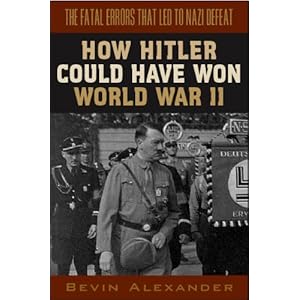
With literally thousands of titles to choose, the average reader may feel overwhelmed. But if you’re looking for an understandable, overall view of Hitler’s generalship, an excellent choice would be How Hitler Could Have Won World War II by Bevin Alexander.

How Hitler Could Have Won World War II

Among “the fatal errors that led to Nazi defeat” (as proclaimed on the book jacket) were:

  • Wasting hundreds of Luftwaffe pilots, fighters and bombers in a half-hearted attempt to conquer England.
  • Ignoring the pleas of generals like Erwin Rommel to conquer Syria, Iraq and Saudi Arabia–thus giving Germany control of most of the world’s oil.
  • Attacking his ally, the Soviet Union, while still at war with Great Britain.
  • Needlessly turning millions of Russians into enemies rather than allies by his brutal and murderous policies.
  • Declaring war on the United States after the Japanese attacked Pearl Harbor. (Had he not done so, Americans would have focused all their attention on conquering Japan.)
  • Refusing to negotiate a separate peace with Soviet dictator Joseph Stalin–thus granting Germany a large portion of captured Russian territory in exchange for letting Stalin remain in power.
  • Insisting on a “not one step back” military “strategy” that led to the unnecessary surrounding, capture and/or deaths of hundreds of thousands of German servicemen.

As the war turned increasingly against him, Hitler became ever more rigid in his thinking. He demanded absolute control over the smallest details of his forces. This, in turn, led to astounding and needless losses in German soldiers.

One such incident was immortalized in the 1962 movie, The Longest Day, about the Allied invasion of France known as D-Day.

On June 6, 1944, Rommel ordered the panzer tanks to drive the Allies from the Normandy beaches. But these could not be released except on direct order of the Fuehrer.

As Hitler’s chief of staff, General Alfred Jodl, informed Rommel: The Fuehrer was asleep–and, no, he, Jodl, would not wake him.

By the time Hitler awoke and issued the order, it was too late.

Nor could he accept responsibility for the policies that were clearly leading Germany to certain defeat. Hitler blamed his generals, accused them of cowardice, and relieved many of the best ones from command.

Among those sacked was Heinz Guderian, creator of the German panzer corps–and thus responsible for its highly effective “blitzkrieg” campaign against France in 1940.

Heinz Guderian

Another was Erich von Manstein, designer of the strategy that defeated France in six weeks–something Germany couldn’t do during the four years of World War 1.

Erich von Manstein

Finally, on April 29, 1945–with the Russians only blocks from his underground bunker in Berlin–Hitler dictated his “Last Political Testament.” Once again, he refused to accept responsibility for unleashing a war that would ultimately consume 50 million lives:

“It is untrue that I or anyone else in Germany wanted war in 1939. It was desired and instigated exclusively by those international statesmen who either were of Jewish origin or worked for Jewish interests.”

Hitler had launched the war with a lie–that Poland had attacked Germany, rather than vice versa. And he closed the war–and his life–with a final lie.

All of which, once again, brings us back to Niccolo Machiavelli, the father of political science.

In his classic book, The Discourses, he wrote at length on the best ways to maintain liberty within a republic. In Book Three, Chapter 31, Machiavelli declares: “Great Men and Powerful Republics Preserve an Equal Dignity and Courage in Prosperity and Adversity.”

It is a chapter that Adolf Hitler would have done well to read.

“…A truly great man is ever the same under all circumstances. And if his fortune varies, exalting him at one moment and oppressing him at another, he himself never varies, but always preserves a firm courage, which is so closely interwoven with his character that everyone can readily see that the fickleness of fortune has no power over him.

“The conduct of weak men is very different. Made vain and intoxicated by good fortune, they attribute their success to merits which they do not possess, and this makes them odious and insupportable to all around them.

“And when they have afterwards to meet a reverse of fortune, they quickly fall into the other extreme, and become abject and vile.

“Thence it comes that princes of this character think more of flying in adversity than of defending themselves, like men who, having made a bad use of prosperity, are wholly unprepared for any defense against reverses.”

Stay alert to signs of such character flaws among your own business colleagues–and especially your superiors. They are the warning signs of a future catastrophe.