If you visit San Francisco, forget what Julie Andrews told you in Mary Poppins: Don’t “Feed the Birds.”
Getting caught doing so can net you a fine from $25 to $1,000.
City officials launched the campaign in 2004, fining people who fed pigeons in the Tenderloin area.
Within a month, they extended the crackdown to Fisherman’s Wharf, Chinatown and the cable car turnaround in downtown.Feeding birds “damages property, and it’s not good for the bird population,” said Christine Falvey, a spokeswoman for the Public Works Department at the time of the ban.
“We have a whole education campaign letting people know it’s against the law,” said Falvey.
This includes posters erected by the Department of Public Works, which read:
“Please do not feed the pigeons. There are dozens of reasons why, but mainly: feeding pigeons harms our neighborhoods and also harms the birds.
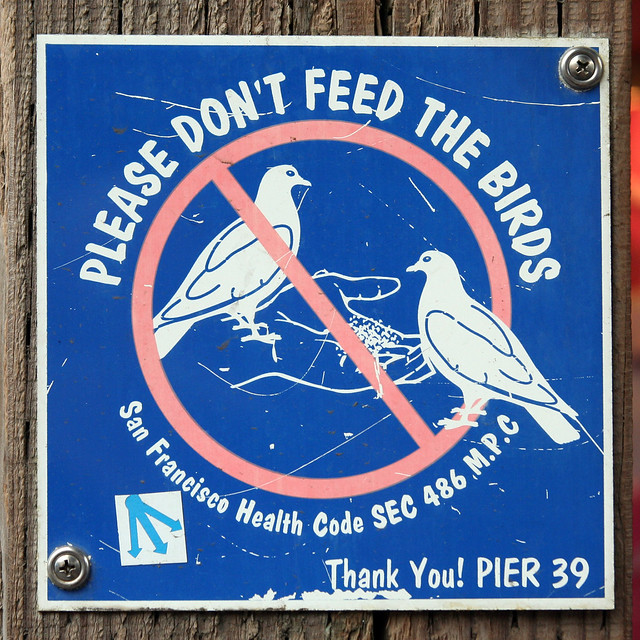
“Large population of pigeons is a health hazard. Our huge feral pigeon population is a health hazard and creates many problems in the city.
“Pigeon droppings dirty public spaces, do costly damage to buildings, and can spread life-threatening diseases, especially to the elderly and immune-deficient. Their nesting materials block drains and harbor parasites like bird mites. Pigeon food makes a mess and attracts rats.
“Feeding pigeons promotes over-breeding. Pigeon feeding produces over-breeding.
“Pigeons normally breed two or three times a year, producing two eggs per brood. Overfed city pigeons can breed up to eight times a year.
“Pigeons are harmed when fed. When you feed pigeons, you are not doing them a favor. They lose their natural ability to scavenge and survive on their own.
“Pigeon over population leads to overcrowded, unsanitary conditions and produces sick and injured birds. A smaller flock is healthier and does less damage.
“It is illegal. It’s against the law to feed pigeons on the streets or sidewalks of San Francisco (Sec. 486. M.P.C). Violators may be cited and fined.
“You can help keep your neighborhood safe and clean and the pigeon population under control by not feeding pigeons. Keep edible garbage away from pigeons by discarding it in a securely covered garbage can.
“And don’t feed pets outside.You may report pigeon feeders to the San Francisco Police Department at 415-553-0123, or by calling 3-1-1.
“Please join in on the efforts to keep San Francisco clean and beautiful by NOT feeding the pigeons.”
* * * * *
At the same time that city officials are telling residents, “Please don’t feed the pigeons,” they aren’t telling them, “Please don’t feed the bums.”
Because of its mild climate and social programs that give cash payments to just-arrived vagrants, San Francisco is often considered the homelessness capital of the United States.
Former San Francisco Mayor Willie Brown (1996–2004) actually proposed that the city create electronic cards for transients that residents could swipe with their credit cards, thus transferring money from their accounts to that of the recipient.
Brown dropped the idea when faced with the brutal truth that not many citizens–especially women–would be willing to whip out their credit card when confronted by a smelly, unshaved and possibly psychotic transient.
San Francisco spends $250 million annually on services for what are now euphemistically called “the homeless.”That’s because city officials don’t want to use words that accurately describe who makes up the overwhelming majority of this population:
- Druggies
- Drunks
- Mental cases
- Bums
Eight city departments oversee at least 400 contracts to 76 private organizations, most of them nonprofits, that are charged with eliminating this pestilence.
Estimates of this population range from 7,000-10,000 people, of which approximately 3,000-5,000 refuse shelter.
A similar public crackdown on “bum-feeders” could go like this:
“Please do not feed the bums. There are dozens of reasons why, but mainly: feeding bums harms our neighborhoods and also harms the bums.
“Our huge feral bum population is a health hazard and creates many problems in the city.Bum droppings dirty public spaces, do costly damage to buildings, and can spread life-threatening diseases, especially to the elderly and immune-deficient.
“Their stolen shopping carts and filthy possessions block sidewalks and harbor parasites like bedbugs and lice. Bum food makes a mess and attracts rats.
“Feeding bums promotes overbreeding. Bums normally travel alone, foraging for drugs and/or alcohol.Pampered city bums flock to liquor stores and drug dens where they can indulge their vices, thus taxing city medical services to the limit.
“When you feed bums, you are not doing them a favor. They lose their natural ability to find work and support themselves and their families.
“Bum over population leads to overcrowded, unsanitary conditions and produces sick and injured bums. A smaller horde is healthier and does less damage.
“It’s against the law to feed bums on the streets or sidewalks of San Francisco. Violators may be cited and fined.
“You can help keep your neighborhood safe and clean and the bum population under control by not feeding bums.
“Keep edible garbage away from bums by discarding it in a securely covered garbage can. And don’t feed bums outside.
“It is Illegal. You may report bum feeders to the San Francisco Police Department at 415-553-0123, or by calling 3-1-1.
“Please join in on the efforts to keep San Francisco clean and beautiful by NOT feeding the bums.”

 Bureaucracybuster's Blog
ABC NEWS, ALCOHOLISM, ALTERNET, AP, BEGGING, BUMS, BUZZFEED, CBS NEWS, CNN, DAILY KOS, DISEASE, DRUG ADDICTION, FACEBOOK, HEPATITIS B, HEPATITIS C, HILLARY RONEN, HIV, HOMELESS, HOMELESSNESS, MENTAL ILLNESS, MOTHER JONES, MOVEON, NBC NEWS, NEWSWEEK, NPR, PANHANDLING, POLITICO, PUBLIC HEALTH, RAW STORY, REUTERS, ROTAVIRUS, SALON, SAN FRANCISCO, SAN FRANCISCO CHRONICLE, SAN FRANCISCO DEPARTMENT OF PUBLIC WORKS, SEATTLE TIMES, SLATE, THE ATLANTIC, THE CHICAGO SUN-TIMES, THE CHICAGO TRIBUNE, THE DAILY BEAST, THE GUARDIAN, THE HILL, THE HUFFINGTON POST, THE LOS ANGELES TIMES, THE NEW YORK TIMES, THE WALL STREET JOURNAL, THE WASHINGTON POST, TIME, TWITTER, U.S. NEWS & WORLD REPORT, UPI, USA TODAY, WILLIE BROWN
BRING ON THE ROACHES–INSECT AND HUMAN: PART ONE (OF TWO)
In Bureaucracy, History, Law, Law Enforcement, Medical, Politics, Social commentary on June 21, 2018 at 1:45 amImagine that, late one night, you wake up and decide to go to the kitchen for a drink of water. You turn on the light—and suddenly find a virtual army of cockroaches hurriedly scurrying across the floor.
In the morning, you call an exterminator, and a “pest control specialist” soon knocks at your door.
“What you need to do,” he says, “is to put out big packets of sugar for the roaches.”
“Wait a minute—don’t roaches love sugar? How is this going to make them go away?”
“It won’t.”
“Then what’s the point?”
“The point is that roaches are God’s creatures, and they need to eat, too.”
A typical cockroach scene
“But they’ve taken over my kitchen. They’re filthy, they leave droppings everywhere and they contaminate the food I’m supposed to eat.”
“You must learn to have compassion for all of God’s creatures, and learn to get along with them.”
“So if I hire you, you’re not going to get rid of them for me?”
“No.”
“So what are you going to do?”
“Help you to accept that they have a right to be a part of your community.”
If a pest control company actually operated like that, how long would they be in business?
Not long.
Yet, in San Francisco, successive mayors and members of the Board of Supervisors operate in exactly that manner toward succeeding waves of human pestilence. And they remain in office for years.
Huge areas of the city are covered in feces, urine, trash and needles. Hospitals overflow with patients that have fallen ill due to the contamination.
NBC News surveyed 153 blocks of the city—an area more than 20 miles. That area includes popular tourist spots like Union Square and the cable car turnaround. It’s bordered by Van Ness Avenue, Market Street, Post Street and Grant Avenue. And it’s also home to City Hall, schools, playgrounds, and a police station.
A typical San Francisco scene
Most of the trash found consisted of heaps of garbage, food, and discarded junk—including 100 drug needles and more than 300 piles of feces throughout downtown. If you step on one of these needles, you can get HIV, Hepatitis C, Hepatitis B or a variety of other viral diseases.
But you don’t have to actually get stuck by a needle to become a victim. Once fecal matter dries, it can become airborne and release deadly viruses, such as the rotavirus.
“If you happen to inhale that, it can also go into your intestine,” says Dr. Lee Riley, an infectious disease specialist at the University of California, Berkeley. The results can prove fatal, especially in children.
As the news unit filmed a typical day’s activity in San Francisco, a group of preschool students, enjoying a field trip, walked to City Hall.
Responding to a reporter’s question, Adelita Orellana said: “We see poop, we see pee, we see needles, and we see trash.
“Sometimes they ask what is it, and that’s a conversation that’s a little difficult to have with a two-year old, but we just let them know that those things are full of germs, that they are dangerous, and they should never be touched.”
San Francisco’s political elite see this blight as well as everyone else. They can’t avoid seeing it, since the city covers 47 square miles.
San Francisco City Hall
Cabe6403 at English Wikipedia [CC BY-SA 3.0 (https://creativecommons.org/licenses/by-sa/3.0) or GFDL (http://www.gnu.org/copyleft/fdl.html)%5D, from Wikimedia Commons
One of those who sees the disgrace up-front is Supervisor Hillary Ronen: “Unacceptable. Absolutely unacceptable We’re losing tourists. We’re losing conventions in San Francisco.”
Yet what does she propose as the solution? “We need more temporary beds for street homelessness.”
This is on a par with a “pest control expert” recommending: “We need more sugar to clear up our roach problem.”
Thanks to its mild climate and social programs that dole out cash payments to virtually anyone with no residency requirement, San Francisco is often considered the “homeless capital” of the United States.
According to a 2016 article in the San Francisco Chronicle, there are about 13,000 “homeless” people in San Francisco. Of these, an estimated 3,000 to 5,000 refuse shelter.
In 2016, San Francisco spent $275 million on homelessness—up from $241 million in 2015. Public Works cleanup crews picked up more than 679 tons of trash from homeless tent camps—and collected more than 100,000 used syringes from the camps.
In 2016, San Francisco residents made 22,608 complaints about encampments—a five-fold increase from 2015.
City officials euphemistically call this population “the homeless.” That’s because they don’t want to use words that accurately describe those who comprise the overwhelming majority of this population:
Or, as even many police, social workers and paramedics who wrestle with this population privately refer to them: DDMBs.
Yet the mere citing of statistics—how many “homeless,” how much money is spent on how many people, how much filth they produce—doesn’t capture the true intensity of the problem.
To do that, you must confront its realities at the street level. Which is what we’ll do in Part Two of this series.
Share this: