New York State prisons are about to get a lot fuller.
New York State Senator Tony Avella is sponsoring a bill to create a felony charge– “aggravated resisting arrest”–for people who have been convicted of resisting arrest twice in a 10-year period.
Under current law, resisting arrest is a misdemeanor, carrying a maximum penalty of one year in prison.
If the charge became a felony, those convicted could be sentenced from four years of probation to life in prison.
The bill has its origins in a letter the Lieutenants Benevolent Association–a police union–sent to New York Police Department (NYPD) Commissioner Bill Bratton in January requesting a change in the current law.
State Senator Avella’s proposed legislation reads as follows:
“A person is guilty of aggravated resisting arrest when he or she commits the crime of resisting arrest pursuant to Section 205.30 and has previously been convicted of such crimetwo prior times within a ten-year period.
“Aggravated resisting arrest is a class E felony.”
And Bratton, in testimony before the New York State Senate in February, supported harsher penalties for those who resist arrest.
“We need to get around this idea that you can resist arrest,” Bratton said to reporters after his appearance. “One of the ways to do that is to give penalties for that.”
This legislation–if enacted–will have both local and national implications.
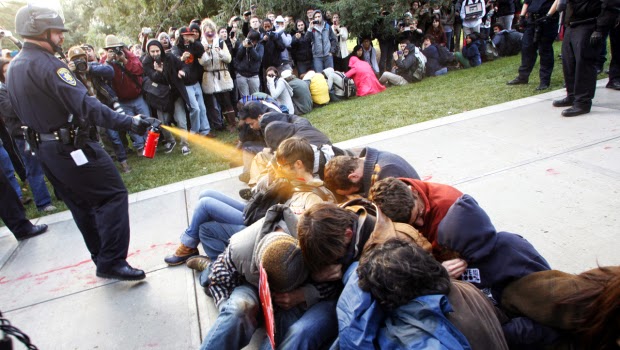
Police pepper-spraying non-violent protesters
Local–because the NYPD is the largest police department in the country. Its website states that it now has “approximately 34,500” uniformed officers.
(To put that number into historical perspective: When Alexander the Great set out in 334 B.C. to conquer the Persian empire, his army numbered 30,000.)
National–because the NYPD is one of the most respected police departments in the country. And other police departments will almost certainly follow suit in urging their state legislatures to pass similar legislation.
So what’s wrong with that?
“Resisting arrest” is one of those terms that can mean whatever a police officer wants it to mean.
If a prosecutor accuses someone of bank robbery, he must present valid evidence–such as witnesses, camera footage and (probably) portions of stolen money in the arrested person’s possession.
But if a cop says someone “resisted arrest,” the “evidence” often consists of only his claim.
“Resisting arrest” can mean anything–including that the person merely asked, “Why am I being arrested?”
WNYC–New York’s highly respected public radio station–reported in 2014 that 40% of resisting arrest cases are brought by five percent of police officers.
If an officer routinely claims that people are resisting arrest, this might signal his being overly aggressive toward civilians.
He might even use the criminal charge to cover up his use of excessive force.
This is especially relevant in light of a series of recent cases–some caught on camera–of police savagely beating arrestees, or using forbidden chokeholds on them.
Consider how such increased penalties could have affected the life of Tyeesha Mobley.
Mobley, 29, caught her nine-year-old son stealing $10 from her purse. She called the called the NYPD.
Can you please send over an officer to explain to my kids that stealing is wrong? she asked.
The police department obliged, sending over four officers to meet Mobley and her two boys at a nearby gas station.
%23!031915-national-Tyeesha-Mobley&docid=JHk4KstsAEHWfM&tbnid=O-hToga7ZXEKgM%3A&w=1200&h=675&ei=undefined&ved=undefined&iact=c "https://www.google.com/imgres?imgurl=http://www.bet.com/content/dam/betcom/images/2015/03/National/031915-national-Tyeesha-Mobley.jpg.custom1200x675x20.dimg&imgrefurl=http://www.bet.com/news/national/photos/bring-that-week-back/2015/03/bring-that-week-back-parents-says-daughter-not-allowed-at-black-friend-s-sleepover.html?utm_source=feedburner&utm_medium=feed&utm_campaign=Feed%3A+Betcom-LatestPhotos+(BET.com+-+Latest+Photos)#!031915-national-Tyeesha-Mobley&docid=JHk4KstsAEHWfM&tbnid=O-hToga7ZXEKgM:&w=1200&h=675&ei=undefined&ved=undefined&iact=c")
Tyeesha Mobley
The meeting started off well. “Three officers was joking around with [the nine-year-old who had stolen the $10], telling him, ‘You can’t be stealing; you’ll wind up going in the police car,’” Mobley testified at a court hearing in October, 2014.
But the fourth officer apparently resented the assignment. According to a lawsuit subsequently filed by Mobley, the following happened:
“You black bitches don’t know how to take care of your kids,” said the fourth officer. “Why are you wasting our time? Why don’t you take your fucking kid and leave?”
Mobley decided that was a good time to do just that
But before she could do so, the cop told her she was under arrest.
“What for?” she asked. “If you’re going to say another fucking word,” the lawsuit alleges the cop warned her, “I’m going to knock your teeth down your throat.”
He then shoved her up against a car, kicked her legs, and handcuffed her.
Mobley spent a night in jail. Her two boys were taken away and placed in foster care for four months–with a family that spoke no English.
Finally, a judge threw out the case against her.
Mobley has since filed a lawsuit against New York City, the NYPD and the Administration for Children’s Services.
It doesn’t take a genius to see how Mobley’s life could have been turned into an even greater hell under the proposed change in “resisting arrest” laws.
 Bureaucracybuster's Blog
ABC NEWS, BALTIMORE POLICE DEPARTMENT, CBS NEWS, CNN, FACEBOOK, FREDDIE GRAY, MARILYN MOSBY, NBC NEWS, POLICE BRUTALITY, ROUGH RIDES, THE CHICAGO SUN-TIMES, THE CHICAGO TRIBUNE, THE LOS ANGELES TIMES, THE NEW YORK TIMES, THE WASHINGTON POST, TWITTER, USA TODAY
WHEN COPS ARE LAWBREAKERS: PART ONE (OF TWO)
In Bureaucracy, Law, Law Enforcement, Social commentary on May 6, 2015 at 12:01 amLeave out his name for a moment. Then consider the following:
His biography includes at least 18 arrests:
His criminal record was one of drug charges and minor crimes. He was involved in 20 criminal court cases–five were still active at the time of his death.
In February 2009, he was sentenced to four years in prison for two counts of drug possession with intent to deliver and was paroled in 2011–after serving only two.
In 2012, he was arrested for violating parole but was not sent back to prison.
In 2013, he returned to prison for a month before being released again.
He was due in court on a drug possession charge on April 24.
Who was he?
He was Freddie Gray, the 25-year-old black man who spent seven days in a coma after he suffered injuries while in the custody of Baltimore police.
Click here: Freddie Gray Arrest Record, Criminal History & Rap Sheet
Freddie Gray
His last arrest came on April 12.
While being transported in a police van to the police station, Gray fell into a coma and was taken to a trauma center. He died on April 19, owing to a broken neck.
On April 21, the six Baltimore police officers involved in his arrest were temporarily suspended with pay while an investigation occurred.
According to the police account of Gray’s arrest:
On April 12, at 8:39 A.M. Lieutenant Brian W. Rice, Officer Edward Nero, and Officer Garrett E. Miller were patrolling on bicycles and “made eye contact” with Gray.
According to Miller, Gray, “unprovoked upon noticing police presence,” fled on foot.
After a brief foot chase, he was caught and arrested “without the use of force or incident,” according to Miller.
Miller further wrote that:
A witness to Gray’s arrest have since stated that the police were “folding” Gray. That is: One officer was bending Gray’s legs backwards, while another was pressing a knee into Gray’s neck.
A second witness claimed to have seen Gray being beaten with police batons.
On April 24, Baltimore Police Commissioner Anthony Batts said, “We know our police employees failed to get him medical attention in a timely manner multiple times.”
He also admitted that his officers had failed to buckle Gray in the van–standard police procedure–before he was transported to the police station.
News reports have raised the possibility that Gray was treated to a “rough ride”–where a handcuffed prisoner is placed without a seatbelt in a vehicle deliberately driven over rough roads at high speed as an unofficial punishment.
Inside a typical police van
And Gray had clearly had enough run-ins with the law to be known to police as a habitual criminal.
In fact, medical examiners reported Gray sustained more injuries by slamming around inside the van, “apparently breaking his neck; a head injury he sustained matches a bolt in the back of the van.”
But even worse findings were to come for the officers involved.
Share this: