bureaucracybusters

Posts Tagged ‘NEW YORK POLICE DEPARTMENT’

BLACK THUGS MATTER

In Bureaucracy, History, Law Enforcement, Social commentary on August 4, 2015 at 3:06 pm

Blacks make up 13% of the American population, according to the 2010 census of the United States.

But they committed 52% of homicides between 1980 and 2008, according to the Bureau of Justice Statistics.  Only 45% of whites were offenders in such cases.

Blacks were disproportionately likely to commit homicide and to be the victims. In 2008 blacks were seven times more likely than whites to commit homicide. And they were six times more likely than whites to be homicide victims.

According to the FBI, blacks were responsible for 38% of murders, compared to 31.1% for whites, in 2013.

From  2011 to 2013, 38.5% of people arrested for murder, manslaughter, rape, robbery, and aggravated assault were black.

Click here: FactCheck: do black Americans commit more crime?

In 1971, Robert Daley, a reporter for the New York Times, became a deputy police commissioner for the New York Police Department (NYPD).

In that capacity, he saw the NYPD from the highest levels to the lowest–from the ornate, awe-inspiring office of  Police Commissioner Patrick Murphy to the gritty, sometimes blood-soaked streets of New York.

He spent one year on the job before resigning–later admitting that when he agreed to take the job, he got more than he bargained for.

It proved to be a tumultuous year in the NYPD’s history: Among those challenges Daley and his fellow NYPD members faced were the murders of several police officers, committed by members of the militant Black Liberation Army.

Two of those murdered officers were Waverly Jones and Joseph Piagentini.  Jones was black, Piagentini white; both were partners.  Both were shot in the back without a chance to defend themselves.

Writing about these murders in a bestselling 1973 book–Target Blue: An Inside’s View of the N.Y.P.D.–Daley noted:

  • Jones and Piagentini were the sixth and seventh policemen–of ten–murdered in 1971.
  • About 18 men were involved in these murders.  All were black.
  • The city’s politicians knew this–and so did Commissioner Murphy.  None dared say so publicly.

“But the fact remained,” wrote Daley, “that approximately 65% of the city’s arrested murderers, muggers, armed robbers, proved to be black men; about 15% were of Hispanic origin; and about 20% were white [my italics].”

The overall racial breakdown of the city was approximately:

  • Whites, 63%;
  • Blacks, 20%;
  • Hispanics 17%.

Stated another way: Blacks, who made up 20% of the city’s population, were responsible for 65% of the city’s major crimes.

Or, as Daley himself put it: “So the dangerous precincts, any cop would tell you, were the black precincts.”

That was 42 years ago.

Now, consider the following statistics released by the NYPD for “Crime and Enforcement Activity in New York City” in 2012.  Its introduction states:

“This report presents statistics on race/ethnicity compiled from the New York City Police Department’s records management system.”

Then come the guts of the report:

Murder and Non-Negligent Manslaughter Victims:

  • Black (60.1%)
  • Hispanic (26.7%)
  • White victims (8.7%)
  • Asian/Pacific Islanders (4.2%)

Murder and Non-Negligent Manslaughter Arrestees:

  • Black (51.4%)
  • Hispanic (36.7%)
  • White (9.2%)
  • Asian/Pacific Islander (2.6%)

Rape Victims:

  • Black (37.9%)
  • Hispanic (36.9%)
  • White victims (19.2%)
  • Asian/Pacific Islanders (5.4%)

Rape Arrestees:

  • Black (48.6%)
  • Hispanic (42.8%)
  • White (5.0%)
  • Asian/Pacific Islander (3.1%)

Other Felony Sex Crimes Victims:

  • Black (40.7%)
  • Hispanic (33.6%)
  • White victims (19.6%)
  • Asian/Pacific Islanders (5.9%)

Known Other Felony Sex Crime Arrestees:

  • Black (42.3%)
  • Hispanic (39.8%)
  • White (12.6%)
  • Asian /Pacific Islander (5.1%)

Robbery Victims:

  • Hispanic (36.1%)
  • Black (31.9%)
  • White victims (18.3%)
  • Asian/Pacific Islanders (12.8%)

Robbery Arrestees:

  • Black (62.1%)
  • Hispanic (29.0%)
  • White (6.2%)
  • Asian/Pacific Islander (2.5%)

Felonious Assault Victims:

  • Black (47.8%)
  • Hispanic (33.6%)
  • White (12.4%)
  • Asian/Pacific Islanders (5.5%)

Felonious Assault Arrestees:

  • Black (52.3%)
  • Hispanic (33.6%)
  • White (9.4%)
  • Asian/Pacific Islanders (4.5%)

Grand Larceny Victims:

  • White (42.4%)
  • Black (25.0%)
  • Hispanic (20.1%)
  • Asian/Pacific Islanders (11.8%)

Grand Larceny Arrestees:

  • Black (52.0%) 
  • Hispanic (28.5%)
  • White (14.6%)
  • Asian/Pacific Islanders (4.8%)

Shooting Victims:

  • Black (74.1%)
  • Hispanic (22.2%)
  • White (2.8%)
  • Asian/Pacific Islanders (0.8%)

Shooting Arrestees:

  • Black (75.0%)
  • Hispanic (22.0%)
  • White (2.4%)
  • Asian/Pacific Islander (0.6%)

Drug Felony Arrest Population:

  • Black (45.3%)
  • Hispanic (40.0%)
  • White (12.7%)
  • Asian Pacific Islanders (1.9%)

The Drug Misdemeanor Arrest Population

  • Black (49.9%)
  • Hispanic (34.5%)
  • White (13.3%)
  • Asian Pacific Islanders (2.1%)

The Felony Stolen Property Arrest Population:

  • Black (52.5%)
  • Hispanic (28.9%)
  • White (14.5%)
  • Asian/Pacific Islanders (4.0%)

The Misdemeanor Stolen Property Arrest Population:

  • Black (47.1%)
  • Hispanic (30.2%)
  • White (16.9%)
  • Asian/Pacific Islanders (5.4%)

Violent Crime Suspects:

  • Black (66.0%)
  • Hispanic (26.1%)
  • White (5.8%)
  • Asian/Pacific Islanders (1.9%)

Reported Crime Complaint Juvenile Victims:

  • Black (43.5%)
  • Hispanic (38.7%)
  • White (11.6%)
  • Asian/Pacific Islander (5.8%)

Juvenile Crime Complaint Arrestees:

  • Black (58.6%)
  • Hispanic (32.6%)
  • White (5.8%)
  • Asian/Pacific Islander (2.8%)

Appendix B of the report offers a breakdown of New York City’s racial makeup:

                                            Total Numbers      % the City’s Population  

  • White                                              2,722,904                         (33.3%)
  • Black                                              1,861,295                        (22.8%)
  • Hispanic                                          2,336,076                        (28.6%)
  • Asian/Pacific Islanders                  1,030,914                        (12.6%)

Thus, while Blacks make up 22.8% of New York City’s population, they comprise

  • 51.4% of its murder and non-negligent manslaughter arrests;
  • 48.6% of its rape arrests;
  • 42.3% of its known other felony sex crime arrests;
  • 62.1% of its robbery arrests;
  • 52.3% of its felonious assault arrests;
  • 52.0% of its grand larceny arrests;
  • 75.0% of its shooting arrests;
  • 45.3% of its drug felony arrests;
  • 49.9% of its drug misdemeanor arrests;
  • 52.5% of its felony stolen property arrests;
  • 47.1% of its misdemeanor stolen property arrests;
  • 66.0% of its violent crime suspects;
  • 58.6% of its juvenile crime complaint arrests.

Police, like most people, learn from their experiences.  And if the majority of their experiences with blacks continue to be with the perpetrators of crime, they will continue to associate blacks as a whole with criminals.

This is admittedly unfair to those blacks who are not involved in any way with crime. But it will continue until crime rates among blacks start falling dramatically.
WHY COPS–WHITE AND BLACK–FEAR BLACKS

In Bureaucracy, History, Law Enforcement, Politics, Social commentary on May 13, 2015 at 1:25 pm

Blacks make up 13% of the American population, according to the 2010 census of the United States.

But they committed 52% of homicides between 1980 and 2008, according to the Bureau of Justice Statistics.  Only 45% of whites were offenders in such cases.

Blacks were disproportionately likely to commit homicide and to be the victims. In 2008 blacks were seven times more likely than whites to commit homicide.  And they were six times more likely than whites to be homicide victims.

According to the FBI, blacks were responsible for 38% of murders, compared to 31.1% for whites, in 2013.

From  2011 to 2013, 38.5% of people arrested for murder, manslaughter, rape, robbery, and aggravated assault were black.

Click here: FactCheck: do black Americans commit more crime?

In 1971, Robert Daley, a reporter for the New York Times, became a deputy police commissioner for the New York Police Department (NYPD).

In that capacity, he saw the NYPD from the highest levels to the lowest–from the ornate, awe-inspiring office of  Police Commissioner Patrick Murphy to the gritty, sometimes blood-soaked streets of New York.

He spent one year on the job before resigning–later admitting that when he agreed to take the job, he got more than he bargained for.

It proved to be a tumultuous year in the NY’D’s history:  Among those challenges Daley and his fellow NYPD members faced were the murders of several police officers, committed by members of the militant Black Liberation Army.

Two of those murdered officers were Waverly Jones and Joseph Piagentini.  Jones was black, Piagentini white; both were partners.  Both were shot in the back without a chance to defend themselves.

Writing about these murders in a bestselling 1973 book–Target Blue: An Inside’s View of the N.Y.P.D.–Daley noted:

  • Jones and Piagentini were the sixth and seventh policemen–of ten–murdered in 1971.
  • About 18 men were involved in these murders.  All were black.
  • The city’s politicians knew this–and so did Commissioner Murphy.  None dared say so publicly.

“But the fact remained,” wrote Daley, “that approximately 65% of the city’s arrested murderers, muggers, armed robbers, proved to be black men; about 15% were of Hispanic origin; and about 20% were white [my italics].

The overall racial breakdown of the city was approximately:

  • Whites, 63%;
  • Blacks, 20%;
  • Hispanics 17%.

Stated another way: Blacks, who made up 20% of the city’s population, were responsible for 65% of the city’s major crimes.

Or, as Daley himself put it: “So the dangerous precincts, any cop would tell you, were the black precincts.”

That was 42 years ago.

Now, consider the following statistics released by the NYPD for “Crime and Enforcement Activity in New York City” in 2012.  Its introduction states:

“This report presents statistics on race/ethnicity compiled from the New York City Police Department’s records management system.”

Then follows this chart:

Misdeanor Criminal Mischief
Victim, Suspect, Arrestee Race/Ethnicity                                                                  

American Indians:          Victims:    0.7%    Suspects:   0.3%   Arrestees:  0.3%

Asian/Pacific Islanders:  Victims:   8.4%     Suspects:  3.2%    Arrestees:  3.9%

Blacks:                         Victims: 36.5%  Suspects:  49.6%  Arrestees:  36.5%

Whites:                          Victims: 28.9%    Suspects:  17.0%    Arrestees:  22.9%

Hispanics:                      Victims:  25.4%   Suspects:  29.8%    Arrestees:  36.4%

Total  Victims:        40,985       

Total Suspects:     11,356  

Total Arrests:         7,825

Then come the guts of the report:

Murder and Non-Negligent Manslaughter Victims:

  • Black (60.1%)
  • Hispanic (26.7%)
  • White victims (8.7%)
  • Asian/Pacific Islanders (4.2%)

Murder and Non-Negligent Manslaughter Arrestees:

  • Black (51.4%)
  • Hispanic (36.7%)
  • White (9.2%)
  • Asian/Pacific Islander (2.6%)

Rape Victims:

  • Black (37.9%)
  • Hispanic (36.9%)
  • White victims (19.2%)
  • Asian/Pacific Islanders (5.4%)

Rape Arrestees:

  • Black (48.6%)
  • Hispanic (42.8%)
  • White (5.0%)
  • Asian/Pacific Islander (3.1%)

Other Felony Sex Crimes Victims:

  • Black (40.7%)
  • Hispanic (33.6%)
  • White victims (19.6%)
  • Asian/Pacific Islanders (5.9%)

Known Other Felony Sex Crime Arrestees:

  • Black (42.3%)
  • Hispanic (39.8%)
  • White (12.6%)
  • Asian /Pacific Islander (5.1%)

Robbery Victims:

  • Hispanic (36.1%)
  • Black (31.9%)
  • White victims (18.3%)
  • Asian/Pacific Islanders (12.8%)

Robbery Arrestees:

  • Black (62.1%)
  • Hispanic (29.0%)
  • White (6.2%)
  • Asian/Pacific Islander (2.5%)

Felonious Assault Victims:

  • Black (47.8%)
  • Hispanic (33.6%)
  • White (12.4%)
  • Asian/Pacific Islanders (5.5%)

Felonious Assault Arrestees:

  • Black (52.3%)
  • Hispanic (33.6%)
  • White (9.4%)
  • Asian/Pacific Islanders (4.5%)

Grand Larceny Victims:

  • White (42.4%)
  • Black (25.0%)
  • Hispanic (20.1%)
  • Asian/Pacific Islanders (11.8%)

Grand Larceny Arrestees:

  • Black (52.0%) 
  • Hispanic (28.5%)
  • White (14.6%)
  • Asian/Pacific Islanders (4.8%)

Shooting Victims:

  • Black (74.1%)
  • Hispanic (22.2%)
  • White (2.8%)
  • Asian/Pacific Islanders (0.8%)

Shooting Arrestees:

  • Black (75.0%)
  • Hispanic (22.0%)
  • White (2.4%)
  • Asian/Pacific Islander (0.6%)

Drug Felony Arrest Population:

  • Black (45.3%)
  • Hispanic (40.0%)
  • White (12.7%)
  • Asian Pacific Islanders (1.9%)

The Drug Misdemeanor Arrest Population

  • Black (49.9%)
  • Hispanic (34.5%)
  • White (13.3%)
  • Asian Pacific Islanders (2.1%)

The Felony Stolen Property Arrest Population:

  • Black (52.5%)
  • Hispanic (28.9%)
  • White (14.5%)
  • Asian/Pacific Islanders (4.0%)

The Misdemeanor Stolen Property Arrest Population:

  • Black (47.1%)
  • Hispanic (30.2%)
  • White (16.9%)
  • Asian/Pacific Islanders (5.4%)

Violent Crime Suspects:

  • Black (66.0%)
  • Hispanic (26.1%)
  • White (5.8%)
  • Asian/Pacific Islanders (1.9%)

Reported Crime Complaint Juvenile Victims:

  • Black (43.5%)
  • Hispanic (38.7%)
  • White (11.6%)
  • Asian/Pacific Islander (5.8%)

Juvenile Crime Complaint Arrestees:

  • Black (58.6%)
  • Hispanic (32.6%)
  • White (5.8%)
  • Asian/Pacific Islander (2.8%)

Appendix B of the report offers a breakdown of New York City’s racial makeup:

                                                                Total Numbers        % the City’s Population  

  • White                                             2,722,904                          (33.3%)
  • Black                                             1,861,295                         (22.8%)
  • Hispanic                                          2,336,076                         (28.6%)
  • Asian/Pacific Islanders                  1,030,914                          (12.6%)

Thus, while Blacks make up 22.8% of New York City’s population, they comprise

  • 51.4% of its murder and non-negligent manslaughter arrests;
  • 48.6% of its rape arrests;
  • 42.3% of its known other felony sex crime arrests;
  • 62.1% of its robbery arrests;
  • 52.3% of its felonious assault arrests;
  • 52.0% of its grand larceny arrests;
  • 75.0% of its shooting arrests;
  • 45.3% of its drug felony arrests;
  • 49.9% of its drug misdemeanor arrests;
  • 52.5% of its felony stolen property arrests;
  • 47.1% of its misdemeanor stolen property arrests;
  • 66.0% of its violent crime suspects;
  • 58.6% of its juvenile crime complaint arrests.

Police, like most people, learn from their experiences.  And if the majority of their experiences with blacks continue to be with the perpetrators of crime, they will continue to associate blacks as a whole with criminals.

This is admittedly unfair to those blacks who are not involved in any way with crime.  But it will continue until crime rates among blacks start falling dramatically.

CREATING FELONS WITH A WORD

In Bureaucracy, Law, Law Enforcement, Politics, Social commentary on March 25, 2015 at 2:54 am

New York State prisons are about to get a lot fuller.

New York State Senator Tony Avella is sponsoring a bill to create a felony charge– “aggravated resisting arrest”–for people who have been convicted of resisting arrest twice in a 10-year period.

Under current law, resisting arrest is a misdemeanor, carrying a maximum penalty of one year in prison.

If the charge became a felony, those convicted could be sentenced from four years of probation to life in prison.

The bill has its origins in a letter the Lieutenants Benevolent Association–a police union–sent to New York Police Department (NYPD) Commissioner Bill Bratton in January requesting a change in the current law.

State Senator Avella’s proposed legislation reads as follows:

“A person is guilty of aggravated resisting arrest when he or she commits the crime of resisting arrest pursuant to Section 205.30 and has previously been convicted of such crimetwo prior times within a ten-year period.

“Aggravated resisting arrest is a class E felony.”

Click here: Bills

And Bratton, in testimony before the New York State Senate in February, supported harsher penalties for those who resist arrest.

“We need to get around this idea that you can resist arrest,” Bratton said to reporters after his appearance. “One of the ways to do that is to give penalties for that.”

This legislation–if enacted–will have both local and national implications.

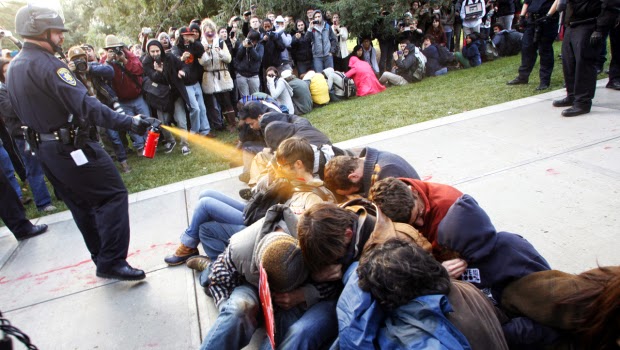
Police pepper-spraying non-violent protesters

Local–because the NYPD is the largest police department in the country.  Its website states that it now has “approximately 34,500” uniformed officers.

(To put that number into historical perspective: When Alexander the Great set out in 334 B.C. to conquer the Persian empire, his army numbered 30,000.)

National–because the NYPD is one of the most respected police departments in the country.  And other police departments will almost certainly follow suit in urging their state legislatures to pass similar legislation.

So what’s wrong with that?

“Resisting arrest” is one of those terms that can mean whatever a police officer wants it to mean.

If a prosecutor accuses someone of bank robbery, he must present valid evidence–such as witnesses, camera footage and (probably) portions of stolen money in the arrested person’s possession.

But if a cop says someone “resisted arrest,” the “evidence” often consists of only his claim.

“Resisting arrest” can mean anything–including that the person merely asked, “Why am I being arrested?”

WNYC–New York’s highly respected public radio station–reported in 2014 that 40% of resisting arrest cases are brought by five percent of police officers.

If an officer routinely claims that people are resisting arrest, this might signal his being overly aggressive toward civilians.

He might even use the criminal charge to cover up his use of excessive force.

This is especially relevant in light of a series of recent cases–some caught on camera–of police savagely beating arrestees, or using forbidden chokeholds on them.

Consider how such increased penalties could have affected the life of Tyeesha Mobley.

Mobley, 29, caught her nine-year-old son stealing $10 from her purse. She called the called the NYPD.

Can you please send over an officer to explain to my kids that stealing is wrong? she asked.

The police department obliged, sending over four officers to meet Mobley and her two boys at a nearby gas station.

https://www.google.com/imgres?imgurl=http://www.bet.com/content/dam/betcom/images/2015/03/National/031915-national-Tyeesha-Mobley.jpg.custom1200x675x20.dimg&imgrefurl=http://www.bet.com/news/national/photos/bring-that-week-back/2015/03/bring-that-week-back-parents-says-daughter-not-allowed-at-black-friend-s-sleepover.html?utm_source=feedburner&utm_medium=feed&utm_campaign=Feed%3A+Betcom-LatestPhotos+(BET.com+-+Latest+Photos)#!031915-national-Tyeesha-Mobley&docid=JHk4KstsAEHWfM&tbnid=O-hToga7ZXEKgM:&w=1200&h=675&ei=undefined&ved=undefined&iact=c

Tyeesha Mobley

The meeting started off well. “Three officers was joking around with [the nine-year-old who had stolen the $10], telling him, ‘You can’t be stealing; you’ll wind up going in the police car,’” Mobley testified at a court hearing in October, 2014.

But the fourth officer apparently resented the assignment. According to a lawsuit subsequently filed by Mobley, the following happened:

“You black bitches don’t know how to take care of your kids,” said the fourth officer.  “Why are you wasting our time?  Why don’t you take your fucking kid and leave?”

Mobley decided that was a good time to do just that

But before she could do so, the cop told her she was under arrest.

“What for?” she asked. “If you’re going to say another fucking word,” the lawsuit alleges the cop warned her, “I’m going to knock your teeth down your throat.”

He then shoved her up against a car, kicked her legs, and handcuffed her.

https://www.google.com/imgres?imgurl=http://lib.store.yahoo.net/lib/yhst-77502422005591/nypdsticker&imgrefurl=http://newyorkcityheros.com/nyshslgrtees1.html&docid=NkjZ5WArupw0GM&tbnid=gHWJFV5oUGoGYM:&w=250&h=298&ei=TdcRVfKaC-eIsQTpnoGIAQ&ved=0CAIQxiAwAA&iact=c

Mobley spent a night in jail.  Her two boys were taken away and placed in foster care for four months–with a family that spoke no English.

Finally, a judge threw out the case against her.

Mobley has since filed a lawsuit against New York City, the NYPD and the Administration for Children’s Services.

It doesn’t take a genius to see how Mobley’s life could have been turned into an even greater hell under the proposed change in “resisting arrest” laws.

CALL A COP, GO TO JAIL

In Bureaucracy, Law, Law Enforcement, Social commentary on March 24, 2015 at 3:21 pm

As the stage line goes: It seemed like a good idea at the time.

A mother finds that her nine-year-old son has stolen money from her purse.  So she decides to have someone who commands respect teach him that stealing is wrong.

So she calls the police–and things go horribly wrong.

Here’s what happened.

Tyeesha Mobley, 29, caught her nine-year-old son stealing $10 from her purse.

So she called the called the New York Police Department (NYPD)

Can you please send over an officer to explain to my kids that stealing is wrong? she asked.

The police department agreed, and sent over not one but four officers to meet Mobley and her two boys at a nearby gas station.

https://www.google.com/imgres?imgurl=http://www.bet.com/content/dam/betcom/images/2015/03/National/031915-national-Tyeesha-Mobley.jpg.custom1200x675x20.dimg&imgrefurl=http://www.bet.com/news/national/photos/bring-that-week-back/2015/03/bring-that-week-back-parents-says-daughter-not-allowed-at-black-friend-s-sleepover.html?utm_source=feedburner&utm_medium=feed&utm_campaign=Feed%3A+Betcom-LatestPhotos+(BET.com+-+Latest+Photos)#!031915-national-Tyeesha-Mobley&docid=JHk4KstsAEHWfM&tbnid=O-hToga7ZXEKgM:&w=1200&h=675&ei=undefined&ved=undefined&iact=c

Tyeesha Mobley

The meeting started off well.

“Three officers was joking around with [the nine-year-old who had stolen the $10], telling him, ‘You can’t be stealing; you’ll wind up going in the police car,’” Mobley testified at a court hearing in October, 2014.

But the fourth officer apparently resented the assignment.

According to a lawsuit subsequently filed by Mobley, the following happened:

“You black bitches don’t know how to take care of your kids,” said the fourth officer.  “Why are you wasting our time?  Why don’t you take your fucking kid and leave?”

Mobley decided that was a good time to leave. But before she could do so, the cop told her she was under arrest.

“What for?” she asked.

“If you’re going to say another fucking word,” the lawsuit alleges the cop warned her, “I’m going to knock your teeth down your throat.”

He then shoved her up against a car, kicked her legs, and handcuffed her.

Mobley’s two sons–ages four and nine–could only watch in horror as their mother was being manhandled.

“Stop, you’re hurting mommy,” they cried, according to the complaint filed in the lawsuit.

https://www.google.com/imgres?imgurl=http://lib.store.yahoo.net/lib/yhst-77502422005591/nypdsticker&imgrefurl=http://newyorkcityheros.com/nyshslgrtees1.html&docid=NkjZ5WArupw0GM&tbnid=gHWJFV5oUGoGYM:&w=250&h=298&ei=TdcRVfKaC-eIsQTpnoGIAQ&ved=0CAIQxiAwAA&iact=c

Yet worse was to come.

Mobley spent a night in jail.  Her two boys were taken away and placed in foster care for four months–with a family that spoke no English.

Finally, a judge threw out the case against her.

Mobley has since filed a lawsuit against New York City, the NYPD and the Administration for Children’s Services.

“She was simply trying to make sure her son stayed on the right path,” said her attorney, Philip Sporn.  “This shouldn’t  happen to anyone, let alone to a good mom with her kids.”

The lawsuit highlights a fundamental weakness of the American justice system.

Americans almost universally believe that any wrong can be rectified if enough money is paid out as punishment.

Thus, car makers who knowingly keep dangerous vehicles on the road instead of issuing a recall settle up in civil lawsuits.

As a rule, they refuse to admit wrongdoing–and the amount of money they’re forced to pay out to victims isn’t disclosed.

Nearly always, this means the victim–or his survivors–is forbidden to publicly say why the company paid out a huge settlement, such as: “They admitted they knew the brakes were faulty but they didn’t want to spend the money fixing them.”

And if the victims disclose this admission–or how much money they got from Car Maker X–that money can legally be taken from them.

Never, however, is a CEO criminally prosecuted for ordering his company to conceal wrongdoing or dangerous products.

Thus, corporate predators are allowed to escape the criminality of their actions–and go on to prey on other victims.

The same holds true with lawsuits against the police.

Even if Mobley wins a huge settlement, the officer who victimized her will almost certainly remain on the NYPD.

And he will be able to victimize others who have the bad luck to encounter him.

Handing out big chunks of money is not enough to establish justice for outrageous violations of people’s civil rights.

It’s as if former Reichsmarshall Hermann Goring, charged with war crimes, were allowed to fork over a big sum of money and then comfortably retire to his estate.

Until Americans realize that some crimes demand more than financial payment, this country’s “criminal justice system” will fail to live up to its name.

RACE AND CRIME

In Bureaucracy, History, Law, Law Enforcement, Politics, Social commentary on December 8, 2014 at 12:00 am

Are some races more prone to crime–and especially violence–than others?

It remains a hotly-debated topic.  But while the origins of crime remain debatable, the races of its perpetrators and victims can be–and have been–statistically tabulated.

And those statistics haven’t changed much during the last 40 years.

Consider this:

In 1971, Robert Daley, a reporter for the New York Times, became a deputy police commissioner for the New York Police Department (NYPD).

In that capacity, he saw the NYPD from the highest levels to the lowest–from the ornate, awe-inspiring office of  Police Commissioner Patrick Murphy to the gritty, sometimes blood-soaked streets of New York.

He spent one year on the job before resigning–later admitting that when he agreed to take the job, he got more than he bargained for.

It proved to be a tumultuous year in the NY’D’s history:  Among those challenges Daley and his fellow NYPD members faced were the murders of several police officers, committed by members of the militant Black Liberation Army.

Two of those murdered officers were Waverly Jones and Joseph Piagentini.  Jones was black, Piagentini white; both were partners.  Both were shot in the back without a chance to defend themselves.

Writing about these murders in a bestselling 1973 book–Target Blue: An Inside’s View of the N.Y.P.D.–Daley noted:

  • Jones and Piagentini were the sixth and seventh policemen–of ten–murdered in 1971.
  • About 18 men were involved in these murders.  All were black.
  • The city’s politicians knew this–and so did Commissioner Murphy.  None dared say so publicly.

“But the fact remained,” wrote Daley, “that approximately 65% of the city’s arrested murderers, muggers, armed robbers, proved to be black men; about 15% were of Hispanic origin; and about 20% were white [my italics].

The overall racial breakdown of the city was approximately:

  • Whites, 63%;
  • Blacks, 20%;
  • Hispanics 17%.

Stated another way: Blacks, who made up 20% of the city’s population, were responsible for 65% of the city’s major crimes.

Or, as Daley himself put it: “So the dangerous precincts, any cop would tell you, were the black precincts.”

That was 42 years ago.

Now, consider the following statistics released by the NYPD for “Crime and Enforcement Activity in New York City” in 2012.  Its introduction states:

“This report presents statistics on race/ethnicity compiled from the New York City Police Department’s records management system.”

Then follows this chart:

Misdeanor Criminal Mischief
Victim, Suspect, Arrestee Race/Ethnicity                                                                  

American Indians:            Victims:  0.7%   Suspects:  0.3%   Arrestees: 0.3%

Asian/Pacific Islanders:  Victims:  8.4%     Suspects: 3.2%    Arrestees: 3.9%

Blacks:                         Victims: 36.5%  Suspects:  49.6%  Arrestees:  36.5%

Whites:                        Victims: 28.9%   Suspects: 17.0%   Arrestees:  22.9%

Hispanics:                   Victims:  25.4%  Suspects:  29.8%  Arrestees:  36.4%

Total  Victims:        40,985       

Total Suspects:     11,356  

Total Arrests:         7,825

Then come the guts of the report:

Murder and Non-Negligent Manslaughter Victims:

  • Black (60.1%)
  • Hispanic (26.7%)
  • White victims (8.7%)
  • Asian/Pacific Islanders (4.2%)

Murder and Non-Negligent Manslaughter Arrestees:

  • Black (51.4%)
  • Hispanic (36.7%)
  • White (9.2%)
  • Asian/Pacific Islander (2.6%)

Rape Victims:

  • Black (37.9%)
  • Hispanic (36.9%)
  • White victims (19.2%)
  • Asian/Pacific Islanders (5.4%)

Rape Arrestees:

  • Black (48.6%)
  • Hispanic (42.8%)
  • White (5.0%)
  • Asian/Pacific Islander (3.1%)

Other Felony Sex Crimes Victims:

  • Black (40.7%)
  • Hispanic (33.6%)
  • White victims (19.6%)
  • Asian/Pacific Islanders (5.9%)

Known Other Felony Sex Crime Arrestees:

  • Black (42.3%)
  • Hispanic (39.8%)
  • White (12.6%)
  • Asian /Pacific Islander (5.1%)

Robbery Victims:

  • Hispanic (36.1%)
  • Black (31.9%)
  • White victims (18.3%)
  • Asian/Pacific Islanders (12.8%)

Robbery Arrestees:

  • Black (62.1%)
  • Hispanic (29.0%)
  • White (6.2%)
  • Asian/Pacific Islander (2.5%)

Felonious Assault Victims:

  • Black (47.8%)
  • Hispanic (33.6%)
  • White (12.4%)
  • Asian/Pacific Islanders (5.5%)

Felonious Assault Arrestees:

  • Black (52.3%)
  • Hispanic (33.6%)
  • White (9.4%)
  • Asian/Pacific Islanders (4.5%)

Grand Larceny Victims:

  • White (42.4%)
  • Black (25.0%)
  • Hispanic (20.1%)
  • Asian/Pacific Islanders (11.8%)

Grand Larceny Arrestees:

  • Black (52.0%)
  • Hispanic (28.5%)
  • White (14.6%)
  • Asian/Pacific Islanders (4.8%)

Shooting Victims:

  • Black (74.1%)
  • Hispanic (22.2%)
  • White (2.8%)
  • Asian/Pacific Islanders (0.8%)

Shooting Arrestees:

  • Black (75.0%)
  • Hispanic (22.0%)
  • White (2.4%)
  • Asian/Pacific Islander (0.6%)

Drug Felony Arrest Population:

  • Black (45.3%)
  • Hispanic (40.0%)
  • White (12.7%)
  • Asian Pacific Islanders (1.9%)

The Drug Misdemeanor Arrest Population

  • Black (49.9%)
  • Hispanic (34.5%)
  • White (13.3%)
  • Asian Pacific Islanders (2.1%)

The Felony Stolen Property Arrest Population:

  • Black (52.5%)
  • Hispanic (28.9%)
  • White (14.5%)
  • Asian/Pacific Islanders (4.0%)

The Misdemeanor Stolen Property Arrest Population:

  • Black (47.1%)
  • Hispanic (30.2%)
  • White (16.9%)
  • Asian/Pacific Islanders (5.4%)

Violent Crime Suspects:

  • Black (66.0%)
  • Hispanic (26.1%)
  • White (5.8%)
  • Asian/Pacific Islanders (1.9%)

Reported Crime Complaint Juvenile Victims:

  • Black (43.5%)
  • Hispanic (38.7%)
  • White (11.6%)
  • Asian/Pacific Islander (5.8%)

Juvenile Crime Complaint Arrestees:

  • Black (58.6%)
  • Hispanic (32.6%)
  • White (5.8%)
  • Asian/Pacific Islander (2.8%)

Appendix B of the report offers a breakdown of New York City’s racial makeup:

                                                                Total Numbers        % the City’s Population  

  • White                                               2,722,904                         (33.3%)
  • Black                                               1,861,295                         (22.8%)
  • Hispanic                                          2,336,076                         (28.6%)
  • Asian/Pacific Islanders                     1,030,914                          (12.6%)

Thus, while Blacks make up 22.8% of New York City’s population, they comprise

  • 51.4% of its murder and non-negligent manslaughter arrests;
  • 48.6% of its rape arrests;
  • 42.3% of its known other felony sex crime arrests;
  • 62.1% of its robbery arrests;
  • 52.3% of its felonious assault arrests;
  • 52.0% of its grand larceny arrests;
  • 75.0% of its shooting arrests;
  • 45.3% of its drug felony arrests;
  • 49.9% of its drug misdemeanor arrests;
  • 52.5% of its felony stolen property arrests;
  • 47.1% of its misdemeanor stolen property arrests;
  • 66.0% of its violent crime suspects;
  • 58.6% of its juvenile crime complaint arrests.

While Hispanics make up 28.6% of the city’s population, they account for:

  • 36.7% of its murder and non-negligent manslaughter arrests;
  • 42.8% of its rape arrests;
  • 39.8% for its known other felony sex crime arrests;
  • 29.0% of its robbery arrests;
  • 33.6% of its felonious assault arrests;
  • 28.5% of its grand larceny arrests;
  • 22.0% of its shooting arrests;
  • 40.0% of its drug felony arrests;
  • 34.5% of its drug misdemeanor arrests;
  • 28.9% of its felony stolen property arrests;
  • 30.2% of its misdemeanor stolen property arrests;
  • 26.1% of its violent crime suspects;
  • 26.1% of its juvenile crime complaint arrests.

In short:

During the first six months of 2012, 96% of shooting victims were blacks or Hispanics–and in 97% of all cases, the shooters were other blacks or Hispanics.

Blacks and Hispanics comprise 89% of murder victims–and 86% of murder suspects.  Of felony assault victims, 81% are non-whites, as are 88% of the suspects.

GUNS AND BLACKS: PART TWO (END)

In Bureaucracy, History, Law, Law Enforcement, Politics, Social commentary on July 17, 2013 at 12:30 am

On July 15, a reporter at a White House press briefing asked Presidential Press Secretary Jay Carney the following question:

Q    Well, tomorrow, Eric Holder, Kathleen Sebelius and Shaun Donovan will be in Florida addressing the NAACP, and one of the issues is on gun violence.

And according to the NAACP, black males ages 15 to 19 were eight times as likely as white males of the same age, and two and a half times as likely as their Hispanic peers, to be killed in gun-related homicides in 2009.  And Kathleen Sebelius, Eric Holder and Shaun Donovan will be addressing those issues.

What does the White House have to say, particularly as you can’t push forward gun legislation?

* * * * *

The clear implication within this question was that blacks were being routinely slaughtered by murderous whites.  But the actual statistics of crime say something very different.

Consider the following statistics released by the NYPD for “Crime and Enforcement Activity in New York City” in 2012.

Other Felony Sex Crimes Victims:

  • Black (40.7%)
  • Hispanic (33.6%)
  • White victims (19.6%)
  • Asian/Pacific Islanders (5.9%)

Known Other Felony Sex Crime Arrestees:

  • Black (42.3%)
  • Hispanic (39.8%)
  • White (12.6%)
  • Asian /Pacific Islander (5.1%)

Robbery Victims:

  • Hispanic (36.1%)
  • Black (31.9%)
  • White victims (18.3%)
  • Asian/Pacific Islanders (12.8%)

Robbery Arrestees:

  • Black (62.1%)
  • Hispanic (29.0%)
  • White (6.2%)
  • Asian/Pacific Islander (2.5%)

Felonious Assault Victims:

  • Black (47.8%)
  • Hispanic (33.6%)
  • White (12.4%)
  • Asian/Pacific Islanders (5.5%)

Felonious Assault Arrestees:

  • Black (52.3%)
  • Hispanic (33.6%)
  • White (9.4%)
  • Asian/Pacific Islanders (4.5%)

Grand Larceny Victims:

  • White (42.4%)
  • Black (25.0%)
  • Hispanic (20.1%)
  • Asian/Pacific Islanders (11.8%)

Grand Larceny Arrestees:

  • Black (52.0%)
  • Hispanic (28.5%)
  • White (14.6%)
  • Asian/Pacific Islanders (4.8%)

Shooting Victims:

  • Black (74.1%)
  • Hispanic (22.2%)
  • White (2.8%)
  • Asian/Pacific Islanders (0.8%)

Shooting Arrestees:

  • Black (75.0%)
  • Hispanic (22.0%)
  • White (2.4%)
  • Asian/Pacific Islander (0.6%)

Drug Felony Arrest Population:

  • Black (45.3%)
  • Hispanic (40.0%)
  • White (12.7%)
  • Asian Pacific Islanders (1.9%)

The Drug Misdemeanor Arrest Population

  • Black (49.9%)
  • Hispanic (34.5%)
  • White (13.3%)
  • Asian Pacific Islanders (2.1%)

The Felony Stolen Property Arrest Population:

  • Black (52.5%)
  • Hispanic (28.9%)
  • White (14.5%)
  • Asian/Pacific Islanders (4.0%)

The Misdemeanor Stolen Property Arrest Population:

  • Black (47.1%)
  • Hispanic (30.2%)
  • White (16.9%)
  • Asian/Pacific Islanders (5.4%)

Violent Crime Suspects:

  • Black (66.0%)
  • Hispanic (26.1%)
  • White (5.8%)
  • Asian/Pacific Islanders (1.9%)

Reported Crime Complaint Juvenile Victims:

  • Black (43.5%)
  • Hispanic (38.7%)
  • White (11.6%)
  • Asian/Pacific Islander (5.8%)

Juvenile Crime Complaint Arrestees:

  • Black (58.6%)
  • Hispanic (32.6%)
  • White (5.8%)
  • Asian/Pacific Islander (2.8%)

Appendix B of the report offers a breakdown of New York City’s racial makeup:

                                                                 Total Numbers        Percentage of the City’s Population

  • White                                                 2,722,904                           (33.3%)
  • Black                                              1,861,295                        (22.8%)
  • Hispanic                                            2,336,076                           (28.6)
  • Asian/Pacific Islanders                   1,030,914                          (12.6%)

During the first six months of 2012, 96% of shooting victims were blacks or Hispanics–and in 97% of all cases, the shooters were other blacks or Hispanics.

Blacks and Hispanics comprise 89% of murder victims–and 86% of murder suspects.  Of felony assault victims, 81% are non-whites, as are 88% of the suspects.

Thus, while Blacks make up 22.8% of New York City’s population, they comprise

  • 51.4% of its murder and non-negligent manslaughter arrests;
  • 48.6% of its rape arrests;
  • 42.3% of its known other felony sex crime arrests;
  • 62.1% of its robbery arrests;
  • 52.3% of its felonious assault arrests;
  • 52.0% of its grand larceny arrests;
  • 75.0% of its shooting arrests;
  • 45.3% of its drug felony arrests;
  • 49.9% of its drug misdemeanor arrests;
  • 52.5% of its felony stolen property arrests;
  • 47.1% of its misdemeanor stolen property arrests;
  • 66.0% of its violent crime suspects;
  • 58.6% of its juvenile crime complaint arrests.

Blacks and their liberal allies have long claimed that the startling numbers of blacks arrested, convicted and incarcerated only prove that racist white cops, prosecutors and judges have rigged the system against them.

But this ignores a fundamental–and ugly–truth: The vast majority of victims of black criminals are other blacks.

But pretending that crime doesn’t flourish in black neighborhoods hasn’t stopped black criminals from preying on black victims.

Fortunately, several prominent black figures have dared to speak bluntly to the crisis of lawlessness within their own community.

One of these is Jesse Jackson.  Speaking at a meeting of Operation PUSH (People United to Save Humanity) in Chicago on November 27, 1993, Jackson famously said:

Jesse Jackson

“There is nothing more painful to me at this stage in my life than to walk down the street and hear footsteps and start thinking about robbery.

“Then look around and see somebody white and feel relieved. After all we have been through.  Just to think we can’t walk down our own streets–how humiliating.”

During a 1998 interview on the PBS investigative series, Frontline, Jackson attacked the “criminal chic” style of dress that has become popular among young black men:

“Well, what does that style [wearing baggy britches or $200 Nike stringless tennis shoes] come from?  It comes from jail.

“That’s recycled jail culture, where they cannot wear belts because they may hang themselves or hurt themselves or hurt someone.  Or they can’t have strings in their tennis shoes.

“So when you find youth having jail culture recycled into them, it is almost as if you’re eating your own vomit.   It’s a kind of recycled sickness.”

Another prominent black who has dared to confront the realities of black criminality is comedian Bill Cosby.

Bill Cosby

Addressing the 20th National Action Network conference in April, 2011, Cosby didn’t mince words before his largely black audience:

“Tell me where Jesus would allow drug dealing on the corner?  Tell me where Jesus would allow people to shoot guns for no reason, missing and then hitting a child who is paralyzed for life?

“And we don’t do anything but have a funeral.  But let a cop shoot [a black man], and you set his car on fire and burn up the police stations.”

GUNS AND BLACKS: PART ONE (OF TWO)

In Bureaucracy, History, Law, Law Enforcement, Politics, Social commentary on July 16, 2013 at 12:01 am

During White House Press Secretary Jay Carney’s press briefing on July 15, there occured this memorable exchange:

Q    Well, tomorrow, Eric Holder, Kathleen Sebelius and Shaun Donovan will be in Florida addressing the NAACP, and one of the issues is on gun violence.

And according to the NAACP, black males ages 15 to 19 were eight times as likely as white males of the same age, and two and a half times as likely as their Hispanic peers, to be killed in gun-related homicides in 2009. And Kathleen Sebelius, Eric Holder and Shaun Donovan will be addressing those issues.

What does the White House have to say, particularly as you can’t push forward gun legislation?

Jay Carney

MR. CARNEY:  Well, the President has made clear his feelings about the failure of the Senate to act on common-sense [gun control] legislation that would have improved upon our background check system–legislation that has enormous support across the country, in blue states and purple states and red states, and that the Senate should have approved.

The fact of the matter is–and the President has spoken about this–he will continue to work with members of his administration to advance the cause of reducing gun violence, using the powers that the administration has, but will also continue to try to impress upon Congress the need to have Congress act on this important problem and to reflect the will of the American people when it comes to common-sense steps….

* * * * *

Okay, let’s focus on the core of the question itself: “According to the NAACP, black males ages 15 to 19 were eight times as likely as white males of the same age, and two and a half times as likely as their Hispanic peers, to be killed in gun-related homicides in 2009.

The question came up two days after self-appointed “neighborhood watchman” George Zimmerman was acquitted on July 13 of murdering 17-year-old Travon Martin.

Zimmerman’s ethnicity is half-German (on his father’s side) and half-Peruvian (on his mother’s).  Martin was black.

From the tone of the question, you’d think that that blacks were being slaughtered daily by whites.

In fact, the racial group most responsible for the murders of blacks is–other blacks.

In 1971, Robert Daley, a reporter for the New York Times, became a deputy police commissioner for the New York Police Department (NYPD).

In that capacity, he saw the NYPD from the highest levels to the lowest–from the ornate, awe-inspiring office of  Police Commissioner Patrick Murphy to the gritty, sometimes blood-soaked streets of New York.

He spent one year on the job before resigning–later admitting that when he agreed to take the job, he got more than he bargained for.

It proved to be a tumultuous year in the NY’D’s history:  Among those challenges Daley and his fellow NYPD members faced were the murders of several police officers, committed by members of the militant Black Liberation Army.

Two of those murdered officers were Waverly Jones and Joseph Piagentini.  Jones was black, Piagentini white; both were partners.  Both were shot in the back without a chance to defend themselves.

Writing about these murders in a bestselling 1973 book–Target Blue: An Inside’s View of the N.Y.P.D.–Daley noted:

“Jones and Piagentini were the sixth and seventh policemen murdered so far that year [1971].  There would be three more….

“The identities of approximately 18 men involved in these murders became known to the police.  All were black.

“The city’s politicians refrained from pointing this out, and so did Commissioner Murphy.

“But the fact remained that approximately 65% of the city’s arrested murderers, muggers, armed robbers, proved to be black men; about 15% were of Hispanic origin; and about 20% were white.

“The overall racial breakdown of the city went approximately this way: whites, 63%; blacks, 20%; Hispanics 17%.”

Stated another way: Blacks, who made up 20% of the city’s population, were responsible for 65% of the city’s major crimes.

Or, as Daley himself put it: “So the dangerous precincts, any cop would tell you, were the black precincts.”

That was 40 years ago.

Now, consider the following statistics released by the NYPD for “Crime and Enforcement Activity in New York City” in 2012.  Its introduction states:

“This report presents statistics on race/ethnicity compiled from the New York City Police Department’s records management system.”

Then follows this chart:

Misdemeanor Criminal Mischief
Victim, Suspect, Arrestee Race/Ethnicity                                                                  

American Indians:               Victims:  0.7%      Suspects:  0.3%      Arrestees:   0.3%

Asian/Pacific Islanders:    Victims:  8.4%      Suspects:   3.2%     Arrestees:    3.9%

Blacks:                                      Victims: 36.5%      Suspects: 49.6%     Arrestees: 36.5%

Whites:                                      Victims: 28.9%      Suspects: 17.0%      Arrestees: 22.9%

Hispanics:                                Victims:   25.4%     Suspects: 29.8%      Arrestees:  36.4%

Total Victims:      40,985       

Total Suspects:     11,356  

Total Arrests:         7,825

Consider the following statistics released by the NYPD for “Crime and Enforcement Activity in New York City” in 2012.

Murder and Non-Negligent Manslaughter Victims:

  • Black (60.1%)
  • Hispanic (26.7%)
  • White victims (8.7%)
  • Asian/Pacific Islanders (4.2%)

Murder and Non-Negligent Manslaughter Arrestees:

  • Black (51.4%)
  • Hispanic (36.7%)
  • White (9.2%)
  • Asian/Pacific Islander (2.6%)

Rape Victims:

  • Black (37.9%)
  • Hispanic (36.9%)
  • White victims (19.2%)
  • Asian/Pacific Islanders (5.4%)

Rape Arrestees:

  • Black (48.6%)
  • Hispanic (42.8%)
  • White (5.0%)
  • Asian/Pacific Islander (3.1%)

RACE AND CRIME: PART TWO (END)

In Law, Law Enforcement, Politics, Social commentary on June 20, 2013 at 12:00 am

“How effective is a police officer with a blindfold on?”

That’s the question posed by an ad sponsored by the Captains Endowment Association of the New York Police Department (NYPD).

The ad will appear in the June 20th edition of the New York Post, as well as on Twitter and Facebook.  And it will appear in response to an upcoming bill proposed by Democrats on the New York City Council.

This latest foray into Political Correctness “will ban cops from identifying a suspect’s age, gender, color or disability,” Roy Richter, president of the Association, told the Post.

“When we have wanted suspects and patterns of crimes, those are very important descriptive terms to let officers know who to look for.”

Under this bill, police could describe a suspect only in terms of the color of his/her clothing–or risk being sued for profiling.

And, according to the Post, the bill is on a fast track–it’s being sent straight to the floor for a vote versus going through the “normal committee process.”

Ad of the NYPD Captains Endowment Association

The timing of the proposed bill may have been prompted by the release of the NYPD’s report on “Crime and Enforcement Activity in New York City” for 2012.

It outlines the racial makeup of the city’s crime population–both that of its victims and its perpetrators.  And it reveals that crime is centered overwhelmingly in minority-group neighborhoods

During the first six months of 2012, 96% of shooting victims were blacks or Hispanics–and in 97% of all cases, the shooters were other blacks or Hispanics.

Blacks and Hispanics comprise 89% of murder victims–and 86% of murder suspects.  Of felony assault victims, 81% are non-whites, as are 88% of the suspects.

Thus, while Blacks make up 22.8% of New York City’s population, they comprise

  • 51.4% of its murder and non-negligent manslaughter arrests;
  • 48.6% of its rape arrests;
  • 62.1% of its robbery arrests;
  • 52.3% of its felonious assault arrests;
  • 52.0% of its grand larceny arrests;
  • 75.0% of its shooting arrests;
  • 45.3% of its drug felony arrests;
  • 52.5% of its felony stolen property arrests;
  • 66.0% of its violent crime suspects;

While Hispanics make up 28.6% of the city’s population, they account for:

  • 36.7% of its murder and non-negligent manslaughter arrests;
  • 42.8% of its rape arrests;
  • 29.0% of its robbery arrests;
  • 33.6% of its felonious assault arrests;
  • 28.5% of its grand larceny arrests;
  • 22.0% of its shooting arrests;
  • 40.0% of its drug felony arrests;
  • 28.9% of its felony stolen property arrests;
  • 26.1% of its violent crime suspects;

Blacks, Hispanics and their liberal allies have long claimed that the startling numbers of blacks and Hispanics arrested, convicted and incarcerated only prove that racist white cops, prosecutors and judges have rigged the system against them.

But this ignores a fundamental–and ugly–truth: The vast majority of victims of black and Hispanic criminals are other blacks and Hispanics.

But pretending that crime doesn’t flourish in black and Hispanic neighborhoods hasn’t stopped the police from making arrests there.

So now members of the City Council have decided to prevent such arrests by making it impossible for police to identify non-white suspects.

Fortunately, several prominent black figures have dared to speak bluntly to the crisis of lawlessness within their community.

One of these is Jesse Jackson.  Speaking at a meeting of Operation PUSH (People United to Save Humanity) in Chicago on November 27, 1993, Jackson famously said:

“There is nothing more painful to me at this stage in my life than to walk down the street and hear footsteps and start thinking about robbery.

“Then look around and see somebody white and feel relieved. After all we have been through.  Just to think we can’t walk down our own streets–how humiliating.”

Jesse Jackson

During a 1998 interview on the PBS investigative series, Frontline, Jackson attacked the “criminal chic” style of dress that has become popular among young black men:

“Well, what does that style [wearing baggy britches or $200 Nike stringless tennis shoes] come from?  It comes from jail.

“That’s recycled jail culture, where they cannot wear belts because they may hang themselves or hurt themselves or hurt someone.  Or they can’t have strings in their tennis shoes.

“So when you find youth having jail culture recycled into them, it is almost as if you’re eating your own vomit.   It’s a kind of recycled sickness.”

Another prominent black who has dared to confront the realities of black criminality is comedian Bill Cosby.

Bill Cosby

Addressing the 20th National Action Network conference in April, 2011, Cosby didn’t mince words before his largely black audience:

“Tell me where Jesus would allow drug dealing on the corner?  Tell me where Jesus would allow people to shoot guns for no reason, missing and then hitting a child who is paralyzed for life?

“And we don’t do anything but have a funeral.  But let a cop shoot [a black man], and you set his car on fire and burn up the police stations.”

Until there is a sharp decline in the crime-rates for blacks and Hispanics, it will be common sense, not racism, that leads white parents to warn their children: Stay out of predominently black and Hispanic neighborhoods.

And for those parents to follow their own advice.

RACE AND CRIME: PART ONE (OF TWO)

In Law, Law Enforcement, Social commentary on June 19, 2013 at 1:17 am

Are some races more prone to crime–and especially violence–than others?

It remains a hotly-debated topic.  But while the origins of crime remain debatable, the races of its perpetrators and victims can be–and have been–statistically tabulated.

And those statistics haven’t changed much during the last 40 years.

Consider this:

In 1971, Robert Daley, a reporter for the New York Times, became a deputy police commissioner for the New York Police Department (NYPD).

In that capacity, he saw the NYPD from the highest levels to the lowest–from the ornate, awe-inspiring office of  Police Commissioner Patrick Murphy to the gritty, sometimes blood-soaked streets of New York.

He spent one year on the job before resigning–later admitting that when he agreed to take the job, he got more than he bargained for.

It proved to be a tumultuous year in the NY’D’s history:  Among those challenges Daley and his fellow NYPD members faced were the murders of several police officers, committed by members of the militant Black Liberation Army.

Two of those murdered officers were Waverly Jones and Joseph Piagentini.  Jones was black, Piagentini white; both were partners.  Both were shot in the back without a chance to defend themselves.

Writing about these murders in a bestselling 1973 book–Target Blue: An Inside’s View of the N.Y.P.D.–Daley noted:

  • Jones and Piagentini were the sixth and seventh policemen–of ten–murdered in 1971.
  • About 18 men were involved in these murders.  All were black.
  • The city’s politicians knew this–and so did Commissioner Murphy.  None dared say so publicly.

“But the fact remained,” wrote Daley, “that approximately 65% of the city’s arrested murderers, muggers, armed robbers, proved to be black men; about 15% were of Hispanic origin; and about 20% were white [my italics].

The overall racial breakdown of the city was approximately:

  • whites, 63%;
  • blacks, 20%;
  • Hispanics 17%.

Stated another way: Blacks, who made up 20% of the city’s population, were responsible for 65% of the city’s major crimes.

Or, as Daley himself put it: “So the dangerous precincts, any cop would tell you, were the black precincts.”

That was 40 years ago.

Now, consider the following statistics released by the NYPD for “Crime and Enforcement Activity in New York City” in 2012.  Its introduction states:

“This report presents statistics on race/ethnicity compiled from the New York City Police Department’s records management system.”

Then follows this chart:

Misdemeanor Criminal Mischief
Victim, Suspect, Arrestee Race/Ethnicity                                                                  

American Indians:               Victims:  0.7%      Suspects:  0.3%      Arrestees:   0.3%

Asian/Pacific Islanders:    Victims:  8.4%      Suspects:   3.2%     Arrestees:   3.9%

Blacks:                                        Victims:  36.5%    Suspects:  49.6%    Arrestees:  36.5%

Whites:                                      Victims:  28.9%    Suspects:  17.0%     Arrestees:  22.9%

Hispanics:                              Victims:   25.4%    Suspects:  29.8%    Arrestees: 36.4%

Total  Victims:      40,985       

Total Suspects:     11,356  

Total Arrests:         7,825

Then come the guts of the report:

Murder and Non-Negligent Manslaughter Victims:

  • Black (60.1%)
  • Hispanic (26.7%)
  • White victims (8.7%)
  • Asian/Pacific Islanders (4.2%)

Murder and Non-Negligent Manslaughter Arrestees:

  • Black (51.4%)
  • Hispanic (36.7%)
  • White (9.2%)
  • Asian/Pacific Islander (2.6%)

Rape Victims:

  • Black (37.9%)
  • Hispanic (36.9%)
  • White victims (19.2%)
  • Asian/Pacific Islanders (5.4%)

Rape Arrestees:

  • Black (48.6%)
  • Hispanic (42.8%)
  • White (5.0%)
  • Asian/Pacific Islander (3.1%)

Other Felony Sex Crimes Victims:

  • Black (40.7%)
  • Hispanic (33.6%)
  • White victims (19.6%)
  • Asian/Pacific Islanders (5.9%)

Known Other Felony Sex Crime Arrestees:

  • Black (42.3%)
  • Hispanic (39.8%)
  • White (12.6%)
  • Asian /Pacific Islander (5.1%)

Robbery Victims:

  • Hispanic (36.1%)
  • Black (31.9%)
  • White victims (18.3%)
  • Asian/Pacific Islanders (12.8%)

Robbery Arrestees:

  • Black (62.1%)
  • Hispanic (29.0%)
  • White (6.2%)
  • Asian/Pacific Islander (2.5%)

Felonious Assault Victims:

  • Black (47.8%)
  • Hispanic (33.6%)
  • White (12.4%)
  • Asian/Pacific Islanders (5.5%)

Felonious Assault Arrestees:

  • Black (52.3%)
  • Hispanic (33.6%)
  • White (9.4%)
  • Asian/Pacific Islanders (4.5%)

Grand Larceny Victims:

  • White (42.4%)
  • Black (25.0%)
  • Hispanic (20.1%)
  • Asian/Pacific Islanders (11.8%)

Grand Larceny Arrestees:

  • Black (52.0%)
  • Hispanic (28.5%)
  • White (14.6%)
  • Asian/Pacific Islanders (4.8%)

Shooting Victims:

  • Black (74.1%)
  • Hispanic (22.2%)
  • White (2.8%)
  • Asian/Pacific Islanders (0.8%)

Shooting Arrestees:

  • Black (75.0%)
  • Hispanic (22.0%)
  • White (2.4%)
  • Asian/Pacific Islander (0.6%)

Drug Felony Arrest Population:

  • Black (45.3%)
  • Hispanic (40.0%)
  • White (12.7%)
  • Asian Pacific Islanders (1.9%)

The Drug Misdemeanor Arrest Population

  • Black (49.9%)
  • Hispanic (34.5%)
  • White (13.3%)
  • Asian Pacific Islanders (2.1%)

The Felony Stolen Property Arrest Population:

  • Black (52.5%)
  • Hispanic (28.9%)
  • White (14.5%)
  • Asian/Pacific Islanders (4.0%)

The Misdemeanor Stolen Property Arrest Population:

  • Black (47.1%)
  • Hispanic (30.2%)
  • White (16.9%)
  • Asian/Pacific Islanders (5.4%)

Violent Crime Suspects:

  • Black (66.0%)
  • Hispanic (26.1%)
  • White (5.8%)
  • Asian/Pacific Islanders (1.9%)

Reported Crime Complaint Juvenile Victims:

  • Black (43.5%)
  • Hispanic (38.7%)
  • White (11.6%)
  • Asian/Pacific Islander (5.8%)

Juvenile Crime Complaint Arrestees:

  • Black (58.6%)
  • Hispanic (32.6%)
  • White (5.8%)
  • Asian/Pacific Islander (2.8%)

Appendix B of the report offers a breakdown of New York City’s racial makeup:

                                                                 Total Numbers        Percentage of the City’s Population

  • White                                               2,722,904                         (33.3%)
  • Black                                            1,861,295                      (22.8%)
  • Hispanic                                     2,336,076                     (28.6)
  • Asian/Pacific Islanders                1,030,914                         (12.6%)

Thus, while Blacks make up 22.8% of New York City’s population, they comprise

  • 51.4% of its murder and non-negligent manslaughter arrests;
  • 48.6% of its rape arrests;
  • 42.3% of its known other felony sex crime arrests;
  • 62.1% of its robbery arrests;
  • 52.3% of its felonious assault arrests;
  • 52.0% of its grand larceny arrests;
  • 75.0% of its shooting arrests;
  • 45.3% of its drug felony arrests;
  • 49.9% of its drug misdemeanor arrests;
  • 52.5% of its felony stolen property arrests;
  • 47.1% of its misdemeanor stolen property arrests;
  • 66.0% of its violent crime suspects;
  • 58.6% of its juvenile crime complaint arrests.

While Hispanics make up 28.6% of the city’s population, they account for:

  • 36.7% of its murder and non-negligent manslaughter arrests;
  • 42.8% of its rape arrests;
  • 39.8% for its known other felony sex crime arrests;
  • 29.0% of its robbery arrests;
  • 33.6% of its felonious assault arrests;
  • 28.5% of its grand larceny arrests;
  • 22.0% of its shooting arrests;
  • 40.0% of its drug felony arrests;
  • 34.5% of its drug misdemeanor arrests;
  • 28.9% of its felony stolen property arrests;
  • 30.2% of its misdemeanor stolen property arrests;
  • 26.1% of its violent crime suspects;
  • 26.1% of its juvenile crime complaint arrests.