bureaucracybusters

Posts Tagged ‘FACE THE NATION’

WHY TRUMP WON: WHAT DIDN’T HAPPEN: PART THREE (END)

In Bureaucracy, History, Law, Law Enforcement, Politics, Social commentary on January 4, 2017 at 12:15 am

Future historians may one day write that it’s what didn’t happen that played at least as great a role in electing Donald Trump President as what actually did.

There were at least four instances where intervention by Federal law enforcement authorities could have utterly changed the outcome of the 2016 election.

Two of these dealt with purely domestic issues—the Trump University scandal and Trump’s repeated threats of violence against Republican and Democratic opponents.

The third and fourth ones dealt with events directly affecting the security of the United States.

It is unprecedented for an American Presidential candidate to repeatedly bestow fulsome praise on the leader of a foreign power hostile to the United States. And to receive equally fawning compliments in return from that leader.

Yet that is precisely what has happened between Donald Trump and Vladimir Putin.

Thus Putin on Trump: “He is a bright personality, a talented person, no doubt about it. It is not up to us to appraise his positive sides, it is up to the U.S. voters. but, as we can see, he is an absolute leader in the presidential race.”

Image result for images of vladimir putin

Vladimir Putin

And Trump on Putin: “It is always a great honor to be so nicely complimented by a man so highly respected within his own country and beyond.  He’s running his country, and at least he’s a leader. Unlike what we have in this country”—a clear attack on President Barack Obama.

Related image

Donald Trump

Case #3: The Justice Department did not invalidate the results of the 2016 election, despite overwhelming evidence that Russia intervened to elect Trump as Vladimir Putin’s chosen candidate.

  • Admiral Michael Rogers, director of the National Security Agency (NSA) and US Cyber Command, said in mid-November that Russia made “a conscious effort” to sway the results of the Presidential election by the hacking of 20,000 emails from the Democratic National Committee.
  • “There shouldn’t be any doubt in anybody’s mind,” said Rogers. “This was not something that was done casually. This was not something that was done by chance. This was not a target that was selected purely arbitrarily. This was a conscious effort by a nation-state to attempt to achieve a specific effect.”
  • The Russians hacked the Democratic committee’s servers–but not those of the Republican National Committee.
  • On December 16, FBI Director James B. Comey and Director of National Intelligence James R. Clapper Jr. agreed with a CIA assessment that Russia intervened in the 2016 election in part to help Donald Trump win the White House. 

Related image

Trump, however, has steadfastly denied any such role by Russia: “I think it’s ridiculous,” he told “Fox News Sunday.” “I think it’s just another excuse. I don’t believe it….No, I don’t believe it at all.”   

Case #4: The Justice Department did not prosecute Trump for treason, even though he solicited aid from Russia, a nation hostile to the United States. And no major official of the government—including President Obama—publicly condemned him as a traitor.     

At a news conference in Doral, Florida on July 27, Trump publicly invited “Russia”—i.e., Vladimir Putin—to hack Hillary Clinton’s emails: “I will tell you this, Russia: If you’re listening, I hope you’re able to find the 30,000 emails that are missing. I think you will probably be rewarded mightily by our press.”

This was essentially treason—calling on a hostile foreign power to interfere directly in an American Presidential election. And it was seen as such by both Democrats and even Republicans.

  • “This has to be the first time that a major presidential candidate has actively encouraged a foreign power to conduct espionage against his political opponent,” Hillary for America policy adviser Jake Sullivan said in a statement. “That’s not hyperbole, those are just the facts. This has gone from being a matter of curiosity, and a matter of politics, to being a national security issue.”
  • “I find those kinds of statements to be totally outrageous because you’ve got now a presidential candidate who is, in fact, asking the Russians to engage in American politics,” said former CIA Director Leon Panetta, a Clinton surrogate. “I just think that’s beyond the pale.”
  • Brendan Buck, a spokesman for House Speaker Paul Ryan, said: “Russia is a global menace led by a devious thug. Putin should stay out of this election.”
  • Even Trump’s Vice Presidential running mate, Mike Pence, said: “If it is Russia and they are interfering in our elections, I can assure you both parties and the United States government will ensure there are serious consequences.”

FBI Director James Comey believed that Hillary Clinton’s emails on a private server were so dangerous to national security that he announced—11 days before the election—that he was re-opening an investigation he had closed.  

That announcement erased widespread outrage over Trump’s unintended admissions of predatory behavior toward women—“Grab them by the pussy”—and reversed Clinton’s growing lead in the polls.

Yet the Bureau has not issued any such statements about the continuing reports of close ties between Trump and Putin, and Trump’s possible investments in Russia.

To their shame, the federal agencies charged with safeguarding America failed to take action against these abuses. And, to their shame, the news media, to date, has failed to indict them for their negligence.

WHY TRUMP WON: WHAT DIDN’T HAPPEN: PART TWO (OF THREE)

In Bureaucracy, History, Law, Law Enforcement, Politics, Social commentary on January 3, 2017 at 12:01 am

Threatening his Republican and Democratic opponents with violence played a major role in Donald Trump’s campaign for President.

No other candidate—Republican or Democrat—had ever made such repeated and brutal use of threats of physical assault in pursuing the Presidency.

  • Philip Klein, the managing editor of the Washington Examiner,  wrote on the eve of the Republican National Convention in July: “Political commentators now routinely talk about the riots that would break out in Cleveland if Trump were denied the nomination, about how his supporters have guns and all hell could break loose, that they would burn everything to the ground. It works to Trump’s advantage to not try too hard to dispel these notions.”
  • On August 9,  Trump told a rally in Wilmington, North Carolina: “Hillary [Clinton] wants to abolish, essentially abolish, the Second Amendment. If she gets to pick her [Supreme Court] judges, nothing you can do folks. Although the Second Amendment people, maybe there is, I don’t know.”
  • “Don’t treat this as a political misstep,” Senator Christopher S. Murphy of Connecticut, who has called for stiffer gun laws, wrote on Twitter. “It’s an assassination threat, seriously upping the possibility of a national tragedy & crisis.”
  • “Well, let me say if someone else said that outside of the hall, he’d be in the back of a police wagon now, with the Secret Service questioning him,” said Michael Hayden, former head of the CIA and National Security Agency (NSA). 

Making threats against anyone under protection by the U.S. Secret Service is a felony. Yet Donald Trump was never held legally accountable by the Justice Department.

Threats of this type continued to be made by Trump supporters right up to the day of the election.

  • On July 29, Roger Stone, a notorious Right-wing political consultant acting as a Trump strategist, told Breitbart News: “The first thing Trump needs to do is begin talking about [voter fraud] constantly. If there’s voter fraud, this election will be illegitimate, the election of the winner will be illegitimate, we will have a constitutional crisis, widespread civil disobedience, and the government will no longer be the government.”
  • At a town hall meeting where Trump’s Vice Presidential nominee Mike Pence appeared, a woman named Rhonda said: “For me personally, if Hillary Clinton gets in, I myself am ready for a revolution.”
  • In Cincinnati, a Trump supporter threatened to forcibly remove Clinton from the White House if she won the race: “If she’s in office, I hope we can start a coup. She should be in prison or shot. That’s how I feel about it,” Dan Bowman, a 50-year-old contractor, said of Hillary Clinton, the Democratic nominee. “We’re going to have a revolution and take them out of office if that’s what it takes. There’s going to be a lot of bloodshed. But that’s what it’s going to take….I would do whatever I can for my country.”

Even Fergus Cullen, former chairman of the New Hampshire GOP, expressed fear of what might happen if Trump lost the election:

Fergus Cullen running for re-election to Dover City CouncilRelated image

Fergus Cullen

“That’s really scary,” Cullen said, recounting the violence at Trump rallies around the country leading up to the Republican National Convention. “In this country, we’ve always had recriminations after one side loses. But we haven’t had riots. We haven’t had mobs that act out with violence against supporters of the other side.

“There’s no telling what his supporters would be willing to do at the slightest encouragement from their candidate,” he said.

Trump even began encouraging his mostly white supporters to sign up online to be “election observers” to stop “Crooked Hillary from rigging this election.” He urged them to act as poll watchers in “other” [non-white] communities to ensure that things are “on the up and up.”

Many of his supporters promised to do so.

“Trump said to watch your precincts. I’m going to go, for sure,” said Steve Webb, a 61-year-old carpenter from Fairfield, Ohio.

“I’ll look for…well, it’s called racial profiling. Mexicans. Syrians. People who can’t speak American,” he said. “I’m going to go right up behind them. I’ll do everything legally. I want to see if they are accountable. I’m not going to do anything illegal. I’m going to make them a little bit nervous.”

Knowing that large numbers of angry—and possibly armed—Right-wingers planned to descend on polling places could only have had a chilling effect on untold numbers of Democratic voters. And this would have been especially true in heavily conservative states.

Both the USA Patriot Act and the Racketeer Influenced Corrupt Organizations (RICO) Act have statutes dealing with making terrorist threats against government institutions to influence their members.
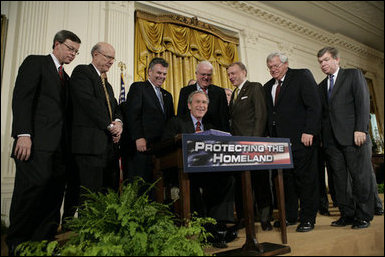
Image result for Official White House photos of George W. Bush signing USA Patriot Act

President George W. Bush signing the USA Patriot Reauthorization Act of 2005

If Trump’s remarks did not violate one or both of those laws, certainly remarks made by his surrogates did.

Thus, the Justice Department could have cited the Patriot Act in indicting Trump and/or any number of his followers for “activities that…appear to be intended…to influence the policy of a government by intimidation or coercion [and]…occur primarily within the territorial jurisdiction of the United States.”

The Justice Department could have also demanded that the results of the election be invalidated on the basis that widespread voter and candidate intimidation played a massive role in it.

But of course this did not happen.

WHY TRUMP WON: WHAT DIDN’T HAPPEN: PART ONE (OF THREE)

In Bureaucracy, History, Law, Law Enforcement, Politics, Social commentary on January 2, 2017 at 12:12 am

On November 9, 1923, Nazi Party Fuhrer Adolf Hitler tried to overthrow the government in Munich, Bavaria.

About 2,000 Nazis marched to the center of Munich, where they confronted heavily-armed police. A shootout erupted, killing 16 Nazis and four policemen. 

Hitler was injured during the clash, but managed to escape. Two days later, he was arrested and charged with treason.

Put on trial, he found himself treated as a celebrity by a judge sympathetic to Right-wing groups. He was allowed to brutally cross-examine witnesses and even make inflammatory speeches.

At the end of the trial, he was convicted of treason and sentenced to five years’ imprisonment.

Serving time in Landsberg Prison, in Bavaria. he was given a huge cell, allowed to receive unlimited visitors and gifts, and treated with deference by guards and inmates.

Hitler used his time in prison to write his infamous book, Mein Kampf-–“My Struggle.” Part autobiography, part political treatise, it laid out his future plans—including the extermination of the Jews and the conquest of the Soviet Union.

Image result for Images of Adolf Hitler outside Landsberg prison

Adolf Hitler leaving Landsberg Prison, December, 20, 1924

Nine months later, he was released on parole—by authorities loyal to the authoritarian Right instead of the newly-created Weimar Republic.

Hitler immediately began rebuilding the shattered Nazi party—and deciding on a new strategy to gain power. Never again would he resort to armed force. He would win office by election—or intrigue.

Writes historian Volker Ullrich, in his monumental new biography, Hitler: Ascent 1889 – 1939: “Historians have perennially tried to answer the question of whether Hitler’s rise to power could have been halted….

“There were repeated opportunities to end Hitler’s run of triumphs. The most obvious one was after the failed Putsch of November 1923. Had the Munich rabble-rouser been forced to serve his full five-year term of imprisonment in Landsberg, it is extremely unlikely that he would have been able to restart his political career.”

Related imageAmazon.com: Hitler: Ascent, 1889-1939: 9780385354387: Ullrich, Volker: Books

Thus, it isn’t just what happens that can influence the course of history. Often, it’s what doesn’t happen that has at least as great a result.

Future historians—if there are any—may one day write that it’s what didn’t happen that played at least as great a role in electing Donald Trump President as what actually did.

There were at least four instances where intervention by Federal law enforcement authorities could have utterly changed the outcome of the 2016 election.

Related image

Donald Trump

Case #1:  The Justice Department did not indict Trump and/or the Attorney Generals of Texas and/or Florida for their roles in the Trump University scandal.

  • Florida Attorney General Pam Bondi personally solicited a political contribution from Donald Trump around the same time her office deliberated joining an investigation of alleged fraud at Trump University and its affiliates.
  • After Bondi dropped the Trump University case against Trump, he wrote her a check $25,000 for her re-election campaign. The money came from the Donald J. Trump Foundation.
  • Republican Texas Attorney General Ken Paxton moved to muzzle a former state regulator who says he was ordered in 2010 to drop a fraud investigation into Trump University for political reasons.
  • Paxton’s office issued a cease and desist letter to former Deputy Chief of Consumer Protection John Owens after he made public copies of a 14-page internal summary of the state’s case against Donald Trump for scamming millions from students of his now-defunct real estate seminar.
  • After the Texas case was dropped, Trump cut a $35,000 check to the gubernatorial campaign of then attorney general and now Texas Governor Greg Abbott.

One attorney general who refused to accept money from Trump was New York’s Eric Schneiderman. His decision to press fraud claims against Trump forced the real estate mogul to settle the case out of court for $25 million.

“Today’s $25 million settlement agreement is a stunning reversal by Donald Trump,” said Schneiderman on November 18, “and a major victory for the over 6,000 victims of his fraudulent university.”

There have been no press reports that the Justice Department investigated these cases to determine if Trump violated the Racketeer Influenced Corrupt Organizations (RICO) Act statutes.

If the Justice Department did not investigate these cases, it should have. And if he did violate the RICO statutes, he should have been indicted, even as a Presidential candidate or President-elect.

Even if an indictment had not produced a conviction, the mere bringing of one would have cast an unprecedented cloud over his candidacy–let alone his being sworn in as President.

Case #2:  The Justice Department did not indict Trump for his series of threats that he made—directly and indirectly—against Republicans and Democrats throughout the 2016 campaign.

  • On March 16, he warned Republicans that if he didn’t win the GOP nomination in July, his supporters would literally riot: “I think you’d have riots. I think you would see problems like you’ve never seen before. I think bad things would happen. I really do. I wouldn’t lead it, but I think bad things would happen.”
  • An NBC reporter summed it up as: “The message to Republicans was clear on [March 16]: ‘Nice convention you got there, shame if something happened to it.'”
  • That Republicans clearly saw this as a threat is undeniable. Paul Ryan, their Speaker of the House, said on March 17: “Nobody should say such things in my opinion because to even address or hint to violence is unacceptable.”
  • And Ohio governor and Republican presidential candidate John Kasich chinned in. “Leaders don’t imply violence,” Kasich told “Face the Nation” on March 20. “When he says that there could be riots, that’s inappropriate. I think you understand that, okay? Secondly, while we have our differences and disagreements, we’re Americans. Americans don’t say, ‘Let’s take to the streets and have violence.'”

FASCISTS FOREVER, JUDGES NO MORE: PART TWO (END)

In History, Law, Politics, Social commentary on May 2, 2014 at 12:00 am

If Newt Gingrich becomes President, he has big plans for the American federal judiciary: To arrest and remove all those judges who do not follow his right-wing agenda.

Adolf Hitler laid out his plans for remaking Germany and the world in his book, Mein Kampf (My Struggle).

And would-be Fuehrer Gingrich has openly proclaimed his own dictatorial intentions.

In a December 18, 21011 appearance on “Face the Nation,” Gingrich spoke candidly with host Bob Schieffer about his hatred for much of the American federal judiciary.

Schieffer: Mr. Speaker, the old saying in legal circles is that the Supreme Court is not last because it’s right, it’s right because it’s last.

There comes a point where you have to accept things as the law of the land. How do you decide, how does the President decide what’s a good law and I’m going to obey the Supreme Court or what’s a bad law and I’m just going to ignore it?

Gingrich: I think it depends on the severity of the case. I’m not suggesting that the Congress and the President review every decision.

I’m suggesting that when there are decisions….in which they’re literally risking putting civil liberty rules in battlefields, it’s utterly irrational for the Supreme Court to take on its shoulders the defense of the United States. It’s a violation of the Constitution.

* * * * *

Schieffer: …. Next year the Supreme Court is going to take up Obama’s healthcare proposal. What if they throw it out? Can President Obama then say I’m sorry boys, I’m just going to go ahead and implement it. Could he do that?

Gingrich: The key question is, what would the Congress then do? Because there are three branches….

Schieffer: But could he do that?

Gingrich: He could try to do that. And the Congress would then cut him off. Here’s the key — it’s always two out of three.

If the President and the Congress say the court is wrong, in the end the court would lose. If the Congress and the court say the President is wrong, in the end the President would lose.

And if the President and the court agreed, the Congress loses. The founding fathers designed the Constitution very specifically in a Montesquieu spirit of the laws to have a balance of power, not to have a dictatorship by any one of the three branches.

Schieffer: ….And a number of conservatives, including two of George Bush’s attorneys general, Alberto Gonzales and Michael Mulcasey, both said and I’m going to just quote what Mr. Mulcasey said.

….He told Fox News, he said “Mr. Gingrich’s proposal is dangerous, ridiculous, totally irresponsible, outrageous, off the wall, and would reduce the entire judicial system to a spectacle.”

Now that’s a conservative judge or a conservative attorney general. How do you respond to that?

Gingrich: I think many lawyers will find this a very frightening idea. They’ve had this run of 50 years of pretending judges are supreme, that they can’t be challenged. The lawyer class defines America.

We’ve had rulings that outlawed school prayer, we’ve had ruling that outlawed the cross, we’ve had rulings the outlawed the 10 Commandments, we’ve had a steady secular drive to radicalize this country away from all of its core beliefs.

I mean what got me into this was the 9th Circuit saying that one nation under God is unconstitutional.

* * * * *

On June 30, 1934, Hitler ordered his private army, the SS (Schutzstaffel, or Protective Squad) to purge his other private army, the S.A., or Brown Shirts.

At least 200 men and women were murdered throughout Germany.

Some died by firing squad. Others were executed in prison. Still others were shot down in their homes.

Afterward, Hitler appeared before the German parliament, the Reichstag, to justify his actions:

“If someone asks me why we did not use the regular courts, I would reply: At that moment I was responsible for the German nation. It was I, alone, who, during those 24 hours, was the Supreme Court of Justice of the German people.”

It took a six-year war that cost the lives of 50 million men, women and children to finally oust this “Supreme Court of Justice for the German People.”

Apparently Newt Gingrich believes it’s a title well worth resurrecting–here in America.

FASCISTS FOREVER, JUDGES NO MORE: PART ONE (OF TWO)

In History, Law, Politics, Social commentary on May 1, 2014 at 12:08 am

Republicans have a love/hate relationship with Adolf Hitler.

On one hand, they repeatedly accuse President Barack Obama of being another Hitler. They decorate his poster with the toothbrush mustache worn by Germany’s Fuehrer. They dismiss Obama’s eloquence with: “Hitler also gave good speeches.”

Adolf Hitler

On the other hand, they run candidates whose power-lust and ruthlessness match that of Hitler or any of his henchmen.

Among these in the past have been such notorious figures as Senator Joseph “Tail Gunner Joe” McCarthy, House Majority Leader Tom DeLay, President Richard M. Nixon and House Speaker Newt Gingrich.

And now a figure from that past is once again planning a last, desperate grasp for absolute power in 2016: Newt Gingrich.

Newt Gingrich

In a half-hour phone call with reporters on December 17, 2011, Gingrich said that, as President, he would abolish whole courts to be rid of judges whose decisions he feels are out of step with the country.

“Are we forced for a lifetime to keep someone on the bench who is so radically anti-American that they are a threat to the fabric of the country?” Gingrich asked.

“What kind of judge says you’ll go to jail if the word ‘invocation’ is used? If this isn’t a speech dictatorship, I’d like you to show me what one looks like.”

And appearing on CBS’ “Face the Nation,” Gingrich said the President could send federal law enforcement authorities to arrest judges who make controversial rulings in order to compel them to justify their decisions before congressional hearings.

When host Bob Schieffer asked how he would force federal judges to comply with congressional subpoenas, there occurred this telling exchange:

Schieffer: Let me just ask you this. You talk about enforcing it because one of things you say is if you don’t like what a court has done, the congress should subpoena the judge and bring him before congress and hold a congressional hearing.

Some people say that’s unconstitutional but I’ll let that go for a minute. I just want to ask you from a practical standpoint, how would you enforce that? Would you send the Capitol police down to arrest him?

Gingrich: If you had to or you’d instruct the Justice Department to send a U.S. Marshal. Let’s take the case of Judge Biery. I think he should be asked to explain a position that radical.

How could he say he’s going to jail the superintendent over the word benediction and invocation?

Because before…because then I would encourage impeachment. But before you move to impeachment, you’d like to know why he said it. Now clearly since the congress has the power.

Schieffer: What if he didn’t come? What if he said, no thank you, I’m not coming?

Gingrich: Well that is what happens in impeachment cases. In an impeachment case, the House studies whether or not, the House brings them in, the House subpoenas them. And as a general rule they show up.

I mean, but you’re raising the core question, are judges above the rest of the constitution? Or are judges one of the three co-equal branches?

* * * * *

The politicizing of the judiciary was one of the major hallmarks of Hitler’s Germany. Those judges who refused to hand out the types of verdicts Hitler desired were quickly removed.

They were replaced by judges like the infamous Roland Freisler, who chaired the First Senate of the People’s Court, and acted as judge, jury and prosecutor.

Roland Freisler

About 90% of all defendants appearing before him were sentenced to death or life imprisonment. The sentences had often been determined before trial.

Between 1942 and 1945, more than 5,000 death sentences were handed out. Of these, 2,600 were issued by the court’s First Senate, which Freisler headed.

Freisler was infamous for humiliating defendants. Several defendants in the July 20, 1944 bomb plot against Hitler appeared before him. One of these was Ulrich-Wilhelm Graf Schwerin von Schwanenfeld.

Schwerin, brought to court without a belt and tie, tried to preserve his dignity by holding up his pants. Freisler mocked him as a pervert for “playing” with his trousers.

When Schwerin said that he had come to oppose Hitler because of “the many murders in Germany and abroad” he was furiously interrupted by Freisler, who finally shouted him down.

On September 8, 1944, Schwerin was hanged in prison in Berlin.

On 3 February 1945, Freisler was conducting a Saturday session of the People’s Court, when American bombers attacked Berlin.   A hit on the courthouse unloosed a heavy beam that crushed his skull, instantly killing him.

Adolf Hitler laid out his plans for remaking Germany and the world in his book, Mein Kampf (My Struggle). Newt Gingrich has openly proclaimed his own dictatorial intentions.

Hitler published Mein Kampf in 1925–eight years before he became Germany’s Fuehrer in 1933.

Five years before the 2016 election, Gingrich has given warning of his own dictatorial plans for remaking the United States in his own image.

Most Germans who detested Hitler refused to take him seriously–until it was too late.

History will judge whether Americans act more responsibly than their German counterparts.

END OF PART ONE