bureaucracybusters

Posts Tagged ‘CONDOLEEZA RICE’

REPUBLICANS: KILLING IS GOOD, FOOD STAMPS ARE BAD

In Bureaucracy, History, Military, Politics, Social commentary on October 3, 2014 at 12:45 pm

In the 1970 film, Patton, General George S. Patton is a man driven by his obsession to be the best field commander in the war–and to be recognized for it.

George C. Scott as George S. Patton

And he sees British General Bernard Montgomery–his equally egotistical rival–as a potential obstacle to that latter ambition.

So, in Algeria, he conjures up a plan that will sideline “Monty” while he, Patton, defeats the Germans–and bags the glory.

The trick lies in throwing a sumptuous dinner-–in the middle of the African desert-–for a visiting British general: Harold Alexander.

As Patton (George C. Scott, in an Oscar-winning performance) tells his aide: “I want to give a dinner for General Alexander. I want to get to him before Montgomery does.  I want the finest food and the best wine available. Everything.”

The aide pulls off the dinner–where, indeed, “the finest food and the best wine” are on full display, along with attentive waiters and a candelabra.

So think about it:

  • In the middle of the desert
  • while American and British forces are forced to subsist on C-rations
  • and are under repeated air attack by the Luftwaffe
  • and tank attack by the Afrika Korps

a handful of ultra-pampered American and British military officers find the time–and luxuries–to throw themselves a fine party.

Now, fast-forward from Algeria in 1943 to Washington, D.C., in 2013.

Returning to Congress after their traditional summer recess, House Republicans planned to cut $40 billion in food stamps for the poor.  That’s double the amount previously sought by Right-wingers.

The cuts would include drug tests of applicants and tougher work rules.  As Republicans see it: There’s no point in “helping” the poor if you can’t humiliate them.
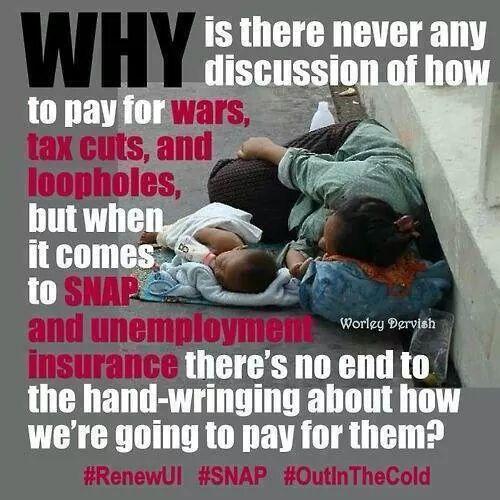
Food stamps, the largest U.S. anti-hunger program, are the pivotal issue for a new U.S. farm law costing $80 billion a year.

One in seven Americans–15% of U.S. households–received food stamps at latest count.  Enrollment in the program soared after the 2008-09 recession–a direct consequence of the Bush administration’s refusal to regulate powerful, greed-fueled corporations.

Republicans claim the program is unbearably expensive at $78 billion a year.

Meanwhile, as 49 million Americans have trouble putting meals on the table, Republicans are eager to spend billions of dollars for another project.

An unnecessary war with Syria.

One of these right-wingers is Bill Kristol, editor of the Weekly Standard–and one of the leading instigators of the 2003 war with Iraq.

He–like senior officials on the George W. Bush administration–claimed that Iraqi dictator Saddam Hussein had weapons of mass destruction and planned to use them against the United States.

That proved to be a lie.

He also pushed the lie that Hussein planned 9/11 with Osama bin Laden.

He has never apologized for either lie–or the resulting war that killed 4,487 American soldiers and wounded another 32,226.

In a recent column, Kristol called for a return to slaughter–not only in Syria but Iran as well:

“…Soon after voting to authorize the use of force against the Assad regime, Republicans might consider moving an authorization for the use of force against the Iranian nuclear weapons program.

“They can explain that Obama’s dithering in the case of Syria shows the utility of unequivocally giving him the authority to act early with respect to Iran.”

Former Secretary of State Condoleeza Rice–who also helped lie the nation into the needless 2003 Iraq war–is another big promoter of “give war a chance”:

“My fellow Americans, we do not have a choice. We cannot be reluctant to lead–and one cannot lead from behind.”

Among Republican U.S. Senators calling for war are John McCain (Arizona) and Lindsey Graman (South Carolina), who issued a joint statement:

“Using stand-off weapons, without boots on the ground, and at minimal risk to our men and women in uniform, we can significantly degrade Assad’s air power and ballistic missile capabilities and help to establish and defend safe areas on  the ground.

“In addition, we must begin a large-scale effort to train and equip moderate, vetted elements of the Syrian opposition with the game-changing weapons they need to shift the military balance against [Syrian dictator Bashir] Assad’s forces.”

Except that there are no “moderate, vetted elements of the Syrian opposition.  The opposition is just as murderous as the Assad regime–and eager to replace one dictator with another.

In addition: A major weapon for “degrading Assad’s air power” would be Tomahawk Cruise missiles.  A single one of these costs $1,410,000.

Firing of a Tomahawk Cruise missile

A protracted missile strike would rain literally billions of dollars’ worth of American missiles on Syria.

Meanwhile, the Pentagon is spending about $27 million a week to maintain the increased U.S. Navy presence in the Mediterranean Sea and Middle East region to keep watch over Syria and be prepared to strike.

Navy officials say it costs about $25 million a week for the carrier group and $2 million a week for each destroyer.

Is there a lesson to be learned from all this?

Yes.

Powerful people–whether generals, politicians or the wealthy–will always find abundant money and resources available for projects they consider important.

It’s only when it comes to projects that other people actually need that such people will claim there is, unfortunately, a cash shortage.

REPUBLICAN PRIORITIES: BOMBING IS GOOD, FOOD STAMPS ARE BAD

In Bureaucracy, History, Military, Politics, Social commentary on September 17, 2013 at 12:00 am

In the 1970 film, Patton, General George S. Patton is a man driven by his obsession to be the best field commander in the war–and to be recognized for it.

George C. Scott as George S. Patton

And he sees British General Bernard Montgomery–his equally egotistical rival–as a potential obstacle to that latter ambition.

So, in Algeria, he conjures up a plan that will sideline “Monty” while he, Patton, defeats the Germans–and bags the glory.

The trick lies in throwing a sumptuous dinner-–in the middle of the African desert-–for a visiting British general: Harold Alexander.

As Patton (George C. Scott, in an Oscar-winning performance) tells his aide: “I want to give a dinner for General Alexander. I want to get to him before Montgomery does.  I want the finest food and the best wine available. Everything.”

The aide pulls off the dinner–where, indeed, “the finest food and the best wine” are on full display, along with attentive waiters and a candelabra.

So think about it:

  • In the middle of the desert
  • while American and British forces are forced to subsist on C-Rations
  • and are under repeated air attack by the Luftwaffe
  • and tank attack by the Afrika Korps

a handful of ultra-pampered American and British military officers find the time–and luxuries–to throw themselves a fine party.

Now, fast-forward from Algeria in 1943 to Washington, D.C., in 2013.

Returning to Congress after their traditional summer recess, House Republicans plan to cut $40 billion in food stamps for the poor.  That’s double the amount previously sought by right-wingers.

The cuts would include drug tests of applicants and tougher work rules.  As Republicans see it: There’s no point in “helping” the poor if you can’t humiliate them.

Food stamps, the largest U.S. anti-hunger program, are the pivotal issue for a new U.S. farm law costing $100 billion a year.

One in seven Americans–15% of U.S. households–received food stamps at latest count.  Enrollment in the program soared after the 2008-09 recession–a direct consequence of the Bush administration’s refusal to regulate powerful, greed-fueled corporations.

Republicans claim the program is unbearably expensive at $78 billion a year.

Meanwhile, as 49 million Americans havetrouble putting meals on the table, Republicans are eager to spend billions of dollars for another project.

An unnecessary war with Syria.

One of these right-wingers is Bill Kristol, editor of the Weekly Standard–and one of the leading instigators of the 2003 war with Iraq.

He–like senior officials on the George W. Bush administration–claimed that Iraqi dictator Saddam Hussein had weapons of mass destruction and planned to use them against the United States.

He also pushed the lie that Hussein planned 9/11 with Osama bin Laden.

He has never apologized for either lie–or the resulting war that killed 4,487 American soldiers and wounded another 32,226.

In a recent column, Kristol called for a return to slaughter–not only in Syria but Iran as well:

“…Soon after voting to authorize the use of force against the Assad regime, Republicans might consider moving an authorization for the use of force against the Iranian nuclear weapons program.

“They can explain that Obama’s dithering in the case of Syria shows the utility of unequivocally giving him the authority to act early with respect to Iran.”

Former Secretary of State Condoleeza Rice–who also helped lie the nation into the needless 2003 Iraq war–is another big promoter of “give war a chance”:

“My fellow Americans, we do not have a choice. We cannot be reluctant to lead–and one cannot lead from behind.”

Among Republican Senators calling for war are John McCain (Arizona) and Lindsey Graman (South Carolina), who issued a joint statement:

“Using stand-off weapons, without boots on the ground, and at minimal risk to our men and women in uniform, we can significantly degrade Assad’s air power and ballistic missile capabilities and help to establish and defend safe areas on  the ground.

“In addition, we must begin a large-scale effort to train and equip moderate, vetted elements of the Syrian opposition with the game-changing weapons they need to shift the military balance against [Syrian dictator Bashir] Assad’s forces.”

Except that there are no “moderate, vetted elements of the Syrian opposition.  The opposition is just as murderous as the Assad regime–and eager to replace one dictator with another.

In addition: A major weapon for “degrading Assad’s air power” would be Tomahawk Cruise missiles.  A single Tomahawk Cruise missile costs $1,410,000.

Firing of a Tomahawk Cruise missile

A protracted missile strike would rain literally billions of dollars’ worth of American missiles on Syria.

Meanwhile, the Pentagon is spending about $27 million a week to maintain the increased U.S. Navy presence in the Mediterranean Sea and Middle East region to keep watch over Syria and be prepared to strike.

Navy officials say it costs about $25 million a week for the carrier group and $2 million a week for each destroyer.

Is there a lesson to be learned from all this?

Yes.

Powerful people–-whether generals, politicians or the wealthy-–will always find abundant money and resources available for those projects they consider important.

It’s only when it comes to projects that other people actually need that such officials will claim there is, unfortunately, a cash shortage.

POLITICS BY ORWELL: “WAR IS PEACE”: PART TWO (END)

In Bureaucracy, History, Military, Politics, Social commentary on September 5, 2013 at 1:40 pm

A two-year civil war is raging in Syria.

United Nations officials estimate that 6,000 people have died there trying to overthrow the dictatorial regime of “President” Bashar al-Assad.

And that’s sending jitters through the Washington elite.

Not the casualties.  The fact that they’re being shown in vivid color on YouTube and CNN.

And this, in turn, has led many members of Congress and the Obama administration to fear for their jobs. They dread that voters will blame them for not “doing something” to end the fighting.

Like sending in American armed forces to somehow stop it.

Another reason driving America’s headlong rush into war: Sheer stupidity.

Start with the neocons, who lustily supported the 2003 Iraq war have been spoiling for yet another war in the Middle East.

On March 21, 2013, House Foreign Affairs ranking Democrat Eliot Engel (D-NY) and House Intelligence Committee Chairman Mike Rogers (R-MI) introduced the “Free Syria Act of 2013,” calling on the Obama administration to arm the Syrian rebels.

And on May 27, Arizona U.S. Senator John McCain secretly entered Syria and met with commanders of the Free Syrian Army, who are fighting forces loyal to “President” Bashar al Assad for control of the country.

He was the first U.S. senator to travel to Syria since civil war erupted there in 2011.  And after he left, he told CNN that he was more convinced that the United States must become more involved in the country’s conflict.

President Barack Obama could have easily confronted these “give war a chance” enthusiests and put them on the defensive–had he wished to do so.

President Obama at press conference

He could have bluntly and repreatedly used the bully pulpit of his office to warn Americans:

  • Since 1979, Syria has been listed by the U.S. State Department as a sponsor of terrorism.
  • There are no “good Syrians” for the United States to support.  There is a civil war between rival terrorist groups.
  • Among the terrorist groups supporting Syrian dictator al-Assad are Hezbollah and Hamas.
  • Assad’s enemies include another terrorist group–Al Qaeda.
  • Syria has never been an ally of the United States.
  • It is, after Iran, the foremost enemy of America’s ally, Israel.
  • The United States faces a crumbling infastructure, record high unemployment and trillions of dollars in debt.  It’s time for Americans to clean up their own house before worrying about the messes in other nations–especially those wholly alien to American values.

And, most importantly, Obama could have directly challenged the macho ethic of the American Right.

Especially those members of it who, while avoiding military service themselves, are always eager to send others into harm’s way at the slightest excuse.

The President could have officially established an all-volunteer brigade for those Americans willing to fight and possibly die in yet another pointless war.  And he could have offered to fly them to the border of Syria so they could carry out their self-appointed “conquer or die” mission.

Of course, many–if not most–of these armchair strategists would have refused to put their own lives on the line in defense of a “cause” they claim to believe in.

But then Obama could have brutally–and repeatedly–pointed this out.  Hypocrisy is something Americans understand all too well–and despise.

Instead, for a man celebrated for his oratorical gifts, Obama has managed to talk himself into a no-win situation.

Theodore Roosevelt claimed to operate by a South African proverb: “Speak softly and carry a big stick, and you will go far.”

Obama spoke loudly about the “big stick” of American military power and said that if Assad’s regime used chemical weapons against its enemies, that would be “a red line in the sand.”

By doing so, he needlessly put his credibility as President on the line.

On August 21, the Assad regime was accused of using chemical weapons in Damascus suburbs to kill more than 1,400 civilians.

On August 30, the Obama administration said it had “high confidence” that Syria’s government carried out the chemical weapons attack.

Having boxed himself in, Obama felt he had to make good on his threat–even if it risked the lives of those flying combat missions over Syria’s formidable air defenses.

Yet, even at this late stage, Obama could find a face-saving reason for not intervening.  He could state that while there is apparent evidence of a chemical attack, there is no conclusive evidence that this was carried out by the Assad regime.

In short: He could shift the blame to one of the many terror groups operating in Syria–such as Hizbollah or Hammas or Al Qaeda.

This would take the United States off the hook–thus saving the lives of countless American soldiers and avoiding a potential nuclear confrontation with Russia.

But having needlessly put his own credibility–and ego–on the line, this is unlikely.

What’s more likely is Obama will continue to hurtle down the road to disaster.

POLITICS BY ORWELL: “WAR IS PEACE”: PART ONE (OF TWO)

In Bureaucracy, History, Military, Politics, Social commentary on September 4, 2013 at 12:00 pm

For the third time in 12 years, America is going to war in the Middle East.

The first war erupted in October, 2001.  The United States invaded Afghanistan to avenge its 3,000 citizens killed by Al Qaeda in New York, Washington, D.C. and Pennsylvania.

The September 11 attacks destroyed the World Trade Center, damaged the Pentagon, and would have demolished the White House or Capitol Building if the passengers on Flight 93 hadn’t heroically sacrificed their lives in trying to recapture the plane.

Osama bin Laden, the mastermind of the 9/11 attacks, was being given sanctuary by the fundamentalist Taliban. When its leaders refused to hand him over, America struck.

That war definitely made sense.  If a nation isn’t allowed to defend itself from brazen terroristic assaults, then there’s no point in having an armed service.

Even America’s bitterest enemies in the Islamic world realized that Bin Laden had gone too far and had brought upon himself–and Afghanistan–the justified wrath of a powerful enemy.

And the results: This October 7 will mark 12 years since the outbreak of that war.  That’s as long as Franklin D. Roosevelt served as President–and he won World War II in less than four years.

Children who were born on September 11, 2001, have never known a time when their country wasn’t at war with Islamic enemies.

American soldiers–somewhere in the Middle East

By early 2012, the United States had about 90,000 troops in Afghanistan, with 22,000 of them due home by the fall. There has been no schedule set for the pace of the withdrawal of the 68,000 American troops who will remain, only that all are to be out by the end of 2014.

The initial goal of this war was to destroy Al Qaeda–especially its leader, Osama Bin Laden–and its Taliban protectors. But, over time, Washington policy-makers embarked on a “nation-building” effort.

So the American military didn’t wrap up its campaign as quickly as possible and then leave the country to its own devices. Instead, U.S. forces wound up occupying the country for the next ten years.

This increasingly brought them into conflict with primitive, xenophobic Afghans, whose mindset remains that of the sixth century.

A series of murderous attacks on American soldiers by their supposed Afghan comrades-in-arms led to the inevitable result:  American forces no longer trust their Afghan “allies” to stand shoulder-to-shoulder with them against the Taliban.

The second war broke out in March, 2003.   President George W. Bush had been looking for an excuse to overthrow Iraqi dictator Saddam Hussein from the moment he entered the White House.

Bush blamed Hussein for the 1992 electoral defeat of his father, President George H.W. Bush, to Bill Clinton.  As the younger Bush saw it: If only his father had “gone all the way” into Baghdad during the 1991 Iraq war and removed Hussein, he would have won a second term as President.

Bush found his excuse with the 9/11 attacks–by repeatedly and falsely charging that Hussein had massed “weapons of mass destruction” throughout Iraq.

Even more falsely, he claimed that Hussein had conspired with bin Laden in plotting 9/11.

Nor was Bush the only culprit.  So were his Vice President, Dick Cheney; his Secretary of Defense, Donald Rumsfeld; and his National Security Advisor, Condoleeza Rice.

To hear them tell it, America would go up in a nuclear mushroom cloud unless the country moved–fast–to overthrow Hussein.

So the country went to war again–on March 19, 2003.

The Bush administration invaded Iraq to turn it into a base–from which to intimidate its neighboring states: Jordan, Saudi Arabia, Kuwait, Turkey, Syria and Iran.

But this demanded that the United States quickly pacify Iraq. The Iraqi insurgency totally undermined that goal, forcing U.S. troops to focus all their efforts inward.

Another unintended result of the war: Saddam Hussein’s Iraq had been a counter-weight to the regional ambitions of Iran, but the destruction of the Iraqi military created a power-vacumn. Into this–eagerly–stepped the Iranian mullahs.

The third war will likely start in September or October, under President Barack Obama.

A major reason: The American political elite is upset at all the depressing news they’re seeing on TV.

You know, all those images they’re seeing–of dead Syrians killed while trying to overthrow their brutal dictator, President-for-Life Bashir al-Assad.

It’s ruining their breakfast–and maybe their dinnertime as well.

Syrians have been fighting a brutal civil war for two years.  Much of the country is trying to overthrow its longtime brutal dictator, Bashir al-Assad, and the rest of it is trying to maintain him in office.

CNN has been covering the war to a larger extent than the formerly “big three” TV networks: CBS, ABC and NBC.

As they say in television journalism: “If it bleeds, it leads.”

And this, in turn, causes many members of Congress and the Obama administration to fear for their jobs. They dread that voters will blame them for not “doing something” to end the fighting.

Like sending in American armed forces to somehow stop it.

CHENEY LIES DESCRIBE 9/11, NOT BENGHAZI: PART TWO (END)

In Bureaucracy, History, Politics on May 16, 2013 at 12:00 am

According to former Vice President Dick Cheney, President Barack Obama is trying to “cover up” the nature of a terrorist attack on the American embassy in Benghazi, Libya, on September 11, 2012.

He made this accusation while appearing on the right-wing Sean Hannity radio program on May 13.

Yet, perhaps unwittingly, Cheney’s accusations say at least as much about the failures of the Bush Administration to prevent 9/11–and its deliberate efforts to lie the United States into a needless war with Iraq.

CHENEY ON BENGHAZI:  There was never any doubt about what was happening here.  And the whole notion, they have gone through this process trying to get to the truth, they did exactly the opposite.

You say this, too, you start out with the truth as reported by the intelligence community, and then you turn it into a total distortion once the political types in the White House and some senior folks at the State Department get their hands on it.

THE RECORD ON 9/11/IRAQ:   Among the lies told by high-ranking Bush Administration officials to persuade Americans that Iraq posed an immediate threat to national security:

  • Iraq had sought uranium from Niger, in west Africa;
  • Thousands of aluminum tubes imported by Iraq could be used in centrifuges to create enriched uranium;
  • Iraq had up to 20 long-range Scud missiles, prohibited under UN sanctions;
  • Iraq had massive stockpiles of chemical and biological
  • Iraq had massive stockpiles of chemical and biological agents, including nerve gas, anthrax and botulinum toxin;
  • Saddam Hussein had issued chemical weapons to front-line troops who would use them when US forces crossed into Iraq.

Specifically:

August 26, 2002: Cheney told the Veterans of Foreign Wars, “There is no doubt that Saddam Hussein now has weapons of mass destruction. There is no doubt he is amassing them to use against our friends, against our allies and against us.”

Related image

Dick Cheney

September 8, 2002: National Security Advisor Condoleeza Rice said on CNN: ”There is certainly evidence that al Qaeda people have been in Iraq. There is certainly evidence that Saddam Hussein cavorts with terrorists.”

September 18, 2002: Rumsfeld told the House Armed Services Committee, “We do know that the Iraqi regime has chemical and biological weapons. His regime has amassed large, clandestine stockpiles of chemical weapons—including VX, sarin, cyclosarin and mustard gas.”

October 7, 2002: Bush declared in a nationally televised speech in Cincinnati that Iraq “possesses and produces chemical and biological weapons. It is seeking nuclear weapons.”

January 7, 2003: Rumsfeld told a Pentagon news briefing, “There’s no doubt in my mind but that they currently have chemical and biological weapons.” This certainty was based on contemporary intelligence, he said, not the fact that Iraq had used chemical weapons in the 1980s.

Related image

Donald Rumsfeld

February 8, 2003: Bush said in his weekly radio address: “We have sources that tell us that Saddam Hussein recently authorized Iraqi field commanders to use chemical weapons—the very weapons the dictator tells us he does not have.”

March 16, 2003: Cheney declared on NBC’s “Meet the Press”: “We believe [Saddam Hussein] has, in fact, reconstituted nuclear weapons.”

March 30, 2003: On ABC’s “This Week” program, 10 days into the war, Rumsfeld said: “We know where they [weapons of mass destruction] are.”

CHENEY ON BENGHAZI:  Remember when they were doing the bin Laden raid, you got pictures all over the place of the President sitting in the Situation Room and monitoring the take-down of Osama Bin Laden.  This was exactly the opposite of that.

THE RECORD ON 9/11/IRAQ:  Remember when–on May 1, 2003–President Bush landed a Lockheed S-3 Viking aboard the U.S.S. Abraham Lincoln?  How, to sailors’ cheers, he announced the end of major combat operations in the Iraq War?  How, above him, a huge banner read: “Mission Accomplished”?

George W. Bush claiming the Iraq war is over

And remember how guerrilla warfare increased in Iraq–and the majority of military and civilian casualties occurred after the speech?  Remember how administration officials grew increasingly testy and evasive in their interviews and press conferences? 

Remember how they suddenly quit talking about all those “weapons of mass destruction” that hadn’t been found in Iraq?

CHENEY ON BENGHAZI:  There were a lot of questions that need to be asked about the military chain of command….We have especially-trained units that practice this thing all the time.  They are very good at it and they are champing at the bit to go….Why weren’t they deployed ready to go to take action….?

THE RECORD ON 9/11:  When the first plane struck the World Trade Center, President Bush was reading My Pet Goat to a group of elementary schoolchildren in Sarasota County, Florida.  Even after being told that a second plane had hit the Center, Bush continued reading to the children for another seven minutes.

No armed Air Force planes were stationed between New York and Washington.  The CIA and the National Security Agency–the nation’s code-cracking center–stood totally vulnerable to aerial attack.  So did the Congress.

At the White House, Secret Service agents threw open the doors and told “ordinary” staffers to evacuate and fend for themselves.  Those officials considered worth protecting–such as Cheney and National Security Advisor Condoleeza Rice–were hustled into a secure, bomb-proof chamber.

CHENEY LIES DESCRIBE 9/11, NOT BENGHAZI: PART ONE (OF TWO)

In History, Politics on May 15, 2013 at 12:09 am

On May 13, 2013, former Vice President Dick Cheney appeared on the right-wing Sean Hannity radio show.

His mission: To assail President Barack Obama for a terrorist attack on the American embassy in Behghazi, Libya, on September 11, 2012.  Four Americans were killed, including Ambassador J. Christopher Stevens.  Ten others were injured.

Dick Cheney

Ironically, many of Cheney’s comments more accurately described the George W. Bush administration during the eight months before 9/11.  In that terrorist attack, 2,977 Americans died.

CHENEY ON BEHGHAZI:  I think it’s one of the worst incidences, frankly, that I can recall in my career….

That the State Department and White House ignored repeated warnings from the CIA about the threat. They ignored messages from their own people on the ground that they need more security.  They reduced what was already there. And the administration  either had no forces ready to respond to an attack, which should have been anticipated….

THE RECORD ON 9/11:   Among the most lethal offenses of the Bush Administration: The appointing of officials who refused to take seriously the threat posed by Al-Qaeda.

And this arrogance and indifference continued–-right up to September 11, 2001, when the World Trade Center and Pentagon became targets for destruction.

One of the few administration officials to take Al-Qaeda seriously was Richard Clarke, the chief counter-terrorism adviser on the National Security Council.

Clarke had been thus appointed in 1998 by President Bill Clinton. He continued to hold this role under President Bush, but with a major difference: The position was no longer given cabinet-level access.

This put him at a severe disadvantage when dealing with other, higher-ranking Bush officials–such as:

  • Vice President Dick Cheney
  • Secretary of Defense Donald Rumsfeld
  • Rumsfeld’s deputy, Paul Wolfowitz and
  • National Security Advisor Condoleeza Rice.

These turned out to be the very officials who refused to believe that Al-Qaeda posed a lethal threat to the United States.

During the entire first eight months of the Bush Presidency, Clarke was not permitted to brief President Bush a single time, despite mounting evidence of plans for a new al-Qaeda outrage.

And  during his first eight months in office before September 11, Bush was on vacation, according to the Washington Post, 42% of the time.

CHENEY ON BEHGHAZI:  …Well they tried to cover it up by constructing a false story, claiming there was confusion about what happened in the Benghazi compound. There was no confusion…..

The cover up included several officials up to and including President Obama and the cover up is still ongoing.

THE RECORD ON 9/11:  Eager to invade Iraq, President Bush searched for any excuse to convince America of the necessity of going to war. 

On the evening after the September 11 attacks, Bush took Clarke aside during a meeting in the White House Situation Room.

World Trade Center on September 11, 2001

“I want you, as soon as you can, to go back over everything, everything. See if Saddam [Hussein, the dictator of Iraq] did this. See if he’s linked in any way.”

Clarke was stunned: “But, Mr. President, Al Qaeda did this.”

“I know, I know,” said Bush. “But see if Saddam was involved. I want to know.”

On September 12, 2001, Bush attended a meeting of the National Security Council.

“Why shouldn’t we go against Iraq, not just Al Qaeda?” demanded Donald Rumsfeld, the Secretary of Defense.

Vice President Dick Cheney enthusiastically agreed.

Secretary of State Colin Powell then pointed out there was absolutely no evidence that Iraq had had anything to do with 9/11 or Al Qaeda. And he added: “The American people want us to do something about Al-Qaeda”–-not Iraq.

On November 21, 2001, only 10 weeks after 9/11, Bush told Rumsfeld: It’s time to turn to Iraq.

Bush and his war-hungry Cabinet officials knew that Americans demanded vengeance on Al Qaeda’s mastermind, Osama bin Laden, and not Iraqi dictator Saddam Hussein,. So they repeatedly fabricated “links” between the two:

  • Saddam had worked hand-in-glove with Bin Laden to plan 9/11.
  • Saddam was harboring and supporting Al Qaeda throughout Iraq.
  • Saddam, with help from Al Qaeda, was scheming to build a nuclear bomb.

Yet as early as September 22, 2001, Bush had received a classified President’s Daily Brief intelligence report, which stated that there was no evidence linking Saddam Hussein to 9/11.

The report added that there was scant credible evidence that Iraq had any significant collaborative ties with Al Qaeda.

Bush administration officials repeatedly claimed that Iraq possessed huge quantities of chemical and biological weapons, in violation of UN resolutions. And they further claimed that US intelligence agencies had determined:

  • the precise locations where these weapons were stored;
  • the identities of those involved in their production; and
  • the military orders issued by Saddam Hussein for their use in the event of war.